Compliance is the Floor, Commitment is the Growth: Rethinking Retailer-Supplier Partnerships
If your account lead left tomorrow, what would your most important partnership lose? In this Insight250 interview, Peter Harris explains how retailers and suppliers earn each other’s trust through shared forecasts and follow-through.

The Insight250 spotlights and celebrates 250 of the world’s premier leaders and innovators in market research, consumer insights, and data-driven marketing. The awards have created renewed excitement across the industry whilst strengthening the connectivity of the market research community. Insight250 announced its 2026 winners in October. You can see the full list of winners at Insight250.com.
With so many exceptional professionals named to the Insight250, we regularly tap into their expertise and unique perspectives across various topics. This regular series does just that: seeking the expert perspectives of many of these individuals in a series of short topical features.
As technology advances at an incredible pace and the value of insights grows, I sat down with Insight250 winner Peter Harris. Peter is Chief Executive Officer at Advantage Group International (AGI) and stands as an exemplary leader in transformative research and business growth. With a career of more than 35 years, highlighted by pivotal board roles at The Research Society, Asia Pacific Research Committee, and Global Research Business Network, Peter’s pioneering spirit has reshaped customer relationships through innovative research and technology integration.
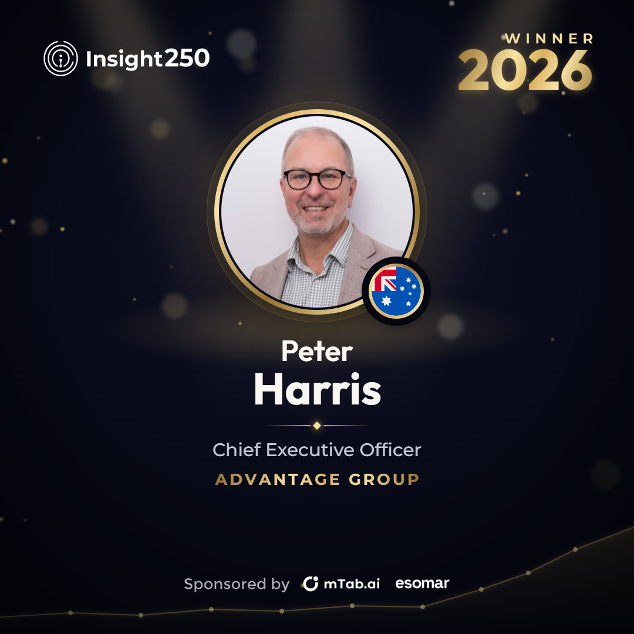
Peter Harris, Chief Executive Officer, Advantage Group International
Crispin: Your career has taken you through Colmar Brunton, Vision Critical, Potentiate and Bastion Insights, and now to Advantage Group, where you became CEO in January 2025. What has the move from consumer research and research platforms into B2B partnership research taught you?
PH: I am a marketer who found a wonderful career in research and agency life. I’ve always believed understanding behaviour and decision-making is key to business and government success, and research turned out to be the most interesting place to work on it.
After 10 years client side, I tentatively jumped into agency life and immediately loved it. I learnt so much working with lots of great research minds at Colmar Brunton, Australia, and seeing the impact that one great insight can have on business. I then joined Vision Critical to learn more about the blend of technology and research, and as it expanded globally, it taught me what it means to be part of a global business: the drive for growth, how much partnership matters when every market works differently, and the importance of inspiring a team of high performers. What I’ve enjoyed most, across all of it, is the difference the work makes: to the people I work with, to clients, and to the profession I care about. Advantage is a wonderful step up to focus on some of the most critical B2B relationships on the planet, those that feed most of the world and sit across the table from each other in trade. What fascinates me is that retailer and supplier trade relationships run on the same thing as every other human relationship: trust.
Crispin: You were AGI’s Chief Research Officer before becoming CEO. How has that research background shaped your priorities as CEO, and what have you focused on most?
PH: As Chief Research Officer, my focus was rigour: is the data right? As CEO, the job is wider, and a lot of it is people. I spend as much time as I can with clients, because that’s where I learn whether what we do is useful. I start with their priorities, not ours: what are they trying to grow, fix, or decide this quarter? The same idea applies inside the team. You can get compliance from a job description, but commitment comes from people who enjoy the work and care about the outcome, and clients feel the difference. I get the most satisfaction when a client says, “You’ve helped us have a better business conversation.” This year, a retailer told me our insights helped them move a supplier relationship from debating performance to solving problems together.
That’s the point where good data becomes better decisions, stronger partnerships, and better outcomes for everyone involved. As a leader, those are the moments that remind me why our work matters.
Crispin: You work with most of the world’s leading manufacturers and retailers. In your experience, what separates the best retailer-supplier partnerships from the rest?
PH: A lot of the industry conversation right now is about leverage: fines, delistings, terms. Leverage matters, but it only buys one thing. Every partnership runs on two currencies. Compliance is what leverage buys: shelf space held, programmes followed, deadlines met. Commitment is earned through trust, continuity and honesty. It shows up when it’s tested: first look at innovation, the benefit of the doubt in a dispute, flexibility when supply is tight.
Earlier this year, we interviewed 166 retailers and suppliers across 13 markets, opening with one unprompted question, and heard the same thing in different words. Commitment pays. Across 21 major retailers, the most collaborative grew revenue 4.6% on average, while the least collaborative declined 1.2%. Compliance is the floor. Commitment is where the growth is. A practical test: name your three most important partners and ask what you’d lose if the account lead left tomorrow.
Crispin: Your 2026 Advantage Report for US retailers found that every Core Food supplier changed position in the rankings, and fewer than half of last year’s top performers stayed at the top. What do you think is driving that degree of movement?
PH: For a supplier, a ranking move means the people who decide your range, promotions and priorities have changed their view. And the people themselves are changing. Reportedly, around 40 retail CEOs left in 2025, more than double 2024, and 13 US grocers have named new CEOs this year. Rankings alone can’t prove the link, but it’s hard to ignore. When a leader changes, compliance carries over: the contract, the terms and the scorecard are still there. Commitment resets, because it was built between particular people and has to be earned again. Size doesn’t protect you either. The biggest supplier isn’t automatically the best partner, and mid-sized specialists often move faster.
Crispin: Supply chain communication ranked first in Core Food for the second year running. Why does what looks like an operational issue matter so much to how retailers judge a partner, and what does that say about the link between feedback and execution?
PH: Retailers experience a supplier through the supply chain, not strategy decks, which is why it ranks first. Reliable supply is the baseline. That’s compliance. Commitment is earned in the layer on top: warning them early, with options attached, not just a problem, and then doing what you said. Suppliers say the mirror image about retailers: advance notice of range changes, shared forecasts. Both sides named follow-through as the biggest lever. No contract can require it, which is exactly why it builds trust.
Crispin: B2B research with senior retail and supplier executives is very different from consumer research. How do you earn the candour of those respondents and keep it year after year?
PH: We earn candour the same way suppliers earn commitment: over time, through trust. Nobody can make a senior executive give an honest answer, so you have to earn it. Ask one open question before any structured ones, so people say what’s on their mind rather than what they think you want. Protect anonymity without exception. And close the loop: show people what came of it. I’ve sat in on or led more than 70 senior decision-maker interviews so far this year, and what stays with me is how generous people are with their time and honest views when they trust it will lead to something useful. Our profession depends on that trust, and it’s worth protecting.
Crispin: You mention advancing the role of insights in driving better business decisions. How has that role changed during your career, and where do insights teams still struggle to influence decisions?
PH: I came to research as a marketer, so I tend to see our work the way the business does. Early in my career, I thought the job was to get insight right. I now think the job is to get something to change. The first earns compliance. The second earns commitment. The thread I’ve followed links research to the numbers the business already cares about, because insights lose influence when they can’t show the line to revenue. And facts alone rarely move people. Stories do. Where we still struggle: we answer questions nobody asked, we speak in methods rather than decisions, and we arrive after the decision is made. Fixing that is how our profession earns its seat at the table.
Crispin: As CRO, you launched AQAI, and LiveLens now offers AI analysis of verbatim feedback and AI-generated summaries, alongside guidance from your Advantage Advisors. Where does AI add most value in turning data into action, and where does human judgement remain essential?
PH: AI is excellent on the compliance side of insight: volume, speed and tracking. It can read thousands of comments and give you a first summary in minutes. In LiveLens, AI analyses verbatim feedback and drafts summaries, and our Advantage Advisors take it from there.
Commitment is different, because senior stakeholders act on what they believe, and they believe people. So let AI do the reading, and keep a person responsible for deciding what matters and having the conversation. AI tells you what. A person still has to say so what.
Crispin: You have written about how AI is reshaping retail media, including agentic commerce, where AI systems research and act on behalf of consumers. What could this mean for the relationship between retailers and suppliers?
PH: The question for any supplier is where the next marketing dollar goes. Research suggests that of roughly $100 billion in CPG budgets, under 10% reaches retail media. The reason is confidence: in measurement, and in whether it sits in brand planning or only trade. Agentic commerce raises the stakes. Tell an AI agent to plan the weekly shop under budget, and it works from structured product data, not brand storytelling. Suppliers told us they want retail media moved out of the cost column and into shared growth. Put another way, they want it to move from compliance to commitment.
Crispin: LiveLens moves partnership insight towards an always-on model, but results only update when the data meets quality thresholds. How do you balance clients’ appetite for speed with the need for statistical rigour?
PH: Clients don’t want more reports. They want less friction: faster answers, fewer meetings, less time working out what the data means. They’re right to ask. The way to square that with rigour is to be plain about what’s solid and what’s directional. That’s how we built LiveLens: results update continuously, but only once the data meets our quality thresholds. People trust a clear “not yet” more than a fast answer that later changes, and trust is where commitment starts.
Crispin: Working across more than 40 countries, what differences do you see in how retailer-supplier relationships work in different markets, and which markets are leading the way?
PH: Working in a global business taught me early that partnership looks different in every market. A playbook that works in one doesn’t travel. Speed is one example. JD.com described 90% of deliveries arriving the same or next day, some Indian retailers promise 15-minute delivery, and Walmart is working towards 30-minute delivery and pickup across the US. Others, like Spinneys and Carrefour, are making the physical store more valuable. These are different versions of retail, not stages of one.
Yet across more than 40 markets, the human pattern is the same: scale versus relationship, policy versus people. So, standardise the basics, like one named contact and plans shared early, and localise the commercial model. Commitment looks different in every market, but people recognise it in all of them.
Hot Topic
Is there an issue you believe the insights industry most needs to confront right now? Please tell us why it matters.
PH: The industry conversation is about leverage, and insights has the same temptation as suppliers. We’re judged on compliance: on time, on spec, on budget. We’re trusted on commitment: the first call when a decision is hard. The hot topic is whether insights functions are vendors to their business or partners in it. I’d love to see our profession choose partner.
Top Tip
What would be your number one piece of practical advice for insights professionals who want their work to drive better business decisions?
PH: Write the decision first, then the research. Know which decision you want to change, who owns it and by when. Then tell it as a story the person who has to act can repeat without you. An insight is only as good as the change it drives.
Crispin: Peter, thank you for such a clear and generous conversation. Your distinction between compliance and commitment runs through the whole interview, from supply chain communication to AI and agentic commerce, and it applies as much to insights teams as it does to retailers and suppliers. Your practical test of asking what we would lose if the account lead left tomorrow is one I suspect many readers will apply to their own most important relationships. I was also struck by your point that people trust a clear “not yet” more than a fast answer that later changes. Above all, your challenge to our profession to be partners rather than vendors, and to write the decision first and the research second, is one every insights leader should take to heart.
Crispin Beale
Chairman at QuMind, CEO at Insight250, Senior Strategic Advisor at mTab, CEO at IDXCrispin Beale is a marketing, data and customer experience expert. Crispin spent over a decade on the Executive Management Board of Chime Communications as Group CEO of leading brands such as Opinion Leader, Brand Democracy, Facts International and Watermelon. Prior to this Crispin held senior marketing and insight roles at BT, Royal Mail Group and Dixons. Crispin originally qualified as a chartered accountant and moved into management consultancy with Coopers & Lybrand (PwC). Crispin has been a Board Director (and Chairman) of the MRS for nearly 20 years and UK ESOMAR Representative for c15 years. As well as being CEO of Insight250, Crispin is currently Worldwide CEO of Digital Communications Solution Agency, IDX. Crispin is also the Senior Strategic Advisor at mTab and the Chairman of QuMind and spent 4 years as Group President of Behaviorally where he was responsibile for the client & commercial teams globally. Crispin is a passionate advocate for blending human intelligence and technology to deliver innovation and leadership across organisations.