What the Research Industry Still Gets Wrong About Business Value
A 700-page report. A 300-page executive summary. Mike Sherman explains why research clients need clear recommendations and how to connect findings to business value.

The Insight250 spotlights and celebrates 250 of the world’s premier leaders and innovators in market research, consumer insights, and data-driven marketing. The awards have created renewed excitement across the industry whilst strengthening the connectivity of the market research community. Insight250 announced its 2026 winners in October. You can see the full list of Winners at Insight250.com.
With so many exceptional professionals named to the Insight250, we regularly tap into their expertise and unique perspectives across various topics. This regular series does just that: inquiring about the expert perspectives of many of these individuals in a series of short topical features.
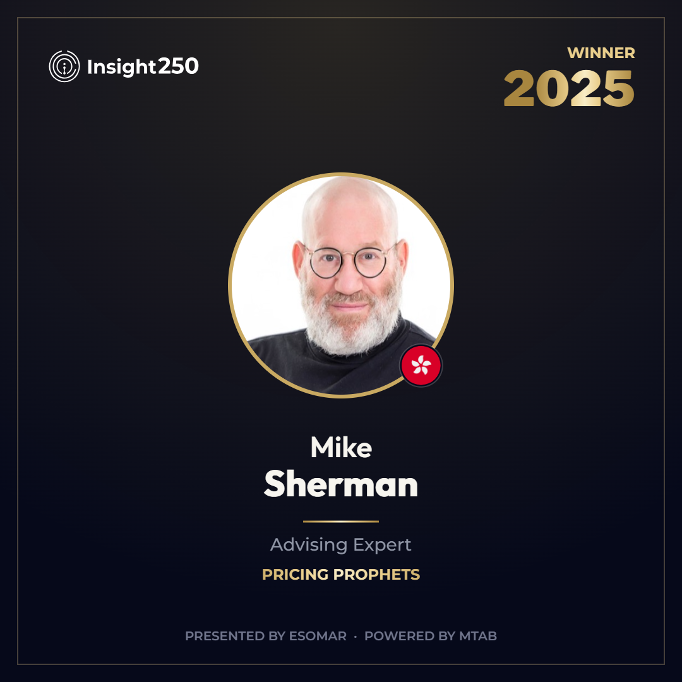
With technology advancing at an incredible pace and the value of insights ever increasing, I sat down with Insight250 Winner Mike Sherman. Mike is an advising expert for Pricing Prophets. He previously spent 17 years at McKinsey, where he built the global CRM practice and then moved to APAC to build the marketing practice. He then moved to Synovate, where he was the global lead for Knowledge and Insights.
Crispin: You have surveyed clients about their satisfaction with market research reports, and the findings are not flattering. What did the data actually show, and why does that gap persist when research providers consistently self-report high client satisfaction scores on those same reports?
MS: What the data shows, across several global surveys and one recently done in New Zealand, is that there is a big gap in perceived report quality between researchers and clients. I believe that the core issue is that clients and researchers aren’t aligned on what their product is. Clients (end users at the client but maybe not the research team) are looking for concise, clear, actionable input into solutions to their marketing issues, while researchers too often view their product as the data or the report.
Crispin: You have spent time on all three sides of the research equation: as a brand manager at P&G, a consultant at McKinsey for seventeen years, and Global Head of Knowledge Management at Synovate. Which vantage point gave you the clearest view of where the system breaks down, and what could you see from that position that the others could not?
MS: It was a common experience, rooted not in the industry but in the particular companies. P&G taught clear communications and the value of the one-page memo; McKinsey taught me about the pyramid principle and the value of solution-oriented communications; Synovate allowed me to demonstrate the increase in customer satisfaction when concise, clear, actionable, solution-oriented presentations were shared with clients.
The last point is perhaps the most surprising to researchers, as the junior clients often pile on the requests for more and more output. But that is not the opinion of the ultimate client; that is the manager who will use the information to help make a decision. (If the research isn’t focused on helping make a decision, that is a separate issue to be addressed; in that case, why do the research?)
Jill Telford, who was head of Synovate Hong Kong when I joined that company, will tell you that coincident with my coaching her teams to write better reports, the customer satisfaction scores rose. She could identify no other cause of this increase and believed the concise, clear and actionable reports were the cause of this increase. So much so that when she moved to the UK to head the Synovate office there, she had me spending a week a month doing the same thing for that office.
Crispin: Your book “52 Things We Wish Someone Had Told Us About Customer Analytics”, co-written with your son Alex, draws on real-life lessons about the gap between analytical output and business impact. What is the single most common and costly mistake you kept seeing repeated across your career?
MS: The failure to connect the work to customer value. Jerry Maguire is my patron saint because he teaches us to “show me the money”. Nothing gets a client more excited than doing just that, and nothing turns off clients - the more senior, the more so - when there is no explicit connection.
Linking research to impact is both simple and difficult. At the simple level, ask the question: how will the findings help to:
Increase share
Increase surplus (through better pricing/segmentation)
Grow the market
Reduce costs
If you can’t help deliver one or more of these, then you can’t show the money. The difficult part is understanding enough about the business and how it makes its profits to link the research to those value drivers. My former McKinsey colleague Davina Stanley shared a compelling anecdote in her book “Engage…How to engage senior leaders and board without burning nights and weekends iterating on your papers.”
She shared: My (Mike’s) SingTel R&D analytics team worked extensively on the executive summary…and building a tight deck that followed. When we presented the summary to the division CEO, he responded with “got it, this is a great idea, go ahead with it.” Amy, the head of the team, spluttered, “But don’t you want to go through the deck?” To which he replied, “No. What you propose is clear, the support is clear, the next steps are clear. I have confidence that the deck will support what you’ve just presented. I don’t need to see the details”. This blew her away – but after that she understood that investing time in the executive summary saved so much time down the road.
Crispin: You learned Barbara Minto’s Pyramid Principle at McKinsey, a discipline that starts with the conclusion rather than building to it. Why has that approach not taken hold in market research reporting after all these years, and what would it actually take to change that?
MS: Two reasons. First, lack of confidence in the researcher's answer. They feel they must “romance” the audience and bring them along before sharing the answer. That works for Agatha Christie when writing mysteries but frustrates clients, and it actually demonstrates a lack of confidence in the ultimate conclusion of a business report.
Second, it is easier to “baffle them with bluster” than “dazzle them with brilliance”. Long, hundreds-of-pages reports make it easy to say that what the clients want is somewhere in there. 20-page reports are much harder to create, as is a pithy one-page executive summary, where every word counts.
The one-page executive summary is key, as noted above. It forces clear thinking. For one project, I was asked to fly to Singapore to assist with an unhappy client. The team sent me a 700-page report. I said I wouldn’t be able to read it (and neither would any client!). I asked for the executive summary. They sent me 300 pages. Without looking at any of the content, I understood the problem – the team was unable to clearly and concisely communicate their findings and recommendations.
Crispin: Research reports are often written to demonstrate rigour rather than to drive decisions. What does a genuinely decision-ready piece of research communication look like, and how different is it from what most clients receive today?
MS: A 30-second elevator speech, a one-page executive summary and a 20-page report with, if needed, appendices. The client bought the approach and rigour when he or she commissioned it; now they want guidance, solutions and advice, not rigour. They assume the rigour is there. Researchers don’t believe this until they see it.
When I first joined Synovate, we did a project for a multinational bank’s wealth management service. I worked with two senior people to create a pithy and actionable executive summary. We presented it to the regional CEO. He stopped us after that summary (the first page of the document), saying he didn’t need to hear more; he assumed the material would support our conclusions, as he said he hired us with that expectation. What he then said was, “Great recommendations, but I can’t do them due to internal issues”, issues that he would never share in a brief. Having earned his trust with our initial work, he then said, here are the internal issues; now, how would you change your recommendations? What followed was a very productive discussion leading to a very happy client.
Crispin: Your second theme is the good, the bad and the ugly of how marketers use customer data to deliver relevant, personalised communications. What does the bad and ugly look like in practice, and why does it remain so common despite years of CRM investment?
MS: Bad is irrelevant or annoying messages. Remarketing is a particular villain as many of us get messages urging us to book a flight or hotel after we’ve already done so. I understand why this happens (as companies don’t share their booking information with Google, FB, etc.) but that doesn’t make it any less annoying to customers.
What is also bad is that Companies often can’t get the basics correct. I live in Hong Kong. By regulation, my bank must issue my statement in the language of my preference, e.g., English. So they know I prefer English. But almost all my marketing communications come in Chinese (with a small ENG in the top right if I want to get the English version). Why can’t they just send me the English version?
Ugly is worse, bordering on offensive or rude messages. One of the examples I share is when FB served me an ad for bras! I love it when people try to justify this as anything other than ugly – no, I don’t buy bras for my partner (what man does?), and I’m not a crossdresser.
When I speak to this topic, I often ask the audience if they received personalised and relevant marketing communications from the companies they personally do business with. Except in rare cases, very few raise their hands, and when I ask for examples, they cite Google or Facebook or other apps, as these products do a better job; rarely do they share company marketing communications (the consistent exception is customers of USAA). But ask them for bad examples, and there are so many.
Crispin: You built the Living Analytics team at SingTel Group Digital Life and set up big data teams at Hong Kong Telecom. What does working at that scale of customer data teach you about the difference between having data and actually understanding customers?
MS: No matter how much data you have and how good it is (and telcos have the best quality data and lots of it), you need to have feedback loops and testing to confirm your hypotheses about customer understanding.
One restaurant recommendation site was the most visited site in their market and so claimed to be the best place to advertise. However, after further investigation, we determined that customers searched on Google when choosing a place to eat and mostly went to the local site to check location or confirm the menu; i.e., they went there after they had made the purchase decision, which reduced the value of any advertisements. So their claim of the most views was correct but didn’t “show me the money.”
To address this requires A/B testing and good qualitative research to see the actual performance and then understand what is truly driving that performance. Second, targeting only works if it is used to deliver a relevant message. We tested one golfer offer. Using multiple sources of internal information (location data on golf courses, watching the golf channel, calls to golf clubs, etc. we achieved over a 50% open rate for the message (the average is usually single digits). However, the sale rate for the offer had several zeros after the decimal point. We reached the right audience but didn’t offer them anything of interest!
Crispin: You created McKinsey’s Asia-Pacific marketing practice and co-founded their global CRM practice. What did building those from scratch teach you about what it takes to make analytics genuinely central to business decision-making rather than a support function consulted after the important decisions have already been made?
MS: Sorry to be repetitive, but “show me the money” to get clients' attention and then pay attention to Harvard’s Ted Levitt, who said, “People don’t want to buy a quarter-inch drill. They want a quarter-inch hole!” so focus on the output, not the input. This is especially relevant in customer data marketing, where the vendors love to spin tales about how good their product is, focusing too much on capability and less on actionable output.
Crispin: You have visited over 125 countries and spent nearly three decades based in Asia working globally. Does the willingness to connect research to commercial outcomes vary significantly by market or culture, and what has that taught you about why some organisations use insights so much more effectively than others?
MS: It does, but the differences within countries or even companies are often even greater. One needs to be sensitive to local customs, but that often becomes an excuse for poor output.
What I have found is that it is the combination of local, regional and global perspectives that creates the best results. The local perspective helps to interpret the findings, while the regional and global perspective drives questioning.
For example, in Korea we did a research project for a fast food chicken chain. The research focused on people eating at KFC, Church’s and other Western fast food chains. As we were finishing up the report, one client asked: “What about the local chicken places?” The agency and client researchers were quick to dismiss them as irrelevant. However, the local places sold cooked chickens for take-home dinner, not that different from KFC, etc. It turns out there are a few hundred Western fast food chicken outlets while there are over 10,000 local chicken places. It was too late to address the gap in that report, but the narrow local definition of competitors led to missing out on exploring a key source of potential volume.
Crispin: Mike, thank you for a candid and thought-provoking conversation. Over my own career in the insights industry, I have seen many of the challenges you describe, and your diagnosis is hard to dispute. Your four value drivers – increasing share, increasing surplus, growing the market and reducing costs – are a simple test that every research team should apply before a project is commissioned, not only when the report is written. Add the discipline of the Pyramid Principle and a one-page executive summary where every word counts, and researchers can earn the kind of trust you described with that regional CEO. They took the rigour as given and moved straight to the decision. As technology changes how insight is gathered and delivered, the ability to “show me the money” will increasingly separate insight functions that shape decisions from those consulted only after the decision has been made. My thanks to you for sharing your knowledge so generously, and to all the Insight250 Winners who continue to contribute their expertise to this series.
Crispin Beale
Chairman at QuMind, CEO at Insight250, Senior Strategic Advisor at mTab, CEO at IDXCrispin Beale is a marketing, data and customer experience expert. Crispin spent over a decade on the Executive Management Board of Chime Communications as Group CEO of leading brands such as Opinion Leader, Brand Democracy, Facts International and Watermelon. Prior to this Crispin held senior marketing and insight roles at BT, Royal Mail Group and Dixons. Crispin originally qualified as a chartered accountant and moved into management consultancy with Coopers & Lybrand (PwC). Crispin has been a Board Director (and Chairman) of the MRS for nearly 20 years and UK ESOMAR Representative for c15 years. As well as being CEO of Insight250, Crispin is currently Worldwide CEO of Digital Communications Solution Agency, IDX. Crispin is also the Senior Strategic Advisor at mTab and the Chairman of QuMind and spent 4 years as Group President of Behaviorally where he was responsibile for the client & commercial teams globally. Crispin is a passionate advocate for blending human intelligence and technology to deliver innovation and leadership across organisations.