Delivering Insights with STILE
Like futurists, many insights professionals seek to have clients not only understand the results of their research, but also to act. One of the challenges and reasons for resistance is the risk involved in change.

Like futurists, many insights professionals seek to have clients not only understand the results of their research, but also to act. One of the challenges and reasons for resistance is the risk involved in change.
Caution: Risk Ahead
Frequently, the findings you bring to the table indicate that shifts are needed in approach or strategy. You face resistance not because your clients are unintelligent but because as humans they are built for self-preservation.
The Fallacy of the Retrospective
No business owner or executive leader wants to be wrong. What is at stake is not only one’s own status which results in rewards like social benefits, increased earnings or promotions but also, organizational investment dollars, brand reputation, and livelihoods. We have all heard the case studies of the strategic errors made by Kodak, Coca-Cola, or Blockbuster. These stories are relayed as punchlines in presentations to make a fast point. Our clients do not want to wind up being the star in a cautionary tale where the wrong assumptions seem obvious, the decisions non-sensical, and our collective response is “What were they thinking???”
The problem with these stories is we are viewing them with the benefit of hindsight. The dust has settled, pressure relieved, and the difference between what is hype and what is critical information is known. Knowledge is no longer incomplete; we know which technologies prevailed and we can survey the actions of competitors with neutrality. Yet, because we live life going forward, none of these was the case when the decisions were made. Forced with stepping into the same uncomfortable shoes worn by those decision-makers from the past, our clients choose the only sane response of delaying action.
Enter STILE
STILE is a framework that helps decision-makers and those making recommendations gain clarity about the reasons behind the actions they are taking. With STILE, even inaction becomes a tactical response with built in triggers for when to reconsider the position. STILE is a method created by two futurists at the University of Houston as part of Horizon Shift Analysis. It is a way to track emerging changes so that decisions can be made intentionally.
Often, as futurists, we might advise our client to take no action when signals are in their early stages, since acting too soon may prove to be impudent."
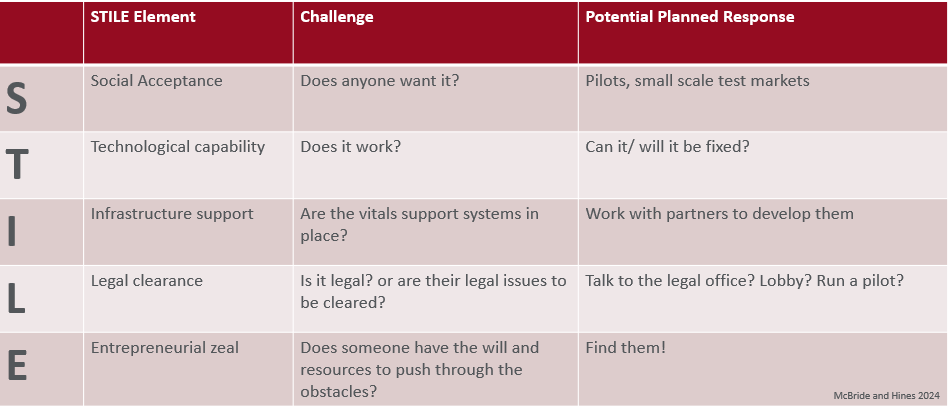
STILE is an acronym for Social acceptance, Technological capability, Infrastructure, Legal Clearance, and Entrepreneurial zeal. By assessing the stage of each element, we can evaluate the viability of concepts, ideas, products, and services. STILE answers the question: “How close is this future to becoming real?”
How to Apply STILE
Step 1: Define what is being Monitored
Define what finding(s) your client is tracking. Ground the definition in a clear hypothesis that came out of the research. What do you expect to happen? The statement of the hypothesis can be directional (“Most people will grow their own food”) or quantitatively measurable (“45% of U.S. adults will produce at least a quarter of their own produce”). Treat this as your reference point.
Step 2: Rate Each STILE Element
Assign each STILE component a rating from 1 to 3: 1 indicates strong presence, 2 suggests partial development or friction, and 3 signals little to no traction. The purpose isn’t to arrive at an exact measurement but rather to gauge momentum. Lower scores indicate stronger alignment with the expected shift.
Step 3: Identify Gaps
Our research shows that for a change to fully materialize; all the STILE elements need to be consistently strong. If one or more elements lag, they act as bottlenecks to change. Pinpoint where constraints are slowing progress.
Step 4: Develop Action Plans
Translate each constraint into a set of targeted actions. This might involve testing new a new product or service, finding partners, or building out necessary systems and infrastructure (see Key Ideas chart for examples).
Step 5: Monitor Over Time
Conduct a STILE evaluation at regular intervals. Use the updated scores to understand how the landscape is shifting over time and to recalibrate approach.
Depending upon the length and type of the engagement, STILE evaluations can be carried out by either the insights team or the client. In a time-pressed environment with multiple pulls on attention, STILE can provide certainty where there is uncertainty. At a minimum, its use establishes a documented process that records when and why specific actions were taken, leaving our clients with the sense of security that comes with knowing they are focusing on what matters.
Mina McBride works as a professional futurist and teaches Pro Seminar in Foresight to graduate students at the University of Houston. Drawing on both quantitative and qualitative methodologies, Mina tracks signals of change and translates them into strategic insight. With a background in education, leadership development, and psychology, she designs workshops and signature talks that challenge conventional thinking and inspires teams to think in new ways.
Dr. Andy Hines is Associate Professor and Program Coordinator at the University of Houston’s Graduate Program in Foresight, bringing together the experience he earned as an organizational, consulting, and academic futurist. He is also speaking, workshopping, and consulting through his firm Hinesight.