The Next Big Thing: Exploring the EDGE for High Growth Opportunities

Innovation teeters on the precipice of convention, where the ordinary meets the extraordinary

7 min read
7 min read

Innovation teeters on the precipice of convention, where the ordinary meets the extraordinary

Historically, multibillion-dollar industries have emerged from niche beginnings, with enthusiastic pioneers addressing problems the wider world had yet to encounter. The $16B doula industry, for instance, emerged from women seeking alternatives to traditional hospital births. Similarly, plant-based milk, now a projected $22B industry for 2025, grew from a niche need to address milk allergies. These journeys from the fringe to the mainstream show how outlier ideas can become major trends.

However, identifying which budding ideas will succeed is difficult. Some fizzle out, while others take off too late, missing the early leadership advantage. Marketers yearn to unearth these golden opportunities at the perfect time, but the fear of failure often shackles innovation. This fear is warranted, as most innovations fail to change consumer behaviour.

Three challenges persist:

  1. identifying viable opportunities,

  2. mitigating risks, and

  3. expediting timing.

Left unaddressed, these challenges become strategic chasms. We believe the secret to successful innovation is finding and understanding the people and behaviours at the fringes. The fringes offer the fresh thinking required to create high-potential opportunities, innovative products, and creative communication strategies.

Today’s unprecedented opportunity from the combination of agentic AI and genuine human understanding paves novel paths to unique opportunities. By investigating what we call the EDGE - Extreme behaviours, Divergences from norms, Gaps and workarounds, and Eccentric quirks - we can wager on where to focus and how to allocate resources with increased confidence.

Collaborating with the MIT Innovation Lab, we employed creative prompting, empathetic experiences, insightful trend analysis, and science-based analytic frameworks to tackle the challenges of discovery, risk, and time.

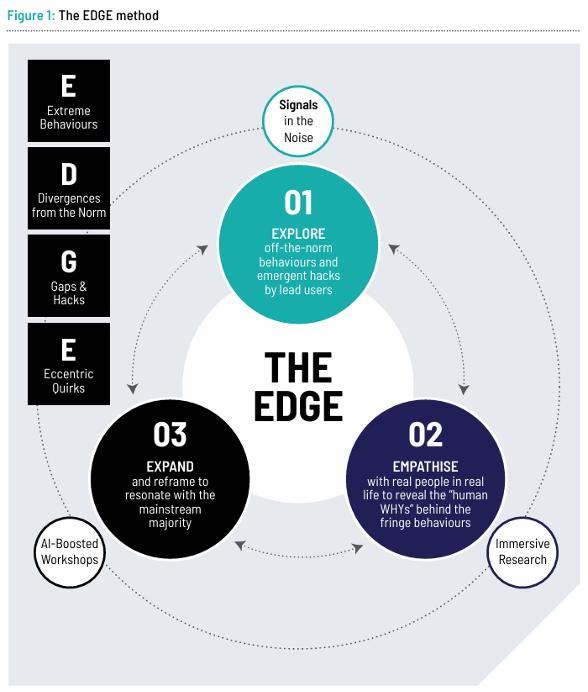
In order to identify and distinguish between long-term disruptive trends and short-term fads we unveiled a process built on three areas of development:

  1. EXPLORE: AI-powered social intelligence discerns market signals from noise, identifying trailblazing users who indicate emerging needs.

  2. EMPATHISE: Human interaction and contextual observation are vital to grasping the rational and visceral connections to a given divergent behaviour. These dialogues furnish deep, human-centred insights.

  3. EXPAND: A pattern of driving forces—passionate connection, reframed opposition, and accelerating trends—can indicate which behaviours are most likely to achieve mainstream status.

Our Method

Explore: Find the EDGE.

People at the EDGE, or "lead users," experience needs well ahead of the mainstream and create novel solutions for previously unknown problems. These signals of change are the first signifiers of potential shifts. Lead users exchange ideas and prototype solutions, attracting others through grassroots techniques.


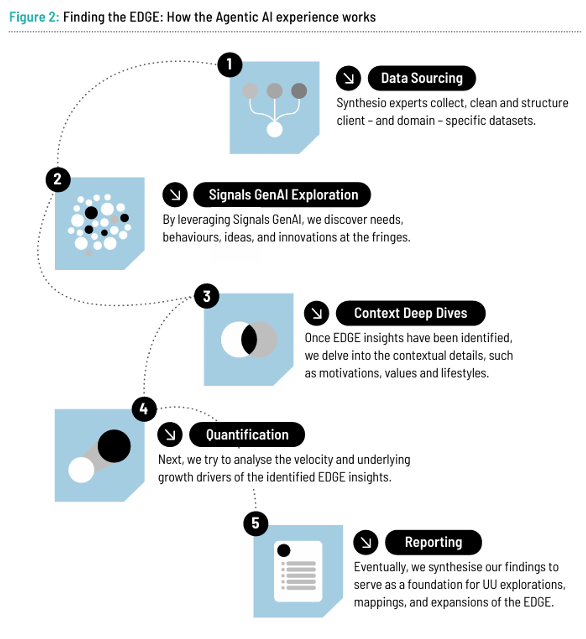
Our Synthesio social intelligence team developed Signals GenAI, an Agentic AI process that discovers and analyses these behaviours from millions of social data signals in under a minute. This approach focuses on the EDGEs where the first flickers of tomorrow appear—fringe behaviours and DIY solutions that might become the next big thing. We begin by scraping social and search data into a single corpus. From there, a dedicated generative AI agent sifts through consumer signals in real time to surface fringe ideas that depart from the category norm.


Empathise: Understand the EDGE.

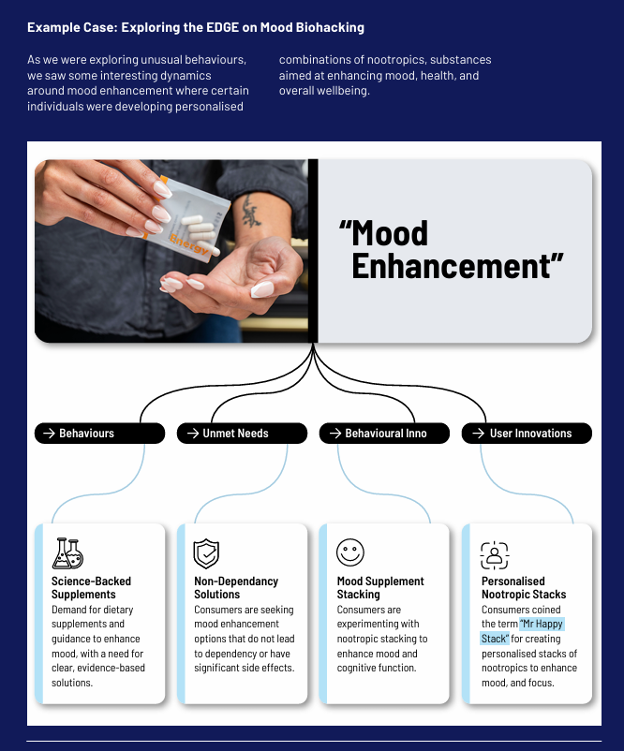
Engaging with those in the margins brings valuable insights into our future needs. Observing these spaces with curiosity and empathy can help organisations get ahead of tomorrow's demands. Nurturing these fringe relationships can unveil speculative ideas from those whose lived experience has been limited by the status quo. At this stage, we uncover the "why" behind extreme behaviours. Human observation and deep listening help us understand what could be, rather than what is. The job is to discover the unexpected and unearth the unseen. We leverage information from Signals GenAI to find these people in real life, where immersive techniques can be used to listen deeply. While data analysis points to opportunities, the real magic comes from the rich context gathered by trained moderators. Conversely, speaking to those predisposed against this behaviour helps us understand the barriers to widespread adoption. For example, in our biohacking research, we observed an overwhelming need for control. This manifested in excessive needs for efficiency and organisation, seen in how various drugs were inventoried, and a borderline arrogance towards cheating unwanted feelings and even death.

EXPAND:  Map, Align and Ideate

With a complete data corpus from social signals and deep observational insights, we use trajectory mapping to determine if a behaviour is a trend or merely trendy for now. This involves analysing accelerating forces and oppositions to its growth.

  • Forces of Passion: High-potential niche users, or virtual tribes, are passionate about their uniqueness and creative ability. This passion is often driven by a deep resistance to how a problem is currently solved, which can stem from ego, health concerns, or deep-rooted fear. Our biohackers, for instance, found a community with others "smart enough" to buck the norm. Understanding the insight driving the behaviour is key.

  • Forces of Opposition: Niche behaviours often have barriers to mainstream acceptance. If something is too difficult, time-consuming, or considered strange or unhealthy, it may be rejected. Biohacking, for example, could be viewed as risky due to concerns about side effects.

  • Forces of Acceleration: Macro forces, societal shifts, and small signals of change can point toward the future. A well-timed emerging trend can strengthen passion and mitigate opposition. For biohacking, current trends of conscientious health and customised individualism might be strong enough to break through immediate concerns if addressed properly.

  • Reframe and Reconsider: The challenge is to determine if the tribe's passion can be reframed to move beyond its niche. Could the insight driving niche adoption be made relevant to a broader group? Can a brand own this repackaging? We arrive at these decisions as a team in a framework-aided workshop.

  • Align & Ideate: The final step is translating EDGE behaviour into actionable concepts. Interactive workshopping allows organisations to align on short, medium, and long-term growth strategies. Teams must consider category position, stakeholder priorities, strategic fit, and operational capabilities.

Key Takeaways

  1. Innovation Originates at the “EDGE”:  The most significant and disruptive market opportunities are not found in the mainstream but at the fringes of society. By studying the “Extreme behaviours, Divergences from norms, Gaps and workarounds, and Eccentric quirks” of lead users, companies can identify unmet needs before they become widespread.

  2. AI Plus Empathy is Fundamental: The most effective way to innovate is by combining technology and humanity. Agentic AI is powerful for scanning millions of data points to find signals of change, but deep human listening and ethnographic observation are crucial for understanding the “why” behind those behaviours and uncovering true, empathetic insights.

  3. Trends Have a Trajectory: Not every niche behaviour will go mainstream. Use trajectory mapping (forces of passion, opposition, acceleration) to separate long-term trends from short-lived fads and to identify how to reframe niche insights for broader adoption.

  4. From Insight to Action: The process doesn’t end with discovery. The final, critical step involves translating these complex insights into tangible concepts through strategic workshopping, ensuring alignment with brand capabilities, stakeholder priorities, and the team that will take the project forward into the next phase of its innovation processes.

Endnotes  

  • a. Chabria, S., Zacharias, B., Taylor, R., and Storry, J. “Innovating in Challenging Times,” Issue 2 (2020), Ipsos, pp6-7.

  • b. Ipsos concept testing database (2024).

  • c. Mehta, M. “Speeding Between the Gates” (2022), Ipsos.

  • d. Leary, A., and Kaulartz, S. “Decoding the Lead User Innovation Landscape” (2019), Ipsos.

  • e. Ing, B., et al. “Ipsos Global Trends” (2024), Ipsos.

  • f. Jeffries, A., and Bangia, A. “The Vibrant Fringes: Spotting opportunities beyond the mainstream” (2024), Ipsos.

  • g. Kaulartz, S. “Bigger Innovation needs Bigger Data”, (2020), Ipsos

  • h. Von Hippel, E., Kaulartz, S. “Next-generation consumer innovation search: Identifying early-stage need-solution pairs on the web” (2021), MIT Sloan School of Management & Ipsos

  • i. Ing, B., et al. “Ipsos Trends and Foresight: Prospectus for the Futures Framework” 2023-26 (2023), Ipsos

  • j. Ing, B., et al. “Ipsos Global Trends, Conscientious Health” (2024), Ipsos.

Ajay Bangia
Chief Innovation Officer (AI Solutions) at Ipsos UU
April Jeffries
President, Global Ethnography, and Immersion at Ipsos UU
Karin O’Neill
Senior Vice President, US Qualitative at Ipsos UU