From Promise to Proof: Why Brand and CX Research Must Finally Unite
Brand and customer experience research must be integrated because true business performance is driven not by strong brand perceptions or high satisfaction scores alone, but by how well customer experiences deliver on the promises a brand makes.

Examining metrics in isolation is misleading. Strategic performance is not defined by their individual strength, but by their alignment. At NLB d.d., this shift revealed that gaps between expectations and delivery were often more important than the scores themselves, redirecting focus from measurement to meaningful action.
There is a quiet contradiction at the heart of modern research. We measure more than ever before. We track awareness, trust, reputation, and brand preference. We analyse customer satisfaction, effort, and NPS. We map journeys, monitor touchpoints, and collect vast volumes of feedback. From a technical perspective, the discipline has never been more advanced. And yet, despite all this sophistication, one deceptively simple question often goes unanswered: Are we truly delivering what we promise to our customers?
The reason lies not in a lack of data, but in the way it is structured. In many organizations, brand research and customer experience research continue to exist as two separate worlds (often also in two separate organizational silos). Brand research captures expectations - what people believe a brand stands for, what they anticipate, what they hope to receive. Customer experience research, on the other hand, captures reality - what people encounter when they interact with products, services and employees.
Both perspectives are valid. Both are necessary. But they are very rarely connected.
This “silos-mindset” has consequences. It creates a subtle but powerful blind spot in decision-making, where two different versions of truth coexist without ever being reconciled. Marketing teams optimize the promise, refining communication, positioning, and storytelling. Operational teams optimize delivery, improving processes, touchpoints, and service interactions. Yet the space between these efforts, the alignment between expectation and experience, remains largely unmeasured.
And it is precisely in that space where value is created or destroyed. A strong brand, when not supported by experience, does not strengthen loyalty. It amplifies disappointment. Expectations rise, but delivery fails to keep pace, and customers feel the gap not as a small inconvenience but as a broken promise. On the other hand, a strong experience without a strong brand rarely translates into growth. Customers may be satisfied, even impressed, but without awareness or consideration, the experience remains invisible, its full potential unrealized.
Seen from this perspective, the traditional questions of research begin to feel incomplete. It is no longer enough to ask how strong the brand is, or how satisfied customers are. These are important indicators, but they describe parallel realities rather than a single, connected system. A more meaningful question begins to emerge: how aligned are we?
Customers do not separate brand and experience in the way most organizations still do. They do not distinguish between what is promised and what is delivered as two independent constructs. They experience them as one continuous narrative, one lived reality in which expectations are constantly being confirmed, adjusted, or broken.
When brand and CX insights are brought together and examined through this lens, something interesting happens. The focus shifts away from individual scores and toward the relationship. What starts to matter is not only how high each metric is, but how far apart they are. This distance - the gap - between expectation and delivery becomes a powerful diagnostic tool.
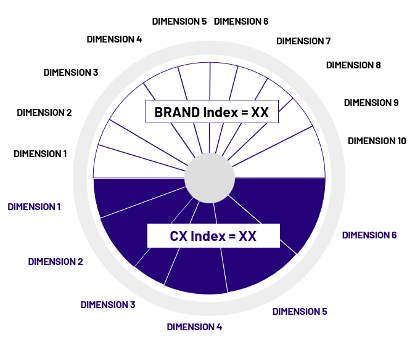 Picture 1: Unified strategic KPI framework illustrating the company’s market position through the alignment of brand expectations and customer experience delivery
When this thinking is embedded into a unified measurement framework, the implications become even more tangible. By bringing together brand perceptions and customer experience evaluations into a single lens weighted not just by performance, but by what truly drives customer choice, the conversation changes. Leadership teams are no longer faced with a fragmented set of indicators, each pointing in a slightly different direction. Instead, they possess a clear picture of where alignment breaks down and where it is holding strong.
This framework revealed that performance is not defined by brand strength or customer satisfaction alone, but by their alignment. It enabled NLB to uncover hidden risks of overpromising and missed opportunities where strong experiences were undervalued. More importantly, it shifted the role of research - from providing insight to guiding decisions. Rather than a retrospective analysis, it became a forward-looking tool for prioritisation, helping identify where expectations should be recalibrated, where experiences must be strengthened, and where existing strengths can be leveraged more effectively. In this way, research moves closer to the core of strategy, not as a supporting function, but as an integral part of decision-making.
This reflects a broader shift within the insights industry. The question now becomes whether data provides direction and clarity: clarity on where to focus, what to change, and what will truly make a difference. This requires a change in mindset. Moving beyond the idea of research as a set of tools and siloed methodologies, and embracing it as a system for connection. A system that brings together different perspectives, aligns them, and translates them into something actionable.
Insights teams should not be just interpreters of data, translating numbers into narratives. They must become architects of decision systems, designing frameworks that integrate complexity and make it manageable. Their value lies not only in what they know, but in how they structure what others need to decide.
At its heart, this is also a cultural shift. Organizations often treat brand as something that is created through communication and experience as something that is delivered through operations. In reality, these are two sides of the same coin. Every interaction carries the weight of the brand. Every process, every conversation, every small moment contributes to what customers ultimately remember. And memory is what defines the brand.
What customers say about an organization is rarely based on its messaging alone. It is shaped by what they have experienced, how they were treated, what worked, and what didn’t. In that sense, the brand is not what is claimed, it is what is proven. The future of research appears less about adding new metrics and more about connecting existing ones in meaningful ways. The challenge is not to measure more, but to understand better. To move from isolated truths to integrated insight. Growth does not come from improving the brand in isolation, nor from optimizing the experience alone. It emerges from the alignment between the two. Customers already experience organizations this way. The real question is whether research is ready to do the same.
As a strategic leader in research and customer experience (CX) transformation at NLB Group, I specialize in aligning customer needs with business strategy to shape board-level decisions and long-term organizational growth. My work focuses on uncovering deep insights into customer behavior and translating them into actionable initiatives that enhance how our bank serves millions across the region.
Over the past decade, I’ve built research frameworks, developed innovative KPIs, and led the implementation of CX strategies across the Group. Today, I oversee group-wide CX execution and lead cultural transformation - ensuring customer centricity evolves from a performance metric into a deeply embedded organizational mindset.