How Can Organizations Turn Insights Into Timely Action?
Your stakeholders seem to trust the research. So why won’t they act on it? Marco Vriens explores why insights face resistance and how researchers can persuade people to act on them.

Summary
How can we get marketing to act on insights offered by the consumer insights team? Stakeholder alignment, trust, credibility and articulating the likely impact may all be necessary but not sufficient. A review of the literature across psychology and organizational science reveals other factors such as the ease with which insights can be understood, timeliness, over-coming decision-maker’s own mental model(s), and increasing psychological receptiveness.
Table stakes
Stakeholder alignment, trust, and credibility of advisor and insights1 are said to be required to ensure insights are acted on. These factors are more like table-stakes; they can prevent an insight from being acted on but likely won’t be sufficient. Stakeholder alignment refers to who needs to be briefed prior, during or after the research and what it is that you should align2. Who is funding the research, who has the power to act on possible recommendations, and who will gain the most from any potential action and possibly who stands to lose if action gets taken. They should align on the decisions that need to be made3. Also, extensively discussed are factors such as trust between advisor and advice takers, and the credibility of the insights because acting on insights inherently carries an information usage risk2. The degree to which the impact of action is articulated is also a strong driver for action. Especially, articulating the impact of action on the stakeholder’s individual short-term objectives is very motivating. The more specific the recommended action, the better. For example, rather than saying “You need to improve NPS by X points”, it is better to say, “If you reduce the percentage of detractors by X%, our revenue will go up by Y%.” Emotions play a role here too. If decision-makers see the actual frustration of a customer in a focus group, they will be more likely to do something.
All these factors matter. However, we believe that they are for the most part table stakes. They won’t get you all the way. Two, these factors are not binary (you have them or you don’t). If a well-known institute such as Ehrenberg-Bass claims something it will carry more weight. Regardless, there are other factors that are key in driving action. Lastly, most insight and their recommended actions are not validated (as validation adds time and expense and hence is often skipped). This means if stakeholders act, it is still with a leap of faith.
Other drivers of (in)action
First, psychology research has shown that the easier research can be understood the more likely they will be accepted4. Two, timeliness of the insight can be both a driver and a barrier. There are certain decision windows in which insights can influence. Before a key meeting, we may find stakeholders most open to receiving useful information. After key meetings where decisions had to be made, it may be game over7. Three, the recipient’s own mental model is a barrier. Executives’ mental models can be based on experience; e.g. “to make my brand stronger, it needs stand out attribute X”. Such mental models can be wrong, and new information may face the hurdle of an executive’s mental model. They won’t throw their own mental model out because of one research project. So, a first step would be to understand the recipient’s mental model. The perspective that getting an insight acted on, means not only do you need to convince someone that your insight is valid, but you may also need to convince that it is better than entrenched mental models. This likely means you need to get someone to be receptive.
Studies have shown that we can measure a person’s receptiveness5. Resistance happens at three levels: seeking, attention and evaluation. A practical implication of seeking: if a stakeholder has low receptiveness, the fight is already lost before you present anything if engagement is optional or effortful. This is an argument for making engagement with the finding low-friction and hard to avoid (e.g., embedding it in a process they already can't skip). A practical implication of attention: put the uncomfortable finding early and make it concrete and vivid. A practical implication of evaluation: pre-empt this by explicitly asking the stakeholder to apply the same bar they would use for supportive data: naming the double standard out loud sometimes neutralizes it.
An analysis of thousands of real disagreement exchanges resulted in proposing the HEAR approach: Hedging, Emphasizing, Acknowledging and Reframing6. A hedge example: “in some cases…”, rather than absolutes. Emphasize agreement refers to stating a specific point you agreed on. Acknowledge refers to acknowledging the other view explicitly before responding to it. Reframing refers stating an insight toward the positive rather than the negation. Negation and reason-giving language (“no,” “the reason is…”) reliably reads as combative. Receptiveness is reciprocal, an insight producer who opens with HEAR-style language tends to receive more of it back.
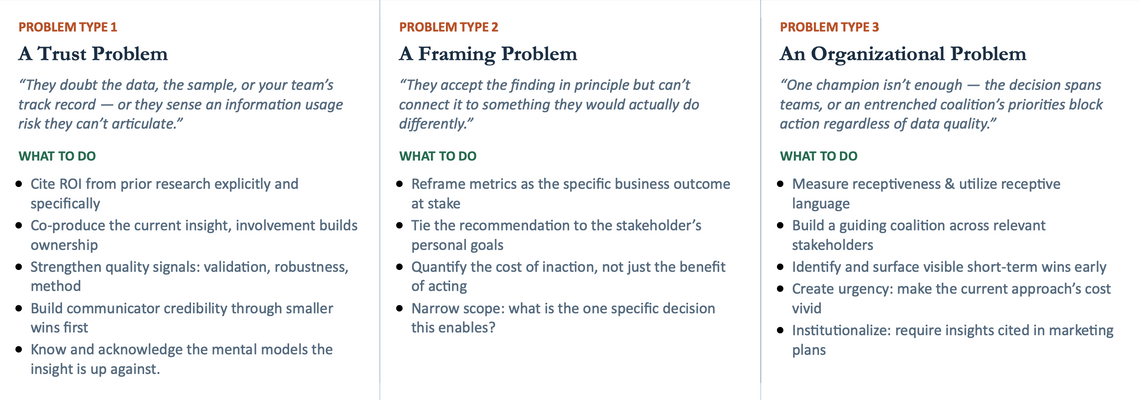
Sometimes, we need to convince an entire team, or even the entire organization needs to shift its approach. Insights from segmentation studies or customer satisfaction programs could mean a dramatic different approach to customers. The change management literature offers the concept of a guiding coalition. Change efforts fail when they rely on a single champion. No individual has the combined authority, expertise, and credibility to make a change stick. This reframes insight activation as a coalition-building exercise, not a single advice-taking transaction. This is also why patience is often required. Exhibits 1 and 2 can be used as guides to get more insights acted on.
Exhibit 1. Framework for getting insights acted on.
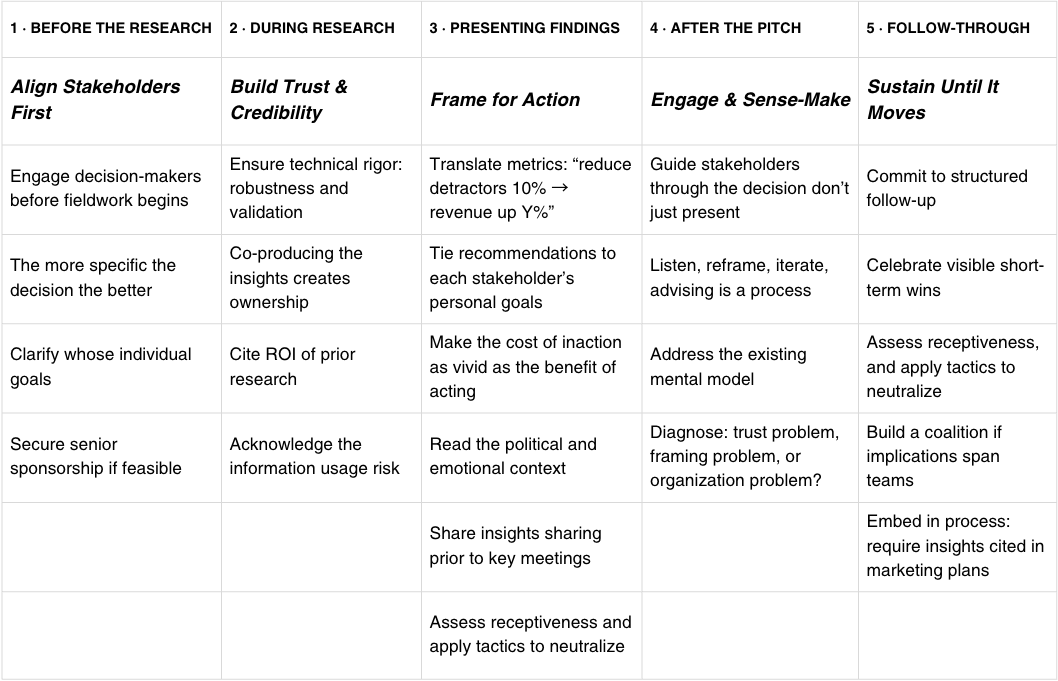
Exhibit 2. Diagnostic framework when insights stall.
Some selected sources
Chadwick & Kersten (2025). The Road to Business Impact (introductory article). Research World, 1 July 2025. A series of papers on this topic.
Grover, R. & Vriens, M. (2006). Trusted Advisor: How it helps lay the foundation for Insights. In: Grover, R. & Vriens, M. Handbook of Marketing Research, Sage Publications, San Diego.
Bonaccio, S., & Dalal, R. S. (2006). Advice taking and decision-making: An integrative literature review, and implications for the organizational sciences. Organizational Behavior and Human Decision Processes, 101(2), 127–151.
Reber, R., & Unkelbach, C. (2010). The epistemic status of processing fluency as source for judgments of truth. Review of Philosophy and Psychology, 1(4), 563–581.
Minson, J. A., Chen, F. S., & Tinsley, C. H. (2020). Why won't you listen to me? Measuring receptiveness to opposing views. Management Science, 66(7), 3069–3094.
Yeomans, Minson, Collins, Chen & Gino (2020). "Conversational Receptiveness: Improving Engagement with Opposing Views", Organizational Behavior and Human Decision Processes, 160, 131–148.