The Case for Contradiction: Designing Research for the Paradoxical Consumer
The Insight250 spotlights and celebrates, annually, 250 of the world’s premier leaders and innovators in market research, consumer insights, and data-driven marketing.

The awards have created renewed excitement across the industry whilst strengthening the connectivity of the market research community. Winners of the 2025 Insight250 were announced last September - you can see the full list of Winners, and those from previous years, at Insight250.com. You can also nominate for 2026.
With so many exceptional professionals named to the Insight250, we regularly tap into their expertise and unique perspectives on a range of topics. This regular series does just that: inquiring about the expert perspectives of many of these individuals in a series of short topical features.
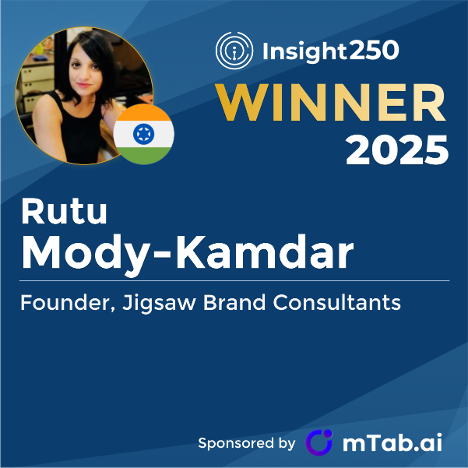
With insights advancing at an incredible pace and the value of insights ever increasing, I sat down with Insight250 Winner Rutu Mody-Kamdar. Rutu is the Founder of Jigsaw Brand Consultants. She is celebrated for her profound expertise in consumer behavior, branding, and business strategy. With a rich academic background, including a doctoral fellowship in consumer behavior, Rutu's extensive experience in teaching and scholarly research has provided a solid foundation for her innovative approach to branding.
Crispin: Why does research design treat contradiction as a problem rather than a signal?
RMK: Research, at its core, is a service industry. It exists to help someone make a decision and decisions need clarity. That need for clarity has hardened over time into a methodological prejudice: contradiction comes to look like untidy work. A sample badly drawn, a guide badly written, an analyst who hurried the data. The PowerPoint deck reduces. Its grammar is one slide, one takeaway, one arrow, all built for resolution. So is the persona, which collapses a hundred contradictions into a single composite human. We have trained an entire generation of researchers to clean before they listen. The result is research the client can act on, certainly, but that no longer quite resembles the consumer who walked into the room.
Crispin: What has working in India taught you about the gap between what consumers say, do and mean?
RMK: In Indian households, the same person learns to speak as a daughter, a daughter-in-law, a professional, an aspirant and a worry, often all at the same time. The young woman who tells me she chooses skincare for its ingredients is also choosing it because her future mother-in-law will inspect her in a few weeks for her glowing skin. The middle-class father who insists his children must learn "good values" is also quietly proud that his son negotiates better than the neighbours. What looks like a contradiction is the everyday Indian habit of holding many audiences in mind at once-family, society, the version of oneself one is trying to become, and answering each of them in turn. Twenty-five years in this environment has taught me that the gap between what consumers say, do and mean is a problem of register, more than a problem of access. The researcher's job is to learn which register a respondent is speaking in at any given moment, and to listen for the silences between them. That is where the most honest data tends to live.
Crispin: What does a paradox-tolerant recruitment brief actually look like in practice?
RMK: A paradox-tolerant screener begins by recruiting on contradiction itself. I want the woman who owns a treadmill and has not used it in six weeks. I want the household that subscribes to organic vegetables and orders pizza twice a week. The standard screener forces respondents to declare an identity: health-conscious, traditional, premium-seeker and the field agency dutifully sorts them into those identities. The trouble is that nobody actually lives inside a single identity. So I write screeners that ask about behaviour and exceptions in roughly equal measure. When was the last time you broke your own rule? What is something you say you believe but find difficult to live up to? Which category of products do you have strong opinions about, and which do you genuinely not care about? The third question is often the most useful, because the consumers without strong opinions are usually the ones a brand is failing without knowing it. A good screener should leave room for the respondent who is, at any given moment, slightly contradicting herself. That is the room where insight begins.
Crispin: How do you design a debrief that holds contradiction intact?
RMK: The first thing I do is refuse to put the most useful contradiction in the appendix. I bring it forward. There is usually a moment in every study where two findings sit uneasily next to each other. The consumer who values speed and resents being rushed, the parent who wants choice and is exhausted by it. I give that tension its own slide, with two verbatim quotes that disagree, and the question we are leaving open. Clients are often more comfortable with this than the industry assumes. What they cannot tolerate is being told a tidy story that the market then refuses to confirm. The architecture of a paradox-tolerant deck holds three things at once: what is clear, what is contradictory, and what the contradiction is asking the brand to do. The last slide typically offers a choice the brand now has to make consciously, with the trade-offs named. Consciousness about the trade-off is, in my experience, what clients actually pay for. Certainty, by comparison, is the cheap thing on offer.
Crispin: How does Jigsaw's integrated model change the way you handle ambiguity?
RMK: Every handoff is also a sanitisation. The research agency tidies up its findings to write a strategy brief. The strategist tidies up the brief to commission design. The designer tidies up the brief into a route the client can sign off on. By the time the work reaches the consumer, three rounds of simplification have already happened, and the original paradox, which is what made the work interesting, has usually been ironed out. Jigsaw was built on the belief that the contradiction should travel with the work. When the same team that did the home visits also writes the brand platform and sketches the packaging, the inconvenient finding has a fighting chance. Design, in particular, has a remarkable ability to hold paradox that prose cannot. A visual metaphor can mean two things at once without straining. A piece of copy struggles to do the same. The brands consumers love most are usually slightly contradictory- premium and democratic, modern and rooted, serious and playful. Brands that resolve themselves too cleanly tend to be the ones consumers respect but rarely choose.
Crispin: How do you make the case to a client that the most useful thing is the part that doesn't resolve cleanly?
RMK: The trick is to stop calling it ambiguity and start calling it competitive advantage. Every brand in the category has access to the same clean data. The same syndicated reports, the same usage and attitude studies, the same demographic cuts. What separates the brands that read the market well from the ones that misread it is almost always their willingness to sit with what does not fit. When I present an inconvenient finding, I frame it as a part of the consumer that the competition has not yet noticed. That changes the conversation entirely. The other useful move is to remember that the client, very often, already suspects the contradiction. They have seen it in their own sales data, their complaint logs, and their own household consumption. When the research names it openly, there is usually a moment of recognition rather than resistance. The research has named something they already half-knew. That moment, in my experience, is when the client starts to trust the work.
Crispin: Will AI engineer paradox out even faster?
RMK: Yes, and the risk is real. Large language models are pattern-recognition engines. They are built to find the dominant signal in a body of text, and the contradictory data point is, almost by definition, the outlier the algorithm wants to suppress. Left to itself, a synthesis tool will give you a tidier consumer than the one you started with. The point of using one will have been quietly defeated. The fix is in how we brief the model, more than in whether we use it. I ask AI tools to do the opposite of what they are optimised to do. Show me the quotes that contradict the consensus. Find me the respondents whose answers do not cluster. Tell me what does not fit. Used this way, AI is genuinely useful. It can do in minutes what would take a junior analyst a week. The bigger risk, I think, is cultural. As decks get faster and synthesis gets cheaper, the industry will lose the muscle of actually reading the transcript. The qualitative analyst's irreducible job is to look at what the model has flattened, and ask why.
Crispin: Where does the industry's instinct to resolve contradiction actually come from?
RMK: It is partly all of those, but I think the deepest source is something the industry rarely names: a professional anxiety about what research is actually for. If we admit that consumers are contradictory, that the data does not converge, that the truth depends on register and context — what, then, are we selling? An entire generation of researchers was trained to answer that question by performing certainty. The deck has a single takeaway. The persona has a single motivation. The recommendation comes with three bullets. This is partly methodology, partly business school training in case-study confidence, partly client pressure, and partly the entirely human discomfort of standing in front of a senior leader and saying "it depends." Underneath all of that, I think, sits a fear that the more honest answer would make the work feel less valuable. My experience has been the opposite. The clients who keep coming back are the ones I have been willing to tell that the consumer is genuinely conflicted, that the brand has a real choice to make, and that I cannot make that choice for them. I can only see it more clearly than they can.
Crispin: If you could change one thing about how senior insights leaders brief, conduct and report qualitative research, what would it be?
RMK: Send senior leaders back into the field. The deepest structural problem in qualitative research today is that the most experienced readers of consumer behaviour are also the furthest from the actual consumer. Fieldwork has been delegated downward to junior moderators, to local field agencies, to AI transcription and the senior insights leader reads the consumer through three layers of summary. By the time the deck lands on her desk, the brownie has been removed from the wellness shopper's bag. If I could change one thing, it would be to require every senior insights leader, including myself, to spend at least ten days a year sitting on a respondent's sofa, watching her get ready in the morning, watching her open her fridge, simply witnessing. There is no methodological substitute for the moment when a respondent says something that does not match anything in the screener, and you are in the room to hear it. That moment is what good research is. Everything else is logistics.
Hot Topic: Are we building a picture of the consumer that is clean enough to present but too tidy to actually trust?
RMK: Yes, and this is, I think, the real reason so much research is quietly disbelieved by the very clients who commissioned it. They have spent the money, they have read the deck, they have nodded politely. And yet, when the actual market behaves in ways the research did not predict, they are rarely surprised. They had half-expected it. The cleaner the picture, the more suspicious senior leaders have quietly learned to be. The consumers they meet in their own lives-their teenage children, their elderly parents, their friends have never been as coherent as the persona on slide twelve. The industry has, slowly and almost without noticing, built a product that is too consistent with itself to be quite believable. The answer is more honesty about what rigorous qualitative work actually looks like: messy, layered and unfinished, holding its findings in tension rather than in resolution. Trustworthy research should feel a little uncomfortable to present. If the deck is too easy to deliver, we should be worried about it.
Top Tip: The single most important thing you have learned about listening well, and your tip for the next generation.
RMK: The most important thing I have learned is to stay in the room past the polite answer. Every respondent has a first answer-the socially acceptable one, the one she thinks the researcher wants, the one she has been giving for years. That answer is rarely useful. The useful answer is usually the second one, which arrives only when the room has slowed down enough for her to feel that she is allowed to contradict herself. My tip for the next generation is to learn to do nothing for slightly longer than feels comfortable. Resist the urge to fill the silence. Resist the urge to ask the next question in the guide. Resist the urge to summarise what she just said back to her, because that flattens it. Let the silence do its work, and watch what she chooses to say into it. Twenty-five years on, that is still where I find the most honest data. Listening well is, in the end, a willingness to be a little useless in the moment, in service of being more useful later.
Crispin: Thank you, Rutu. It’s been fantastic to hear your thoughts on the state of the insights and how innovation will continue to play a leading role in transforming our industry.
For me this has really been a genuinely rare conversation. In an industry that often mistakes clarity for truth, your work is a quiet act of intellectual courage: building the methodological and organisational conditions for contradiction to survive long enough to become insight. The idea that stays with me most is your observation that trustworthy research should feel a little uncomfortable to present, and that the tidiness of a deck is almost an inverse signal of its honesty. For the next generation of insight professionals navigating a world of faster synthesis and cheaper certainty, that is perhaps the most important lesson of all: that the consumer has never lived on slide twelve, and the job is to keep finding ways to bring the real, contradictory, unresolved person back into the room. Thank you again.
Crispin Beale
Chairman at QuMind, CEO at Insight250, Senior Strategic Advisor at mTab, CEO at IDXCrispin Beale is a marketing, data and customer experience expert. Crispin spent over a decade on the Executive Management Board of Chime Communications as Group CEO of leading brands such as Opinion Leader, Brand Democracy, Facts International and Watermelon. Prior to this Crispin held senior marketing and insight roles at BT, Royal Mail Group and Dixons. Crispin originally qualified as a chartered accountant and moved into management consultancy with Coopers & Lybrand (PwC). Crispin has been a Board Director (and Chairman) of the MRS for nearly 20 years and UK ESOMAR Representative for c15 years. As well as being CEO of Insight250, Crispin is currently Worldwide CEO of Digital Communications Solution Agency, IDX. Crispin is also the Senior Strategic Advisor at mTab and the Chairman of QuMind and spent 4 years as Group President of Behaviorally where he was responsibile for the client & commercial teams globally. Crispin is a passionate advocate for blending human intelligence and technology to deliver innovation and leadership across organisations.