AI Fluency for User Researchers
What it means, how to assess it, and why the market signal matters

"AI fluency" is not a certificate. It is a visible behaviour, and the market is now actively testing for it.
It is tempting to treat AI fluency as a skills checkbox; someone either has it or they do not. That framing is not only reductive but also practically unhelpful. What employers are actually looking for and what user researchers genuinely need to develop is something considerably more nuanced: the disciplined judgment to decide when to use AI, how its outputs should be verified, and what governance and ethical obligations come with it. That distinction is easy to miss in a market where the rhetoric has outrun both the evidence and the practice.
The labour-market signal is real and accelerating. LinkedIn's January 2026 report found that the share of jobs listing an AI literacy skill increased more than sixfold in a single year, and that US jobs requiring AI literacy grew 70% year over year. Indeed's Hiring Lab recorded a 170% increase in US job postings mentioning generative AI terms between January 2024 and January 2025. But the picture is more concentrated than it first appears. By late 2025, only about one in twenty companies had even a single AI-related posting, and nearly 90% of those postings were concentrated among just 1% of employers. The signal is real; the standard is not yet settled.
Inside user research, adoption has moved faster than governance. Maze found that 58% of respondents were already using AI tools in 2025, while User Interviews put that figure at 80%. Yet 91% of researchers in the User Interviews study worried about output accuracy and hallucinations, and 63% feared that AI could devalue human insight and critical thinking. That combination of high adoption and high anxiety is precisely why “AI fluency” in research contexts must be defined with precision rather than enthusiasm.
1. What AI Fluency Actually Means for User Researchers
Most of the time, the term "AI literacy" is used rather than "AI fluency. AI literacy is the set of competencies that enable people to critically evaluate AI technologies, communicate and collaborate effectively with AI, and apply AI as a tool across online, professional, and personal settings. More recent work on generative-AI literacy has expanded this into broader competency models. At the same time, discipline-specific literature persuasively argues that AI capability must be calibrated to the norms, evidence standards, and ethical obligations of the profession using it.
For user researchers, AI literacy, as a general concept, is insufficient. What the role actually demands is something more bound and more demanding:
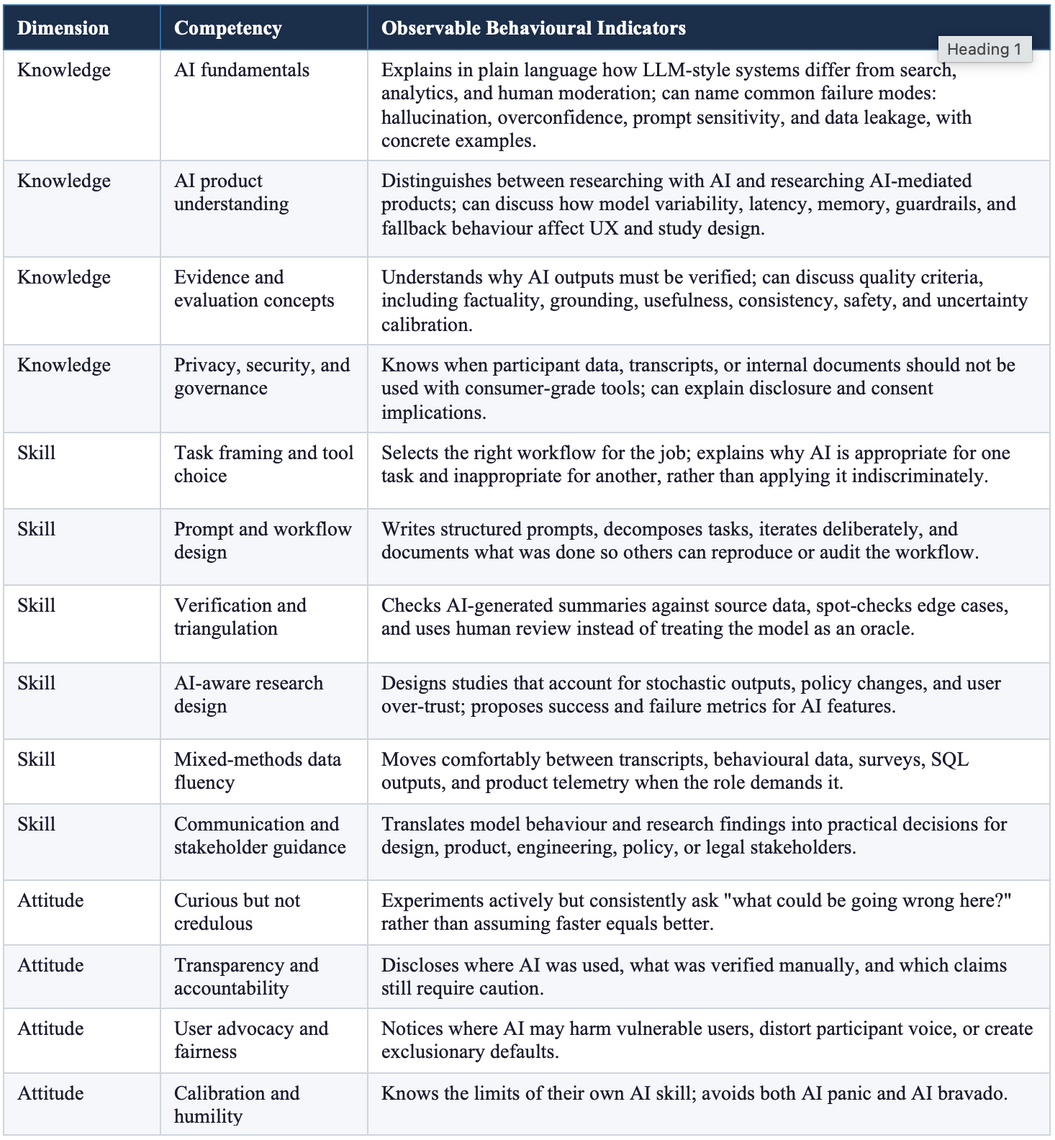
AI fluency for user researchers is the ability to decide when AI should and should not be used in the research workflow; to frame tasks and prompts with precision; to verify and triangulate outputs against source data; to understand how AI changes the product or service being studied; and to handle the ethical, privacy, fairness, and communication implications of all of the above."
A fluent user researcher is not someone who can name every AI tool on the market. It is someone who can use AI to save time without outsourcing judgment; who can study AI-mediated products without being seduced by novelty; and who can explain, in plain language, exactly where the human must remain firmly in the loop.
2. A Taxonomy of Measurable Competencies
3. What the Evidence Says About Prevalence and Hiring Outcomes
LinkedIn’s 2026 reporting shows not only the sixfold increase in jobs listing AI literacy skills and 70% year-over-year growth in US AI-literacy requirements, but also that employers created at least 1.3 million AI-related job opportunities in the prior two years, and that the number of AI literacy skills added by members rose 177% since 2023.
PwC’s 2025 AI Jobs Barometer, which analysed close to a billion job ads worldwide, found wages rising twice as fast in the most AI-exposed industries. Its Australia-specific data adds that AI-skilled workers globally earned an average 56% wage premium in 2024. McKinsey & Company reports that 92% of companies plan to increase AI investment over the next three years, but only 1% describe themselves as mature in deployment. The gap between investment intention and operational maturity is exactly the context that makes disciplined AI fluency a genuine competitive differentiator.
Employers, in other words, are not testing for a fringe skill. They are testing for a practice that the majority of researchers already use, but use with highly variable levels of discipline and rigour.
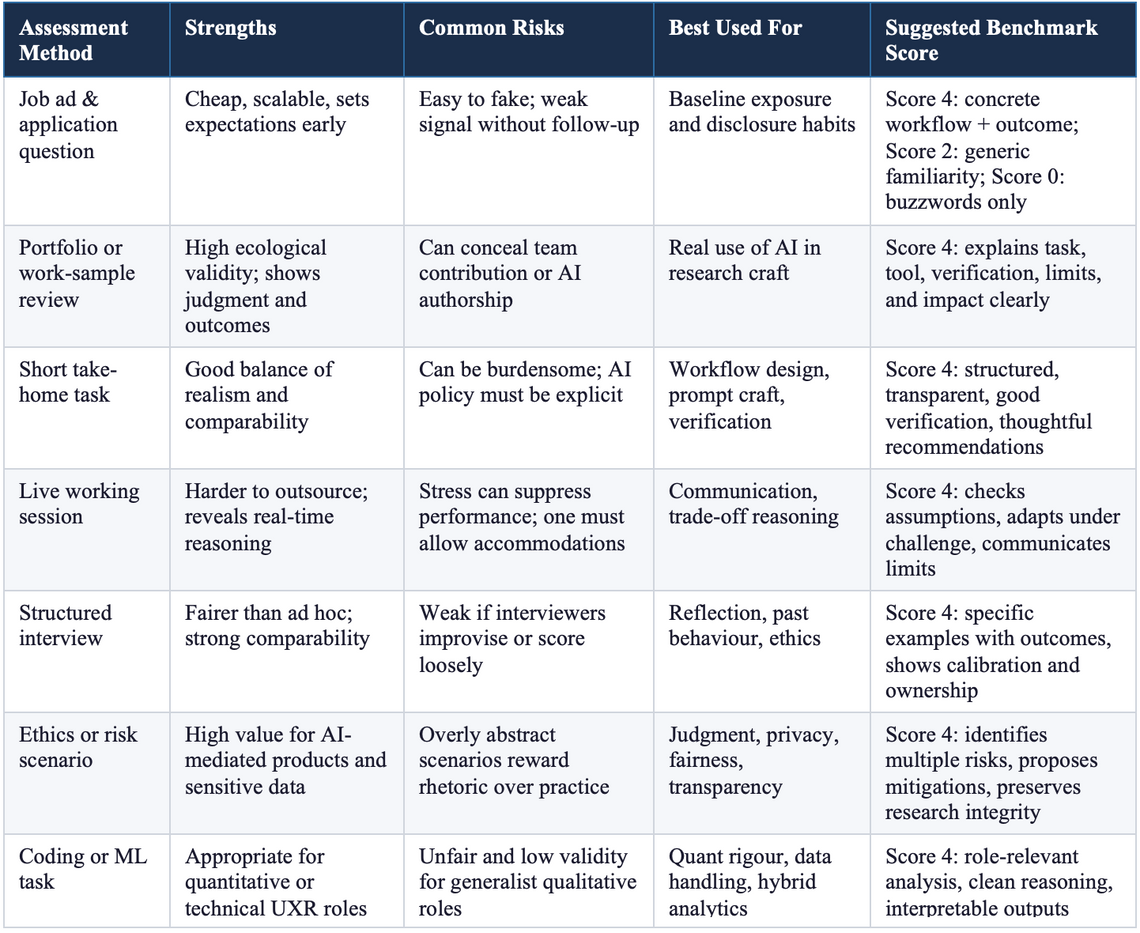
4. How Employers Are Assessing AI Fluency
Employers are using several methods, see the table below
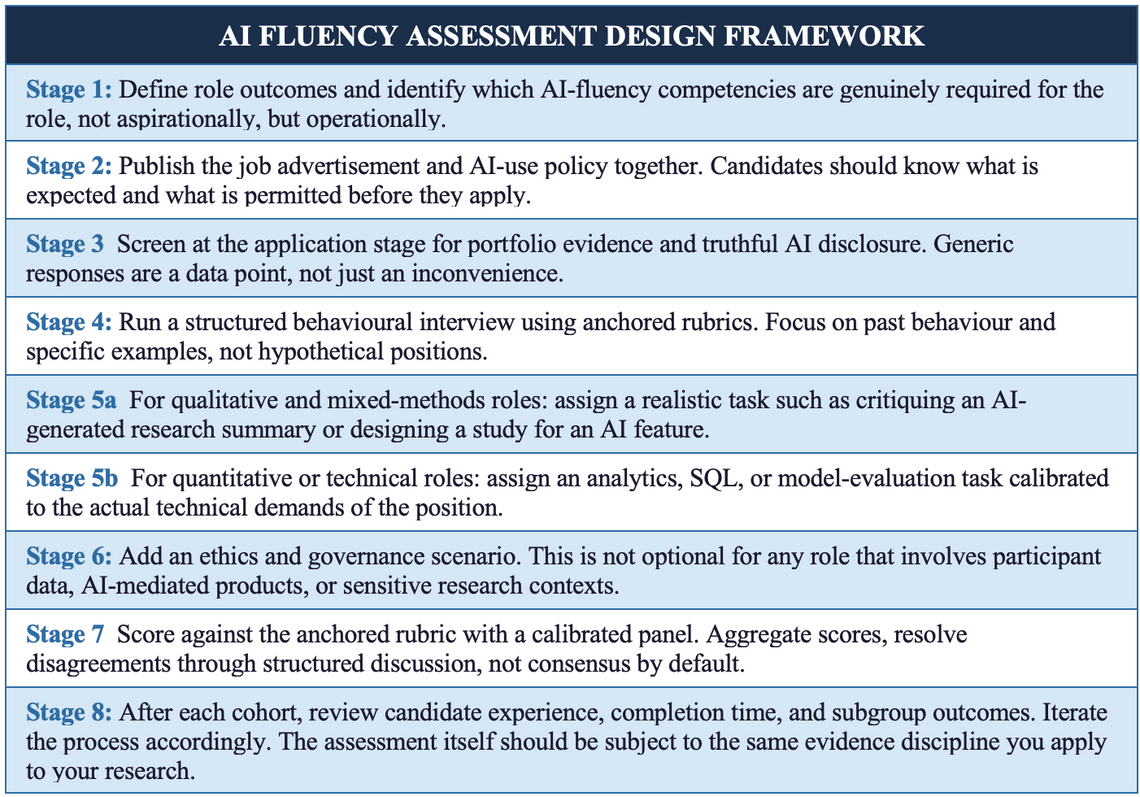
5. The AI Fluency Assessment Framework
6. The Strategic Implication
AI fluency is not the end destination. It is the new baseline from which meaningful research work will increasingly be measured. Demand is rising, UXR adoption is already mainstream, and the wage premium for AI-capable practitioners is measurable and growing. But the assessment infrastructure has not kept pace with the hiring signal.
That gap creates both risk and opportunity. The risk is that teams conflate AI enthusiasm with AI judgment, or over-engineer assessments toward technical tasks that most UXR roles do not actually require. The opportunity is that teams willing to define competencies with precision, design assessments that mirror real research work, and measure the fairness and predictive validity of their own processes will consistently make better hires than those relying on market noise.
That does not weaken the main conclusion. It simply means the most responsible approach is to design role-specific, evidence-based, low-burden assessments and then measure their effectiveness over time. Pretending the standard has already been settled is not rigorous. It is precisely the kind of uncalibrated confidence that genuinely AI-fluent researchers are trained to question.
Test the work, not the hype. The more an assessment looks like the real decisions a researcher will make in the role, the more valid, fair, and predictive it is likely to be.
I am a research strategist who partners with businesses, technology organisations, and SaaS teams to turn research into clear strategic direction and measurable impact. I work hands-on across the full research lifecycle, spanning academic, consulting, industry, and policy research, with a strong focus on evidence-based decision-making.
My expertise brings together data-driven insights, UX and CX (Voice of Customer) research, strategic research planning, stakeholder engagement, and robust survey and measurement design. Using a mix of primary and secondary research methods, I help organisations move beyond surface-level insights to understand what truly drives customer behaviour, product adoption, and long-term value.
As a customer-centred, insights-led researcher, I focus on uncovering human behaviours, habits, motivations, and attitudes to help teams design products, services, and strategies grounded in real-world needs. I’m particularly drawn to emerging technologies and SaaS environments, where strong research can shape how people learn, work, and interact at scale.
Beyond UX and customer research, I bring deep experience in strategic research program design, vendor management, and cross-sector collaboration. I work closely with senior stakeholders and interdisciplinary teams to ensure research findings are translated into actionable strategy, product roadmaps, and policy-ready recommendations.
I actively contribute to the research and technology community through thought leadership, including writing on Medium and publishing a LinkedIn newsletter focused on research practice and emerging industry trends. I also partner with SaaS companies to evaluate user research platforms and capabilities, providing practical, real-world feedback that informs product innovation.
Forward-thinking and outcomes-focused, I bridge academic rigour, industry innovation, and strategic insight to help organisations build better products, make confident decisions, and deliver meaningful customer experiences.