Introduction
For decades, researchers have navigated a persistent dilemma: the trade-off between volume and nuance. Standard quantitative surveys offer rapid scale, but often fall short of capturing the rich detail found in qualitative interviews. Today, market research is moving beyond basic automation into agentic research—where autonomous AI agents execute complex tasks to redefine how insights are gathered.
To explore how this transformation is impacting respondent experiences, Cint examined one pivotal aspect of the agentic revolution: AI-moderated interviews, or AIMIs.
Our report, AI-moderated interviews, human insights, is available to download, and below is a brief rundown of the key findings.
Getting to grips with AIMIs
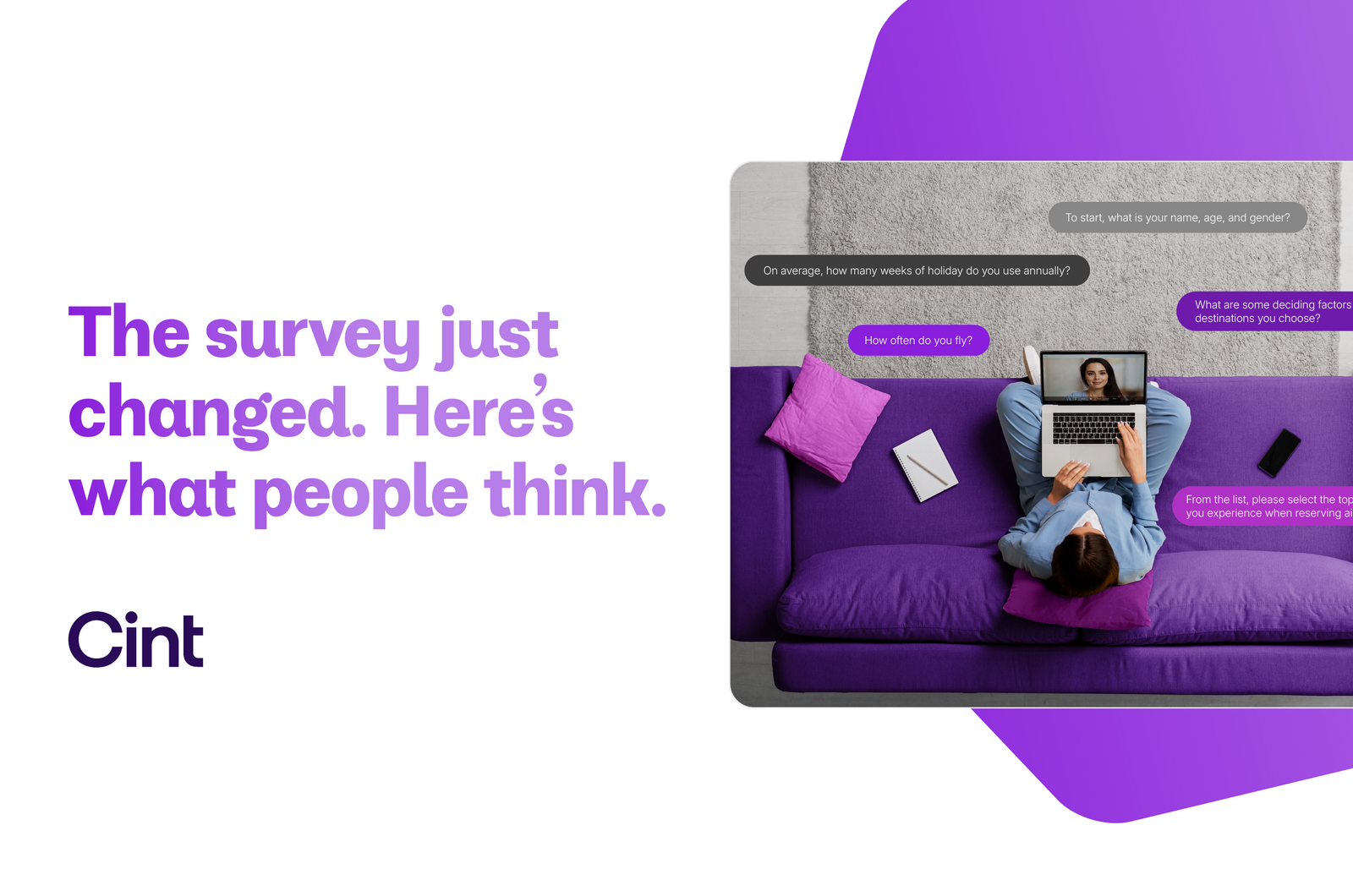
AI-moderated interviews combine the detailed insights of a traditional qualitative interview with the speed and scale of a quantitative survey. Instead of a human researcher, an AI agent conducts the study in real-time, asking intelligent follow-up questions via text, audio, or video. This format allows researchers to gain a level of depth that standard surveys simply cannot deliver.
Respondents are ready to adapt
Market research methodologies have always evolved—respondents adapted to phone interviews, moved to online panels, and are now proving ready to embrace AI-led research. Cint Snapshot data reveals that a massive 73% of UK respondents and 76% of US respondents are likely to regularly participate in AI-moderated interviews. Far from being a novelty, participants are demonstrably eager to join these sessions.
Closing the "humanity gap"
A common concern is whether respondents will feel comfortable opening up to an algorithm. Reassuringly, half of all surveyed participants (51% UK / 50% US) agree that sharing opinions with an AI interviewer feels just as authentic and reliable as speaking directly to a human researcher. This baseline level of trust allows brands to deploy automated interviewers with confidence.
Depth beyond the text box
The true value of AIMIs lies in their ability to overcome the limits of traditional written open-ends. A clear majority of respondents (58% UK / 62% US) agree that recording an audio or video response allows them to provide far more detailed and comprehensive answers than typing. Video and audio formats capture natural voice inflexions and organic vocabulary that text boxes miss.
Comfort starts with transparency
While enthusiasm is high, camera comfort varies by region—49% of US respondents feel comfortable recording video/audio for an AI agent, compared to 37% in the UK. To put respondents at ease, researchers must provide clear assurances on data protection and offer flexible options to switch between text, audio, and video.
Conclusion
AI-moderated interviews successfully bridge the gap between qualitative nuance and quantitative scale. By addressing respondent preferences with transparency and flexible formats, organisations can confidently capture authentic, high-fidelity human insights.
Dive deeper into best practices by grabbing Cint’s full report: AI-moderated interviews, human insights.
https://www.cint.com/knowledge-center/ai-moderated-interviews-human-insights/?utm_campaign=486340832-Conference%20%7C%20ESOMAR%2009-2026%20Advertorial&utm_source=Conference%20%7C%20ESOMAR%2009-2026&utm_medium=advertorial&utm_content=AIMI%20white%20paper