How to Decide Between Expanding Existing Locations or Investing in New Property
Teams must decide whether to expand existing locations or invest in new ones. Strong demand and operational limits often conflict, so the goal is balancing short-term performance with long-term growth.

For market researchers and growth teams supporting local business expansion, the hardest call often comes down to a simple question with messy consequences: build out existing locations or invest in new property. Market demand can look strong on paper while operational capacity tells a different story in the day-to-day, and neither view is wrong. The real tension is choosing a move that protects today’s performance while still serving long-term growth strategies. A clear way to weigh demand, capability, and direction turns this from a debate into a decision.
Understanding the Variables Behind Expansion Choices
At the center of the renovation versus new-site choice is a simple discipline: compare the same variables, the same way, every time. Start with market demand analysis, then pressure-test what your teams, systems, and space can truly support. Add a clear growth trajectory and a real estate lens, so your cost-benefit view stays complete.
This matters because strong demand does not automatically equal profitable scale. A consistent checklist helps researchers and growth teams defend recommendations, align cross-functional partners, and share learnings through best-practice communities. It also reduces the risk of “expanding” into higher complexity with flat results.
With the variables set, financing terms become the next lever to model predictability.
Use Fixed Payments to Make Expansion Budgets Less Scary
Once you’ve mapped out demand, capacity, and timing, the next big stress test is whether the numbers stay steady enough to support a long runway.
When expansion includes a new property, or additional space alongside an existing location, fixed-rate financing can make the commitment feel far more manageable. Evaluating a conventional fixed loan is essentially an exercise in cost predictability: by locking in stable payments, you reduce the chance that shifting rates will rewrite your budget mid-growth. That matters when build-outs, permitting, and ramp-up periods stretch across years, because your financing stays consistent even while staffing, inventory, and local marketing evolve.
With stable monthly payments, owners can model cash flow with more confidence and make clearer calls about how aggressively to expand, whether that’s acquiring a new site now or pacing the investment so the business can absorb it. Predictable financing structures don’t make the decision for you, but they do create a steadier baseline for comparing scenarios during periods of growth and local market expansion.
Next, we’ll lay the trade-offs side by side in a quick table so it’s easier to compare build-out versus new property at a glance.
Expansion Options Compared at a Glance
This table compares common expansion paths so you can weigh operational upside against ownership and financial commitment. For market researchers and growth-focused professionals, it also clarifies what to benchmark across peers, what to pressure-test in training scenarios, and what to discuss in networking groups when strategies differ.
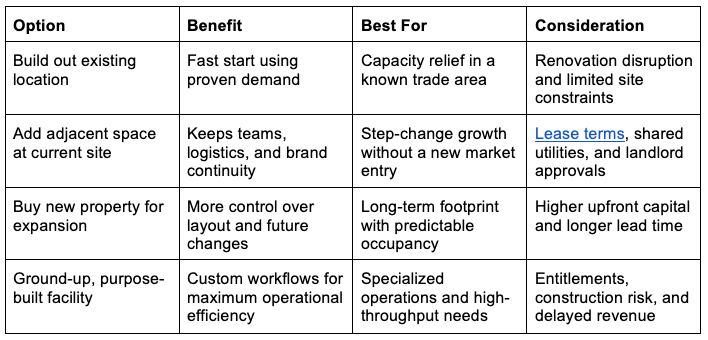
A practical rule is to choose the option where your biggest bottleneck is most directly removed, whether that is throughput, staffing, or geographic reach. Ownership typically increases control but also locks in longer commitments, so pair it with scenario planning. Knowing which option fits best makes your next move clear.
Next, we will unpack how ownership and risk controls change the outcome.
Growth Expansion Q&A Leaders Ask Most
Q: What does ownership really change when expanding capacity?
A: Ownership increases your ability to reconfigure workflows, extend hours, and invest in specialized build-outs without asking permission. It also concentrates risk because you carry vacancy and resale exposure if demand shifts. Treat the decision like a long-term operating bet: define the capacity problem, then stress-test the downside with conservative volume assumptions.
Q: How can I compare cost predictability between leasing more space and buying?
A: Buying can stabilize occupancy costs over time, but it introduces lumpy capital needs for debt service, maintenance, and major replacements. Leasing can look cheaper until renewals, pass-throughs, and improvement clauses move the goalposts. Ask for a 5 to 10 year cash view that includes rent escalators, capex, and disruption costs.
Q: When should long-term commitments push us toward improving an existing site instead of a new property?
A: If your demand signal is strong but still volatile, shorter commitments help you adapt without getting trapped. Expansion is often hardest when business growth challenges tighten cash flow and slow decisions. Use phased upgrades with clear stop points tied to utilization targets.
Q: How do I manage demand swings without overbuilding?
A: Design flexibility first: modular equipment, swing shifts, and overflow partners can absorb spikes. Set trigger metrics such as wait times, lost sales, or on-time performance and only release the next investment when triggers hold for multiple periods. A pilot or pop-up footprint can validate demand before you commit.
Q: What practical steps reduce disruption risk when expanding an active location?
A: Plan around customer peaks, isolate construction zones, and pre-stage inventory and signage so service stays predictable. Map the exact constraint you are solving because growth bottlenecks are where progress slows down or completely stops. Run a weekly operations review during the build to catch safety, staffing, and throughput issues early.
Keep it simple: pick the path that protects cash while removing your most painful constraint.
Make Expansion Choices You Can Sustain Through Real-World Constraints
Strategic local expansion often comes down to a tough tradeoff: grow what you have, or commit to a new property, without overextending. The most reliable path is informed decision making that weighs cost and ownership balance alongside long-term planning insights, so today’s win doesn’t become tomorrow’s constraint. When decisions are grounded in how the business will actually operate for years, the typical business growth success factors, predictable delivery, resilient capacity, and controlled risk, get easier to protect. Choose the option you can operate, and afford, for years, not quarters. Take one next step: pressure-test your assumptions with a simple scenario plan that compares cash, control, and commitment under demand swings. That’s how expansion supports steady performance now and resilience as the market changes.