Q&A-gency with Heidi Kim
It’s the third edition of Q&A-gency where Shape Insight’s Alex Holmes speaks with a leader within creative development and planning.
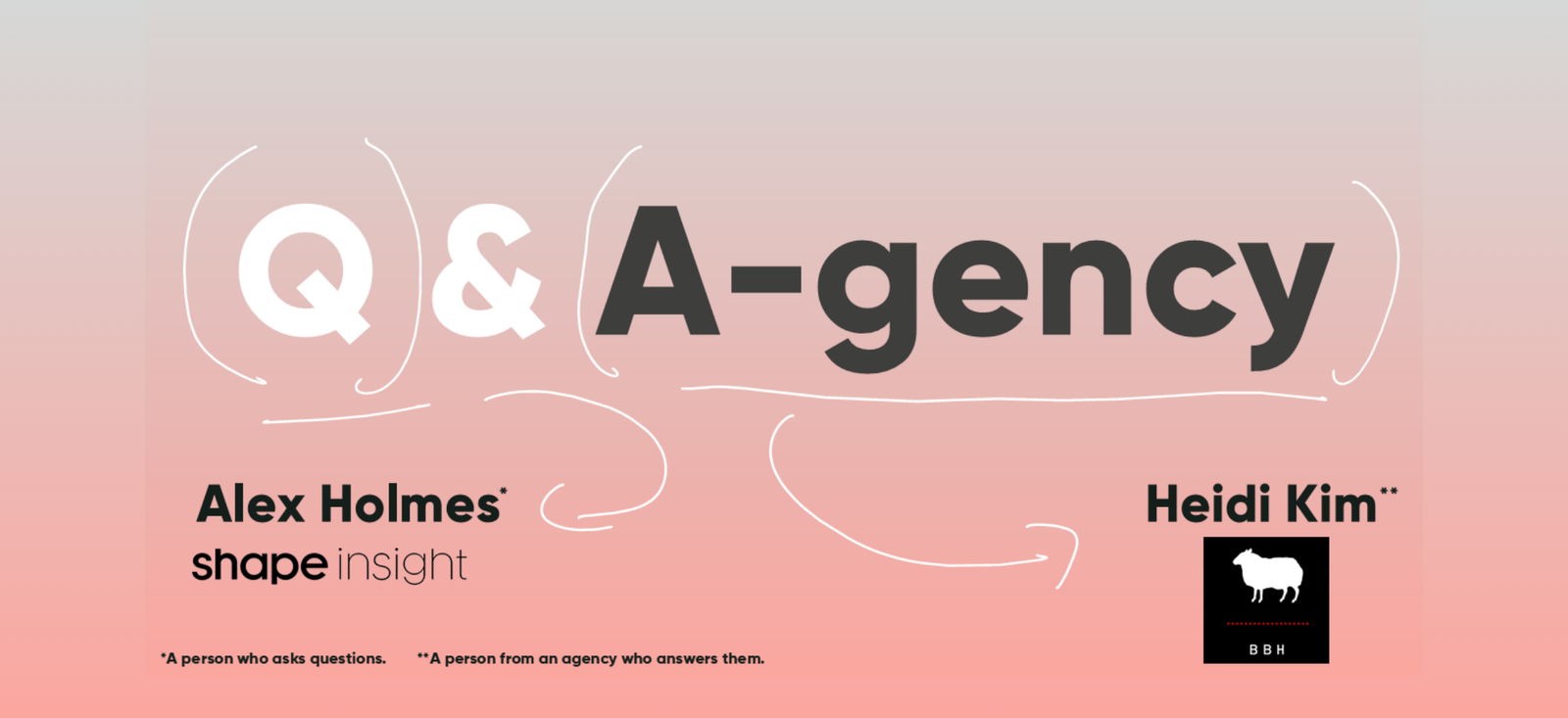
It’s the third edition of Q&A-gency where Shape Insight’s Alex Holmes speaks with a leader within creative development and planning. This time, I had the pleasure of speaking with Heidi Kim. Currently studying for her master's in Clinical Psychology, whilst also working for BBH USA as a Senior Strategist. Let’s find out what her unique perspective will be on how insight shapes her world and work today, and in the future.
Q. Let’s kickstart our conversation with a question I ask each interviewee. What change has had the most significant impact on what you do today?
My answer to this question is not linear. The first thing that comes to mind is the mentorship I’ve had throughout my career. When it comes to advertising, I always knew I wanted to be within this industry, but I wasn’t 100% clear on what the path to get there should be. Early on, different mentors helped me see where my strengths could live in this industry and eventually nudged me into strategy.
The other big lesson has been learning not to fear the pivot. That may sound like corporate jargon, but it matters in the world of advertising. Whether it’s in the work itself or in a broader career move, knowing when to let go of an idea, re-orient, and start again is critical. I’ve learned not to get too attached to specific ideas or outcomes in this industry - often change and challenge are what breed creativity.
Q. That’s an interesting point of view – that challenges breed creativity. What other ways do you experience challenge in what you do day-to-day?
Working in financial services and on a client like PayPal means working in a category charged with emotion. Money is deeply personal, and people’s relationship to it shifts based on what’s going in the world at large. And dealing with such an emotional topic like personal finances makes working in this category inherently challenging. Staying informed about timely topics such as the current geopolitical climate and the state of the economy is essential because of the direct impact on consumer sentiment.
As a strategist, my challenge is to stay in tune with how people are feeling so I can make sure our brand communications come across as both relevant and sensitive.
Q. You’ve talked about the need to pivot, embrace challenge, and understand people and culture. How have these themes shaped your approach to insight, and what tools do you use?
For me, insight starts with curiosity. Being culturally sensitive, staying plugged into what people are saying, feeling and responding to - is foundational.
My studies and personal interest in psychology also shape how I work. Facts alone don’t make an insight; what matters is what they reveal about human behaviour. If you look at consumer data as just plain fact, you’re missing out on the opportunity to go deeper and find the nuance in how people actually feel. And I’m skeptical there’s ever one “right” insight - often it’s about the unique flair you bring to it.
Q. Building on discussions with Loz Horner about the different flavours of insight, how does your training in Clinical Psychology shape your approach, and how does it differ from more traditional insight backgrounds?
I often have joked that I live a double life, strategist at an ad agency by day, psychology student by night. For the last three years, I have been pursuing my M.A. in Clinical Psychology part-time at Teachers College at Columbia University.
But while in some ways the two worlds are miles apart (literally), the parallels feel clear to me. Both what I learn about in the classroom and what I do at the office are about rooting the work in human truths. If you really boil it down, advertising equals psychology.
My coursework and training have made me more aware, and they remind me that while we work in advertising, we’re not just speaking to “consumers,” but to people.
But the overlap feels natural, because great advertising is rooted in understanding people’s behaviours on a deeper level. My training has made me more sensitive to language, lived experience, and empathy - and reminded me we’re never just speaking to “consumers,” but to people with real emotions and lived experiences.
Q. Do you think the fact that you have a focus on needing to understand people and how they feel is partly linked to the category that you mainly work in?
I do think that the financial services category demands a higher level of sensitivity. People’s emotions around money are complex, so I’m constantly thinking about trust, support, and what people need from these brands in a given moment.
That’s why I’m always thinking – how are people feeling right now? How is that impacting their relationship with money? When it comes to their bank and financial institutions, what do they need from them? Communication, resources, or to be left alone? Do they trust their banks more or less at this time? Do they feel supported in a way that feels meaningful? All of these questions have to be considered.
But my desire to understand people also comes from an innate interest. I’ve always had a fascination around human behaviour, why people do the things they do, so it just feels like something that’s always been part of me.
Q. Much of what you’ve said, plus your training, reminds me of ‘The Hidden Persuaders’ by Vance Packard, which explores how advertising uses psychology to drive desire for products and brands. To what extent do you see your industry in that same light?
I think people’s understanding of advertising has naturally progressed as they’ve been exposed to more and more in today’s age.
On the idea of persuasion - my senior thesis in college was called ‘The Art of Persuasion’. So yeah, I would say advertising and persuasion do go hand in hand. As advertisers, it’s our job to persuade customers. But I would argue that persuasion today feels less about manipulation and more about resonance: helping brands tell stories people genuinely connect with. Don’t get me wrong, the ethical piece still matters, so I’m also mindful of that.
Q. I’ve previously discussed inclusivity with Curtis Weir through his mentoring work with MEFA, and I noticed you’ve also been a mentor. From your perspective, how do advertising and market research need to evolve to become more inclusive and diverse?
Whenever I tell someone that I work in advertising the first thing they ask me is, “Is it like Mad Men?” The industry has thankfully come a LONG way from that stereotype, though of course there’s still work to do.
What makes me optimistic is seeing the influx of communities, mentorship programs, business resource groups, and even creative agencies specifically focused on broadening representation.
For example, I’ve been part of this amazing organization called Asians in Advertising, which has connected me to an extensive community of other Asian Americans in the industry and introduced me to a wonderful mentor who even helped me with my transition from Account to Strategy.
I feel lucky to come into advertising at a time where organizations and resources exist to help empower people like me to thrive in their careers.
In terms of the work itself, this really is kind of always going to be an uphill battle. When working with clients you’re working within their vision. But I have definitely noticed some clients starting to be more mindful of inclusivity in a way that feels more authentic.
Q. In my world, we rely heavily on singular ‘target customer’ profiles. Do you think we can move beyond this approach - and if so, how?
It depends on the ad. Sometimes, specificity matters–if an ad is clearly trying to talk to a very specific kind of consumer or demo that makes sense for that product and that brand. But then you have those ads where no matter who you are or what you like, it stirs something in you. It taps into something almost universal–an emotion or lived truth that cuts across audiences. That’s where mass insights live.
Q. With fragmented media and ever‑evolving audiences, I’ve long questioned whether sampling and cohort‑based approaches will become redundant. Do you agree?
People are too nuanced to fit neatly into boxes - but segmentation still has value.
Cohorts aren’t perfect truths, but they’re useful tools. When we develop an audience for a brand, we first hypothesize. We have to make decisions to make sharper insights, but with the understanding that there’s going to be nuance– it’s not a perfect science.
You need some structure to identify patterns. But as long as you remember real people are unlikely to fit 100% perfectly into the mould you’ve created.
Q. Keeping on the topic of diversity, we know each other through a project run by BBH USA called ‘Silent Spenders’. What’s interesting about this project is that it’s an opportunity for strategists to learn more about the craft of insight. Briefly tell us what the project is about this time AND what attracted you to take part.
Silent Spenders is a research project that started in the BBH UK office, and my colleague Jessica Garlick is now leading the charge here in NYC. It’s focused on building insights around underrepresented communities in order to help brands better support them.
Right off the bat, the ethos of the project was really attractive to me. It takes a much more human-centric, psychology-forward approach. I loved the idea of using our superpower as marketers, or even just as people who constantly immerse ourselves in consumer insight, to help brands really see underrepresented communities as the powerful consumers we know that they are.
I got even more excited when Jessica told me that the focus was going to be on neurodivergent individuals. This was a hugely happy coincidence because I had recently decided to focus my final integrative project for my Master’s program on the associations between ADHD and maladaptive financial behaviours.
Silent Spenders felt like an amazing opportunity to fully bring together my two worlds and make something that could have a tangibly positive impact on culture.
Q. And thinking about the project and what you have learnt, what has been your biggest learning when it comes to the craft of insight and analysis?
When working on such a sensitive topic you’re always having to check in with yourself and understand that you’re going to bring some misconceptions and biases with you.
The biggest lesson for me was to remember to challenge my own assumptions and stay open to learning things I didn’t expect. Be ready to pivot and go with where the learning is telling you to go. And as you’re building insights, don’t be afraid to scrap everything and start anew.
For me, this project reinforced that good insight starts with an initial hypothesis - but the best discoveries often happen when you’re willing to abandon it.
Q. That’s interesting, because we’ve taken this conversation all the way back to the start. Do you think this idea of being able to comfortably pivot came through when you were moderating your sessions?
With any interview you always go into it feeling nervous at first. But I reminded myself that this is just like meeting a new person for a coffee. They are a person who has had experiences, and I’m a person who has had experiences. All right, now let’s talk about it.
I went in with a discussion guide, but I was pleasantly surprised by how little I found myself looking at it. And some of the richest moments came from following those unexpected tangents. Like, okay, this isn't what I thought we were going to talk about. Let’s roll with it.
This reminds me of BBH’s philosophy, "When the world zigs, zag." Don’t be afraid to go off the straight and narrow path.
Q. Arthur Sadoun argues Publicis will always be a people‑led business. While that feels clear for creativity, how do you view the role of AI but also the rise of synthetic respondents within market research?
AI definitely has value, but I believe we do work in an industry where the value of real people will always exist. That’s because people’s nuances and their unique perspectives give the work colour.
Without that, you lose that ‘je ne sais quoi’ that comes with working with real-life people.
For me, research still depends on human contradiction, surprise, and texture–that’s where the real depth is.
Q. Do you feel the same way as AI moderators?
A good moderator is not easy to find. One who knows the right moments to lean into, when to go off-script, or even when to let a moment linger a bit. That kind of human instinct would be extremely hard for AI to simulate.
And honestly, even if it was able to, I personally as a consumer would be very uncomfortable with the idea of getting interviewed by an AI.
If I reflect on being in the room for the interviews we did for Silent Spenders, I remember this distinct feeling of ease that would come over me after a while. When people’s walls would start coming down. It was when they realized I was just a normal person like them, and we were just two people having a conversation. That’s real human connection – and I don’t think AI can recreate that.
Q. So what role will AI play for you then in the future?
AI is going to play a role in almost every industry at some point, if it hasn’t already. So I think it’s about learning how to adapt and use these tools to enhance our abilities and skills rather than replace them. It can also certainly help with efficiency when it comes to more time-consuming tasks such as synthesizing data into high-level themes or generating mock-ups for client presentations.
Q. To wrap things up, do you think AI will make insight better or just faster?
My first inclination is to say faster, but I don’t think that’s necessarily true. I think AI can help us weed out the insights that aren’t really landing or don’t feel as substantial in terms of depth– like a pressure check. If the idea starts to feel muddled or overly predictable or complex, chances are it will feel similarly to a consumer.
But in my eyes, a strong brief written by a human person will always have value. That’s because of those undefinable, indescribable things that we each bring to the table as strategists. And I think that’s something AI won’t ever be able to replicate.
Q. Does that mean our jobs are safe?
Ha - depends on whether we prioritize efficiency or great work.
But, I’d like to think there will always be a place for people making work that makes people feel something.
Alex Holmes
Co-Founder at Shape InsightAlex Holmes is the co-founder of Shape Insight. He has over 16 years of experience working with major brands across technology, FMCG, and travel and hospitality sectors.
A trained design thinker, Alex creates award-winning methodologies to solve complex challenges and pioneers new, impactful ways to cascade insights and strategic recommendations.
He has been nominated for or won eight awards and his work and views have been widely published.
Heidi Kim
Senior Strategist at BBH NYHeidi Kim is a Senior Strategist at BBH NY, where she works with brands to build brand strategies for ad campaigns. While she has worked on a variety of brands across categories such as Consumer Packaged Goods and Retail, she has a specialty in the Financial Services category, having worked across Citi, American Express, and now PayPal.
In addition to her day job, Heidi is wrapping up her Master of Arts in Clinical Psychology at Teacher’s College at Columbia University, where she is working on her Integrative Project focused on the associations between maladaptive financial behaviors and Attention-Deficit / Hyperactivity Disorder. Her hope is to continue to find opportunities to integrate her studies into her work in advertisin,g to create more inclusive, resonant work for consumers and brands alike.