Research Under Missiles: How Gradus Is Tracking a Nation Under Stress
War has displaced millions of Ukrainians and made chronic stress a daily reality. Evgeniya Blyznyuk explains how Gradus adapts its research to these conditions. Where do they draw the line between AI-driven automation and human judgement?
The Insight250 spotlights and celebrates 250 of the world’s premier leaders and innovators in market research, consumer insights, and data-driven marketing. The awards have created renewed excitement across the industry whilst strengthening the connectivity of the market research community. Insight250 announced its 2026 winners in October. You can see the full list of Winners at Insight250.com.
With so many exceptional professionals named to the Insight250, we regularly tap into their expertise and unique perspectives across various topics. This regular series does just that: inquiring about the expert perspectives of many of these individuals in a series of short topical features.
With technology advancing at an incredible pace and the value of insights ever increasing, I sat down with Insight250 Winner Evgeniya Blyznyuk. As CEO and Founder of Gradus Research, Evgeniya has proven that research is not just a tool for understanding change amid unprecedented challenges. What sets Evgeniya apart is her ability to sustain a business in crisis and her visionary approach.
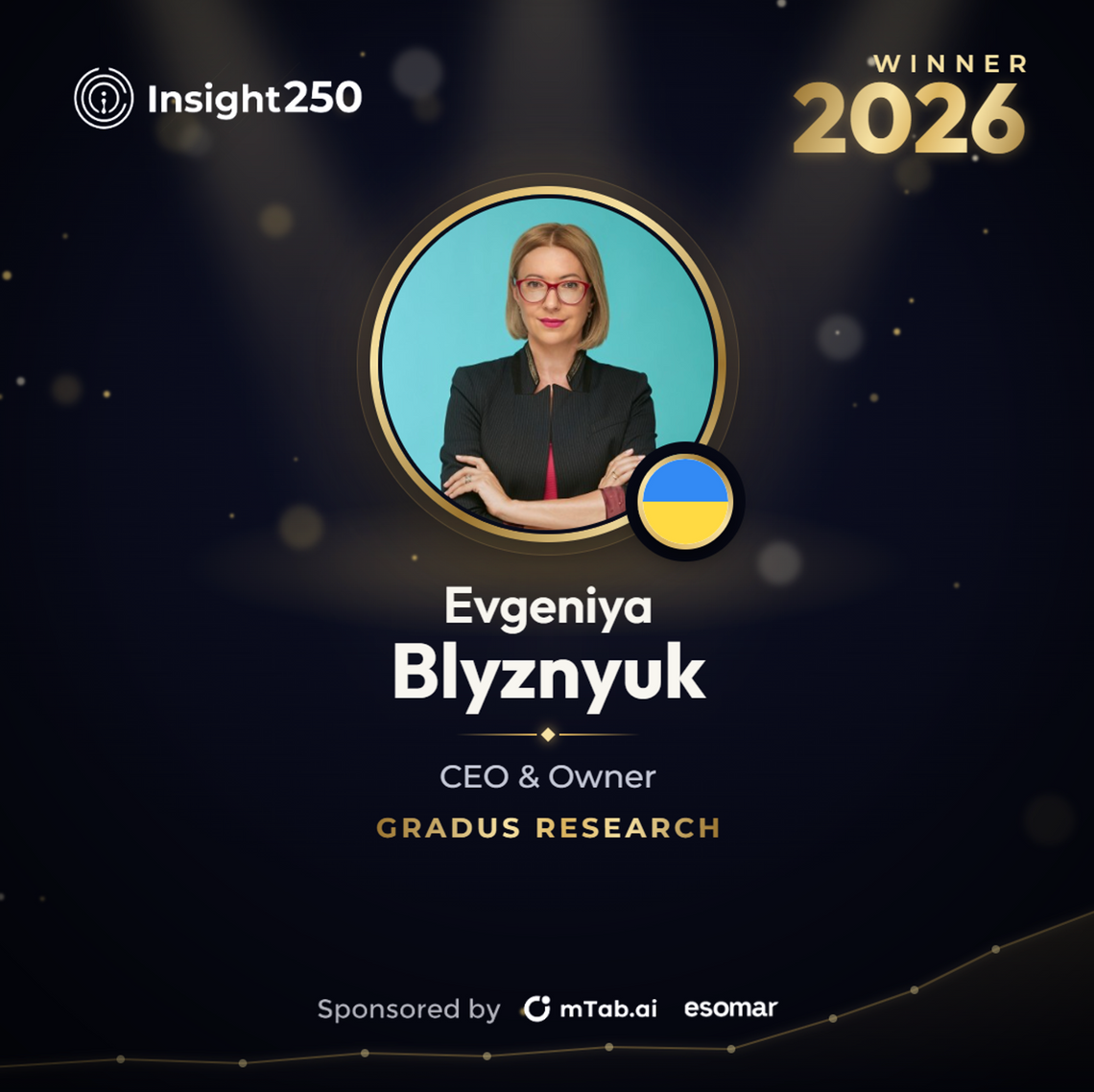
Image. Evgeniya Blyznyuk, CEO & Owner, Gradus Research
Crispin: You founded Gradus Research in August 2019, just months before the pandemic and years before the full-scale invasion. Looking back, how has the mission of the company shifted, or held firm, through those consecutive crises?
EB: Our core mission at Gradus has not shifted; rather, it has been deeply validated and accelerated by these consecutive crises. From day one, we built Gradus as a technology-driven MarTech company designed to deliver fast, reliable insights through integrated mobile panels. We wanted to move away from traditional, slow-moving research to capture real-time societal reflections.
When the pandemic hit, followed by the mega-crisis of the full-scale invasion, society began transforming overnight, rendering static data obsolete. Our mission transformed from just providing fast market intelligence into building a vital "knowledge bank" for the country. We realised that in a landscape where consumer behaviour shifts deeply and unpredictably, businesses and policymakers cannot make decisions blindly. By tracking societal changes continuously — even when there isn’t an immediate commercial client request — we hold firm to the belief that real-time data is a stabilising anchor in an otherwise chaotic reality.
Crispin: Gradus has maintained continuous tracking studies throughout the invasion. What were the most significant methodological adaptations you had to make – in fieldwork, sampling or data interpretation – when traditional assumptions about respondent behaviour no longer held?
EB: Wartime research breaks almost every rule in traditional textbooks. When the invasion began, millions of Ukrainians were displaced within days. Traditional face-to-face fieldwork became functionally impossible and dangerous, and conventional sampling frameworks collapsed overnight.
Methodologically, our biggest asset was our mobile app-based panel infrastructure, which allowed us to follow people as they moved. However, we had to adapt rapidly in three key areas:
Sampling Adjustments: We had to strictly modify our target parameters to exclude temporarily occupied territories and zones of active, direct combat operations to ensure both data validity and respondent safety.
Speed as an Ethical and Methodological Imperative: Fieldwork windows had to be radically compressed. For instance, we began deploying rapid-response polls completed within 24 to 48 hours to capture fleeting psychological states before the next major external event altered the baseline again.
Data Interpretation Shifts: We had to discard the assumption that respondents act as fully rational, long-term planners. Data interpretation now requires a deep understanding of psychological defence mechanisms. We see massive emotional swings — such as the intense "emotional uplift" and sense of hyper-unity in the first months of the war, followed by a gradual slide into severe cognitive fatigue, pragmatism, and exhaustion by 2025 and 2026.
Crispin: Your research consistently shows 91% of Ukrainians reporting high levels of stress. At what point does a finding like that stop being a data point and start being something a researcher has to sit with personally?
EB: It stops being just a data point the moment you close your laptop and realise that you, your family, and the team analysing the charts are part of that exact 91%.
As researchers, we are trained to maintain objective distance, but a full-scale war completely erases the line between the analyst and the subject. When we run our longitudinal studies — like our "Ти як?" (How are you?) tracking — we are measuring our own collective trauma. Our team is processing data about stress, displacement, and loss while sitting in bomb shelters or dealing with blackouts. You have to sit with it personally when you see that this stress is no longer an acute spike; it has become a prolonged, chronic baseline that bleeds into sleep deprivation, altered eating habits, and severe emotional depletion across the entire workforce. The professional responsibility to present accurate data becomes a deeply personal mission to ensure that the voice of a society under extreme pressure is accurately communicated to the world.
Crispin: You have described a shift from "I need this" to "this will help me feel better" as the dominant logic of consumption. How durable is that shift? Is it a crisis response, or are you seeing evidence of something more permanent in how Ukrainians relate to brands and purchases?
EB: This shift is incredibly durable because it is tied to prolonged psychological survival. What initially began as an acute crisis response has solidified into a long-term behavioural pattern as the war extends into 2026.
When people live under a constant cloud of existential threat and financial pressure, the importance of price and promotions intensifies dramatically. However, we observe that shopping has simultaneously transformed into a vital source of quick endorphins. Because individuals cannot plan their lives years or even months in advance, buying small, immediate pleasures becomes a mechanism for self-soothing and emotional self-regulation. This creates an intricate psychological loop where emotional purchases are often accompanied by a distinct sense of guilt. It is not a passing anomaly; it is a fundamental reconfiguration of the consumer value proposition. Rational utility has taken a backseat to emotional preservation, and this permanent psychological overlay will dictate brand relationships for years to come.
Crispin: You presented at the Ukrainian Marketing Forum on the tension between pragmatic and emotional consumer behaviour -- small frequent purchases as a form of control, online shopping as emotional self-regulation. What does that tension mean for how brands should communicate right now?
EB: The tension between aggressive pragmatism (hunting for discounts) and emotional indulgence (buying a small treat to cope) means that brand communication must be extraordinarily nuanced. It requires what I call "balanced communication: positive messaging with an anchor in reality.”
Our research clearly shows that consumers reject tone-deaf, overly polished marketing that depicts an "ideal, perfect life.” Only 14% of respondents say they are willing to watch or engage with that type of content. Instead, the highest resonance belongs to communication that is socially sensitive, addresses real problems, and balances authentic positivity with everyday hardships. Brands should not try to sell an illusion. They need to acknowledge the exhaustion their consumers feel, offer practical economic support (like clear pricing and special offers), and position their products as small, guilt-free tools for comfort, stability, and emotional relief.
Crispin: Your research for the Ministry of Culture found that 71% of Ukrainians still consume Russian-language content despite 62% using Ukrainian in daily life. What does that gap tell us about the relationship between identity, habit and product quality in content consumption?
EB: Choosing to speak Ukrainian in daily life is a conscious, declarative act of national identity and cultural self-determination. However, content consumption habits operate on a more subterranean, subconscious level. They are driven by decades of media algorithms, search histories, and comfort loops. When individuals are emotionally exhausted, they naturally default to historical paths of least resistance for relaxation. Furthermore, this highlights an urgent challenge regarding product availability and quality: it tells us that the demand for high-quality, engaging content is outstripping the immediate supply of Ukrainian-language alternatives in certain digital niches. For researchers and cultural strategists, it proves that identity shifts do not occur uniformly across all behaviours simultaneously; changing a conscious public declaration is much faster than overwriting automated, private consumption habits.
Crispin: Your Gradus study ahead of Forbes AI Day found that 85% of Ukrainians are already using AI, yet only 6% have paid subscriptions and trust drops sharply when responsibility and context matter. What does that pattern suggest about the future relationship between AI-assisted research and human judgement?
EB: This pattern points directly to a future of collaboration rather than substitution. The high adoption rate (85%) shows that Ukrainians are highly innovative and quick to embrace efficiency tools out of sheer necessity, especially when looking for rapid optimisation in high-pressure environments. Yet, the tiny share of paid users (6%) and the sharp drop in trust regarding high-responsibility contexts reveal that people view AI as a utility, not an authority.
In research, this means AI is brilliant at handling execution, processing massive structural datasets, or automating administrative friction. But when it comes to context, cultural nuance, and high-stakes decision-making, human judgment remains irreplaceable. In a society navigating deep trauma and complex sociopolitical shifts, an AI cannot truly comprehend the subtext of an interview or the emotional weight behind a respondent’s hesitation. The future belongs to hybrid methodologies where AI maximises our speed, but human synthesis guarantees the truth.
Crispin: You have spoken about AI being embraced where the cost of error is low and resisted where trust and context matter. How do you apply that insight within Gradus itself? Where do you lean on AI and where do you hold back?
EB: At Gradus, we maintain a very strict boundary based exactly on this risk-to-context matrix.
We lean heavily into AI and advanced technologies to automate our operational plumbing. We use automation to manage our quality control checks against fraudulent responses and handle initial data structuring. In these areas, technology allows us to achieve the unprecedented turnaround speeds that wartime research demands.
However, we deliberately hold back when it comes to deep analytical synthesis, qualitative interpretation, and ethical oversight. We do not allow AI to independently write our strategic insights or draw conclusions about the psychological states of our respondents. When interpreting sensitive tracking data, such as employee burnout or shifting societal values, the cost of an analytical error is simply too high. An algorithm can spot a statistical deviation, but it takes a human sociologist to understand why that deviation is happening in a country under missiles.
Leadership, wellbeing and the workplace
Crispin: At the People Power Conference in Warsaw you spoke about managing trust rather than just talent, and about organisations becoming spaces of stability for employees living under chronic stress. What does that ask of leaders who are themselves exhausted?
EB: It asks leaders to shift from a framework of pure performance management to one of radical empathy and transparency. Our 2026 Workplace Environment and Psychological Wellbeing study reveals a striking phenomenon: while employee loyalty to companies is generally low, internal trust within teams is incredibly high; 58% trust their colleagues and 56% trust their management. Over half of working Ukrainians note they feel physically or psychologically safe only within their corporate team and can rely heavily on their direct supervisor during crises.
For an exhausted leader, this means your role is no longer just about driving KPIs; it is about maintaining the workplace as a vital psychological sanctuary of predictability when the external world is completely unpredictable. It requires leaders to openly acknowledge their own limitations, foster "pockets of silence" where mental health can be discussed safely, and actively mitigate workloads. When your team is chronically overloaded and losing their emotional connection to work, managing trust means proving that the organisation cares about their survival as much as their output.
Crispin: You completed a programme at LSE in June 2025 and earlier participated in the York University international start-up programme. How important has it been to keep investing in your own development while simultaneously running a company through a war?
It has been an absolute lifeline, both operationally and psychologically. When you are managing a company through an existential crisis, your operational field of vision naturally shrinks to daily survival — managing immediate risks, blackouts, and safety protocols. Stepping into rigorous global educational ecosystems like LSE or York University forces a conscious expansion of that horizon.
It provides the intellectual distance needed to step back from the front lines of daily management and ask: “How does our hyper-localised crisis data fit into global sociological frameworks?” It allows me to bring world-class structural thinking back to Gradus, ensuring that our methodologies remain globally competitive and robust. Moreover, on a personal level, learning is a powerful form of resilience. It is an active investment in a future that extends beyond the war, reinforcing the belief that there is a sophisticated, post-crisis world we are actively building toward.
Crispin: You have suggested that what is happening in Ukraine -- to consumers, to employees, to research practice -- is not an exception but an accelerated version of global trends. Which of those trends do you think the international research community is least prepared for?
EB: The international research community is least prepared for the permanent collapse of the "rational, predictable actor" model under chronic macro-stress. Globally, researchers still design methodologies based on the assumption that consumer behaviour operates within a stable baseline, punctuated by temporary, short-term crises.
What we see in Ukraine is that prolonged exposure to existential, economic, and systemic pressures permanently fragments long-term brand loyalty and traditional career ambitions. The global research community is underprepared for a world where consumer behaviour is dictated by continuous emotional self-regulation, micro-compensations, and widespread professional burnout. We are seeing a global rise in polarisation, climate anxiety, and economic instability. When these forces accelerate globally, traditional, slow-moving quarterly trackers will fail. If your methodologies cannot handle deep emotional volatility and provide real-time, rapid-response data infrastructure, they will become obsolete in a world that is increasingly volatile.
Crispin: If you could change one thing about the way the global research industry approaches studies conducted in conflict or high-stress contexts, what would it be?
EB: I would demand that the global industry stop viewing conflict-affected populations merely as passive objects of humanitarian or academic interest, and instead recognise them as highly adaptive, resilient agents of innovation.
Too often, global agencies look at high-stress contexts through a lens of pity or transactional data collection, assuming that research under stress is inherently compromised or "compromised in quality". I want the industry to realise that crisis-driven research can actually be a driver of methodological pioneering. The speed, digital flexibility, and deep psychological tracking we have developed out of necessity in Ukraine offer invaluable blueprints for the future of global research. We should move away from rigid, legacy corporate frameworks and embrace high-speed, technology-first methodologies that respect the respondent's safety while capturing their authentic, unvarnished psychological reality.
Hot Topic
When 91% of a population reports high stress and nearly seven in ten describe persistently low energy, research becomes something more than market intelligence. Since founding Gradus in 2019, you have built a rare longitudinal picture of how Ukrainians adapt, as consumers, as employees, as citizens, under conditions of prolonged crisis. Your findings challenge comfortable assumptions: that respondents are rational actors, that brand relationships are stable, that stress is a short-term variable. What is happening in Ukraine, you argue, is not an edge case but an accelerated version of pressures reshaping behaviour everywhere. For the research industry, the question is urgent: are our methodologies built for the world as it actually is?
EB: The short answer is: no, most legacy methodologies are built for a world that no longer exists. They are designed for a predictable, air-conditioned reality where consumer choices are linear, economic indicators move gradually, and stress is a minor anomaly to be ironed out in the annual tracking data.
But look around. The world as it actually is is defined by hyper-volatility, systemic fracturing, and a baseline of chronic collective anxiety. When our Gradus data shows that 91% of an entire nation is living in high stress, and 40% of the workforce is actively contemplating walking away from their jobs due to burnout, it shatters the classic market intelligence illusions. Respondents are not static statistics; they are exhausted human beings using consumption as a desperate form of emotional regulation and control. If our industry continues to rely on sluggish data collection cycles and sterile, hyper-rational models, we will keep providing brands with beautifully polished charts that are entirely divorced from the lived human experience. Ukraine is not an isolated anomaly; it is an accelerated laboratory showing exactly how human behaviour restructures itself when the safety net is pulled away. We must build methodologies that are as agile, empathetic, and resilient as the people we are studying.
Top Tip
We ask all our Insight250 winners to share one practical tip for the ResearchWorld community. What is yours?
EB: Embrace speed as an ethical obligation to the truth, and never stop building your "knowledge bank" before the market asks for it. In times of radical change, slow data is wrong data. Do not wait for a client or a budget to start tracking the shifting tectonic plates of human values and psychological behaviour in your market. Collect baseline data on sensitive social topics proactively. Having an independent, continuous, and high-speed data stream allows you to anchor your insights in times of crisis, transforming our industry from a mere vendor of corporate metrics into an indispensable guardian of societal truth.
Crispin: Evgeniya, thank you for a conversation of real depth and candour. What you and the Gradus team have achieved is remarkable. You have kept a rigorous, continuous record of a society under sustained pressure while living through that same pressure yourselves. Your central point should resonate well beyond Ukraine. Conditions that many in our industry still treat as exceptional are fast becoming the norm, and methodologies built for stability will not serve a volatile world. Your case for treating speed as an ethical obligation, for building knowledge before the market asks for it, and for keeping human judgement at the heart of interpretation is one the global research community would do well to heed. Above all, you have shown that research carried out in the hardest circumstances can lead methodological progress rather than lag behind it. We wish you, your team and your respondents strength and safety in the months ahead. Thank you.
Crispin Beale
Chairman at QuMind, CEO at Insight250, Senior Strategic Advisor at mTab, CEO at IDXCrispin Beale is a marketing, data and customer experience expert. Crispin spent over a decade on the Executive Management Board of Chime Communications as Group CEO of leading brands such as Opinion Leader, Brand Democracy, Facts International and Watermelon. Prior to this Crispin held senior marketing and insight roles at BT, Royal Mail Group and Dixons. Crispin originally qualified as a chartered accountant and moved into management consultancy with Coopers & Lybrand (PwC). Crispin has been a Board Director (and Chairman) of the MRS for nearly 20 years and UK ESOMAR Representative for c15 years. As well as being CEO of Insight250, Crispin is currently Worldwide CEO of Digital Communications Solution Agency, IDX. Crispin is also the Senior Strategic Advisor at mTab and the Chairman of QuMind and spent 4 years as Group President of Behaviorally where he was responsibile for the client & commercial teams globally. Crispin is a passionate advocate for blending human intelligence and technology to deliver innovation and leadership across organisations.