Achieving Quality at Scale
Scale the research, keep the human judgment. Carol Fitzgerald makes the case for removing the delays around qualitative research while preserving the expert conversations that give it depth.

Article series
Insight250
- The importance of business sense in research
- The role of humour in effective leadership
- The importance of ethics
- The importance of disruption in innovation and leadership
- The importance of Disruption in Innovation and Leadership Part 2
- The importance of Diversity & Inclusion
- The impact of colour
- Communicating insight with impact
- Insights on leadership, culture and polling
- The evolution of electric vehicles
- 2022 Top tips (part 1)
- 2022 Top tips (part 2)
- Maximising the potential of data
- The importance of flexible working
- Winners
- The importance of advanced analytics
- Judges for the 2022 Insight250 Awards announced
- The evolution from social listening to digital intelligence
- The Judges' Perspective
- The judge's perspective - part 2
- Insight Climate Collective
- Insights technology
- Understanding employee ownership
- Global insight perspectives
- Top Tips from our Leaders and Innovators
- The Evolution of Insights in the Food & Beverage Market
- The Evolution of Insights in CPG
- Neural Mechanisms Behind Consumer Decision-Making
- Celebrating and Elevating the Insights Industry
- The State of the Insights Industry
- Opportunities, challenges and threats that AI presents
- 2024 Insight250 Winners Announcement
- Connecting Brands and Consumers Through Insights
- The Importance of Human Insight and Attention
- The Elevating Role of Insights with Technology Innovation
- Haleon’s Insight Expert on Consumer Healthcare
- Insight from the Insight250: How AI is Impacting Qualitative Research
- How AI Tech is Doing the ‘Heavy Lifting’ for Insights
- Reviewing the top tips for 2025
- Google's Sarah Ashley on AI and revolutionising insights - Insights from the Insight250
- Beyond BI: The Future of Decision Intelligence for Insight Professionals
- The Advancement & Impact of Insights - An Insight250 Winners Series perspective with David Smith
- International Jury for the 2025 Insight250 Awards Announced
- Newly elected President, Anne-Sophie, on Revolutionizing the Impact of Insights
- Haleon's Litthya Baez on Enhancing Healthcare with Insights - Insight250 Winners Series
- Understanding the Insights of Consumer Decisions
- Moving Beyond Dashboards to Deliver Decisions with AI
- How AI is Transforming Insights
- How AI is Transforming Insights
- Five Years of Insight250: Elevating the Insight Industry
The Insight250 spotlights and celebrates 250 of the world’s premier leaders and innovators in market research, consumer insights, and data-driven marketing. The awards have created renewed excitement across the industry whilst strengthening the connectivity of the market research community. Winners of the 2026 Insight250 were announced at the start of October - you can see the full list of Winners at Insight250.com.
With so many exceptional professionals named to the Insight250, we regularly tap into their expertise and unique perspectives across various topics. This regular series does just that: inquiring about the expert perspectives of many of these individuals in a series of short topical features.
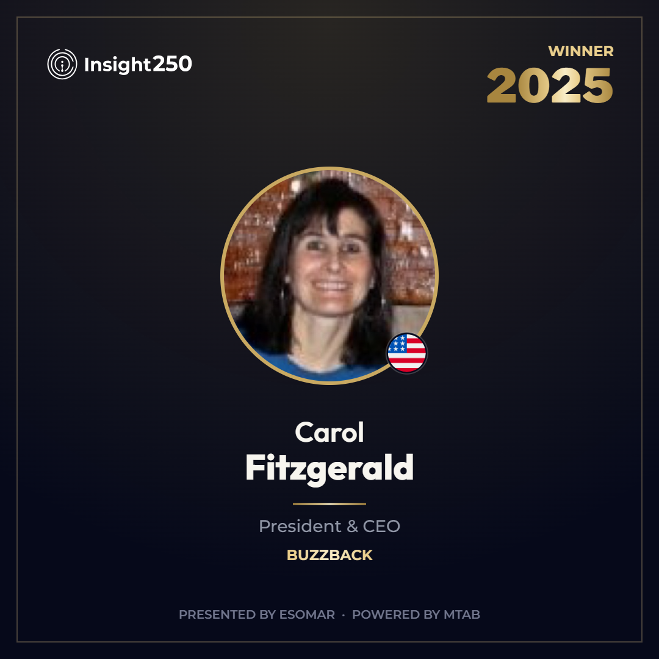
With technology advancing at an incredible pace and the value of insights ever increasing, I sat down with Insight250 Winner Carol Fitzgerald. Carol has been pioneering new ways to rethink and reinvent insights for 25 years. She founded BuzzBack with the vision to change how consumers interact with marketers online, focusing on making the research experience fun, engaging, visual and intuitive. BuzzBack delivers innovative online research. She is a recipient of the Enterprising Women of the Year and International Women’s Entrepreneurial Challenge Foundation awards.
Crispin: Qual at scale is the phrase everyone in the industry seems to be wrestling with right now. What does it mean to you, and how does it differ from what some vendors are currently selling under that label?
CF: When our clients and peers talk AI, they naturally link to qual at scale. Most of the time that’s focused on AI moderation and automating analysis – they talk about the future of qual in this context.
At buzzback, we liken qual at scale to platforms such as Airbnb and Uber and what they did for lodging and transportation. They did not change the fundamental experience; they removed barriers that made access difficult. That’s why we developed Studio! Studio does the same for qual: enabling organisations to conduct more expert-led, in-depth conversations, more often, without sacrificing the depth, flexibility, and human judgment that make qualitative research valuable in the first place.
It’s ‘real’ qual with flexibility, depth, and emotion, not technology-generated conversations – or what we sometimes call ‘conversational quant.’ And it has natural use cases, but it’s more of a survey than true qual. Done right, qual at scale means getting deeper human understanding faster and more efficiently without compromising the value of qual in the first place. It means removing operational friction that has historically made qual slow and expensive, so teams can do more of it, more often.
Studio by buzzback was built to solve this problem, and it’s uniquely different. Real qual at scale also means an expert human moderator leading a 60-to-90 minute in-depth session, adapting in real time to what participants say and following the conversation where it needs to go. Scale should not come from replacing expertise. It comes from making it dramatically easier to access and expand.
Crispin: The GRIT report recently ranked Studio by buzzback second in qual, and you have described it as modernising a fragmented and time-consuming qualitative process. What was most broken about the traditional process, and what has been hardest to fix?
CF: Traditional qual [not AI-generated qual] still has antiquated processes and ways of working. At buzzback, 30% of our revenue is qual – a lot of it global and in-person, so we know the drill! The most broken part is how dependent the system is on who you know. It’s like going back in time, and many companies rely on the people/companies they know to get the job done instead of a more structured resourcing process.
Let me give you an example: many clients who want to run qual projects are limited by the size of their personal moderator network or by who is ‘approved’ in their corporate system. If the person is not available, they start with someone new and have minimum visibility into what they’ll get. That’s a huge risk no one really wants to take. Not to mention other contracting, scheduling and stakeholder coordination that could take up to 20 hours per project.
That’s just one of the problems we tried to solve with Studio. Just like Care.com or Airbnb gives you access to broader networks, we have a curated network of 50+ vetted moderators. They showcase their portfolios, have video intros, client reviews, and real-time availability so buyers can make informed decisions rather than blind ones. And Studio consolidates this entire lifecycle from RFP to final report into one integrated platform, including built-in access to qual fieldwork and recruiting tools like User Interviews, Discuss.io, and Recollective, without separate contracts.
Liz White, our Managing Director for Studio, can genuinely say: the 10-day turnaround Studio delivers from RFP to final report is not a shortcut. It is what becomes possible when the infrastructure is no longer working against you. Convincing teams takes real proof, and the proof accumulates project by project.
Crispin: AI is now being used to moderate interviews, cluster themes, analyse transcripts and generate synthetic respondents. Which of these genuinely excites you and which ones concern you?
CF: The AI applications that excite me most are the ones that give researchers time back. Transcript analysis, thematic clustering, and synthesis support remove administrative burden so researchers can spend more time interpreting, challenging assumptions, and advising on critical business issues. When AI handles the processing work, researchers get their time back for interpretation, for strategy, for higher-level thinking to actually add value.
Crispin: There is a version of qual at scale that delivers speed and volume but loses the emotional texture and human nuance that makes qualitative insight valuable. How do you protect against that in your own work?
CF: The protection is structural. Studio by buzzback was developed with the position that we don’t need to trade off or compromise speed and rigour. The reason qual historically felt slow was the operational overhead, not the research itself. Clients will need the depth and emotional understanding, and now more than before. AI enables automation and elimination, but it doesn’t enable humans.
By streamlining the infrastructure, automating scheduling, unifying tools, and removing the procurement friction, Studio compresses timelines dramatically without touching what matters: an expert human moderator, a well-designed discussion guide, and enough time in the room with participants to get to the real story.
The other protection is a clear definition of what Studio is and is not. Studio sits between AI-first tools and full-service agency engagements by design, built for the moments when teams need both speed and depth. When a project needs evaluative testing at speed, there are tools for that; we even have one called Express, and we test ideas overnight, literally. When a project needs real exploratory depth — the kind of foundational, nuanced understanding to drive strategy — that’s what Studio is built for.
Protecting qual at its core and maintaining true quality means knowing what to use when, and not letting commercial pressures blur that line.
Crispin: The insight industry has a long-standing tension between rigour and speed. With compressed timelines and tightened budgets, is rigour still genuinely valued by clients, or is it becoming a selling point that masks something simpler?
CF: Rigour is absolutely required for strategic decisions and the ones with the greatest risk and longer-term impact. Of course, if you can get research done faster and more efficiently — clients come back for it. buzzback’s 90% client repeat rate reflects that. But the pressure is real. Budgets are tighter, timelines compressed, and AI is supposed to enable more. That’s when research becomes vulnerable – new risks emerge when we accept faster, cheaper output because it fits the calendar or budget.
When it comes to qual, AI moderation or unmoderated video is often used as an equivalent to expert-led qual. But we know they are not the same; they have different purposes and applications, and they answer different questions. The honest answer for insights leaders is that rigour requires knowing when to apply it and when a lighter-touch approach is genuinely sufficient.
Studio’s value proposition is rooted in this exact distinction: agency-calibre rigour, delivered faster and at a fraction of the traditional cost, without asking teams to accept methodological compromise.
Crispin: If the qual industry gets the transition to AI-enabled scale wrong, what is the
risk? And what would getting it right actually look like?
CF: Let’s start with getting it right; that’s the goal. We want and need AI for processing and repetitive tasks, plus the creative applications and agents making our lives easier today. For qual, there are naturally suited use cases for these exact areas, but we still need humans to challenge AI and tackle the emotionally complex topics and higher-level strategy.
So the risks are twofold:
We can’t use AI to replace the highly strategic – AI-moderated interviews and synthetic respondent outputs can support our direction, but they can’t replace and answer the strategic questions.
Second, we risk our professional community and experts – AI can certainly empower us as researchers and moderators, but we’ve built expertise based on years of cultural development, human probing and getting deeper for real qual.
Instead, we can find AI-empowered tools such as Studio to help us scale and make qual more accessible.
Hot Topic: What about synthetic respondents and AI-moderated interviews? Can they be positioned as legitimate alternatives to real consumer conversations? Where do you stand, and is the industry having an honest enough conversation about the trade-offs?
CF: No, the industry is not having an honest enough conversation. The incentives are misaligned. Platforms selling AI-moderated and synthetic tools have a commercial interest in positioning as equivalents to real consumer research. They leverage the benefits of what qual can deliver, but what they actually provide is categorically different. And when under pressure on timelines and budget, we want to believe the equivalence claim.
Synthetic respondents and digital twins have real applications, for example with audiences such as oncologists or B2B where universes are small. However, synthetic is typically developed based on previous research and responses.
What gets lost in that dynamic is the core of what qualitative research exists to do: surface the unexpected. A synthetic respondent cannot surprise you. It cannot produce a response that contradicts your assumptions, because it was built on your assumptions. An AI moderator running pre-set probes cannot follow the thread that leads somewhere genuinely new. The unpredictable human moment, a pause, a contradiction, something said off-script that becomes the Aha moment and unlocks the real answer is why we have real qual.
Don’t get me wrong, there is a genuine place for AI-moderated tools and synthetic data in the research toolkit. For evaluative testing, directional pulse checks, or early-stage stimuli screening, the speed and cost advantages are significant. When it comes to finding new tools for building qual at scale, Studio sits deliberately in the space between AI-first tools and traditional agency work, designed for the research moments that require genuine depth without the traditional overhead.
If we come back to the goal of leveraging AI to enable better qual, our credibility in the research community will depend on getting the distinction right, even when it is commercially inconvenient. And if we get this wrong, we’ll confuse efficiency with understanding. We’ll generate more data, faster, but learn less about people and the human angle. If we get it right, AI will make qualitative research more accessible and more strategically influential than it’s ever been. Researchers will spend less time coordinating projects and more time uncovering what actually matters.
Crispin: Carol, thank you for sharing your expertise and insight on achieving quality at scale, particularly since this is a primary goal of so many researchers and insight professionals. Yet achieving it takes incredible foresight and commitment, given the increasing complexities of research today. Your distinction between genuine qual at scale and what you call "conversational quant" is one the industry needs to hear. The slowness of traditional qual has always come more from operational friction than from the research itself. You are right that it is still too dependent on who you know, and that the coordination around each project can eat up as much as 20 hours. Removing that burden, while keeping an expert moderator in the room, is where the real opportunity lies. Your view on synthetic respondents is especially important. Because they are built on our existing assumptions, they cannot surprise us, and surfacing the unexpected is exactly what qualitative research exists to do. As budgets tighten and timelines shorten, the discipline to know which tool fits which question will set the most credible insight leaders apart. Thank you for your candour on a debate the industry would benefit from having more honestly.
Crispin Beale
Chairman at QuMind, CEO at Insight250, Senior Strategic Advisor at mTab, CEO at IDXCrispin Beale is a marketing, data and customer experience expert. Crispin spent over a decade on the Executive Management Board of Chime Communications as Group CEO of leading brands such as Opinion Leader, Brand Democracy, Facts International and Watermelon. Prior to this Crispin held senior marketing and insight roles at BT, Royal Mail Group and Dixons. Crispin originally qualified as a chartered accountant and moved into management consultancy with Coopers & Lybrand (PwC). Crispin has been a Board Director (and Chairman) of the MRS for nearly 20 years and UK ESOMAR Representative for c15 years. As well as being CEO of Insight250, Crispin is currently Worldwide CEO of Digital Communications Solution Agency, IDX. Crispin is also the Senior Strategic Advisor at mTab and the Chairman of QuMind and spent 4 years as Group President of Behaviorally where he was responsibile for the client & commercial teams globally. Crispin is a passionate advocate for blending human intelligence and technology to deliver innovation and leadership across organisations.
Article series
Insight250
- The importance of business sense in research
- The role of humour in effective leadership
- The importance of ethics
- The importance of disruption in innovation and leadership
- The importance of Disruption in Innovation and Leadership Part 2
- The importance of Diversity & Inclusion
- The impact of colour
- Communicating insight with impact
- Insights on leadership, culture and polling
- The evolution of electric vehicles
- 2022 Top tips (part 1)
- 2022 Top tips (part 2)
- Maximising the potential of data
- The importance of flexible working
- Winners
- The importance of advanced analytics
- Judges for the 2022 Insight250 Awards announced
- The evolution from social listening to digital intelligence
- The Judges' Perspective
- The judge's perspective - part 2
- Insight Climate Collective
- Insights technology
- Understanding employee ownership
- Global insight perspectives
- Top Tips from our Leaders and Innovators
- The Evolution of Insights in the Food & Beverage Market
- The Evolution of Insights in CPG
- Neural Mechanisms Behind Consumer Decision-Making
- Celebrating and Elevating the Insights Industry
- The State of the Insights Industry
- Opportunities, challenges and threats that AI presents
- 2024 Insight250 Winners Announcement
- Connecting Brands and Consumers Through Insights
- The Importance of Human Insight and Attention
- The Elevating Role of Insights with Technology Innovation
- Haleon’s Insight Expert on Consumer Healthcare
- Insight from the Insight250: How AI is Impacting Qualitative Research
- How AI Tech is Doing the ‘Heavy Lifting’ for Insights
- Reviewing the top tips for 2025
- Google's Sarah Ashley on AI and revolutionising insights - Insights from the Insight250
- Beyond BI: The Future of Decision Intelligence for Insight Professionals
- The Advancement & Impact of Insights - An Insight250 Winners Series perspective with David Smith
- International Jury for the 2025 Insight250 Awards Announced
- Newly elected President, Anne-Sophie, on Revolutionizing the Impact of Insights
- Haleon's Litthya Baez on Enhancing Healthcare with Insights - Insight250 Winners Series
- Understanding the Insights of Consumer Decisions
- Moving Beyond Dashboards to Deliver Decisions with AI
- How AI is Transforming Insights
- How AI is Transforming Insights
- Five Years of Insight250: Elevating the Insight Industry