Why In-Person Research Still Matters
What does research save when it skips real people, and what does it risk? Katrina Noelle makes the case for in-person research and explains how to defend its value in your next budget discussion.

The Insight250 spotlights and celebrates 250 of the world’s premier leaders and innovators in market research, consumer insights, and data-driven marketing. The awards have created renewed excitement across the industry whilst strengthening the connectivity of the market research community. Winners of the 2026 Insight250 were announced in October. You can see the full list of Winners at Insight250.com.
With so many exceptional professionals named to the Insight250, we regularly tap into their expertise and unique perspectives across various topics. This regular series does just that: inquiring about the expert perspectives of many of these individuals in a series of short topical features.
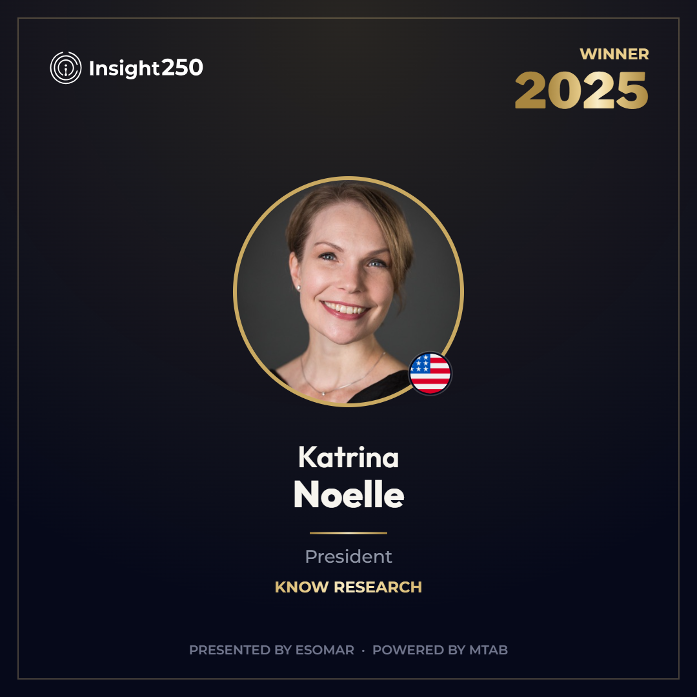
With technology advancing at an incredible pace and the value of insights ever increasing, I sat down with Insight250 Winner Katrina Noelle. As President of KNow Research, Katrina has contributed extensively to the industry, not only through thought leadership, but through extensive volunteer work through the Insights Association (through the DII Council, chapter Board Member and as a Laureate), WIRe, QRCA, MRII sponsorship, MSU board and others. In 2023, she launched a female founder award to help the next generation of female founders.
Crispin: You came back from POSSIBLE in Miami struck by how consistently the conversation there returned to AI-powered measurement and performance tracking as the primary tools for understanding customers, with very little room for asking real people real questions. How representative is that of where the broader marketing and insights industry is heading right now?
KN: It was more representative than I wanted it to be. The AI stage at POSSIBLE was full of brilliant people who have built genuinely impressive technology, and the enthusiasm in that room was real. But there was a pattern I kept noticing: the conversation almost always landed on what people did, and seldom on why they did it.
Behavioural data, clicks, purchases, social signals. All of it telling you the score. None of it telling you the game. The marketing industry has always been seduced by things that are fast and scalable, and right now AI fits that description perfectly. The danger is not the technology. The danger is the assumption that scale and fluency equal understanding. They do not. And the organisations that conflate the two are going to pay for it in ways that will be expensive and very public.
Crispin: Hootology's Super Bowl research found that when people remember an ad, only 16% say it was because of a celebrity, and yet 61% of this year's commercials featured celebrity talent. That is a striking gap between what brands invest in and what actually works. What does that tell us about the state of customer understanding in even the most sophisticated marketing organisations?
KN: It tells us that even the most sophisticated organisations are still making billion-dollar decisions based on assumptions rather than evidence. The Super Bowl is the highest-stakes advertising moment of the year, and brands are spending millions on creative strategies that their own customers are telling us do not drive recall. That is not a celebrity problem. That is a listening problem. Somewhere between the brief and the buy, the customer got left out of the conversation. That gap, between what brands invest in and what actually works, is exactly the gap that good research exists to close. The fact that it persists at this level, with this much money on the table, says the industry still has significant work to do in making insights genuinely central to creative and strategic decision-making.
Crispin: You have been combining in-person and digital methodologies since 2003, and you still run an in-person research facility in San Francisco. At a time when virtual research has become the default, what is the argument for in-person that the industry is in danger of forgetting?
KN: The argument is human beings. When you put a real person in a room, things happen that simply do not happen on a screen. People read the energy in the space. They respond to each other in real time. They hesitate in ways that tell you something. They laugh, they contradict themselves, they say one thing with their words and something entirely different with their face. A skilled moderator in that room catches all of it. Those moments are where the most valuable insights live, and they are extraordinarily difficult to replicate virtually. I am not arguing against digital research. I use it constantly, and it serves real purposes. But when the stakes are high, and the questions are complex, in-person creates conditions for truth that convenience cannot match. The industry is in danger of forgetting that not because virtual research is bad, but because virtual research is easier to sell.
Crispin: There is a difference between research that is convenient and research that is true. Where does the line fall, and in what kinds of decisions or categories do you think the cost of getting it wrong through remote or synthetic methods is simply too high?
KN: The line falls wherever the cost of being wrong is high. New product launches. Brand repositioning. Anything touching health, finance, or major life decisions. Any category where the audience is complex, emotionally engaged, or historically underrepresented in research. These are the moments where convenience is a false economy.
I have seen organisations save money on research and spend multiples of that savings correcting a product launch that missed the mark. I have seen campaigns built on synthetic data land so far from the actual customer experience that the brand had to walk them back publicly. The question is never really "can we afford to do this properly?" The question is "can we afford not to?"
Crispin: You co-host the TRIP podcast, dedicated to raising awareness of more inclusive research practices. Does the shift away from in-person research make inclusion harder or easier, and what are the hidden costs of convenience when it comes to reaching the audiences that are hardest to reach?
KN: It is both, and that complexity is exactly why the conversation matters. Digital research has genuinely opened doors. People who cannot travel, who have mobility challenges, who live in communities without easy access to research facilities, can now participate in ways they could not before. That is real and meaningful progress.
But the shift to convenience has also narrowed the participant pool in ways the industry does not talk about enough. Online panels skew toward people who have time, reliable internet access, and comfort with technology. That is not a representative picture of most audiences. The hardest-to-reach communities, the ones that brands and organisations most need to understand, require intentional effort and genuine relationship-building. Convenience research rarely makes that investment. When we accept panels of convenience as sufficient, we are making a choice about whose voices count. That choice has consequences.
Crispin: Your Scoot Insights methodology was built around bringing different perspectives together to guide decision-making. Now that AI can simulate perspectives at scale, what is the argument for the real thing, and how do you make it to a client who has just been told they can get the same output for a fraction of the cost?
KN: The argument is accuracy. A simulated perspective is only as good as the data it was trained on, and most of that data is behavioural. It tells you what people have done in the past, in contexts that may have nothing to do with the decision your client is trying to make right now.
Real human beings bring contradiction, nuance, and context that no model can manufacture. They also bring surprise. Some of the most valuable insights I have ever delivered to clients came from something a participant said that nobody anticipated and no synthetic persona would ever have generated. When a client tells me they can get the same output for a fraction of the cost, I ask them one question: how will you know if it is wrong? With real research, you have a methodology you can defend. With synthetic output, you have fluency. Those are not the same thing, and the difference tends to become apparent at the worst possible moment.
Crispin: You are a strong champion of women in research through WIRe, your own recognition as one of the 100 Women to KNOW in America, and your mentoring work. What does the AI transition mean specifically for the women who built careers in qualitative and human-centred research, and what do they need to do to ensure their expertise is not devalued in the rush to automate?
KN: Women built the qualitative research industry. The skills at the centre of this work- deep listening, building trust quickly, holding complexity without flattening it, reading what is underneath what is being said- are skills that women have developed and honed and been undervalued for throughout their careers. Now those same skills are being described as automatable. I find that both infuriating and clarifying. The answer is not to resist AI.
The answer is to make absolutely sure that the expertise behind human-centred research gets credited, compensated, and positioned as the thing AI cannot replace, because it genuinely cannot. Women in this field need to own their methodology, sharpen their ability to articulate its value in business terms, and stop letting the industry treat their expertise as a soft skill. It is not soft. It is the hardest thing in research to do well, and the most consequential when it is missing.
Crispin: You signed the GDQ Data Quality Excellence Pledge on behalf of both KNow Research and Scoot Insights. In a world where AI can generate synthetic respondents, simulate focus groups and produce research reports without a single real human being consulted, what does a meaningful commitment to data quality actually require?
KN: It requires honesty about what the data actually is and where it came from. A meaningful commitment to quality starts with being willing to say out loud, to clients and to the industry, that synthetic respondents are not research participants. Simulated focus groups are not focus groups. A report generated without real human input is not insight. It is pattern recognition dressed up as understanding. Quality also requires standards that have teeth. The GDQ pledge matters because it signals that the people who signed it are willing to be held accountable. But pledges only work if the industry builds actual consequences for violating them, and right now the market is rewarding speed and affordability in ways that make it very easy to cut corners and very hard to explain why you did not. The organisations that hold the line on quality right now will be the ones clients trust when the shortcuts start failing publicly.
Crispin: If the industry continues on its current trajectory - faster, cheaper, more automated - what is the version of market research that exists in ten years, and is it one you would want to work in?
KN: If the trajectory holds without correction, ten years from now the industry looks like a lot of very confident, very fast, very wrong answers. Organisations will have spent a decade optimising for efficiency and will be sitting with brand strategies built on synthetic understanding and customer personas that never talked to a real person. That is not a version of the industry I want to work in.
But I do not think that is the only possible future. I think the organisations that get burned first will course-correct, and the researchers who held the line on rigour will be exactly who they turn to. The case for human-centred research does not get weaker as automation accelerates. It gets stronger. Every shortcut the industry takes creates a gap, and gaps are where good researchers do their best work.
Crispin: Should research firms be doing more pro bono work for non-profits, and if they are not, what does that say about the industry's stated values?
KN: Yes, and I say that as someone who has run an annual pro bono program at KNow Research for years. The skills this industry applies to understanding consumers of luxury goods or financial products are exactly the skills that non-profit organisations need to understand the communities they serve.
The gap between those two worlds is not a capability gap. It is a priority gap. When research firms say they care about inclusion and equity but reserve their best work for clients with the largest budgets, that is a values statement whether they intend it to be or not. Pro bono work is not charity. It is the industry putting its expertise where its stated commitments are. The organisations doing this work consistently, not as a one-time gesture but as a genuine part of how they operate, are the ones I most respect. And the industry would be well served by more of them.
Crispin: What is your top tip for a researcher who wants to push back against the race to automate and make the case, internally and with clients, for research that keeps real human beings at the centre?
KN: Learn to speak the language of risk. Researchers often make the case for human-centred work in methodological terms, talking about validity and rigour and depth, and those arguments land with other researchers. They do not always land with the person who controls the budget. What lands with that person is the question: what is the cost of being wrong? Reframe every conversation about research quality as a conversation about business risk. Synthetic personas sound efficient until a product launch fails because nobody talked to a real customer. Convenient panels sound affordable until a campaign misses an entire audience segment that was never in the sample. The moment you connect research quality to business outcomes, the conversation changes. Know your numbers, know your examples, and do not let the industry trade accuracy for speed without naming what is actually being traded.
Crispin: Katrina, thank you for such a candid and thought-provoking conversation. Your argument for keeping real people at the centre of research is a timely reminder that speed and scale are no substitute for understanding, and that the true cost of convenience often only becomes clear once it is too late. Your point about reframing research quality as business risk is one every insights professional should carry into their next budget discussion. It is perhaps the most practical piece of advice I have heard on making the case for rigour. Your commitment to inclusion, data quality and pro bono work shows what it looks like when an industry’s stated values are actually put into practice. Thank you for sharing your perspective and experience so generously.
Crispin Beale
Chairman at QuMind, CEO at Insight250, Senior Strategic Advisor at mTab, CEO at IDXCrispin Beale is a marketing, data and customer experience expert. Crispin spent over a decade on the Executive Management Board of Chime Communications as Group CEO of leading brands such as Opinion Leader, Brand Democracy, Facts International and Watermelon. Prior to this Crispin held senior marketing and insight roles at BT, Royal Mail Group and Dixons. Crispin originally qualified as a chartered accountant and moved into management consultancy with Coopers & Lybrand (PwC). Crispin has been a Board Director (and Chairman) of the MRS for nearly 20 years and UK ESOMAR Representative for c15 years. As well as being CEO of Insight250, Crispin is currently Worldwide CEO of Digital Communications Solution Agency, IDX. Crispin is also the Senior Strategic Advisor at mTab and the Chairman of QuMind and spent 4 years as Group President of Behaviorally where he was responsibile for the client & commercial teams globally. Crispin is a passionate advocate for blending human intelligence and technology to deliver innovation and leadership across organisations.