Agentic Commerce: A New Opportunity for Innovators
An outlook of what NPD cycles can look like with agentic AI and robotics

Autonomous software agents and physically embodied robots are beginning to mediate a growing share of commercial activity. As these systems become capable of independently searching for products, optimizing trade‑offs, executing payments, and even using or interacting with products, the assumptions underpinning traditional marketing and innovation processes are increasingly misaligned with emerging reality. This paper examines how agentic commerce, commerce executed partially or fully by autonomous agents on behalf of humans, will reshape new product development (NPD) and the market research practices that support it. We focus particularly on sectors characterized by high digital penetration, strong online retail infrastructures, and increasing adoption of AI‑driven tools (e.g., consumer packaged goods, retail, and digitally enabled services) in advanced economies.
The analysis is guided by three questions:
Q1: How is agentic commerce likely to evolve over time, and what are its main technological enablers?
Q2: How will agentic commerce reshape the design and execution of NPD across concepts, products, and packaging?
Q3: What transformations are required in market research methods to remain decision‑relevant in an agent‑mediated ecosystem?
The paper is structured as follows. Section 2 defines agentic commerce and outlines its evolutionary phases and technological enablers. Section 3 describes four structural shifts in innovation practice. Section 4 examines implications for concept, product, and packaging research, including an illustrative experiment using digital twins. Section 5 briefly discusses limitations, risks, and boundary conditions. Section 6 concludes with an “innovator’s mandate” for the era of agentic commerce.
The global digital economy is currently undergoing a structural realignment catalyzed by the rapid transition from human-driven discovery toward autonomous, machine-driven execution [2][8] [13[14]. We have entered the era of “Agentic Commerce” [3][7], a paradigm wherein artificial intelligence systems act autonomously on behalf of users to navigate options, negotiate product features, execute purchases, and evens part of the product experience itself [13][14].
As transactions increasingly become "informed by humans, bought by agents," the traditional architectures of mass marketing and brand loyalty are becoming obsolete. Forecasts indicate that agent-orchestrated transactions could account for up to $12 trillion in annual global online sales by 2030 [1][2][6]. This foundational shift provides opportunities for prepared businesses to rethink how products are conceived, tested, packaged, and experienced in a dual-tiered consumer landscape: the human end-user and their AI proxy, which could take shape anywhere between a digital shopping assistant, to a robotic home maker.
Part 1 - The evolution of agentic commerce and its technological enablers
In this paper, we define agentic commerce as: “Commercial exchanges in which autonomous or semi‑autonomous software or robotic agents, acting on behalf of human principals, perform one or more core functions across the purchase and usage funnel, such as search, evaluation, negotiation, transaction execution, and/or physical interaction with products”[2][8][13].
This definition emphasizes three dimensions:
Degree of autonomy: Ranging from human‑in‑the‑loop decision support (e.g., recommendation agents) to fully automated agent‑to‑agent negotiation and purchasing.
Form of embodiment: Including purely digital agents (e.g., shopping bots, recommender systems) and physically embodied agents (e.g., household robots, delivery drones).
Scope of activity: Extending beyond purchase to include logistics, setup, maintenance, and ongoing product usage.
Forecasts suggest that agent‑orchestrated transactions could account for trillions of dollars of global online sales by 2030. While specific numbers vary and remain uncertain, the directional trend is clear: a growing proportion of commercial decisions will be made by non‑human actors, constrained and guided by human preferences but not directly supervised at each decision point.
1.1. - Phases of Agentic Commerce Adoption
Agentic commerce is not a distant future; it is an accelerating reality unfolding in three distinct phases:
Phase 1. - Agentic shopping assistants (current)
In the first phase, AI agents act primarily as decision support tools for consumers. AI agents search and recommend product and services, providing optimized options to consumers at decision points, smoothing processes and managing chores like shipment tracking [5][9].
Alibaba’s Qwen (千问) is one such example already gaining millions of users. With simple natural language instruction for a bubble tea delivery, the agent takes care of searching nearby offers, analyzing taste preferences based on user data to recommend options, confirming choice and handle payments, shipping, and even calling customer service when needed.
Major platforms such as TikTok, Amazon, and Walmart are rapidly building or integrating similar assistant capabilities into their ecosystems.
Phase 2. Proactive autonomous agents (emerging)
In the second phase, consumers fully delegate low-risk, repetitive, or predictable shopping missions to proxy agents. The human no longer participates in the point-of-purchase decision but remains a critical step in the post-purchase feedback loop [4][16].
Amazon has experimented with “anticipatory shipping,” pre‑positioning inventory based on predictive models of household demand.
Google’s AI‑enabled shopping tools increasingly support automatic purchasing when specific user‑defined criteria (e.g., price thresholds) are met.
Phase 3. Fully integrated agent‑to‑agent commerce (near future)
In the third phase, proxy agents exist on both the supply and demand sides. Starting from when the products are still in factory, the agents negotiate (in milliseconds) the optimized product and service delivery, based on preference of the buyer and the constraints of the manufacturer they each represent. A key feature at this phase is product communication and configuration can be fully personalized.
At this stage, the agents are also no longer limited to digital forms. For those of you who have watched the Figure 03 humanoid robots operating dishwasher fully autonomously and without teleoperators in early 2026, you will not fail to see how our proxy agents will soon transition from only assisting shopping, to fully participate in the usage experience.
1.2. - Technological Enablers: From Multimodal AI to Household Robotics
This evolution is driven by several critical enablers.
Multimodal AI and synthetic consumers
Multimodal foundation models can now process text, images, video, and increasingly sensor data. This enables agents to:
Interpret complex product information (e.g., ingredient lists, technical specifications, regulatory labels).
Generate consumer‑facing stimuli (text, images, video) tailored to individual preferences.
In parallel, the rise of digital twins and synthetic consumers is transforming how we simulate and study consumer behavior:
Digital twins of consumers are AI agents trained on traceable behavioral and attitudinal data from real individuals (e.g., purchase histories, stated preferences, survey responses), constrained by privacy and consent rules.
These twins can be organized into simulative synthetic panels that approximate the dynamics of real consumer segments, particularly for tasks such as new product adoption and communication response.
Autonomous logistics and the “low‑altitude economy”
In the realm of commercial logistics, the advent of autonomous retail, driverless delivery vehicles, and the "low-altitude economy" represented by delivery drones are systematically removing consumers from traditional physical retail touchpoints, shifting the landscape toward impulse-driven, direct-to-balcony sales and proxy-managed subscriptions [17][20]. Both in the US and China, legislations regarding civil aviation and transportation are being actively revisited to prepare policy infrastructures needed for such transformations.
The “Model T moment” for household robotics
Perhaps the most disruptive enabler of Agentic Commerce is the physical manifestation of the AI proxy. We are rapidly approaching a "Model T moment" for household robotics, which will become the dominant large-ticket household purchase in the coming decade. Demographic shifts such as the aging global population will drive a massive demand for assistive robots that can help in daily tasks to allow older adults to maintain their independence longer. Or the increase of time-strapped dual-income households are increasingly looking to outsource mundane chores and desire automated home maintenance solutions. Robots empowered by physical AI will serve as personal proxy agents in physical form, introducing a radical new dimension to product development: robotic product usage. Consumers will no longer directly participate in certain "moments of truth" along the product experience. Instead, a household robot will scan the house and order products in shortage, receive the drone delivery, open the packaging, and prepare the product. Consequently, innovators must design for "2nd-hand product usage," where the primary handler of the physical good is their physical AI proxy.
Part 2: New Era of Innovation under Agentic Commerce
In 2024, we thought that a New Era of Innovation was dawning with the rapid advancement of Generative AI [15]. 2 years later, most of the predictions have become true. Traditional stage gates are shattered, innovation mix across concept/pack/product are developed in single cycles, and the divide between discovery, development, validation and launch monitoring disappears. We think we are now facing another inflection point where the emergence of agentic commerce will completely change the NPD game. This round of change will be characterized by 4 inter-related and consecutive elements of change:
1. The Decline of Mass Marketing.
Mass marketing was born out of an era where marketers must find a common, optimized marketing mix for all because that’s the only possible thing to do given the constraint of media vehicles, manufacturing capabilities, and retail logistics. These technical constraints are being rapidly removed. The audience for brand communication is increasingly the Agent Proxy, which algorithmically reflects its individual human’s attitudes and preferences in real time, the era of mass marketing where the thinking is ONE optimized version of marketing mix must satisfy all, is effectively over.
2. The emergence of super-personalization.
Marketers have always had “consumer centricity” as a slogan and vow to respect each consumer as an individual competitive universe, only now it has become possible with technology [10]. AI models can analyze vast amounts of individualized behavioral and attitudinal data of a consumer to generate personalized communication for products. The product configurations themselves can be personalized with the convergence of AI and precision robotics.
3. Agent to Agent Gaming.
The game of marketing as a result, is shifting from a conversation between manufacturers and consumers (aided by mass production and communication), to an agent-to-agent chess game where the manufacturer and consumer agents engage in rapid, real-time exchanges with communication optimization, product development and purchase decisions made in milliseconds, favoring algorithmic winners in the process.
For example, traditional SEO is approaching obsolescence, giving way to Generative Engine Optimization (GEO). With more than half of the queries projected to end in "zeroclick" AI summaries by 2026, brands must structure their data to ensure high “Citation frequency” in social media and “Share of AI Voice” [11][12]. Innovators must leverage tools and methodologies to ensure LLMs preferentially cite their products. Similarly, User Experience (UX) is being superseded by Agent Experience (AX) [22][23]. Digital systems must be engineered with clean, exceptionally welldocumented APIs, allowing proxy agents to interface seamlessly with retailer infrastructures.
4. The Emergence of Perpetual Beta Product States
In traditional NPD models, products are “launched” as relatively stable configurations and periodically updated through discrete reformulations or rebranding efforts. Under agentic commerce we use Perpetual Beta State to describe a condition in which products and associated communications are continuously updated based on real‑time data from agent‑mediated usage and feedback, such that there is no stable, final ‘launched’ version.
As consumer side and manufacturer side proxy agents engage in constant exchange of data reflecting real human inputs in each purchase-use-feedback cycle, the product shipped to the next consumer could be slightly tweaked and improved, and the marketing communication made to the next consumer agent could also reflect strength and weaknesses summarized from previous buyers. The products under agentic commerce are never “launched and done”, they go through constant launchfeedback-tweak loops that iterate and evolves the product continuously, hence a “Perceptual Beta State”.
The new era of innovation under agentic commerce opens up exciting challenges and opportunities to innovators and is promised to also completely change market research that supports agentic innovation. Boundary conditions still apply regulatory requirements, manufacturing constraints, and physical supply chains limit how far and how quickly changes can propagate. However, the direction of travel is clear; more continuous, data‑driven iteration and less emphasis on discrete, one‑time “launch events.”
Part 3: Innovation Research in the New Era of Agentic Innovation
In an agentic commerce paradigm, a single product‑mix must satisfy two interdependent but distinct “consumers”:
The human end user, with their subjective experiences, emotions, and social contexts.
The autonomous purchasing and usage agent, with its data‑driven preferences, constraint models, and algorithmic decision rules.
This introduces a mandatory to transform the market research services that support innovators and marketers. This change will be profound and the innumerable. This article will only discuss what the new era might mean to the most common elements of NPD market research: Concept, Pack and Product.
3.1 Concept development and testing: individualized and simulative
Autonomous agents require deterministic, machine-readable clarity. Concept generation and testing has evolved into discovery and validation of individualized consumer truth reflected in communication preferences.
A product concept must mathematically prove that its core attributes (Insights, Benefit, RTB, price, ingredients) can be flawlessly ingested by third-party retrieval-augmented generation (RAG) systems, for example [12][19][23].
Therefore, the fundamental business question for concept generation and testing has shifted from “how to deliver ONE optimized concept to maximize mass acceptance” to “how to deliver millions of individualized concepts to maximize collective probability of trial”. Market research to answer these business questions are empowered today by [18]:
o Simulative synthetic consumer panels, composed of digital twins of representative real consumers for certain country and categories, trained with large amounts of observable behavior and attitudinal data reliably collected from their human counterparts, with a focus on new product adoption. The tireless and agile army of digital twins can be deployed to simulate effectiveness of concept communications. They can be used to test new product ideas, provide individualized optimization suggestions, generate personalized concept messaging, and iterate till an optimized version of the personalized concept is released to their human counterparts for realworld validations.
o Agentic learning-generation-iteration cycles. Marketers should be equipped with professionally trained, specialized innovation agents that can rapidly learn from success and failures of past launches, analyze market trends and competitive situations in real time, generate product ideas and deliver thousands of individualized concept communication based on data provided by consumers, or their simulative synthetic twins. At Ipsos, we have deployed “Learning Agents” that can instantly learn from concept best practices and live data feeds. The learning is then passed on to “Generation Agents” that are trained with specialized innovation know-how distilled from decades of NPD experience, to generate product ideas and personalized communication. Those stimuli are then consumed by representative digital twin panels for key countries/categories for feedback and iterations. The agents work hand in hand with our synthetic panels to make instant learn-generate-iterate cycles possible to power agentic commerce.
To demonstrate the potential of simulative synthetic panels working hand in hand with specialized innovation agents, we have recently made an experiment.
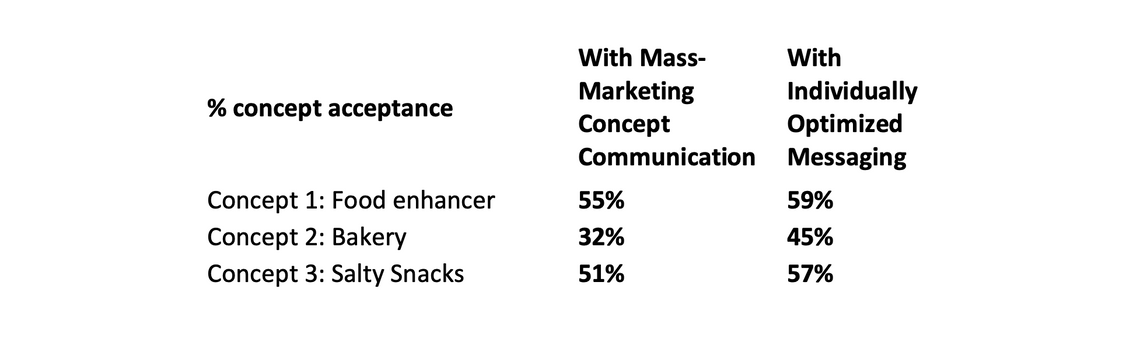
We have created a digital twins panel from 1000 representative US food purchasers. We exposed 3 food product innovation concepts to this digital panel, asking them to evaluate the new products against competitors. All digital twins were exposed with the same massmarketed product concept at this step.
Then, among those who evaluated the new concepts negatively, we probed the digital twins to understand the barrier to trial. Armed with the individualized feedback, our Concept Learning and Generation Agents then get to work to create personalized versions of optimized concept communications based on the specific feedback each digital twins provided.
These personalized concepts are then re-exposed to the same digital twins (memory of previous exposure has been wiped out before re-exposure). We were delighted to see that the individualized concepts proved to be better accepted overall than the original mass-marketed ones.
This experiment, although preliminary, demonstrates the power of individualized product communication over mass-marketing. If the technology is used in scale and real-time, individualized marketing of new products will greatly raise the bar for product innovators.
3.2 - Product Testing Under Auto‑Replenishment and IoT
To fully master the Total Product Experience (TPE) [21] in agentic commerce, innovation must move beyond automation toward continuous, data‑driven co‑evolution with consumers and their agents.
From agentic AI to “autotelic” AI
Traditional agentic AI executes tasks toward human‑defined goals (e.g., maximize likelihood of repurchase). Emerging systems increasingly incorporate elements of intrinsic motivation, such as curiosity‑driven learning and novelty search (as studied in reinforcement learning). For the purposes of this paper, we use the term autotelic AI metaphorically to denote:
AI systems that are designed to continuously seek new information, reduce uncertainty, and refine models of the product‑usage environment, without requiring explicit human prompts for each learning step.”
These systems:
Continuously crawl social media, IoT data streams, and product testing outputs.
Form and test hypotheses about product performance, usage patterns, and unmet needs.
Propose or automatically implement incremental refinements to formulations, instructions, or usage recommendations.
The “autotelic” characterization is not meant to imply consciousness or literal self‑generated goals, but rather a design pattern emphasizing ongoing, self‑initiated learning.
Multisensory AI for product evaluation
To achieve this, AI is be equipped with the five human senses to evaluate the TPE:
Sight (Computer Vision): “Product View AI” analyzes packaging, texture, and visual cues (foam, shine) that signal efficacy.
Touch/Feel (Physical AI): Smart Labels and embedded sensors capture temperature, pressure, viscosity, and real grip/squeeze behaviors.
Hearing (Voice-to-Text): Always-on social listening captures real-world product talk to identify emergent needs.
Smell (Artificial Olfaction): Electronic noses map objective "scent signatures" to emotional responses and detect subtle batch changes.
Taste (Artificial Gustatory Systems): Electronic tongues provide physicochemical taste profiling (sweet, bitter, umami) to support recipe optimization.
By combining these multimodal foundation models, Autotelic AI creates a living, selfimproving multisensory engine that co-evolves products with consumers' lived experiences. To truly capture this real-world data, the industry is moving away from traditional, labor-intensive research methods, like consumer diaries, which often suffer from consumer fatigue and a pronounced 'say-do gap.' [19]. Instead, innovators are deploying advanced Smart Home Solutions, such as next-generation Smart Labels. These thin, flexible, Bluetooth-enabled labels are equipped with sensors that passively collect real-time product usage and dosage data with zero effort required from the consumer. By transmitting this naturalistic, in-home consumption data directly to cloud dashboards via mobile apps, these IoT devices provide a seamless, automated pipeline of behavioral truth. This allows Autotelic AI systems to observe exactly how, when, and where products are being used, automatically flagging anomalies and feeding this data back into the innovation loop.
With the rise of IoT and connected packaging (e.g., embedded sensors measuring consumption), products exist in a state of perpetual beta. Product testing must heavily weight utility metrics and technical reliability over mere sensory appeal. If a product fails to trigger an auto-replenishment API, the seamless experience breaks. Furthermore, AI agents instantly ingest human sentiment from online reviews, customer experiences, or surveys; a minor physical flaw becomes an algorithmic warning, penalizing the product in future automated purchases.
3.3 Packaging Research for Human and Robotic Users
Packaging is evolving from a static visual “billboard” to a dynamic data carrier and physical interface for both humans and machines. Traditional pack research focused on human eye-tracking and visual survey-based appeal. Now, researchers must conduct "Digital Validation Testing" to ensure the 2D barcodes are machine-readable under various physical conditions (glare, crinkling, condensation) so that AI agents can instantly route to compliance payloads.
At the mean time, companies are rushing to create packaging optimized for robotic delivery and handling, designed to be easily received, opened, and recycled by household robots, making delivery and packaging a seamless part of the automated usage experience. So, pack testing may require physical stress tests for robotic grippers and aerodynamic assessments for drone flight, rather than just shelf-impact tests. For example, the Chinese food delivery giant Meituan uses standardized, aerodynamic cardboard boxes specifically sized to fit into the underbelly of its 4th-generation drones.
Under such context, the business questions facing marketers regarding product packaging rapidly expands. Packaging still needs to stand out on the shelf and communicate the core proposition of a product, when a human is doing the purchasing. The same business question under the agentic commerce world takes on new meanings:
Does the packaging design and on-pack claims stand out to the search algorithms from consumers’ proxy agents?
Is product packaging compatible with autonomous logistics such as delivery drones, and secondary product users such as household robots?
Can product packaging be personalized like concept and products to deliver maximized value to individual consumers?
We can only scratch the surface here with examples from concept, product and package. We believe however agentic commerce is poised to change every aspect of innovation and the market research that supports it. The new era of innovation will require marketers and research suppliers to realign tool kits and skillsets very quickly.
Conclusion: The Innovator's Mandate
The fundamental tasks of innovations to solve real consumer needs better than existing products in differentiated ways, remain unchanged. However, the game and the rules to win are rapidly shifting. The mindset of the marketer must shift away from mass marketing and toward "Agent-to-Agent gaming" characterized by hyper-personalization and robotic product usage. Marketers must become data consolidators, setting up predictive, rich data streams to fulfill the proxy needs of their consumers through simulative means such as digital twins in their control. Commercial success in the era of Agentic Commerce will belong to organizations that embrace predictive, algorithm-based market research and marketing tools.
Competitive advantage in agentic commerce will accrue to business that can:
Model the behaviors of both human consumers and their agents.
Design products, packs, and communications that satisfy both.
Continuously learn and iterate through autotelic‑style innovation loops.
By leveraging advanced platforms that enables real time learning, hyper-personalized concept generation, Product View AI for multisensory evaluation, and Innovation Agents to navigate the autotelic loop, brands can secure market dominance. The future of commerce is informed by human intent, executed by machines, and optimized by autotelic intelligence.
Sources
Agentic payments: a new frontier in digital commerce | Kearney, https://www.kearney.com/industry/financial-services/article/agentic-payments-a-newfrontier-in-digital-commerce
Agentic commerce: How agents are ushering in a new era | McKinsey, https://www.mckinsey.com/capabilities/quantumblack/our-insights/the-agenticcommerce-opportunity-how-ai-agents-are-ushering-in-a-new-era-for-consumers-andmerchants
The agentic AI revolution in retail | Strategy& - Strategyand.pwc.com, https://www.strategyand.pwc.com/de/en/industries/consumer-markets/agentic-airevolution-retail.html
2030 Forecast: How Agentic AI Will Reshape US Retail | Bain & Company, https://www.bain.com/insights/2030-forecast-how-agentic-ai-will-reshape-us-retail-snapchart/
The Agentic Commerce Landscape: Who's Building What in 2026 - Rye, https://rye.com/blog/agentic-commerce-startups
Agentic Commerce Impact Could Reach $385 Billion by 2030 | Morgan Stanley, https://www.morganstanley.com/insights/articles/agentic-commerce-market-impactoutlook
Agentic Commerce Market Report 2026 | $547M to $5.2B Growth Forecast - Sanbi.ai, https://sanbi.ai/blog/agentic-shopping-market-trends
Agentic Commerce is Redefining Retail - How to Respond | BCG, https://www.bcg.com/publications/2025/agentic-commerce-redefining-retail-how-torespond
AI Agents and the Future of E-Commerce - Riverty,
https://www.riverty.com/en/business/insights/blog/agentic-commerce/
The Power of Personalization - Diva-Portal.org, https://www.divaportal.org/smash/get/diva2:1990403/FULLTEXT01.pdf
GEO: Visibility in AI Chat Experiences | valantic blog, https://www.valantic.com/en/blog/generative-ai-optimization-geo/
Can machines read your product content? | Valtech, https://www.valtech.com/blog/anmachines-read-your-product-content/
The rise of Agentic Commerce - Business payment solutions to help you grow | Visa, https://corporate.visa.com/content/dam/VCOM/corporate/services/documents/vca-riseof-agentic-commerce.pdf
The rise of agentic commerce could revolutionize buying behavior — sooner than you think, https://www.pwc.com/us/en/industries/consumer-markets/library/agenticcommerce.html
The automation curve in agentic commerce - McKinsey, https://www.mckinsey.com/capabilities/quantumblack/our-insights/the-automationcurve-in-agentic-commerce
Agentic AI in Retail: How Autonomous Shopping Is Redefining the Customer Journey, https://www.bain.com/insights/agentic-ai-in-retail-how-autonomous-shopping-redefiningcustomer-journey/
Shaping the Future of Retail for Consumer Industries - World Economic Forum, https://www3.weforum.org/docs/IP/2016/CO/WEF_AM17_FutureofRetailInsightReport.pdf
Invisible Bias in AI‑Assisted Market Research: AI Didn't Create Bias, It Just Made It Harder to Ignore, https://researchworld.com/articles/invisible-bias-in-ai-assisted-marketresearch-ai-didn-t-create-bias-it-just-made-it-harder-to-ignore
Why Product Specs Are Becoming the Interface for AI-Driven Engineering | by Marty Bradley, https://medium.com/@marty916/why-product-specs-are-becoming-theinterface-for-ai-driven-engineering-06d2e80b322e
daksh_report_final_25.01_single_page_view.pdf - UNDP, https://www.undp.org/sites/g/files/zskgke326/files/202602/daksh_report_final_25.01_single_page_view.pdf
Regulating algorithmic filtering on social media - NeurIPS, https://proceedings.neurips.cc/paper/2021/file/38b4f06e27fd4f6fdcceabc6f5c068eaPaper.pdf
Agent-Based Experience Design: The Future of UX in an AI-Driven World - Standard Beagle, https://standardbeagle.com/agent-based-experience-design/
How AI Enhances Spec-Driven Development Workflows | Augment Code, https://www.augmentcode.com/guides/ai-spec-driven-development-workflows
Jiongming Mu
Global Head of Innovation Testing and Forecasting at IpsosManager of a portfolio of global research products in the Innovation Testing and Forecasting space, including a few fully digital and automated services operated globally. Responsible for maintaining the portfolio while designing and scaling new offers globally at the same time to deliver growth on an 8-digit revenue stream. Manage a global inter-disciplinary team in product development, implementation and execution.