From Awareness to Action
How PRIDE translated Interconnectedness and Empathy to ‘Mindful disposal’ for waste pickers in Bengaluru
Building on Phase 1 of the PRIDE project—which successfully shifted awareness and recognition, the next challenge was to translate empathy into action. Learnings highlighted the need to deepen empathy and better connect waste disposal behaviours to waste pickers’ realities. Early research also identified 25–34-year-olds as highly digitally linked (Instagram being a favoured platform) and behaviourally engaged audience, so the strategy pivoted to deepen engagement within this group. The second phase sharpened its focus on behaviour change—linking everyday actions to waste pickers’ health, safety, and dignity.
Consequently, Phase 2 of the intervention adopted a multi-layered, Instagram-led strategy targeting 25–34-year-old residents. The approach combined:
An “always-on” Instagram community – @Invaluable.Bengaluru
Collaboration with influencers and supported by @invaluables.Bengaluru, and campaign bursts
Partnership with 36 restaurants, food delivery app, WeWork, etc.
Outdoor media and digital out-of-home screens
Radio, print, and Resident Welfare Association collaborations
On-ground workplace and community events
Our campaign strategy moved beyond awareness creation to positioning waste management not as “waste picker’s job,” but as a shared responsibility between citizens and waste pickers. At the heart of all the work done in Phase 2 were four focused, action-oriented campaigns. Each campaign introduced a distinct call to action (CTA) designed to translate empathy into everyday behaviour—strengthening interconnectedness between residents and waste pickers.
Research Design and Methodology
In Phase 2, the methodology shifted from a longitudinal panel adopted earlier in Phase 1, to a mixedmethods design, to ensure alignment with the evolving approach and strategic priorities. It also allowed for a comprehensive assessment of campaign implementation and effectiveness. Social media analytics were regularly monitored, and monthly in-depth interviews provided structured feedback to refine creative assets. The strengthened evaluation framework combined quantitative face-to-face surveys (n=600 per round, including exposed and unexposed respondents) with 8–12 qualitative interviews to assess reach, diagnostics, KPIs, and attitudinal shifts, benchmarked against a new baseline, marking the communication going deeper with the amenable subset of audiences-25 to 34year-olds.
Over 3,000 social media comments were analysed to compare online sentiments with primary research findings and the reported behaviour change was triangulated with on-ground insights from waste pickers and sorters to enhance validity and interpretation of impact.
The ensuing narrative marks the onward journey and impact of the project from Phase 1 of the campaign.
#Invaluables: Four Campaigns. Four Clear Calls to Action.
Each campaignin Phase 2 was rooted in a simple idea- If people understand how their behaviour affects waste pickers’ health and dignity, they are more likely to act responsibly.
Round 1: ‘Wash The Dabba’- CTA: Wash food containers before disposal.
A critical yet often overlooked issue in waste segregation is the improper disposal of food containers, which leads to contamination, odour, and increased occupational health risks for waste pickers who handle waste manually. Through a clear and practical call to action—empty, rinse, and dry plastic food containers before disposal, #WashTheDabba reframed rinsing as more than a hygiene practice for households, positioning it instead as an act of care and solidarity towards waste pickers. By linking a simple household behaviour to the daily realities faced by waste pickers, the campaign fostered empathy grounded in lived experience.
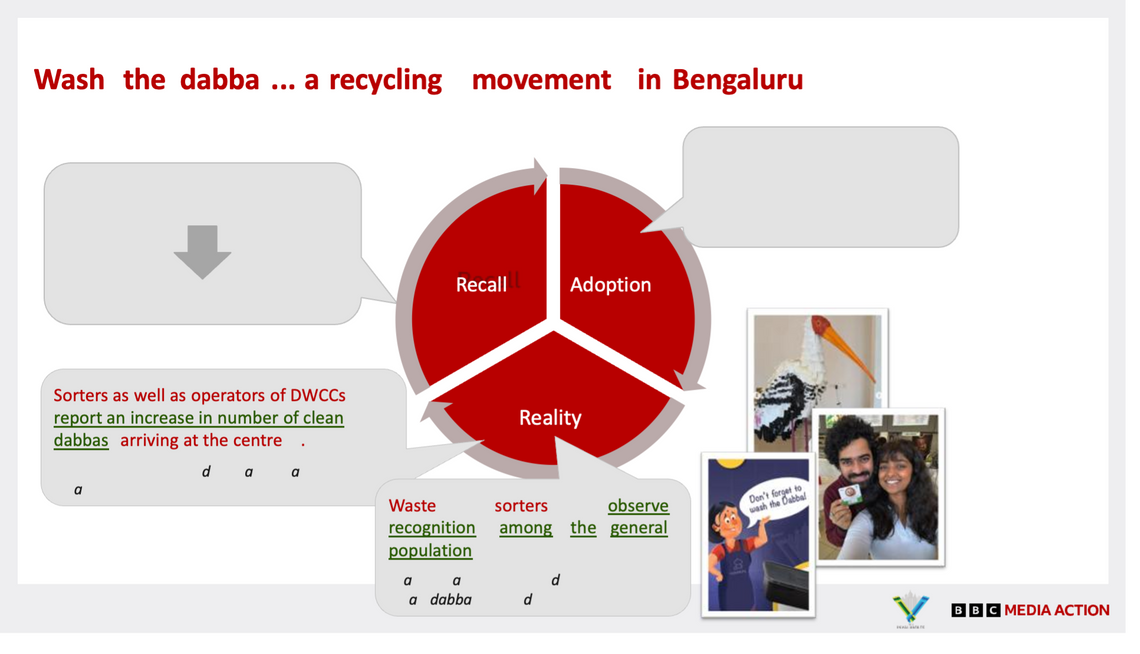
Total campaign recall reached 93%, and 60% of exposed respondents reported adopting the practice of washing their dabba before disposal. This behavioural shift was also corroborated by waste pickers, who observed a 30–40% increase in the number of food containers arriving in a cleaner condition. The campaign built empathy through visibility: showing how small acts at home directly shape working conditions on the ground, and positioned respect for waste pickers as something practiced, not just professed. Qualitative accounts from Dry Waste Collection Centre (DWCC) workers suggested noticeable reductions in contamination following the campaign, reinforcing the tangible impact of behaviour change.
Picture 1 below presents the impact of #Washthedabba
The campaign and its impact was globally recognised and received two Anthem Awards in the year 2025 - described by The New York Times as the “Internet’s highest honour”— the campaign was honoured in the 5th edition of the Anthem Awards with a Gold in the Sustainability, Environment, and Diversity category, and a Silver in Diversity, Equity, and Inclusion category.
Round 2: ‘Got Old Clothes?’- CTA: Wash, fold, and hand over old clothes separately for recycling.
Textile waste, the third-largest category of waste reaching landfills, frequently reaches collection centres soiled or mixed with general waste, diminishing its recycling potential and compromising both safety and dignity in handling. The #GotOldClothes? campaign responded by linking responsible textile disposal practices to the wellbeing and professional identity of waste pickers, reframing textile recycling as a shared civic responsibility. A key innovation of the campaign was the introduction of professional business cards for waste pickers—symbolically positioning them as skilled workers within the circular economy rather than informal labourers. These cards featured a WhatsApp chatbot number that enabled residents to locate nearby Dry Waste Collection Centres (DWCCs) or schedule textile pick-ups, effectively removing practical barriers to action.
Our campaign achieved strong engagement—93% recall of the key message to send clean, folded clothes for recycling, significant appeal, and message sharing—and was widely perceived as new and informative. During the intervention period, textile collection at DWCCs/TRFs doubled within the first month, public queries surged 20-fold, and Bengaluru Solid Waste Management Limited (BSWML) issued guidelines underscoring the importance of public service campaigns.
Beyond the numbers, the initiative strengthened public recognition of waste pickers as professionals, elevating their visibility, skills, and contribution within Bengaluru’s recycling ecosystem.
Round 3: ‘Mark It Red’ - CTA: Wrap sanitary waste in paper and mark it with a red cross.
Unsegregated sanitary waste poses serious health risks to waste pickers, who often handle it without warning or adequate protection. Through the #MarkItRed campaign we addressed this danger through a simple but powerful visual cue—a red cross marked on package containing sanitary waste—to enable safer identification and handling. By making invisible occupational hazards visible, the campaign deepened public understanding of the risks embedded in everyday disposal practices. Waste disposal was reframed as an ethical act: how one discards waste directly determines whether another person handles it safely or at risk.
The campaign achieved strong reach (44%, with 38% via WhatsApp), high appeal (79%), and nearuniversal recall of the core message that indiscriminate disposal of sanitary waste is hazardous to waste pickers (99%), with 65% specifically recalling the “Mark it Red” instruction. Importantly, 41% reported adopting the behaviour, signaling meaningful progress toward safer sanitary waste practices. While direct verification of this number is limited due to the nature of sanitary waste processing (ending up in landfills and incineration), DWCC managers acknowledge receiving packets marked with a red “X”— early signs of behaviour adoption.
Beyond behaviour change, the campaign was perceived as unique and morally resonant, prompting reflection, empathy, and a heightened sense of responsibility toward those who manage the city’s waste.
Round 4: ‘Recycle Resolutions’- CTA: Sustain mindful disposal as a long-term habit.
Rather than introducing new behaviours, #RecycleResolutions reinforced earlier messages strengthening retention and habit formation. The campaign reiterated the conversation around contributions of waste pickers while emphasizing collective responsibility and continuity—ensuring that empathy translates into sustained behaviour change.
The high decibel campaign achieved strong reach (59%), and high appeal (92%). The content pieces were deemed creative with a fun/easygoing tonality, while highlighting the struggles of waste pickers and clearly offering CTA led solutions to help waste pickers and contribute to ‘Namma Benguluru” (“Our Benguluru”).
Measurable Impact: Awareness, Interconnectedness, Empathy, and Identity
Over the four rounds of campaign in Phase 2, clear impact is evident.
Reach and Engagement:
17.1 million individuals reached online, of which 7.2 million are from Bengaluru
1.46-1.78 million reached for Wash the Dabba and 2.01million for Recycle Resolution through outdoor interventions/activations
#Invaluables Instagram community grew from 5,000 at Phase 1 to 39,000 followers at the end of Phase 2
Engagement rates averaged 16%, exceeding platform benchmarks
Content centered explicitly on waste pickers generated nearly double average watch time, signaling genuine audience interest in our content.
Shifts Across Key Performance Indicators
Awareness and Knowledge
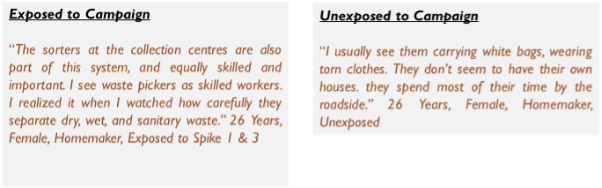
Awareness of waste pickers’ roles has increased by 10 points over baseline at endline (Baseline 76% to Exposed 86% Vs Unexposed 73%). Audiences increasingly used terms like “recyclers” and “sorters,” signaling professional recognition. This clarity of role and adoption of new vocabulary to address waste pickers was consistently missing among the unexposed audiences.
Appreciation and Recognition
This indicator, measuring appreciation for, recognition of the contribution of waste pickers, and discussion of their work with friends/family/peers, showed a 20-point increase over baseline at endline (Baseline 66% to Exposed 86% Vs Unexposed 67%). Both qualitative interviews and social media commentary reflected greater acknowledgment of the essential role waste pickers play in maintaining urban health and cleanliness. Online comments like "T a a d a k T d v a d k u u " reflect growing respect.
Empathy
Empathy scores increased by 13 points over baseline at endline (Baseline 74% to Exposed 87% Vs Unexposed 72%). Creative storytelling and realistic visuals resonated with the audiences. Exposure to the campaign narratives prompted self-reflection among audiences regarding their own disposal practices and their implications for waste pickers’ well-being. Mindful disposal was increasingly conceptualized not only as an environmental practice but as a moral responsibility which is reflected in the quote from our qualitative exercise - “ u W ju uff u k a d av d a ’ a ”
Identity Reframing
Positive identification of waste pickers rose from 62% at baseline to 83% among Exposed (Vs Unexposed 67%) at endline. The confident portrayal of waste pickers in the campaigns and use of elements like the business card contributed to the cause. Waste pickers were increasingly recognized as environmentalists and skilled professionals—rather than “rag pickers” or “dirty workers.”
Key Learnings and Implications
After six years of sustained intervention, our adaptive programming approach—systematically integrating learning into implementation and continuously refining strategy—has yielded measurable results. PRIDE demonstrates that sustained communication—when grounded in empathy and anchored in clear, achievable actions—can drive measurable change- case in point that 41% of our exposed audiences at Endline reported to be practicing one or more of the CTA’s advocated as part of the campaign rounds. It has shown that communication can do more than inform—it can reshape social norms.
Four core elements have proven critical in achieving this change:
Humanising waste pickers – Portraying waste pickers confidently and professionally, and keeping them at the core of the communiation.
Clear CTAs – Translating empathy into simple, specific behaviours,
Interconnected Framing – Showing how residents’ actions directly shape waste pickers’ working conditions.
Patient belief in the process – Recognizing that entrenched norms and deep-rooted stigma take time to shift. Now in its seventh year, our partnership with H&M Foundation reflects a shared understanding that meaningful behaviour change is gradual and cumulative.
Our campaigns did not rely on sympathy; they emphasized shared responsibility and mutual dependence, positioning waste pickers and residents as co-actors within the city’s ecosystem. Waste pickers are increasingly seen as skilled environmental workers. Residents are beginning to recognise that waste management is not a one-sided transaction, but a shared system.
When citizens wash a container, separate textiles, or mark sanitary waste, they are not just managing waste.
They are acknowledging a relationship.
And in doing so, it moves waste pickers from invisible to truly invaluable.
Sonal T Chaudhuri
Senior Research Consultant at BBC Media ActionSonal T Chaudhuri, is a senior research consultant at BBC Media Action India. Her research repertoire includes work on social issues such as health, gender, climate change, as well as strategic initiatives for brands.
She has more than 13 years of research experience across both agency and programme-side and has strong applied knowledge of SBCC research. In her current role, she supports research across various projects at BBC Media Action.
Neema Gupta
Research Manager at BBC Media ActionNeema Gupta is a Research Manager working with BBC Media Action India. She has worked in the sector for 8+ yrs with multiple agencies like Kantar, IFMR LEAD etc.
She is currently leading research for the PRIDE Project, a programme designed to change the perception of waste pickers among the target audiences.
Her favourite thing about research is going to the field and immersing herself in the experience of engaging with target audiences.