Research in advertising has shown that share-of-voice (buzz), or more specifically excess share-of-voice, correlates to market share growth. A recent HBR paper showed that the number of positive/negative associations that a brand evokes is strongly correlated with market share and future spending. It also showed that the more inter-connected these associations are the stronger the correlation. Such brand associations can be mixed and connected to consumer’s own beliefs and values. The brand association network then evolves into a brand narrative. A brand narrative includes functional associations (what does the brand do for me), emotional associations (how does it make me feel), to what does it mean in my life. Narratives merge specific brand attributes with themes that are relevant for the consumer such as values (love, ambition, security, etc.) and cultural elements (survival, winning, identity, etc.). It gives consumers a deeper emotional connection with the brand beyond the functional utility. Brand narratives are influenced by share-of-voice (e.g. ad spending), what a consumer’s experience is with the brand, and how the brand is covered in earned media (e.g. PR, podcasts, blogs, etc.).
When we look at the effectiveness of earned media, both buzz and narrative richness could drive public interest. In earned media we define share-of-voice (buzz) as simply the frequency with which brands are mentioned. We can also apply the brand narrative concept to assess the quality with which brands are covered in earned media. Specifically, here, we look at long-form content such as podcasts which are well suited to measure brand narrative richness. When we use podcast data, we are not measuring consumer narratives directly—the podcasts are typically conversations between influencers and domain experts. Instead, we measure earned media brand conversation richness: the combination of the number of different themes used in discussing a brand and the interconnectedness of those themes. A brand heavily discussed at high volume but always around the same theme has low conversation richness. Lower volume with more themes and more interconnection yields higher richness. In this paper we discuss how buzz in earned media and narrative richness drive public interest for brands.
How Conversation Richness and Buzz Drives Public Interest
We analyzed 1.36 million podcast transcript segments collected by the AllEars.ai platform, spanning September 2025 through March 2026. We focused on five brands with sufficient weekly volume for robust statistical modeling: OpenAI, Google, Anthropic, Meta, and Microsoft.
There are several dimensions we wanted to capture from this data.
First, we want to track brand buzz over time. This is simply the number of times a brand is mentioned across the podcast over the course of a week.
Second, we used text analysis and emotional classification tools, to analyze the podcasts transcripts and to distill four conversation themes and three emotions: Curiosity & Intrigue, Anxiety & Safety, Distrust & Cynicism, Creative & Media (video, audio, image generation), Consumer Life (learning, productivity, daily use), Developer & Technical (coding, APIs, infrastructure), and Product Launches.
Third, we calculate overall brand conversation richness: this metric is a function of distinct sub-themes, and how connected these themes are in the conversations.
Public interest is measured independently using two external sources: weekly Wikipedia pageviews (Wikimedia API) and Google Trends search index. Neither outcome is controlled by any brand—they reflect genuine public curiosity. Using a Bayesian hierarchical model with within-brand demeaning, we isolated which conversation themes predict week-over-week changes in public interest after controlling for product launches, seasonal effects, and persistent brand-level differences.
Conversation richness drives public interest
When we model public interest (Wikipedia & Google trends) as a function of buzz and conversation richness, we find that both variables have a significant effect on both public interest variables. Interestingly, brand conversation richness has a stronger effect on Google trends search than buzz (about 2 times stronger), whereas buzz has stronger effect on Wikipedia pageviews (about 5 times stronger). So, how much the brand is talked about and how rich that conversation is affects public interest.
There are several reasons why buzz alone does not drive interest. One, the richer the conversation around a brand, the more hooks are out there that can cause someone’s interest to spike. Second, when we analyze what themes and emotions are associated with which brands, we find that not all themes are discussed at the same depth across various brands and the emotions are not evenly spread across the brands. This is relevant because the themes and emotions themselves have an impact on public interest. Some themes have a bigger impact on public interest than others. Figure 1 shows the seven themes and their impact on public interest, calculated across brands using a pooled model (meaning across brands).

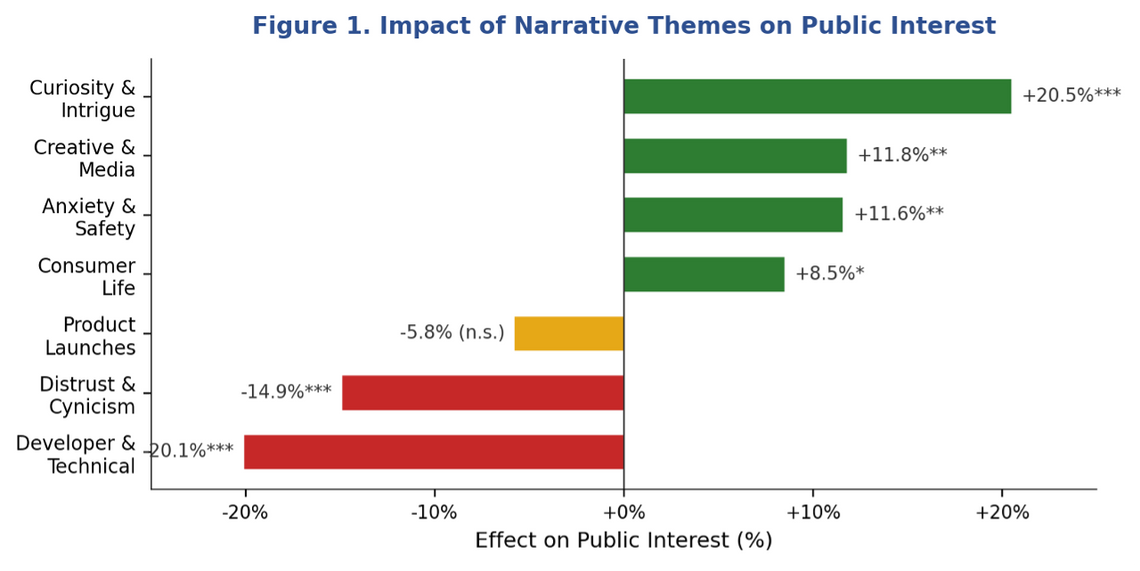 Bayesian hierarchical model, N = 915 brand-weeks, 5 brands. Binary within-brand top-quartile indicators. *** p < 0.001, ** p < 0.01, * p < 0.05.