The Road to Business Impact – Measuring the ROI of Insights
The insights industry has significantly improved its business impact over the past 15 years, according to GRBN’s Insights Maturity Study. This fourth article explores key drivers and strategies to strengthen consumer insights functions.

The insights industry has improved its ability to achieve real business impact over the past 15 years, as demonstrated by GRBN’s Insights Maturity Study. This is the fourth in a series of articles exploring key drivers and strategies to enhance corporate consumer insights functions.
In our introductory article to this series, we laid out the four key drivers of insight maturity – structure and diversity, relationships, ability and communicating proof of value. In our next (and series final) article, we will explore the idea of communicating proof of our value. But before we can do that, we need to understand exactly how to compute our value. The overarching title to this series is The Road to Business Impact, but what exactly is business impact and how can we measure it?
“You can’t measure Return on Investment of insights!!”
How many times have we heard this? Many arguments are put forward as to why measuring the ROI of insights is impossible, the two most cited of which are:
Too much happens between the delivery of insights for success or failure of a business decision to be directly attributed to those insights and
Too many other people are involved in the decision and its activation for insights alone to be credited with its outcome.
As we will seek to show, not only are neither of these arguments relevant but they are both dangerous in that they devalue the immense role that insights play in business today. So much so that, taken at face value, they can lead to false conclusions on the part of senior management such as “we don’t need a full consumer insights team anymore” or “let’s put CI under Information Technology” or even “AI can do it and we can save 50%!”.
Not only this, but these arguments have been proven to be flat out wrong. Our research, in addition to numerous studies carried out by BCG, GRBN and major associations, prove conclusively that measuring insights ROI brings innumerable benefits to CI functions that then allows for even more value to be created for the business.
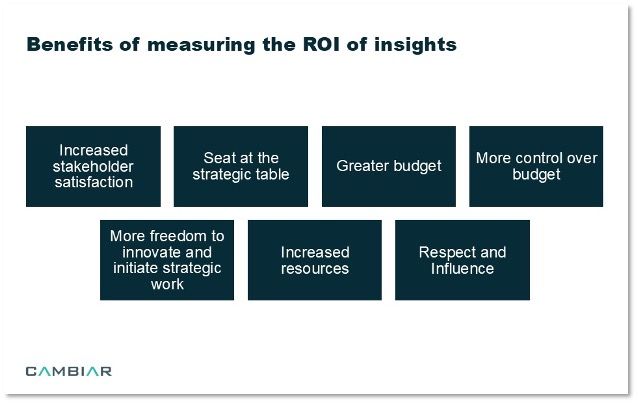
But the best news of all is that not only is it possible to measure the ROI of insights but that 35% of strategic corporate consumer insights functions are systematically doing so today. And another 44% do so on a proportion of their work.[1]
How do they do it? Through three key factors:
By building a framework through which to arrive at an agreed measurement of impact that is not only acceptable to all parties but becomes a key metric that informs corporate decision-making
By adhering to a set of principles that will not only enable measurement but also become part of the fabric of the CI function and its relationship with the rest of the organization
By making impact measurement a cultural pillar of the insights function and its ways of thinking and working.
At this stage, those of you reading this who are on the supply side of the industry might be thinking “how is this relevant to me?” or “how can I apply this in my work?”. The answer is twofold. First, become an active and willing partner in the measurement framework and process of your clients. Increasing and demonstrating the extraordinary impact that insights have on corporate and social health is the responsibility of all players within the industry and profession. By supporting your clients in this mission, you elevate the value of insights overall while also elevating your own perceived value as a strategic partner. Second, collaborating with clients in this way enables you to measure and articulate your own impact. You gain clearer visibility into the value you create, the strength of your partnership and the contribution you make to their outcomes.
Building an Insights Impact Measurement framework
There are three key dimensions to building a framework:
Dimension 1: Granularity – the degree to which impact is measured and the level at which it is most relevant
Dimension 2: Perspective – where is the impact primarily likely to be / being felt and are we looking at impact now or in the future?
Dimension 3: Shades of Impact – how we source and express the impact.
Where Granularity is concerned, they key issue is to discern which elements of the business are implicated by the project in question and how these interrelate.
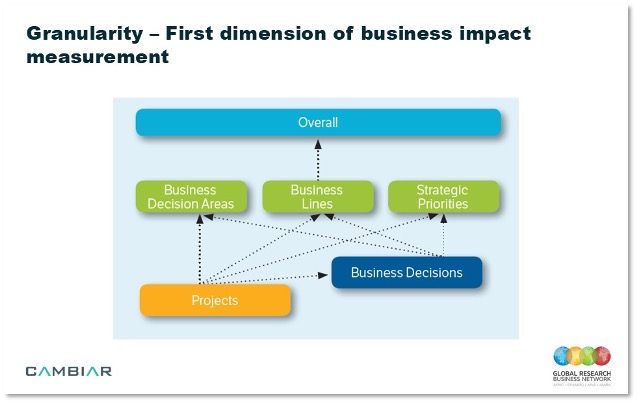
Within each of the areas, there are sub-areas for which the project will be more relevant and its effect or impact that much more relevant as well. For example, within Business Decision Areas, are we talking about the impact of the insights we are generating on strategy, branding, marketing communications, innovation, pricing or customer experience? Each of these will need measurement of impact in different ways but at the same time keeping a common purpose in mind – what the is the impact on the business as a whole?
That being said, Perspective should always be kept in mind – from whose perspective are we measuring impact and are we looking at ROI as it is today or as we expect it to be tomorrow? So, from the perspective of a business line, for example, are we talking about short-term sales impact or forecast sales impact?
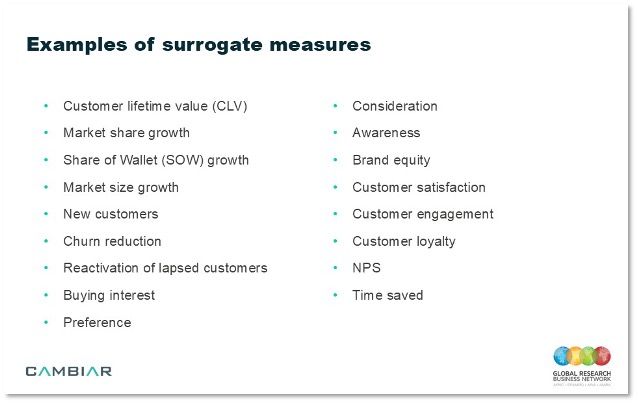
And then there is the question of what indeed are we measuring (Shades of Impact)? From the CFO’s and shareholder’s perspective, the most preferred key measurement would be financial ROI – what’s the revenue effect or the bottom-line effect? In some cases that is relatively easy to compute, but in the majority probably elusive. So, what surrogate measures can we use that could be modeled to point to probable financial outcomes? And how do we decide what types of surrogate measure to use?
In the case of the “what?”, insights professionals are blessed with a plethora of possibilities and choices, a few of which are shown below.
Where the “how” is concerned, not only do we have to take into account the perspectives and attendant granularity discussed above, but we also have to ask a very basic question: are we measuring for growth and opportunity or is this a case of risk management? The surrogate or proxy measures we choose will be very different dependent on the circumstances.
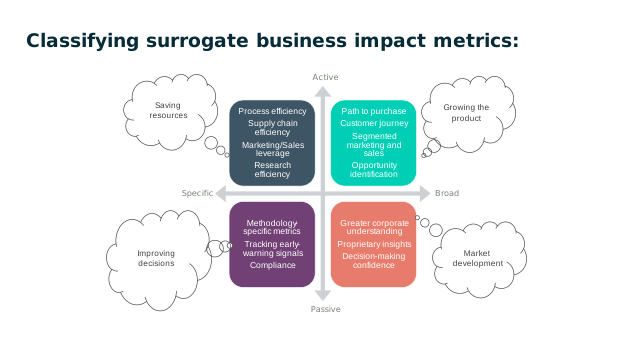
The two figures below show how the answer to this question yields further questions and answers that, together, guide us to all types of proxy impact measurements some of which are more quantitative while others are more “surrogate” or qualitative…
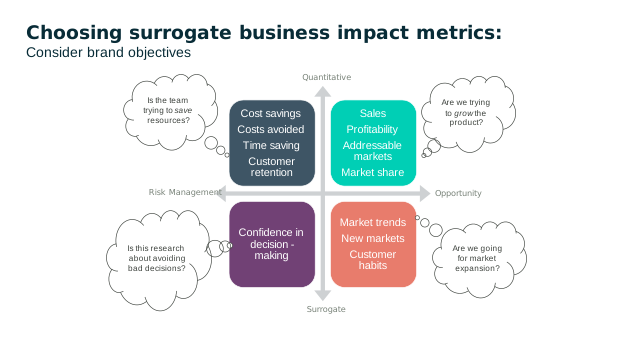
…and some are very specific and active in nature while others can be broader and more passive (for example, the confidence we have in taking the decision).
We recommend starting out on the impact measurement journey slowly, taking baby steps to help iron out initial issues as well as to orient the team(s) to what will undoubtedly be a new and potentially wobbly process in the beginning. Start by measuring the impact of types of work that are simple and rapid, perhaps introducing the concept at first to more process-driven teams in the function as well as to stakeholders who embrace the concept of ROI and want to help. In this way, you can develop systems and processes for deciding what can measured quantitively and financially and what demands the use of surrogate measures. In the latter cases, this will enable the team to build a complete framework of measures to deploy in a complete array of different project and business issue types.
And in those situations where measurement remains difficult or imprecise, you will still be able to capture softer indicators of value, such as feedback, testimonials and anecdotes from decision‑makers who have used your insights to guide their next steps.
Building processes based on principles
Experience has shown that however slowly the CI function starts down the road of impact measurement, it is vital for the measurement process itself to be instilled as a key part of the normal functioning of the organization. The process itself can be individual to the team and the way in which it normally works, but absolutely must be based in four key principles:
Measuring the ROI of Insights is not only possible, it is essential to the wellbeing not only to of the CI function itself but to the business as a whole.
Building a robust ROI measurement system is a collaborative process involving (at a minimum) core stakeholders, Finance and Data Analytics as well as CI.
Credit for business success can be claimed in its totality by all business functions that contribute to that success, including Consumer Insights! It is not something that has to be apportioned.
Because of this, the ROI of Insights is something to be communicated continuously and bravely across the entire business.
As may be expected from these principles, the decision to measure the ROI of Insights is a public commitment of the CI leadership team (and indeed the whole function) to measure and communicate their impact on the business – a commitment that is baked into a roadmap based on CI’s own strategic plan. The plan, roadmap and commitment are shared with senior management and their active support solicited, especially where the CFO is concerned. Once he or she becomes convinced of CI’s real impact on the business, the transformation from being a cost line item in the P&L to an asset on the balance sheet becomes real – and CI’s future as a fundamental part of the way the business is managed is secured.
Aside from Finance, we would also strongly recommend that CI form a strong bond with Data Analytics to help build the models that over time will convert proxy (or surrogate) measures into financial ones, especially where forecasted ROI is concerned.
The switch to measuring impact is cultural…
For the measurement of ROI (business impact) to be seen as real and for its effects to be felt throughout the organization, impact measurement must be adopted as a part of team culture. Every single team member has to make it their responsibility to calculate, report and publicize the impact of their work. This can take time and senior management should not expect miracles overnight. However, by building a core team to develop measurement tools and their scope, combined with coaching and periodic workshops, not only does the process of measuring ROI become a daily part of life – it becomes a cultural mainstay of Consumer Insights and its strategic importance to the business as a whole.
…and so should be communicating that impact
Measurement by itself is not enough!
In order for CI to take its rightful place as a core driver of corporate success, its impact has to be communicated through the organization relentlessly. Of all the drivers of insight maturity – insights being seen and recognized as strategic and a source of competitive advantage – this is the one that is the most vital.
Tune in to our next (and final) article in this series to find out how and why!
[1] GRBN Insights Maturity Study, 2023.
Simon Chadwick
Managing Partner at Cambiar Consulting, Editor in Chief of Research World at EsomarSimon founded Cambiar in 2004 to provide strategic assistance to research and insight companies as they face rapid and fundamental change. With 40 years of guiding and managing international organizations of various sizes and stages, Simon’s advice and counsel has helped many companies increase their value – to stakeholders, investors and clients.
He is an acknowledged industry leader, author and conference speaker. In addition to his role at Cambiar, Simon is also a Fellow of the Market Research Society, past Chairman of the Insights Association and Editor-in-Chief of Research World, ESOMAR’s global magazine.
He holds an MA in Philosophy, Politics and Economics from Oxford University, UK, and has done post-graduate studies at both Columbia and Harvard business schools in Change Management and Strategic Management.