How AI Is Rewiring the Insights Industry: From Experimentation to Integration - Part 1
Usage is close to universal but planning, governance and measurable ROI are lagging. A new study makes the case for a deliberate adoption roadmap.

While examining change and disruption across the Insights industry, Altera Strategy’s recent study explored in depth the progression and impacts of AI adoption. ‘The Future of Insights & the AI Transition 2026–29’, based on 43 interviews with corporate, agency and vendor leaders and 190 industry sources, found that AI is accelerating and reshaping existing trends with consequent changes in industry structure, spend, roles and business models.
As one of the global knowledge industries at the forefront of the AI transition, Insights is evolving on multiple fronts simultaneously, across solutions, workflows, data and talent, and in an environment where AI adoption generally is growing 2.5x faster than prior technology waves.
This two-part article examines initially how AI adoption is progressing in the Insights industry and the benefits it is delivering from the perspective of senior leaders, practitioners and the wider industry. Part two moves on to examine the challenges on the path to AI adoption and the need for a structured Insights AI plan and roadmap to navigate this transition, guide adoption and achieve integration.
Revolution or Transition?
The study asked industry leaders and senior practitioners about a debate at the heart of the industry:
Is AI simply an evolution of existing tools and tasks, or a more fundamental reset of how insight is produced and used?
Most participants landed somewhere in the middle. AI is first seen changing traditional workflows around quantitative and qualitative research delivery, analysis and reporting. Less prevalent but emerging is a future vision of a connected, automated, agentic and predictive Insights function integrated with the enterprise ecosystem.
A common shared belief is that the judgement-based, contextual work that defines genuine insight will retain value as AI becomes ubiquitous, with deep market and customer understanding remaining impactful and valued.
A framing that captures the most common position is:
AI will produce and analyse data at scale, resetting insights workflows and methods, but durable competitive advantage will still be derived from human insight; contextual, synthesised understanding of the customer "why".
Perceptions of the scale and speed of the anticipated disruption also vary. One vendor described Insights as a "$150bn global industry that hasn’t been disrupted and will be", while others were sceptical about the AI boom and how far AI can develop. Most acknowledged the speed of the transition and pressure to keep moving, despite risks and unresolved concerns: "it's just not practical to slow down."
This often creates a tension between the desire to realise the potential and benefits of AI and real reservations about the risks and limitations. What varied was how leaders and practitioners expect this to be resolved: some expect limitations such as hallucinations and inconsistent output quality, to be addressed over the next few years; while others see these issues as inherent to AI.
Universal Use, Uneven Maturity
AI use in Insights is now close to universal, but capabilities and use vary considerably. In the US, industry body, MRSII found 90% of insights professionals are using AI in some form, yet only 13% have it fully integrated into their workflow. Separately, Greenbook's 2026 GRIT Insights Practice Report found corporate practitioners are completing an average of just 2.3 of seven potential AI-enabled tasks, concentrated in data preparation, analysis and reporting rather than more judgement-intensive work.
This study identifies four stages of enterprise adoption in corporate Insights functions and agencies, from Experimentation, then Adoption, Scaling and finally Strategic integration. Most corporates and agencies today are at the second stage, having adopted AI via regular, mostly fragmented LLM, platform or point solution use, but lacking an adoption roadmap, governance, integrated workflows, consistent skills or practices.
Segmenting Insights AI users provides another lens, with the report identifying three broad cohorts along the adoption curve based upon use and attitudes:
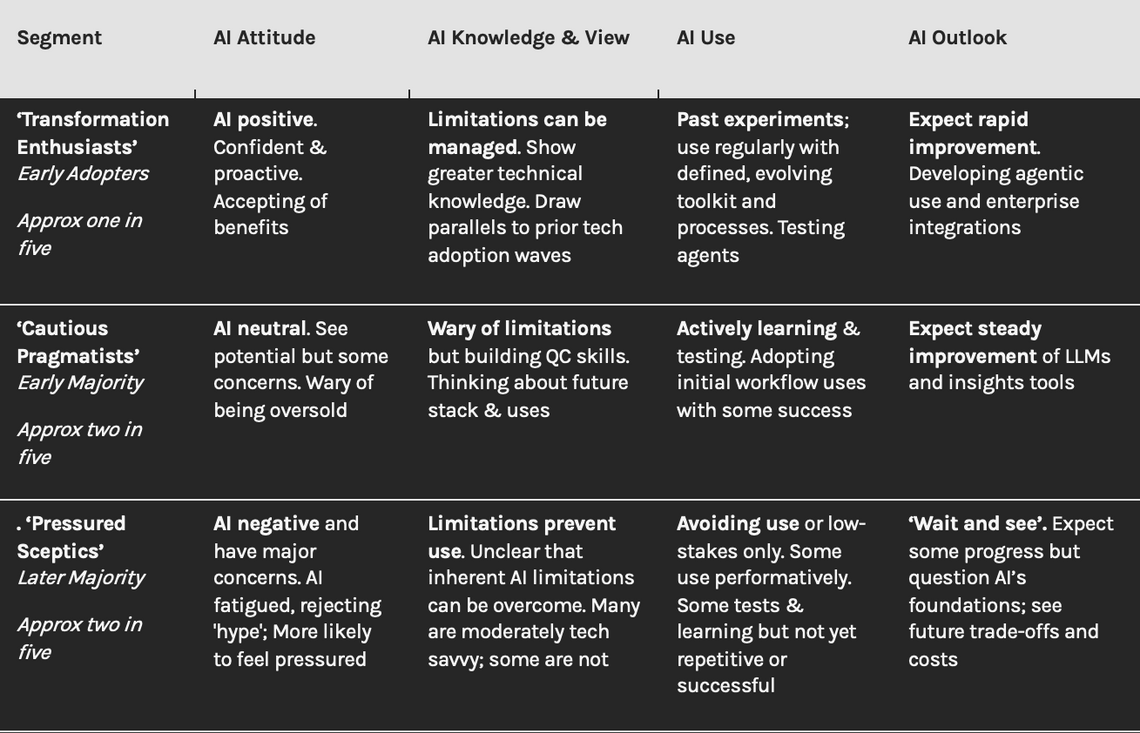
Further work is required to accurately size and track the development of these segments, but they provide a useful framework for corporates, agencies and vendors to consider how they plan, manage and engage with users on their adoption journey, whether in-house or within their client base.
Efficiency benefits dominate for now
When considering the benefits of AI for Insights, saving time on research production and analysis tasks is usually top of mind. Agency leaders and practitioners often talked of the efficiency benefits in specific tasks such as survey scripting, data analysis and report preparation. These benefits were most consistently evident in relation to quantitative research, with fewer perceived drawbacks. For qualitative research, AI tools and LLMs were also used regularly for analysis tasks, but this is accompanied by greater concerns about the limitations and risks of using AI, particularly the loss of the nuance, detail and richness required for qualitative analysis.
Corporate Insights leaders described how AI is helping improve and grow in-house research delivery, enabling their teams to do more with the same resources and improving the ROI of in-house capabilities. Prior to AI, corporate functions operating with small teams could struggle to find time to be hands-on delivering tactical studies. This has shifted and has implications for what is run in-house vs outsourced to agencies. The strategic, higher-stakes work still generally goes to trusted agency partners while AI-enabled platforms and tools can handle tactical, lower-stakes studies.
A major secondary theme was how the efficiencies AI is enabling are shifting methods and design as hybrid methods and qualitative-at-scale gain momentum. Several participants discussed how AI had shifted the economics of qualitative, enabling large multi-country studies or more tactical use of qualitative; uses that were previously prohibitive in cost and timelines. Others described how blended quantitative/qualitative designs were enabled by these same efficiencies when combined with AI-moderated open-ended questions and interviews.
Navigating the Insights AI Transition
While Insights AI adoption has been steadily progressing and substantial benefits accruing to users and their enterprises, there remain substantial challenges and ‘work to be done’ to overcome them. Part 2 of this article will examine the challenges and barriers facing Insights leaders and practitioners and make the case for adopting a structured Insights AI adoption plan and roadmap to navigate this transition successfully in the medium term.
‘The Future of Insights and the AI Transition 2026-29’ is an in-depth, independent study and knowledge base comprising 180 pages and 256 perspectives from 43 insights leader interviews and 190 industry sources. More information can be found at: https://www.alterastrategy.com/services