AI Has Not Reduced the Human Contribution to Design Research. It Has Concentrated It.
Eleven capabilities are now doing the work that production used to hide, and most organisations are still hiring for throughput.

It is tempting to read the current wave of AI adoption as the slow erosion of the human contribution to design and research. The assumption runs that as models absorb more of the analysis, the synthesis, and even the prototyping, the people in the room become progressively less necessary. Methodologically and commercially, that reading is wrong. As AI takes over the predictable, the patterned, and the procedural, the value of what only humans can do does not shrink. It concentrates.
This is a structural observation about where judgement now sits, not a comforting message dressed up as analysis. When a generative tool can produce ten onboarding flows in the time it once took to sketch one, the scarce capability is no longer production. It is the ability to decide which flow deserves to exist, whom it serves, what it costs the user in cognitive load, and whether it should ship at all. Those are human questions. They always were. AI has simply made them the whole job.
What follows sets out the human capabilities that grow in importance as AI reshapes UX and design research, drawing on recent work from McKinsey, Nielsen Norman Group, IDEO, Microsoft Design, and academic studies on co-design. It also translates that evidence into something teams can use: a competency model, a way to write the role, a development pathway, and implications for hiring, team design, and education.
Why AI Raises the Premium on Human Judgement
The clearest finding across the workforce research is that automation does not remove the need for higher-order human work. It relocates it. McKinsey's analysis of AI and the future of work concludes that as machines absorb routine tasks, workers lean more heavily on the capabilities machines do not offer: judgement, relationship-building, critical thinking, and empathy. In the same body of research, McKinsey estimates that more than 70 % of the skills in demand for heavily AI-augmented roles remain human skills rather than technical ones. The strategic implication is direct. Organisations that treat the people side of an AI transformation as seriously as the technology side are the ones that capture the productivity gains. The rest buy the tools and miss the return.
Nielsen Norman Group reaches a parallel conclusion from inside the design discipline. Their guidance is that AI will not eliminate the need for fundamental capabilities such as understanding people and asking the right questions. Designers hold their value by moving up the stack toward strategy, storytelling, and what the group calls design taste, meaning the developed judgement about what is good and why. The economic literature and the design literature arrive at the same place. AI changes how the work is done. It does not change the fact that someone has to understand the human on the other side of the screen.
There is a practical reason this matters for research specifically. AI systems are confident and fluent, and that fluency is precisely what makes uncritical adoption risky. A model will generate a recommendation, a persona, or a synthesis in the same assured tone whether the underlying signal is strong or hollow. The human role is to interrogate that output, to ask whether the data supports it, whether the framing is right, and whether the solution addresses the problem the team set out to solve. That interrogation is not a soft skill in the dismissive sense. It is the control function that determines whether AI creates value or scales a mistake.
The Capabilities That Concentrate
I have grouped these by the function they perform rather than listing them as isolated traits, because in practice they operate together.
Empathy and cultural competence. AI does not possess genuine understanding of human context. It pattern-matches against text. A human researcher notices the pause before an answer, the gesture that contradicts the words, the frustration a participant is too polite to state. Perficient's analysis of AI in UX makes the point plainly: a chatbot can follow a script, but only a human perceives stress, confusion, or anger in the way a user actually communicates. Cultural competence is the same capability extended across difference, and it carries a corrective function, because models inherit the biases of their training data and those biases surface as misinterpretation when a system meets a population it was not built to serve. For research teams, this means empathy and cultural competence are not personality attributes to hope for in a hire. They are core methods.
Critical thinking and systems thinking. Nielsen Norman Group's consulting work found that clients expect practitioners to synthesise evidence and make informed recommendations rather than present a menu of AI-generated options. In one enterprise project the group describes, a team had built an AI recommendation engine, and research revealed that different internal groups were working from inconsistent decision criteria. Deploying the feature would have automated that inconsistency at scale rather than resolving it, so the team recommended delaying launch until the human groups aligned on shared inputs. That insight existed only because someone thought critically about the workflow before trusting the system built on top of it. Systems thinking extends the same discipline across data flows, organisational processes, legacy constraints, and long-term consequences. When a designer reaches for a rapid AI tool, the value they add is not speed. Speed is the commodity the tool already supplies. The value is tracing the user journey through interconnected systems so the fast output does not become a shallow artefact disconnected from the constraints around it.
Ethical judgement. Bias, privacy, accountability, and unintended consequences are now design parameters rather than afterthoughts. Humans set the constraints that define acceptable outcomes, because a model optimises toward whatever objective it is given without any sense of whether that objective is right. Perficient frames the trade-off between personalisation and privacy as a moral grey zone that qualitative human research is built to navigate. The emergence of dedicated roles such as the AI ethicist, which McKinsey notes draws on ethical frameworks and policy rather than technical skill, confirms that ethics is now a named competency rather than an assumed background quality. In practice, it means reviewing AI-generated content before it reaches users, securing genuine consent for data use, protecting user autonomy, and guarding against harms a model will reproduce without hesitation if no one stops it.
Storytelling and communication. AI can draft text and generate visualisations, but it cannot decide which finding matters most to this audience, in this moment, for this decision. That editorial judgement is human. Nielsen Norman Group's client work found that clients value clear thinking and plain language as much as the underlying analysis. As AI automates the production of charts and reports, the differentiating capability becomes the human ability to listen, present, persuade, and facilitate a conversation that ends in a decision. Insight that is not communicated is insight that does not act.
Facilitation, co-design, and collaboration. The value of facilitation becomes more visible when AI enters the room, because the tool generates raw material that still needs a human to organise, prioritise, and direct toward a decision. A recent academic study on participatory co-design makes this concrete. Researchers ran a workshop using an AI visualisation tool, and participants with no formal design training were able to sketch and then refine their ideas with the AI acting as an intermediary, which widened participation and produced a richer range of ideas. The key detail is that the human facilitator still taught the co-design principles, guided the dialogue, and framed the problem. The AI amplified the session. It did not run it.
Contextual inquiry and observation. A system can process logs and click data, but understanding why a person behaves as they do requires a human observer who can ask the unscripted follow-up, adapt the probe to what just happened, and read the tone and body language that a sentiment model flattens into a score. AI can usefully flag patterns in transcripts. A human has to validate whether those patterns reflect genuine user intent or surface noise.
Synthesis and the craft of prototyping. Microsoft Design's account of a workshop in which a team imagined itself as the AI supporting enterprise users is instructive. The UX researcher organised more than four hundred sticky notes into meaningful clusters and used the team's AI assistant to help extract themes. Still, the grouping, the emphasis, and the decisions about wording all rested on human judgement. The tool accelerated the work. A person still authored the narrative. Prototyping follows the same pattern. Perficient describes AI accelerating the production of wireframes and flows, after which a human refines the design to inject brand personality and warmth. The designer is the one who makes the interface feel intentional and accessible, who tests it with real users, and who iterates.
Curiosity, adaptability, and stakeholder management. Three further capabilities determine whether all of the above stays current. Curiosity keeps a practitioner relevant in a field where tools change quarterly. Adaptability is its companion, and Nielsen Norman Group's adaptable generalist is the practitioner who treats change as the operating condition rather than the disruption. Stakeholder management is the human work of aligning interests, building trust, and steering decisions, and AI cannot perform any of it. In a UX context, the stakeholder manager is the person who presents research to executives, negotiates priorities with product, and, when the AI-generated options flood the table, has the standing to say the team should align on the problem before automating a solution.
What the Documented Cases Show
The pattern across published cases is consistent. AI performs best where a human applies insight to it.
A healthcare provider described by IDEO used AI-powered sentiment analysis to surface pain points across a large volume of patient feedback, and human researchers then interpreted those signals to improve service delivery. The AI handled the scale. The empathy and systems thinking that made the findings actionable were human. In a second IDEO case, a technology startup used generative design and AI brainstorming to accelerate ideation for a wearable device. At the same time, human designers held the vision and used storytelling and taste to select and refine the winning concept. Nielsen Norman Group's two consulting examples, the delayed recommendation engine and the AI-personalised onboarding that increased cognitive load until a human-crafted baseline was restored, both show human-centred research correcting overreliance on automation. Read together, these cases describe a single operating model. AI is the instrument. The human is the guide, the editor, and the one accountable for the decision.
A Competency Model Teams Can Use
Naming the capabilities is not enough. They have to be defined, developed, and assessed. The model below sets out three levels of proficiency, and it deliberately excludes tool knowledge, because the focus is the human contribution the tools cannot supply.
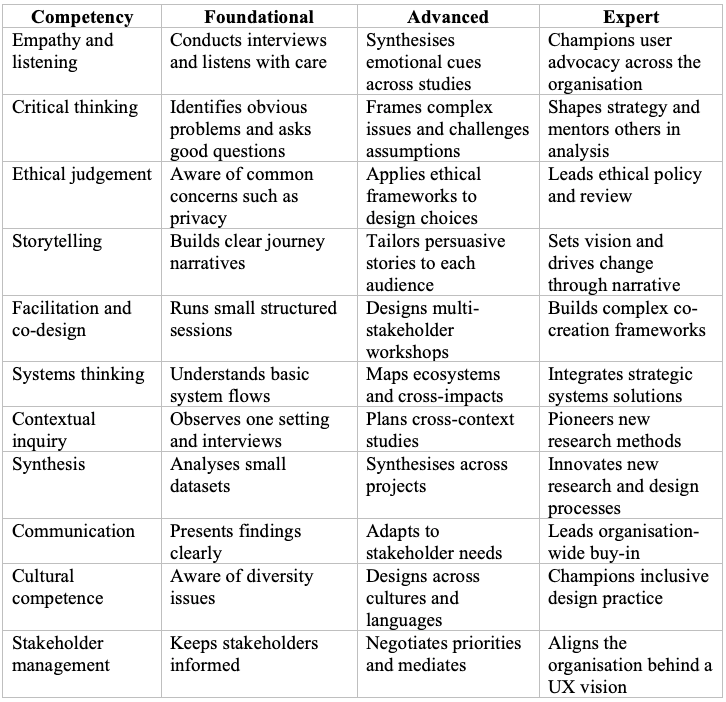
Each organisation should adapt the model to its own context, but the principle holds. The expectations that drive hiring and development should be written in terms of human competency, because that is the contribution being bought.
Writing the Role, and Building the Pathway
The shift shows up most concretely in how a role is described. A specification for a UX researcher working on AI products should make the human capabilities explicit requirements rather than implied background: leading research for AI-enabled features, applying contextual inquiry, collaborating with engineers to define genuine user needs, telling credible user stories to stakeholders, and guiding design with both empathy and ethical judgement. The qualifications should value a track record of research that drove decisions over a list of tools mastered. Written this way, the specification signals that the organisation is hiring judgement rather than throughput.
Capabilities of this kind are built through deliberate practice over time, not absorbed from a single course. A workable pathway across twelve to twenty-four months moves from the personal capabilities outward to the collaborative and strategic ones. The early months strengthen empathy and observation through structured interviews, persona work, and field study. The middle period adds contextual inquiry at greater depth, synthesis practice, and storytelling craft, ideally on live projects so the learning is grounded in real stakes. The later months tackle systems thinking, facilitation of complex sessions, ethical review, and stakeholder leadership, which need the earlier capabilities in place first. Mentorship accelerates the whole arc, and quarterly reviews against the competency model keep development honest.
Assessment should match the capability being measured. Facilitation reveals itself in workshop outcomes and attendee feedback. Storytelling shows in the clarity of a journey map or the effect of a presentation. Critical thinking can be tested by asking a candidate to critique an AI-generated design. Ethical judgement responds well to scenario questions that ask a practitioner to reason through a real trade-off.
Implications for Hiring, Teams, and Education
For hiring, interview processes should test human-centred capability directly rather than inferring it from a portfolio of artefacts. Competency-based interviews, work trials, and case exercises surface empathy, critical thinking, and communication in ways a tool checklist does not. For leadership roles, the weight shifts further toward strategic judgement and the ability to align people.
For team composition, the balance to strike is between AI-literate technical capability and human-centred design judgement. New roles are emerging at that intersection, including the AI ethicist and the strategist who specialises in human and AI interaction, and existing staff need AI literacy in the specific sense of understanding what the tools can and cannot do. A designer who can interrogate a dataset, or a researcher comfortable steering an AI analysis tool, holds an advantage precisely because they can keep human judgement in command of the technical capability.
For education, curricula in human-computer interaction and design need to treat human and AI collaboration as a core topic rather than an elective, teaching students to use AI as an instrument while staying focused on the user and the context. Programs that pair this with explicit instruction in ethics, storytelling, and facilitation will produce graduates equipped for the work as it now is.
Conclusion
AI does not diminish the human contribution to design and research. It exposes which parts of that contribution were always the point. Production was never the value. The value was understanding people, framing the right problem, exercising judgement under uncertainty, and taking responsibility for a decision. Enough of the surrounding work is now automated that those capabilities stand uncovered as the discipline's differentiating skills.
The implication for practitioners and the organisations that employ them is to invest in human-centred capability with the same seriousness applied to the tooling. Practitioners should treat AI as an instrument for ideation and acceleration while continuing to ask whom the work serves and why. Leaders should fund the time and mentorship that empathy, judgement, and facilitation require, and should reward those qualities in performance reviews rather than treating them as nice-to-have. Educators should build the next cohort to operate at the intersection of human insight and machine capability.
McKinsey's conclusion is the right one to close on. The organisations that capture the full benefit of AI are those that leverage their people as seriously as their technology. In UX and design research, that means doubling down on the human capabilities that matter more, not less, as the machines grow more capable. The scarce resource was never the output. It was the judgement that decides what the output should be.
If you were rewriting your own team's role descriptions this quarter, which of these eleven competencies would survive the edit, and which are still sitting in the nice-to-have column?
I am a research strategist who partners with businesses, technology organisations, and SaaS teams to turn research into clear strategic direction and measurable impact. I work hands-on across the full research lifecycle, spanning academic, consulting, industry, and policy research, with a strong focus on evidence-based decision-making.
My expertise brings together data-driven insights, UX and CX (Voice of Customer) research, strategic research planning, stakeholder engagement, and robust survey and measurement design. Using a mix of primary and secondary research methods, I help organisations move beyond surface-level insights to understand what truly drives customer behaviour, product adoption, and long-term value.
As a customer-centred, insights-led researcher, I focus on uncovering human behaviours, habits, motivations, and attitudes to help teams design products, services, and strategies grounded in real-world needs. I’m particularly drawn to emerging technologies and SaaS environments, where strong research can shape how people learn, work, and interact at scale.
Beyond UX and customer research, I bring deep experience in strategic research program design, vendor management, and cross-sector collaboration. I work closely with senior stakeholders and interdisciplinary teams to ensure research findings are translated into actionable strategy, product roadmaps, and policy-ready recommendations.
I actively contribute to the research and technology community through thought leadership, including writing on Medium and publishing a LinkedIn newsletter focused on research practice and emerging industry trends. I also partner with SaaS companies to evaluate user research platforms and capabilities, providing practical, real-world feedback that informs product innovation.
Forward-thinking and outcomes-focused, I bridge academic rigour, industry innovation, and strategic insight to help organisations build better products, make confident decisions, and deliver meaningful customer experiences.