From Data to Decision: Why Insight Must Lead Action
The Insight250 spotlights and celebrates 250 of the world’s premier leaders and innovators in market research, consumer insights, and data-driven marketing.

Article series
Insight250
- The importance of business sense in research
- The role of humour in effective leadership
- The importance of ethics
- The importance of disruption in innovation and leadership
- The importance of Disruption in Innovation and Leadership Part 2
- The importance of Diversity & Inclusion
- The impact of colour
- Communicating insight with impact
- Insights on leadership, culture and polling
- The evolution of electric vehicles
- 2022 Top tips (part 1)
- 2022 Top tips (part 2)
- Maximising the potential of data
- The importance of flexible working
- Winners
- The importance of advanced analytics
- Judges for the 2022 Insight250 Awards announced
- The evolution from social listening to digital intelligence
- The Judges' Perspective
- The judge's perspective - part 2
- Insight Climate Collective
- Insights technology
- Understanding employee ownership
- Global insight perspectives
- Top Tips from our Leaders and Innovators
- The Evolution of Insights in the Food & Beverage Market
- The Evolution of Insights in CPG
- Neural Mechanisms Behind Consumer Decision-Making
- Celebrating and Elevating the Insights Industry
- The State of the Insights Industry
- Opportunities, challenges and threats that AI presents
- 2024 Insight250 Winners Announcement
- Connecting Brands and Consumers Through Insights
- The Importance of Human Insight and Attention
- The Elevating Role of Insights with Technology Innovation
- Haleon’s Insight Expert on Consumer Healthcare
- Insight from the Insight250: How AI is Impacting Qualitative Research
- How AI Tech is Doing the ‘Heavy Lifting’ for Insights
- Reviewing the top tips for 2025
- Google's Sarah Ashley on AI and revolutionising insights - Insights from the Insight250
- Beyond BI: The Future of Decision Intelligence for Insight Professionals
- The Advancement & Impact of Insights - An Insight250 Winners Series perspective with David Smith
- International Jury for the 2025 Insight250 Awards Announced
- Newly elected President, Anne-Sophie, on Revolutionizing the Impact of Insights
- Haleon's Litthya Baez on Enhancing Healthcare with Insights - Insight250 Winners Series
- Understanding the Insights of Consumer Decisions
- Moving Beyond Dashboards to Deliver Decisions with AI
- How AI is Transforming Insights
- How AI is Transforming Insights
- Five Years of Insight250: Elevating the Insight Industry
The Insight250 spotlights and celebrates 250 of the world’s premier leaders and innovators in market research, consumer insights, and data-driven marketing. The awards have created renewed excitement across the industry whilst strengthening the connectivity of the market research community. Winners of the 2025 Insight250 were announced last September - you can see the full list of Winners at Insight250.com.
With so many exceptional professionals named to the Insight250, we regularly tap into their expertise and unique perspectives across various topics. This regular series does just that: inquiring about the expert perspectives of many of these individuals in a series of short topical features.
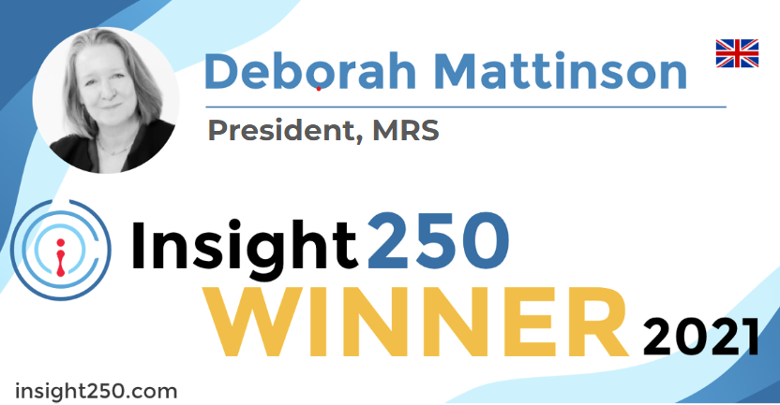
With technology advancing at an incredible pace and the value of insights ever increasing, I sat down with Insight250 Winner Deborah Mattinson. With over 25 years of experience in research-based strategy, Deborah serves in the House of Lords and has recently been appointed as President of MRS (The UK professional & trade association and regulator) in its 80th year. Previously, she was also the Co-founder of BritainThinks, a research and strategy consultancy, and was Joint Chair and CEO of Chime Research.
Crispin: You’ve had a remarkable journey from co-founding both Opinion Leader and BritainThinks to working with senior political leaders and now serving in the House of Lords and as President of MRS. How have your experiences across research, politics, and advisory roles shaped your view of the role of insight in decision-making?
DM: “It’s so straightforward - decisions informed by insight are better than decisions informed by a hunch! That’s as true for politicians as it is for business leaders.”
Crispin: You’ve said, “Information is power. If you don’t use it, you don’t have power.” How do you see that principle applying not just in politics but in business leadership and corporate strategy?
DM: “I think too often the default for market researchers is to collect the data, analyse it, and present it back without thinking hard enough about how it might be used. That leaves us underpowered. Either our work won’t have the significance that it should, or someone else will claim it for their own by interpreting it and applying it. That’s why I believe that we must swim upstream and own the implications of our research as well as the findings themselves: become strategists. That’s as true whether you are an agency or in-house and whether you are working on brand strategy, corporate strategy, or political strategy.”
Crispin: Many organisations collect vast amounts of data but struggle to turn it into an actionable strategy. What are the common barriers you see to turning insight into organisational decision-making - and how can they be overcome?
DM: “This is about relationship building. I would often say to my team, ‘You're not in the business of collecting data, you’re in the business of building relationships.’ It is only by really understanding what your client - internal or external - wants (needs?) to achieve that you can make your work relevant. If organisations are collecting vast amounts of data but not using it, it is because the market research function is not on the inside track, not understanding what the objectives are, and failing to sell the findings as solutions. Get out from behind your laptop and get to know your clients and colleagues. Become an integral part of the mix. Make your data indispensable to the project.”
Crispin: Given your experience advising Gordon Brown and Sir Keir Starmer, what lessons could politicians learn from the research industry’s mantra “Evidence matters”? How might evidence-driven insight strengthen public trust?
DM: “The trust gap in politics can only be narrowed by improved mutual understanding. That is a two-way street - politicians need to understand the public they serve much better, and the public needs to have a better sense of what politicians are trying to do - that means better communications. None of this can be done well without insight - politicians need to understand what voters think - and say - about them when they are not in the room. So, of course, evidence matters; hence, this has been the core of MRS communications and we will be doubling down on it for our 80th anniversary this year.”
Crispin: As the newly appointed President of MRS during its 80th anniversary year, what are your strategic priorities for championing the research and insight sector in an age of AI and rapid technological change?
DM: “I think the more rapid the technology change, the more important it is to take on the strategic role I’ve outlined. And of course, we must embrace new technologies - MRS has been resilient and thrived over the past 80 years because it has done just that. This is not a choice. But AI cannot replace all traditional methods - as the MRS debate last week confirmed. We need to understand where it can enhance what we do and develop hybrid methodologies.”
Crispin: You’ve championed both qualitative depth and quantitative rigour in research. In an era of big data and AI, how should organisations balance these methodologies to ensure insights lead to real understanding and better decisions?
DM: “We need to be clear about what the advantages and shortcomings of each methodology are. The balance will depend on what we are trying to achieve. We need as many options as possible in our toolbox. And we need a new emphasis on professional skills, whatever the methodology.”
Crispin: With democracies and markets facing increasing polarisation, misinformation, and complexity, what role can insight professionals play in helping organisations and leaders make better decisions - and avoid misinterpretation of data?
DM: “Our starting point must always be to demonstrate the value of what we do. And of course, we must challenge misinformation. I believe we have a duty to give citizens (and consumers) a seat at the table and a real say in decision-making.”
Crispin: Finally, what would be your “Top-Tip” or piece of advice that you would share with emerging leaders in insight, marketing, and strategy who want to influence positive change in their organisations and sectors?
DM: “In summary, build relationships, understand the challenges, and see research as a problem-solving tool. Get the best people around you and strive to elevate your collective role.”
Crispin: Thank you for sharing the unique perspective you have on research and insights. It’s been fantastic to hear your thoughts on the state of the industry and how the innovation of insights will continue to play a leading role in evolving our world.
Crispin Beale
Chairman at QuMind, CEO at Insight250, Senior Strategic Advisor at mTab, CEO at IDXCrispin Beale is a marketing, data and customer experience expert. Crispin spent over a decade on the Executive Management Board of Chime Communications as Group CEO of leading brands such as Opinion Leader, Brand Democracy, Facts International and Watermelon. Prior to this Crispin held senior marketing and insight roles at BT, Royal Mail Group and Dixons. Crispin originally qualified as a chartered accountant and moved into management consultancy with Coopers & Lybrand (PwC). Crispin has been a Board Director (and Chairman) of the MRS for nearly 20 years and UK ESOMAR Representative for c15 years. As well as being CEO of Insight250, Crispin is currently Worldwide CEO of Digital Communications Solution Agency, IDX. Crispin is also the Senior Strategic Advisor at mTab and the Chairman of QuMind and spent 4 years as Group President of Behaviorally where he was responsibile for the client & commercial teams globally. Crispin is a passionate advocate for blending human intelligence and technology to deliver innovation and leadership across organisations.
Article series
Insight250
- The importance of business sense in research
- The role of humour in effective leadership
- The importance of ethics
- The importance of disruption in innovation and leadership
- The importance of Disruption in Innovation and Leadership Part 2
- The importance of Diversity & Inclusion
- The impact of colour
- Communicating insight with impact
- Insights on leadership, culture and polling
- The evolution of electric vehicles
- 2022 Top tips (part 1)
- 2022 Top tips (part 2)
- Maximising the potential of data
- The importance of flexible working
- Winners
- The importance of advanced analytics
- Judges for the 2022 Insight250 Awards announced
- The evolution from social listening to digital intelligence
- The Judges' Perspective
- The judge's perspective - part 2
- Insight Climate Collective
- Insights technology
- Understanding employee ownership
- Global insight perspectives
- Top Tips from our Leaders and Innovators
- The Evolution of Insights in the Food & Beverage Market
- The Evolution of Insights in CPG
- Neural Mechanisms Behind Consumer Decision-Making
- Celebrating and Elevating the Insights Industry
- The State of the Insights Industry
- Opportunities, challenges and threats that AI presents
- 2024 Insight250 Winners Announcement
- Connecting Brands and Consumers Through Insights
- The Importance of Human Insight and Attention
- The Elevating Role of Insights with Technology Innovation
- Haleon’s Insight Expert on Consumer Healthcare
- Insight from the Insight250: How AI is Impacting Qualitative Research
- How AI Tech is Doing the ‘Heavy Lifting’ for Insights
- Reviewing the top tips for 2025
- Google's Sarah Ashley on AI and revolutionising insights - Insights from the Insight250
- Beyond BI: The Future of Decision Intelligence for Insight Professionals
- The Advancement & Impact of Insights - An Insight250 Winners Series perspective with David Smith
- International Jury for the 2025 Insight250 Awards Announced
- Newly elected President, Anne-Sophie, on Revolutionizing the Impact of Insights
- Haleon's Litthya Baez on Enhancing Healthcare with Insights - Insight250 Winners Series
- Understanding the Insights of Consumer Decisions
- Moving Beyond Dashboards to Deliver Decisions with AI
- How AI is Transforming Insights
- How AI is Transforming Insights
- Five Years of Insight250: Elevating the Insight Industry