Unlocking GenAI’s Creative Potential for Data Storytelling
Crispin sat down with Insight250 Winner Caroline Florence, to discuss how GenAI offers more than just time-saving benefits and has the potential to become a true creative collaborator for data storytelling.

Article series
Insight250
- The importance of business sense in research
- The role of humour in effective leadership
- The importance of ethics
- The importance of disruption in innovation and leadership
- The importance of Disruption in Innovation and Leadership Part 2
- The importance of Diversity & Inclusion
- The impact of colour
- Communicating insight with impact
- Insights on leadership, culture and polling
- The evolution of electric vehicles
- 2022 Top tips (part 1)
- 2022 Top tips (part 2)
- Maximising the potential of data
- The importance of flexible working
- Winners
- The importance of advanced analytics
- Judges for the 2022 Insight250 Awards announced
- The evolution from social listening to digital intelligence
- The Judges' Perspective
- The judge's perspective - part 2
- Insight Climate Collective
- Insights technology
- Understanding employee ownership
- Global insight perspectives
- Top Tips from our Leaders and Innovators
- The Evolution of Insights in the Food & Beverage Market
- The Evolution of Insights in CPG
- Neural Mechanisms Behind Consumer Decision-Making
- Celebrating and Elevating the Insights Industry
- The State of the Insights Industry
- Opportunities, challenges and threats that AI presents
- 2024 Insight250 Winners Announcement
- Connecting Brands and Consumers Through Insights
- The Importance of Human Insight and Attention
- The Elevating Role of Insights with Technology Innovation
- Haleon’s Insight Expert on Consumer Healthcare
- Insight from the Insight250: How AI is Impacting Qualitative Research
- How AI Tech is Doing the ‘Heavy Lifting’ for Insights
- Reviewing the top tips for 2025
- Google's Sarah Ashley on AI and revolutionising insights - Insights from the Insight250
- Beyond BI: The Future of Decision Intelligence for Insight Professionals
- The Advancement & Impact of Insights - An Insight250 Winners Series perspective with David Smith
- International Jury for the 2025 Insight250 Awards Announced
- Newly elected President, Anne-Sophie, on Revolutionizing the Impact of Insights
- Haleon's Litthya Baez on Enhancing Healthcare with Insights - Insight250 Winners Series
- Understanding the Insights of Consumer Decisions
- Moving Beyond Dashboards to Deliver Decisions with AI
- How AI is Transforming Insights
- How AI is Transforming Insights
- Five Years of Insight250: Elevating the Insight Industry
The Insight250 spotlights and celebrates 250 of the world’s premier leaders and innovators in market research, consumer insights, and data-driven marketing. The awards have created renewed excitement across the industry whilst strengthening the connectivity of the market research community. Winners of the 2025 Insight250 were announced this past September - you can see the full list of Winners at Insight250.com.
With so many exceptional professionals named to the Insight250, we regularly tap into their expertise and unique perspectives on a range of topics. This regular series does just that: inquiring about the expert perspectives of many of these individuals in a series of short topical features.
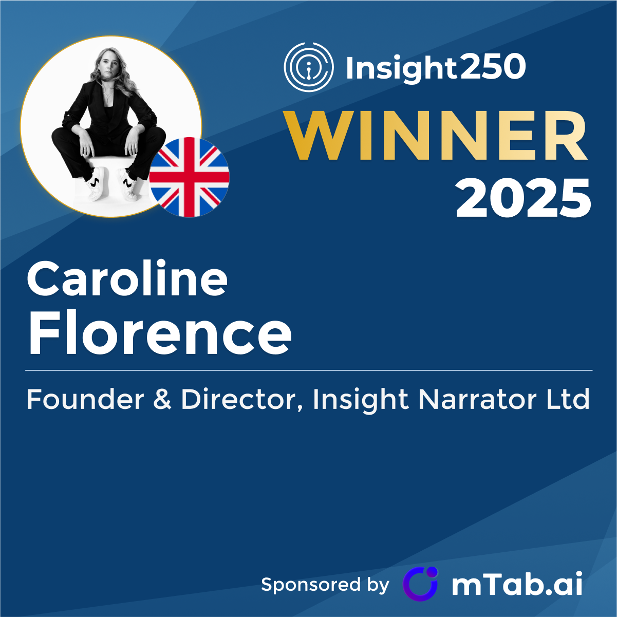
As Artificial Intelligence (AI) continues to create disruption across the insight industry, I sat down with Insight250 Winner Caroline Florence, Founder & Director, Insight Narrator, to discuss how GenAI offers more than just time-saving benefits and has the potential to become a true creative collaborator for data storytelling.
Crispin: Where are you seeing GenAI genuinely elevating data storytelling?
CF: GenAI is accelerating the early parts of the storytelling journey and compressing the time between accessing raw data and generating compelling content. Already, we are seeing many researchers and insight professionals leaning on GenAI to help them distil complex analysis into concise summaries. For me, the more interesting examples of GenAI and data storytelling are when it is used to explore alternative angles, create ‘what-if’ narratives, draw connections, and provoke deeper thinking. If we only ask it to condense, we never access that potential. This capability can help us synthesise across multiple unstructured sources to find the coherent narrative thread, reframe stories for different audiences, and create engaging outputs that resonate with stakeholders. These are the applications where GenAI stops being an admin function to help save time and becomes part of the insight generation and creative storytelling process.
Crispin: What role does the human-in-the-loop need to play to ensure high-quality data storytelling?
CF: GenAI can generate ideas from the data, but it has no sense of strategic relevance, organisational priorities, or emotional nuance. To ensure high-quality data storytelling, the insight professional still needs to frame the context and the decision that the story needs to inform, to challenge and validate the outputs, and to make the judgement regarding what is meaningful and matters the most. Human input and direction also provide the emotional resonance. Data stories land with the audience because the storyteller chooses the right metaphor, the right tension, or the right moment to prompt action.
Crispin: What does this shift mean for the skills insight professionals now need to prioritise?
CF: As AI takes over the mechanical tasks, the essential principles of good data storytelling that I shared in my book become even more important. In practice, this means dialling up our critical thinking skills to be able to pinpoint the problem statement, frame the decision, select the most important signals from the noise, recognise bias, and manage uncertainty. Those responsible for insight generation and business intelligence still need to ensure the integrity of how the data story is formed, so strong analysis and interpretation skills are a must.
Crispin: What are the biggest advantages of using GenAI beyond speed?
CF: GenAI can provide creative scaffolding to help identify provocative points of view and key tension points to define the narrative arc. While humans don’t have the time to generate multiple story options, using GenAI can quickly offer a range of potential angles or help adapt the story for different audiences and channels. Using GenAI to create audience personas can allow you to quickly stress test the narrative and isolate areas of weakness that need improving or engaging hooks that help land the message more efficiently.
Crispin. And what are the limitations or risks?
CF: I don’t buy into the idea that AI is eroding creativity. Done well, it should make creativity more accessible. But there are some downsides if we over-rely on the tool. Depending on the quality of your prompts, GenAI can produce superficial insight with weak logic and fabricated facts that create a false sense of certainty, which crumbles under scrutiny. The tone, structure, and even outputs can start to feel the same with each story, making the story feel generic and lacking in depth. And while it can be great at distillation and help with brevity, the summaries it generates can also flatten complexity, resulting in data stories that lack tension, nuance and originality. To work around these limitations, you still need to spend time checking the outputs, and sometimes it can take longer to iterate on your story using GenAI than just using your own capabilities.
Crispin: So, what’s your top tip for avoiding the pitfalls and unlocking the creative potential?
CF: Use it intentionally and really think about what you are asking it to do. Shift the first question you ask. Instead of asking GenAI to summarise the findings, start with prompts like “What questions does my draft story raise and what alternative interpretations do I need to consider to stress-test and validate my recommendations?” Then apply human judgement ruthlessly - refine, prioritise, edit, and challenge, until the story is genuinely meaningful.
Crispin: What do you see as a ‘hot topic’ in data storytelling right now?
CF: The emergence of new tools that can help you create compelling outputs more efficiently and effectively is exciting. Tools such as Google Notebook LM, Story Builder GPT, Google Gemini Storybook and Claude Artifacts all offer interesting ways to communicate the story and land the message with the audience. They can quickly help you to turn multimodal inputs, including text, images, data charts, video and audio, into cohesive, visually engaging story outputs such as interactive flipbooks, quizzes and explorable infographics.
As GenAI becomes woven into the insight toolkit, the opportunity is not simply faster summaries but more creative, more adaptive, and more resonant stories. The teams that use these tools intentionally and keep a human foundation will succeed.
Crispin: Caroline, thank you for sharing your expertise in data storytelling. It’s been great to hear your thoughts on how GenAI can elevate data storytelling and the skills we need to build and nurture to leverage the tools. Finally, where can people get your book?
CF: The book is available via Amazon and all good bookstores. However, if you buy directly from the Kogan Page website (click here) and use the code DSM20 at checkout, you can access a 20% discount.
Crispin: Caroline, thank you for sharing your expertise on such a timely and impactful topic as generative AI. It’s been wonderful to hear your thoughts on this evolution AI is bringing to research and where you see it evolving in the future.
Crispin Beale
Chairman at QuMind, CEO at Insight250, Senior Strategic Advisor at mTab, CEO at IDXCrispin Beale is a marketing, data and customer experience expert. Crispin spent over a decade on the Executive Management Board of Chime Communications as Group CEO of leading brands such as Opinion Leader, Brand Democracy, Facts International and Watermelon. Prior to this Crispin held senior marketing and insight roles at BT, Royal Mail Group and Dixons. Crispin originally qualified as a chartered accountant and moved into management consultancy with Coopers & Lybrand (PwC). Crispin has been a Board Director (and Chairman) of the MRS for nearly 20 years and UK ESOMAR Representative for c15 years. As well as being CEO of Insight250, Crispin is currently Worldwide CEO of Digital Communications Solution Agency, IDX. Crispin is also the Senior Strategic Advisor at mTab and the Chairman of QuMind and spent 4 years as Group President of Behaviorally where he was responsibile for the client & commercial teams globally. Crispin is a passionate advocate for blending human intelligence and technology to deliver innovation and leadership across organisations.
Article series
Insight250
- The importance of business sense in research
- The role of humour in effective leadership
- The importance of ethics
- The importance of disruption in innovation and leadership
- The importance of Disruption in Innovation and Leadership Part 2
- The importance of Diversity & Inclusion
- The impact of colour
- Communicating insight with impact
- Insights on leadership, culture and polling
- The evolution of electric vehicles
- 2022 Top tips (part 1)
- 2022 Top tips (part 2)
- Maximising the potential of data
- The importance of flexible working
- Winners
- The importance of advanced analytics
- Judges for the 2022 Insight250 Awards announced
- The evolution from social listening to digital intelligence
- The Judges' Perspective
- The judge's perspective - part 2
- Insight Climate Collective
- Insights technology
- Understanding employee ownership
- Global insight perspectives
- Top Tips from our Leaders and Innovators
- The Evolution of Insights in the Food & Beverage Market
- The Evolution of Insights in CPG
- Neural Mechanisms Behind Consumer Decision-Making
- Celebrating and Elevating the Insights Industry
- The State of the Insights Industry
- Opportunities, challenges and threats that AI presents
- 2024 Insight250 Winners Announcement
- Connecting Brands and Consumers Through Insights
- The Importance of Human Insight and Attention
- The Elevating Role of Insights with Technology Innovation
- Haleon’s Insight Expert on Consumer Healthcare
- Insight from the Insight250: How AI is Impacting Qualitative Research
- How AI Tech is Doing the ‘Heavy Lifting’ for Insights
- Reviewing the top tips for 2025
- Google's Sarah Ashley on AI and revolutionising insights - Insights from the Insight250
- Beyond BI: The Future of Decision Intelligence for Insight Professionals
- The Advancement & Impact of Insights - An Insight250 Winners Series perspective with David Smith
- International Jury for the 2025 Insight250 Awards Announced
- Newly elected President, Anne-Sophie, on Revolutionizing the Impact of Insights
- Haleon's Litthya Baez on Enhancing Healthcare with Insights - Insight250 Winners Series
- Understanding the Insights of Consumer Decisions
- Moving Beyond Dashboards to Deliver Decisions with AI
- How AI is Transforming Insights
- How AI is Transforming Insights
- Five Years of Insight250: Elevating the Insight Industry