Ode to the Micro-Moment
In a world of AI polish, messy becomes an act of resistance
Something strange is happening to perfection. It’s everywhere: flawless images, seamless edits, frictionless storytelling. Yet, it’s starting to feel oddly empty. The more polished our feeds become, the less we seem to believe, to really feel, what we’re seeing. And into that gap, something else is creeping in. Something scarce. Small glimmers of imperfection. A shaky clip. A voice that cracks mid-sentence. A moment that lingers just a bit too long. Things that feel unplanned, slightly awkward, and above all, hard to fake.
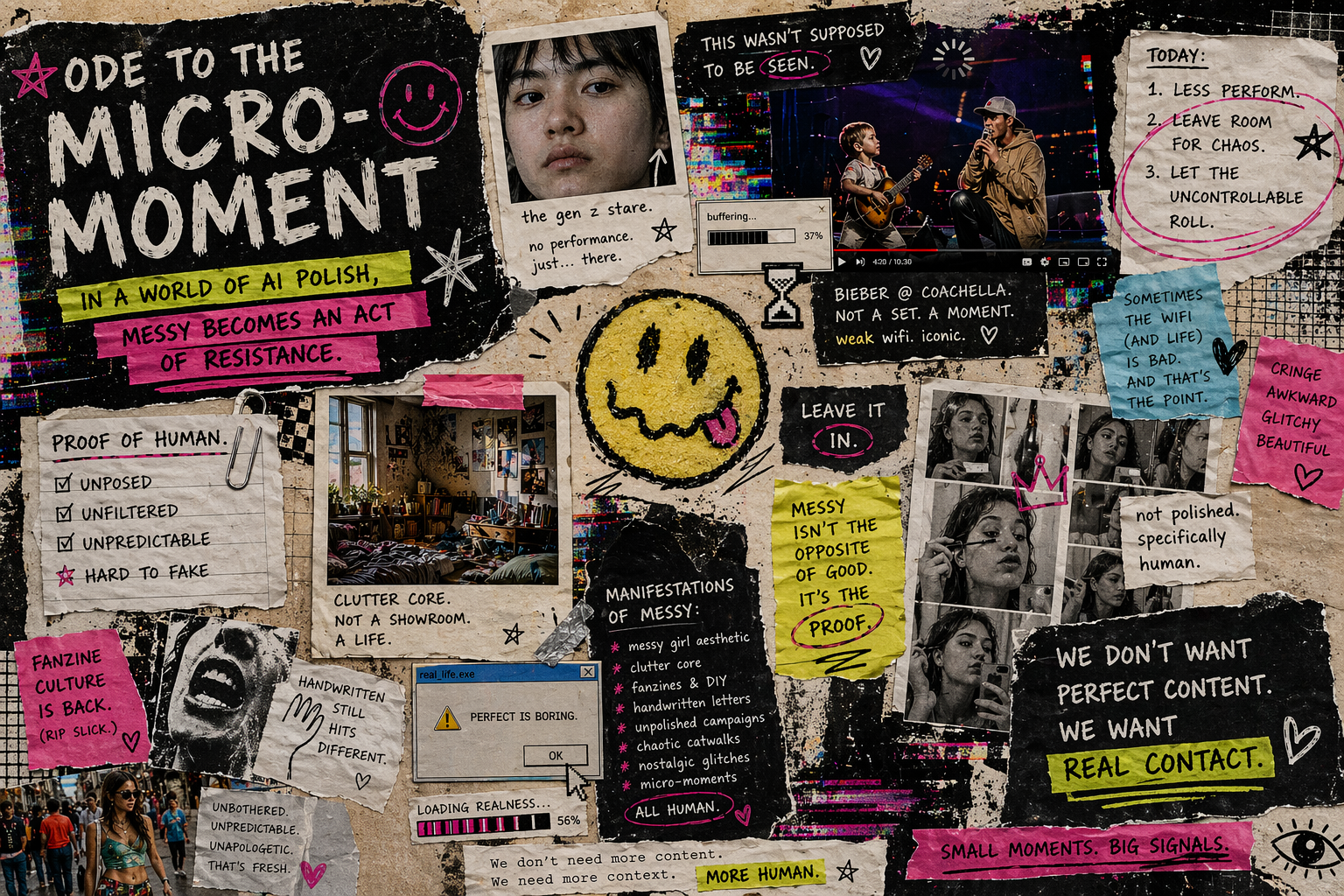
The micro-moment is gaining cultural traction. Not as an aesthetic, but as a signal. A proof of life. And in this context, imperfection is no longer something to fix, but something to trust in a world saturated with AI-generated polish.
For over a decade, culture has been on a trajectory toward optimisation. Better lighting. Cleaner edits. Smoother narratives. Then came AI, accelerating this to an extreme. Now, anyone can generate flawless visuals, perfect copy, entire identities at the click of a button. Gloss is no longer a result of friction and resilience but has become the baseline. As a result, culture does what it always does: it looks for the edge.
Enter the micro-moment. The unposed, unfiltered, accidental. Those in-between fragments that feel so close, so real, it’s almost as if we shouldn’t be witnessing them. What we’re seeing is a growing demand for what can only be described as “proof of human.” Not just craftsmanship or handmade aesthetics, but something harder to replicate: unpredictability. Messiness. Chaos even. And the reason is simple: scarcity. In a world where performance and perfection are omnipresent, it’s only natural to long for the other end of the spectrum. Think cringe, awkwardness and glitches. The things we used to edit out are becoming the things we trust.
Come to think of it, the viral Gen Z stare captures it perfectly. Beyond awkwardness it conveys an utter lack of performance. No attempt to entertain, reassure, or engage on cue. In a culture trained to optimise expression, even neutrality starts to feel radical. The uncurated, unimpressed, unbothered attitude are not flaws. They’re the point.
Manifestations of Messy
Online, the “messy girl” aesthetic thrives. Unmade beds, cluttered desks, emotional spillover. It’s not aspirational. It’s just recognisable. Lived-in. It serves as a relaxed, often romanticized alternative to the "clean girl" look, featuring uncombed hair, smudged makeup, eclectic, or vintage fashion, showcasing a carefree "just rolled out of bed" energy.
Interiors are shifting too. Visit Clutter Core on TikTok and you’ll find lived-in spaces rather than showrooms. Books stacked unevenly, objects accumulated over time, unmade beds and traces of life left visible.
In graphic design, we see a return to fanzine culture. Xeroxed layouts, handmade compositions, visible glue, misaligned type. A rejection of digital slickness in favour of authorship. In fact Pinterest predicts a renaissance of pen pals and the art of handwritten letters.
Even luxury is leaning in. The recent Jacquemus’ campaign, shot from the perspective of a young boy observing his mother, captures moments that feel almost too intimate: rushing, coat sleeve getting caught on a door handle, leaving the bathroom door open while peeing, making silly faces in the mirror while applying lipstick. Nothing is polished. Everything feels specifically human.
Take Diya Joukani the young designer and content creator Cool Girl from India, who turns the vibrant, chaotic streets of Mumbai into her catwalk. It feels fresh precisely because she leans into unpredictability rather than trying to control it. Her unbothered attitude and straight-faced gaze add to the notion. Even though it’s staged it feels less performative.
And then there was the ultimate micro-moment masterclass, Bieber at Coachella. Instead of performing, Bieber played old YouTube clips of himself as a kid jamming and joined in. It felt less like a set and more like a moment. A global pop star quietly harmonising with his younger self, while the audience watched. Vogue journalist Christian Allaire described it as “an epic nostalgia play, performed in a novel way. Noting how Bieber sat on stage scrolling through his old hits on YouTube, weak Wi-Fi cutting in and out, unintentionally adding to the charm. It wasn’t the biggest stage moment. Not the most polished. But it was one of the most talked about. Because crucially, it didn’t feel like it was trying to land with everyone. Some people didn’t get it. Others felt it deeply. And that asymmetry was the point.
What this means for marketing strategies
So, what can researchers, cultural strategists and marketers learn from this? When AI can generate perfection on demand, culture starts craving the opposite: the unfiltered, the unpolished, the slightly uncomfortable. Moments that feel unscripted, uncontrolled, human.
1. Accept that resonance beats reach
Being slightly off-centre drives talkability, but it won’t appeal to everyone. And that’s the point. Cultural relevance increasingly comes from depth, not mass appeal. If everyone gets it, it’s likely been over-optimised.
2. Don’t design imperfection. Do embrace it
Messy aesthetics, crafted intimacy, strategic vulnerability - these are already being codified. But the opportunity isn’t just to replicate the look of chaos, but to allow for moments that feel less engineered. To be clear. It’s not about being random. It’s OK to be strategic about it. Just make sure to allow for the in-between moments that are unplanned. Slightly off. Slightly awkward. Slightly incomplete.
3. Let the uncontrollable roll
Even realness is now being performed under AI conditions. Again, mess can be staged. Vulnerability can be scripted and audiences know this. They are fluent in spotting what’s constructed versus what slips through. What makes micro-moments powerful is precisely what brands struggle with: they are not fully controlled. They feel risky. Exposed. Unresolved. That’s what makes them believable.
Zooming out, this signals a broader shift: away from the controlled and measurable, toward the spontaneous, the emotional, the impulsive. So maybe the question isn’t whether something is real. It’s whether it feels controlled. Cringe, awkwardness and chaos are not aesthetic choices. They are signals that something slipped through. That not everything was optimised. The micro-moment works because it feels like it escaped the system. And in a world built on polish, that’s exactly what we’re looking for.
A new gradient lens for researchers and strategists
We’re no longer operating in a simple binary of real versus fake, but in gradients: performed authenticity, accidental authenticity, strategic vulnerability, genuine leakage. The question is no longer is this authentic? It’s how much control is visible? Where does something feel too neat? Where does it feel unresolved, unnecessary, slightly off? That’s the sweet spot, where belief starts to build.
Authenticity isn’t dead. It’s mutating from curated to uncontainable. From storytelling to leakage. From polish to presence. From perfection to proof of life. The micro-moment matters because it doesn’t scale cleanly. It resists replication. It carries contradiction. And in a system optimised for output, leaving room for that becomes an act of resistance.
Pernille Kok-Jensen
Trends & Cultural Insights Director at MAREPernille Kok-Jensen – Trends & Cultural Insights Director, MARE
Pernille Kok-Jensen is a seasoned expert with 20 years of experience turning trends and cultural insights into powerful, actionable strategies. With a sharp eye for emerging signals and a deep understanding of cultural shifts, she helps organizations across industries anticipate change and stay ahead of the curve.
Blending her background as a trend researcher and creative strategist, Pernille crafts future-proof strategies that resonate. She has guided leading start-ups, scale-ups and leading brands such as MTV, Spotify, Stoov, Nike, Glenfiddich, ANWB, Campina, and VGZ in navigating cultural shifts and embedding innovation.
A published author and award-winning keynote speaker, Pernille is known for her bold thinking and passionate storytelling. Born in Denmark in 1976 and raised across Africa and Asia, she holds a Bachelor’s degree in International Culture & Communication and a Master of Arts. Fun fact: her early career as a nightlife performer in her twenties adds a unique creative edge to her strategic work today.