Accelerating Advancements: The Expanding Impact of Insights
The Insight250 spotlights and celebrates, annually, 250 of the world’s premier leaders and innovators in market research, consumer insights, and data-driven marketing.

Article series
Insight250
- The importance of business sense in research
- The role of humour in effective leadership
- The importance of ethics
- The importance of disruption in innovation and leadership
- The importance of Disruption in Innovation and Leadership Part 2
- The importance of Diversity & Inclusion
- The impact of colour
- Communicating insight with impact
- Insights on leadership, culture and polling
- The evolution of electric vehicles
- 2022 Top tips (part 1)
- 2022 Top tips (part 2)
- Maximising the potential of data
- The importance of flexible working
- Winners
- The importance of advanced analytics
- Judges for the 2022 Insight250 Awards announced
- The evolution from social listening to digital intelligence
- The Judges' Perspective
- The judge's perspective - part 2
- Insight Climate Collective
- Insights technology
- Understanding employee ownership
- Global insight perspectives
- Top Tips from our Leaders and Innovators
- The Evolution of Insights in the Food & Beverage Market
- The Evolution of Insights in CPG
- Neural Mechanisms Behind Consumer Decision-Making
- Celebrating and Elevating the Insights Industry
- The State of the Insights Industry
- Opportunities, challenges and threats that AI presents
- 2024 Insight250 Winners Announcement
- Connecting Brands and Consumers Through Insights
- The Importance of Human Insight and Attention
- The Elevating Role of Insights with Technology Innovation
- Haleon’s Insight Expert on Consumer Healthcare
- Insight from the Insight250: How AI is Impacting Qualitative Research
- How AI Tech is Doing the ‘Heavy Lifting’ for Insights
- Reviewing the top tips for 2025
- Google's Sarah Ashley on AI and revolutionising insights - Insights from the Insight250
- Beyond BI: The Future of Decision Intelligence for Insight Professionals
- The Advancement & Impact of Insights - An Insight250 Winners Series perspective with David Smith
- International Jury for the 2025 Insight250 Awards Announced
- Newly elected President, Anne-Sophie, on Revolutionizing the Impact of Insights
- Haleon's Litthya Baez on Enhancing Healthcare with Insights - Insight250 Winners Series
- Understanding the Insights of Consumer Decisions
- Moving Beyond Dashboards to Deliver Decisions with AI
- How AI is Transforming Insights
- How AI is Transforming Insights
- Five Years of Insight250: Elevating the Insight Industry
The Insight250 spotlights and celebrates, annually, 250 of the world’s premier leaders and innovators in market research, consumer insights, and data-driven marketing. The awards have created renewed excitement across the industry whilst strengthening the connectivity of the market research community. Winners of the 2025 Insight250 were announced last September - you can see the full list of Winners, and those from previous years, at Insight250.com. You can also nominate for 2026.
With so many exceptional professionals named to the Insight250, we regularly tap into their expertise and unique perspectives across various topics. This regular series does just that: inquiring about the expert perspectives of many of these individuals in a series of short topical features.
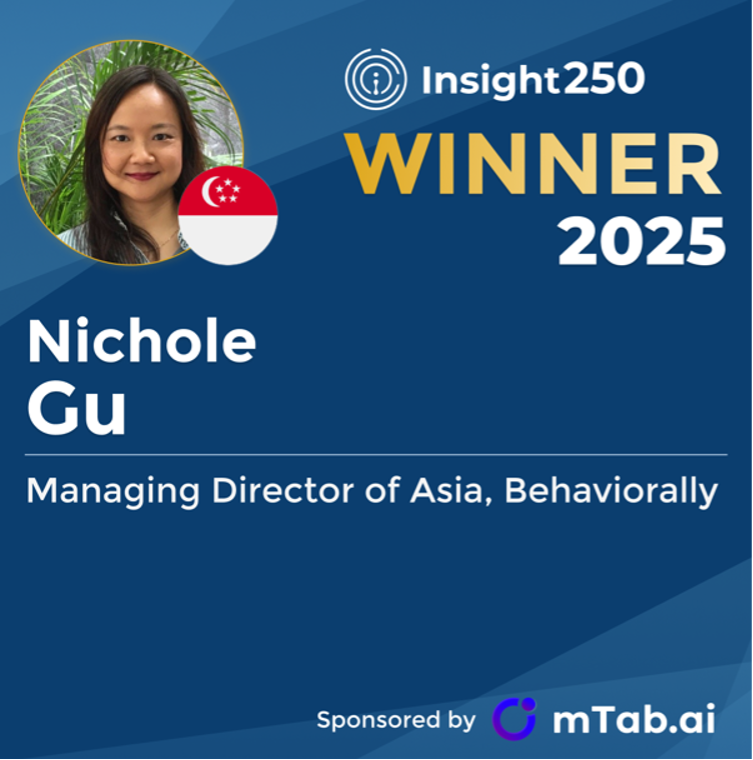
With insights advancing at an incredible pace and the value of insights ever increasing, I sat down with Insight250 Winner Nichole Gu. As a key member of Behaviorally’s Executive Management Team, Nichole has played a pivotal role in expanding the company’s footprint and influence, particularly across the Asia-Pacific region, opening offices in locations sucha as Singapore, China and Australia. Through her efforts, Nichole has not only built thriving teams but has also cultivated deep client relationships, ensuring that brands across the region benefit from cutting-edge insights to drive commercial success. Having worked with Nichole in the past, I have seen first-hand, Nichole’s ability to navigate complex markets, develop high-performing teams, and champion innovation, making her a true force in the industry. It was a pleasure to catch-up.
Crispin: You’ve built a career at the intersection of behavioral science, insights, and commercial impact. What first drew you to this field, and what continues to excite you about it today?
NG: I worked part-time as an interviewer during university - listening to people and noticing the contradictions between what they said and what they actually did sparked my curiosity about human behavior and drew me into the insights industry.
Today, what excites me most is the pace of change – especially how Technology and AI have reshaped both our daily lives and our industry over the past 12 months. Yet, despite all this transformation, our clients’ needs remain constant – i.e. making sense of consumer behavior and guiding decisions with precision – that challenge is exactly what continues to inspire me every day.
Crispin: Behaviorally focuses on the “moment of purchase” as the most important moment in marketing. How has that philosophy shaped the way you think about consumer insight and business decisions?
NG: Focusing on the moment of purchase simplifies everything because it cuts through the noise. It’s the ultimate “moment of truth" - people may say they love a brand or value a certain feature, but their true priorities are revealed only when they are either in-store or online making purchase decisions.
This philosophy has shaped my thinking on insights and business decisions in three key ways:
● Context is King: Instead of asking people what they think they'll do – we should focus on observing how they behave in the retail environment where purchase decisions actually happen.
● Benefits vs. Barriers: Minimizing friction is just as important as conveying a compelling benefit. A great product can still fail if the purchase moment feels confusing or stressful.
● Efficiency: For our clients, it clarifies where to invest. Winning at the moment of purchase delivers immediate ROI as it shifts the focus from vague "awareness" to concrete "conversion".
Ultimately, narrowing the lens to that critical decision point makes insights far more actionable and far more powerful
Crispin We are seeing rapid advances in AI across the insights industry. Where do you think AI is genuinely transforming our industry - and where is human expertise still irreplaceable?
NG: In 2025, AI evolved from a fancy tool to a daily essential. The insights industry is settling into a model of "Hybrid Intelligence" where AI does the heavy lifting and humans provide the meaning. AI can process, simulate and predict at scale, but it’s human curiosity, empathy and judgment that turn those outputs into decisions that matter.
In my opinion, three areas where AI is genuinely transforming the insight industry are:
● Operational Efficiency: Automation has stripped away the "grunt work" of research - tasks like transcription and basic report drafting are now handled by AI with “good enough” efficiency, freeing researchers for higher-value strategy.
● Synthesizing the "What": AI can process mountains of structured or unstructured data, spotting patterns in seconds that would take humans weeks to uncover.
● Predictive Simulation: We can now use AI to model how concepts or packaging designs might land before going to market, making the "test and learn" phase much faster and cheaper.
However, there are areas where human expertise remains irreplaceable, for example:
● The "Why" and the "So What": AI is great at correlation but terrible at causation. It can tell you what’s happening, but humans are still needed to interpret the cultural nuance and emotional friction.
● Originality and Innovation: AI is fundamentally derivative - it predicts based on the past. True "leaps" in creative thinking, disruptive innovation or reframing a market opportunity still require human lived experience and intuition.
In short: AI provides the map, but it is humans who must choose the destination. The future of insights will be built on interconnected multi-agentic systems that are autonomous, dynamic and continuously evolving to deliver higher‑impact outcomes - with humans firmly in the loop to ensure meaning, ethics, and strategic direction.
Crispin: Packaging is often the last - and most powerful - marketing touchpoint before a purchase decision. How is AI reshaping the way brands design packaging today?
AI is transforming packaging design from a creative gamble into a predictive science.
In the retail environment - whether digital or physical - brands have only seconds to capture attention and convert it into a purchase. That conversion is won or lost the moment a pack is seen on the shelf. Brands need to know exactly how hard their packaging is working in that critical moment, and the precise impact of any changes.
By equipping teams with predictive, behavioral insights in a flexible, scalable format, we remove the guesswork. Pack Design Intelligence Platform like myBehaviorally, empowers creative teams to pitch ideas backed by data, gives brand teams confidence in redesigns, and enables insights professionals to scale what works while learning from what doesn’t. Most importantly, it provides organizations with a shared language for what ‘good’ packaging looks like - ensuring marketing budgets are never wasted.
In short: Predictive AI strips away the noise. By the time a package hits the shelf, the brand already knows it will be seen, shoppable, seductive, and most importantly, selected by shoppers."
Crispin: Behaviorally’s work suggests that packaging performance can now be predicted before a product reaches the shelf. How reliable are these predictive models becoming, and how are brands using them in practice?
NG: Predictive models for packaging are reaching a point where they are not just best guesses but robust statistical tools that can reliably replace many traditional testing phases. Their reliability hinges on the quality, diversity, and scale of the underlying database.
myBehaviorally is the industry’s first and only dedicated pack design intelligence platform, developed by Behaviorally - the global leader in pack design testing and validation. With a Normalized Mean Average Error (NMAE) of less than 10%, it delivers highly accurate predictions of packaging performance.
The platform provides direct access to Behaviorally’s proprietary PackPower Score™, a simple, one‑number metric that forecasts the sales impact of any packaging design. By combining decades of behavioral science with the world’s most robust global packaging database, myBehaviorally unlocks predictive diagnostics through our proven behavioral model - Be Seen, Be Shoppable, Be Seductive, Be Selected - and delivers actionable KPIs directly to clients.
This is more than a platform; it’s a transformation in how packaging will be tested moving forward. myBehaviorally gives every brand, regardless of size, the ability to make smarter, faster design decisions at scale - anytime, anywhere."
Crispin: Behaviorally recently launched Studio B, which brings together human insight, generative design, and predictive AI in a single workflow. What problem in the insights process were you trying to solve with this innovation?
NG: Studio B., our new upstream pack design intelligence solution, was created to break down silos and bridge collaboration between brands, insights and design. By integrating Human Insight, Generative Design and Predictive AI into one connected system, Studio B. enables all stakeholders to speak the same language - empowering designers and brands to create packaging that sells before it reaches final validation.
At the core of Studio B is a three-part flywheel: Humanize. Design. Predict.
● The Humanize phase anchors every engagement in qualitative shopper insight. Through immersive interviews and contextual exploration, Behaviorally uncovers emotional and functional drivers that shape purchase decisions.
● The Design phase leverages generative AI to create and refine packaging concepts using Behaviorally’s proprietary Design Levers™. Grounded in Behaviorally’s proven 4S framework, Be Seen, Be Shoppable, Be Seductive, Be Selected, Studio B enables rapid design generation and optimization to strengthen packaging systems early in the process.
● The Predict phase is powered by Behaviorally’s proprietary myBehaviorally platform and the industry leading PackPower Score™. This predictive AI engine provides one easy to understand forecast of a pack’s expected sales performance and full diagnostic of the drivers and barriers to success.
Unlike traditional qualitative research that evaluates finished work, Studio B moves research upstream, transforming it into a creative intelligence system that builds, iterates, and predicts performance in one integrated motion. Ultimately, Studio B. shifts the process from a linear one (Research → Design → Testing) to a circular one - where insights provide a steady pulse throughout the entire creative journey.
Crispin: Studio B moves research earlier into the creative process rather than simply evaluating finished designs. How do you think this changes the role of insight teams within organizations?
NG: Shifting research upstream transforms the role of insight teams from being the "police" to becoming "co-pilots". Historically, the insights team was the "final hurdle" - testing finished designs and often delivering bad news if they didn’t perform. That approach was inefficient and created tension with brand & design teams.
By moving research earlier in the process, the role changes in three key ways:
● Moves from Evaluators to Enablers: Rather than simply declaring “this failed,” insight teams now define the parameters where success is most likely to occur, empowering design teams to explore freely within a proven space.
● Reduces Wasted Energy: Testing at design territory stage eliminates sunk‑cost bias, allowing the organization to become more agile and avoids last‑minute pivots.
● Deserves a Strategic Seat at the Table: Insights shift from being a budget line for verification to a foundational part of strategy.
In short, insights become a generative tool - building the right thing from the start rather than fixing the wrong thing once it’s already built.
Crispin: Looking ahead, how do you see AI-enabled design tools evolving over the next five years - particularly in areas like packaging, retail environments, and digital shelves?
NG: Over the next five years, AI-enabled design tools will become central to packaging, offline and online retail environments - shifting from creative assistants to fully integrated decision-making systems that optimize sustainability, consumer engagement, and speed-to-market. We can expect tools that merge generative design with predictive analytics, enabling brands to test, iterate, and deploy concepts virtually before committing to production.
The cycle from ‘insight’ to ‘prototype’ will shrink from weeks to minutes. If a brand spots a cultural trend on social media, AI tools will enable them to design, virtually test, and deploy updated packaging or digital assets almost instantly.
The Bottom Line: Design tools will become outcome‑oriented. Instead of asking “Does this look good?” we’ll ask “Which of these variations will actually trigger a purchase from such shoppers in such stores?” - and AI will deliver the answer.
Top-Tip:
Crispin: As an Insight250 winner, what advice would you give to the next generation of insights professionals about developing the skills they’ll need in an AI-powered research world?
NG: I’m pleasantly surprised to be included again on the Insight250 list - thank you Insight250 and ESOMAR, for the recognition! I am proud to represent the entire Behaviorally team at a time when our industry is at a tipping point. It’s critical that we continue to push boundaries and drive innovations that will shape our future, making this profession exciting and meaningful for the next generation of researchers.
For the next generation, I would give four key pieces of advice:
● Be Curious: Curiosity is our industry’s superpower. In an AI‑powered world, the person who asks the best questions - not the one with the fastest answers - will lead. Treat AI as a high‑speed assistant, but maintain the human inquisition needed to challenge its outputs.
● Be Brave: Adopt a ‘fail fast, learn fast’ mindset. Don’t see new technology as a threat; see it as a way to automate tactical tasks so you can focus on bigger strategic challenges.
● Storytelling: AI can generate charts and summaries, but it cannot yet craft narratives that move a boardroom to action. Your value lies in translating machine outputs into human stories that drive business decisions.
● Commercial Impact: True innovation isn’t just about new tools; it’s about reapplying existing ideas in new contexts to fuel growth. Always ask: How does this insight change a business decision?
The future of insights depends on curiosity, courage, storytelling, and impact - and it’s up to us to make it a profession that inspires the next generation.
Crispin: Thank you, Nichole, for sharing the unique perspective you have on research and insights and it rapid expanding advancements. It’s been fantastic to hear your thoughts on the state of the industry and how the innovation of insights will continue to play a leading role in evolving our world.
Crispin Beale
Chairman at QuMind, CEO at Insight250, Senior Strategic Advisor at mTab, CEO at IDXCrispin Beale is a marketing, data and customer experience expert. Crispin spent over a decade on the Executive Management Board of Chime Communications as Group CEO of leading brands such as Opinion Leader, Brand Democracy, Facts International and Watermelon. Prior to this Crispin held senior marketing and insight roles at BT, Royal Mail Group and Dixons. Crispin originally qualified as a chartered accountant and moved into management consultancy with Coopers & Lybrand (PwC). Crispin has been a Board Director (and Chairman) of the MRS for nearly 20 years and UK ESOMAR Representative for c15 years. As well as being CEO of Insight250, Crispin is currently Worldwide CEO of Digital Communications Solution Agency, IDX. Crispin is also the Senior Strategic Advisor at mTab and the Chairman of QuMind and spent 4 years as Group President of Behaviorally where he was responsibile for the client & commercial teams globally. Crispin is a passionate advocate for blending human intelligence and technology to deliver innovation and leadership across organisations.
Article series
Insight250
- The importance of business sense in research
- The role of humour in effective leadership
- The importance of ethics
- The importance of disruption in innovation and leadership
- The importance of Disruption in Innovation and Leadership Part 2
- The importance of Diversity & Inclusion
- The impact of colour
- Communicating insight with impact
- Insights on leadership, culture and polling
- The evolution of electric vehicles
- 2022 Top tips (part 1)
- 2022 Top tips (part 2)
- Maximising the potential of data
- The importance of flexible working
- Winners
- The importance of advanced analytics
- Judges for the 2022 Insight250 Awards announced
- The evolution from social listening to digital intelligence
- The Judges' Perspective
- The judge's perspective - part 2
- Insight Climate Collective
- Insights technology
- Understanding employee ownership
- Global insight perspectives
- Top Tips from our Leaders and Innovators
- The Evolution of Insights in the Food & Beverage Market
- The Evolution of Insights in CPG
- Neural Mechanisms Behind Consumer Decision-Making
- Celebrating and Elevating the Insights Industry
- The State of the Insights Industry
- Opportunities, challenges and threats that AI presents
- 2024 Insight250 Winners Announcement
- Connecting Brands and Consumers Through Insights
- The Importance of Human Insight and Attention
- The Elevating Role of Insights with Technology Innovation
- Haleon’s Insight Expert on Consumer Healthcare
- Insight from the Insight250: How AI is Impacting Qualitative Research
- How AI Tech is Doing the ‘Heavy Lifting’ for Insights
- Reviewing the top tips for 2025
- Google's Sarah Ashley on AI and revolutionising insights - Insights from the Insight250
- Beyond BI: The Future of Decision Intelligence for Insight Professionals
- The Advancement & Impact of Insights - An Insight250 Winners Series perspective with David Smith
- International Jury for the 2025 Insight250 Awards Announced
- Newly elected President, Anne-Sophie, on Revolutionizing the Impact of Insights
- Haleon's Litthya Baez on Enhancing Healthcare with Insights - Insight250 Winners Series
- Understanding the Insights of Consumer Decisions
- Moving Beyond Dashboards to Deliver Decisions with AI
- How AI is Transforming Insights
- How AI is Transforming Insights
- Five Years of Insight250: Elevating the Insight Industry