Context is Everything: Why Insight Must Build Intuition, Not Just Provide Answers
The Insight250 spotlights and celebrates, annually, 250 of the world’s premier leaders and innovators in market research, consumer insights, and data-driven marketing.

Article series
Insight250
- The importance of business sense in research
- The role of humour in effective leadership
- The importance of ethics
- The importance of disruption in innovation and leadership
- The importance of Disruption in Innovation and Leadership Part 2
- The importance of Diversity & Inclusion
- The impact of colour
- Communicating insight with impact
- Insights on leadership, culture and polling
- The evolution of electric vehicles
- 2022 Top tips (part 1)
- 2022 Top tips (part 2)
- Maximising the potential of data
- The importance of flexible working
- Winners
- The importance of advanced analytics
- Judges for the 2022 Insight250 Awards announced
- The evolution from social listening to digital intelligence
- The Judges' Perspective
- The judge's perspective - part 2
- Insight Climate Collective
- Insights technology
- Understanding employee ownership
- Global insight perspectives
- Top Tips from our Leaders and Innovators
- The Evolution of Insights in the Food & Beverage Market
- The Evolution of Insights in CPG
- Neural Mechanisms Behind Consumer Decision-Making
- Celebrating and Elevating the Insights Industry
- The State of the Insights Industry
- Opportunities, challenges and threats that AI presents
- 2024 Insight250 Winners Announcement
- Connecting Brands and Consumers Through Insights
- The Importance of Human Insight and Attention
- The Elevating Role of Insights with Technology Innovation
- Haleon’s Insight Expert on Consumer Healthcare
- Insight from the Insight250: How AI is Impacting Qualitative Research
- How AI Tech is Doing the ‘Heavy Lifting’ for Insights
- Reviewing the top tips for 2025
- Google's Sarah Ashley on AI and revolutionising insights - Insights from the Insight250
- Beyond BI: The Future of Decision Intelligence for Insight Professionals
- The Advancement & Impact of Insights - An Insight250 Winners Series perspective with David Smith
- International Jury for the 2025 Insight250 Awards Announced
- Newly elected President, Anne-Sophie, on Revolutionizing the Impact of Insights
- Haleon's Litthya Baez on Enhancing Healthcare with Insights - Insight250 Winners Series
- Understanding the Insights of Consumer Decisions
- Moving Beyond Dashboards to Deliver Decisions with AI
- How AI is Transforming Insights
- How AI is Transforming Insights
- Five Years of Insight250: Elevating the Insight Industry
The Insight250 spotlights and celebrates, annually, 250 of the world’s premier leaders and innovators in market research, consumer insights, and data-driven marketing. The awards have created renewed excitement across the industry whilst strengthening the connectivity of the market research community. Winners of the 2025 Insight250 were announced last September - you can see the full list of Winners, and those from previous years, at Insight250.com. The 2026 Insight250 nominations are currently in review.
With so many exceptional professionals named to the Insight250, we regularly tap into their expertise and unique perspectives on a range of topics. This regular series does just that: inquiring about the expert perspectives of many of these individuals in a series of short topical features.
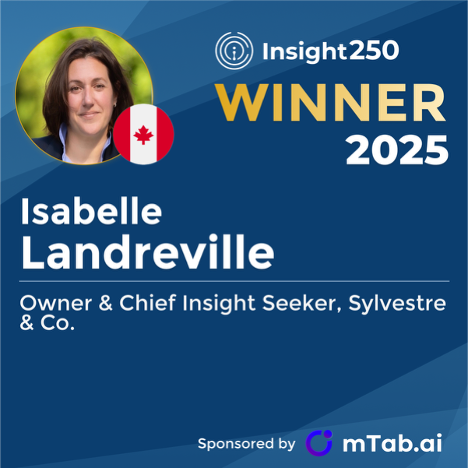
With insights advancing at an incredible pace and the value of insights ever increasing, I sat down with Insight250 Winner Isabelle Landreville. With over 25 years of experience in qualitative research, Isabelle is a trailblazer in the insights industry. As the Owner of Sylvestre & Co. for the past 10 years, she leads one of North America’s most respected qualitative research agencies—recognized twice in the GRIT Report’s Top 10 Most Innovative Qual Agencies. Isabelle is not just a researcher; she is a storyteller, an innovator, and a mentor.
Crispin: You argue that as research gets faster and data gets richer, context is actually getting harder to preserve — and that when context gets lost, culture gets misread. Can you give us a concrete example of what that misreading looks like in practice, and what the consequences are for the brands involved?
IL: Yes, and it’s a story I still tell my team. We were running a creative assessment — simple enough, we all thought. We’d travelled the country, done the fieldwork in English, and we had lovely trends coming through. We felt good about the design. Then we landed in Montreal to moderate in French.
Now, code-switching has never been an issue for us. But the concept opened with a line — “When you don’t have time for lunch…” — and our very first participant stopped and said, “Quoi?!” We wrote it off. The playback volume, surely. First exposure is first exposure; people need a second to settle in. So we ran it again. “Quoi?!” And again. By the third time we knew it wasn’t the sound. We couldn’t even get past the opening line.
So we stopped and asked her, simply, why. Her answer: “There are words missing in that first sentence.” We probed — what do you mean? “That just can’t be. You cannot have time for lunch. You can not have time to pack a lunch, to plan for lunch — but you cannot not have time for lunch.” Pure gold.
In Québec, lunch is not a slot to be optimized away. It’s protected, almost sacred. The whole ad was built on a premise the audience flatly rejected in the first four words. Had we not stopped — had we filed that “quoi?!” as one confused person — we’d have scored the concept, moved on, and helped a brand launch a campaign that insults its audience’s relationship with the table in its opening line. The consequence isn’t a soft one. It’s real money spent saying the wrong thing to the very people you’re trying to court. Stopping for context — making room for it — is the whole job.
Crispin: There is a specific danger you identify: that what is cultural, social, generational or situational gets mistaken for something personal. Why is that particular confusion so costly — and why is it so easy to make?
IL: It’s easy because a sample of one looks like an outlier. That one “quoi?!” in a room feels like a person having a moment, not a culture drawing a line. And research is under pressure to keep moving — the debrief is booked, the timelines are tight, “initial exposure is what it is.” Every instinct in a fast process tells you to write it off and carry on.
It’s costly because if you read the cultural as personal, you fix the wrong thing. You tweak the execution when the premise is what’s broken. You reassure yourself it was a one-off, then you scale the misread across a whole market. And worst of all, you quietly distance the brand from the very people it’s trying to love — because you’ve decided their truth was noise. Culture rarely shows up with a label on it. It shows up as a small, easy-to-dismiss moment. The discipline is catching yourself before you dismiss it.
Crispin: Sylvestre & Co. has been doing qualitative research for over 50 years. What does that depth of experience teach you about context that a faster, more data- driven approach simply cannot replicate?
IL: We’re eternal learners — we learn for a living. But carrying our OS, our IP and our Cultural Intelligence Engine forward since 1972 is like having the luxury of perfecting a diamond for fifty-five years. We’ve simply seen so much. We know how to distill what’s generational from what’s cultural from what’s target from what’s niche — and those are very different things that a fast read will happily collapse into one.
That depth doesn’t slow us down; it lets us work smart. Since 1972, there is almost always a story, a best practice, an insight somewhere in the collective that gives us a starting point and lets us move with more ease, more speed, honestly more elegance. And it’s a real blend — young, fresh, innovative thinking building on the legacy of two generations before us. I also believe tension is where insights hide — in the research, and in us. The healthy tension inside our own team, across those generations, is a big part of what makes us wise as a whole.
Crispin: You’ve written in ResearchWorld about moving beyond consumer insights to discovering human truths — understanding people as complete human beings rather than as data points. How does that shift in framing change what qualitative research actually looks like on the ground?
IL: It changes who’s in the room, what you listen for, and what you hand back. When you’re chasing a consumer insight, you’re looking at a person through the narrow slot of your category — as a buyer, a user, a target. When you’re after a human truth, you have to meet the whole person: their culture, their contradictions, their lived reality, the stuff that has nothing to do with your brand and everything to do with why they do what they do.
On the ground, that means we don’t reduce people to data points, and we don’t let our clients either. One brand manager once ran into me before a debrief and said, “We just cannot forget about John — he was such an amazing ambassador of our audience. Now we bring him into every meeting. We always ask, how would John feel about this? How would he react?” That’s the shift, right there. John stopped being a respondent and became a human they carry with them. That only happens when the research is designed to introduce a real human being, not deliver a persona on a slide.
Crispin: You describe insight as a learning journey, not just a delivery of answers. What does it mean in practice to design research as a learning experience for decision makers — and how do you know when it has actually worked?
IL: Think about telling your kid not to put their hand on the oven — “you’ll burn yourself.” Once, twice, maybe three times… and what happens? They touch it anyway. There’s something about a whole-body experience that being told will never match. You don’t need endless time or money to protect that. You need to safeguard how people learn, because seeing it, feeling it, touching it will always leave a deeper mark than hearing about it.
So at Sylvestre we don’t field projects or conduct studies — we have shared learning journeys. They come in every size and shape, but each one is collaborative, a safe space for us to grow together. And I know it’s worked not when the deck looks good, but when the learning outlives the debrief — when a client is in a meeting months later asking, unprompted, “But how does this connect back to what we know to be true about John?”
When the audience has moved into the room and stayed there. That’s the mark.
Crispin: You recently keynoted at the QRCA Best of Canada Symposium on humour as a shortcut to cultural truth — the idea that what a society finds funny reveals what it holds sacred, fears, and where its fault lines live. How do you use that lens in your own research practice?
IL: Humour fascinates me because it’s such a cultural product — a cultural manifestation. Beyond the golden rules of a good joke and personal taste, culture is always at the heart of it. Some jokes travel and some simply don’t, and to me comedians are among the most insightful people alive. You need real insight for a joke to land, and you have to know exactly what the unspoken rules are — whether you can go there, and how far.
In Québec, I’d go further: humour is almost an emotion in itself. It’s a love language. The more a Quebecer teases you, the more you know you’re in the nook, part of the family. But only a Quebecer can make fun of a Quebecer — so tread lightly. It has to feel like it comes from the inside; a wise comedian told me that once. So in practice, I listen for it. What a group laughs at, and just as tellingly what they won’t joke about, shows me the fault lines and the sacred ground faster than any direct question. That “quoi?!” over lunch? There was a laugh in it too — and the laugh was the culture telling me where the line was.
Crispin: You make a distinction that I think is quite powerful: empathy is not just a feeling, it is intuition. It is multi-sensorial and built through context, not through isolated findings. How do you actually help a leadership team build that kind of intuition — what does that process look like?
IL: Consumer intuition, to me, is the ability to bridge the empathy gap through foundational research — that quiet moment where you just know it, feel it. Call it a spidey sixth sense for your consumer. And it’s built the way all real learning is built: through experience, not through being told.
Here’s a concrete example. We brought a global segmentation to life through a deep-dive, multimedia self-ethnography — and then we refused to present it as a normal debrief. Instead we turned it into a meet-and-greet. We cast and briefed a real ambassador for each segment, and they walked into the room and introduced themselves to the brand managers who serve them. Suddenly a marketer wasn’t reading about “Segment 3” — they were shaking their audience’s hand, hearing their voice, catching their humour. You cannot un-feel that. That’s how intuition gets built: you make it multi-sensorial, you let people meet the human, and the understanding lives in their body long after the numbers fade.
Crispin: You talk about wanting clients to fall in love with their consumers again. What has stopped them falling in love in the first place — and what does research need to do differently to rekindle that?
IL: Distance. Layers and layers of it. Dashboards, data points, decks, speed — every one a well-meaning tool that quietly puts a little more space between the human creating value, the brand, and the human seeking it, the consumer. You can’t fall in love with a bar chart.
You fall in love with a person.
So research has to do the opposite of what most of the pressure pushes it toward. Instead of adding another layer of abstraction, it has to close the gap — engineer the actual encounter. Bring John into the room. Let the marketer meet the segment. Insights exist to bridge these two humans, to bind them in a meaningful way and find the win-win between them. When we forget that, we hand over information that speaks to people’s brains. When we remember it, we help them fall in love again.
Crispin: Cultural fluency is central to your practice — working bilingually and biculturally across English and French Canada and beyond. What does genuine cultural fluency require of a researcher, and how do you know when you have it versus when you are just pattern-matching?
IL: Fluency isn’t vocabulary. Pattern-matching hears the words; fluency feels the premise underneath them. The tell is that you can catch what’s missing, not just what’s said — you can hear a “quoi?!” and know instantly it’s the culture rejecting a premise, not a person mishearing a line.
I’ll give you another one. We were testing a campaign built to make a product trendy — a product that’s only ever enjoyed cold — playing cleverly on “cold” and “cool.” The trouble was it landed at the exact moment the culture had decided what was cool was now “hot.” Oops. Fluency is having your finger on that pulse, because context isn’t static — it moves under your feet. You know you have it when you can feel the unspoken rule in the room, when you know precisely how far a joke can go, when the thing that’s not being said is louder to you than the thing that is. If you’re translating, you’re pattern-matching. If you’re feeling it, you’re fluent. It all comes down to understanding, not only knowing.
Crispin: In a world of AI, virtual interactions and more data than ever, you argue it is becoming easier to collect information and easier to lose context. What specifically does AI get wrong about context — and is there anything it gets right?
IL: Let me start with what it gets right, because I’m genuinely a fan. AI really enhances us. It created safety in a brand personification exercise we ran with Gen Z at the height of the cancel moment — a group that did not want to talk about stereotypes out loud found a way to, because the tool gave them cover. It’s given people the safety to ask a financial advisor the questions they secretly wish they could ask but never would. And yes, it’s sped things up and made room for deeper, richer thinking. I’ve always loved thinking — I used to say if I could be paid just to think and make friends, I’d be happy. Which, twenty-five years in, isn’t far from what I actually do.
What it gets wrong is context. AI would have taken that “quoi?!” over lunch, coded it as an outlier, and moved on — confidently. It doesn't feel the premise, the tension, the body, the lived reality underneath the words. So I treat it exactly like a brilliant, fast junior member of the team: you have to set it up for success, grow it, guide it — and you have to hold the keys. Used that way, it’s a gift. Left to hold the pen alone, it will strip out the very thing that turns information into understanding.
Crispin: You host the Insightful Inspiration podcast and have explored what it takes to be an insights leader. What does leadership in qualitative research look like now compared to when you started — and what has genuinely changed versus what has simply been relabelled?
IL: What’s genuinely changed is access. AI has democratized insights — the tools, the speed, the reach are extraordinary compared to when I started. What’s been relabelled is more of the language than the substance: “human truths” instead of “consumer insights” is partly a real evolution and partly new packaging on something great researchers have always done — meet the whole person, listen hard, safeguard how we learn.
I draw a parallel to music. Home recording and putting yourself out there let real stars pop faster and shine brighter than ever — and it also created a whole lot of “ok stuff.” Same in our field. So leadership now is less about being the only one with the tools and more about holding the bar: guiding the tools, protecting the craft, and making sure the humanity doesn’t get automated out. The curiosity hasn’t changed. The responsibility to keep it honest has only grown.
Crispin: If you could change one thing about how the broader insights industry thinks about context — what would it be, and why does it matter so much?
IL: I’d stop us treating context as a nice-to-have — a slide near the back, a caveat, something you get to if there’s time. Context isn’t the garnish on the insight; it is the insight. The moment where you stop and ask “wait, why did she say quoi?” is not a delay in the process. It’s the process.
It matters because everything else compounds off that decision. Protect the moment where you pause for context and you build understanding that creates intuition. Skip it in the name of speed and you scale a misread. In a world moving this fast, that small act of stopping is the most valuable — and most endangered — thing we do.
Hot Topic
Crispin: The insights industry is investing heavily in speed, scale and automation. If insight without context produces misreading, and if misreading culture is the most expensive mistake a brand can make, is the industry’s current direction making its clients smarter — or just faster at being wrong?
IL: Yes and no — but honestly, it depends entirely on what we do with the time speed gives us back.
Automation hands us hours we never used to have. If a team pours those hours back into understanding people more deeply, then faster genuinely becomes smarter. But if we simply do more, faster, and ship it, we’ve just built a quicker printing press for our own blind spots.
That’s my trouble with the “smarter or faster” framing — they’re not the same axis. A client can be flooded with answers and still be starving for understanding. Generating ten thousand findings in an afternoon doesn’t make a brand smarter. It makes it louder. Smart is knowing which finding to stop on.
And no one ever hired us to be fast. They hire us to be right about people. Being fast at the wrong answer is the most expensive speed there is — because you don’t just make the mistake, you scale it before anyone thinks to question it.
So is the direction dangerous? Only if we let the tools choose the destination. Used well, speed is a gift. Used lazily, it industrializes the misread. The technology isn’t deciding for us. We are.
Top Tip
Crispin: What is your top tip for an insights professional who wants to move beyond delivering answers and start building the kind of contextual understanding that creates genuine intuition in the people they work with?
IL: Ask a different question at the very start. My favourite question at any kickoff — often before the proposal even exists — is: How do you like to learn? What would be the most meaningful way for us to learn about this together? Then safeguard the answer and reverse-engineer the whole design from there, leveraging every tool you have, AI included.
Because if you protect how people learn — making it whole-body, in context, human — you don’t just hand them answers. You help them build the intuition to make better, sharper, faster decisions long after you’ve left the room. Don’t take the humanity out of it. That’s the whole point.
Crispin: Thank you, Isabelle, for such a unique and in-depth discussion across the spectrum of insights and human truths. What stays with me most is the "quoi?!" itself: a single syllable that, left unexamined, would have been filed away as noise, and instead became the whole lesson. That is the discipline this conversation points to. Not more data, not more speed, but the willingness to stop on the small moment that does not fit and ask why. As AI takes on more of the collecting, that willingness becomes the one thing no tool can do for us. It is, as Isabelle says, the whole job.
Crispin Beale
Chairman at QuMind, CEO at Insight250, Senior Strategic Advisor at mTab, CEO at IDXCrispin Beale is a marketing, data and customer experience expert. Crispin spent over a decade on the Executive Management Board of Chime Communications as Group CEO of leading brands such as Opinion Leader, Brand Democracy, Facts International and Watermelon. Prior to this Crispin held senior marketing and insight roles at BT, Royal Mail Group and Dixons. Crispin originally qualified as a chartered accountant and moved into management consultancy with Coopers & Lybrand (PwC). Crispin has been a Board Director (and Chairman) of the MRS for nearly 20 years and UK ESOMAR Representative for c15 years. As well as being CEO of Insight250, Crispin is currently Worldwide CEO of Digital Communications Solution Agency, IDX. Crispin is also the Senior Strategic Advisor at mTab and the Chairman of QuMind and spent 4 years as Group President of Behaviorally where he was responsibile for the client & commercial teams globally. Crispin is a passionate advocate for blending human intelligence and technology to deliver innovation and leadership across organisations.
Article series
Insight250
- The importance of business sense in research
- The role of humour in effective leadership
- The importance of ethics
- The importance of disruption in innovation and leadership
- The importance of Disruption in Innovation and Leadership Part 2
- The importance of Diversity & Inclusion
- The impact of colour
- Communicating insight with impact
- Insights on leadership, culture and polling
- The evolution of electric vehicles
- 2022 Top tips (part 1)
- 2022 Top tips (part 2)
- Maximising the potential of data
- The importance of flexible working
- Winners
- The importance of advanced analytics
- Judges for the 2022 Insight250 Awards announced
- The evolution from social listening to digital intelligence
- The Judges' Perspective
- The judge's perspective - part 2
- Insight Climate Collective
- Insights technology
- Understanding employee ownership
- Global insight perspectives
- Top Tips from our Leaders and Innovators
- The Evolution of Insights in the Food & Beverage Market
- The Evolution of Insights in CPG
- Neural Mechanisms Behind Consumer Decision-Making
- Celebrating and Elevating the Insights Industry
- The State of the Insights Industry
- Opportunities, challenges and threats that AI presents
- 2024 Insight250 Winners Announcement
- Connecting Brands and Consumers Through Insights
- The Importance of Human Insight and Attention
- The Elevating Role of Insights with Technology Innovation
- Haleon’s Insight Expert on Consumer Healthcare
- Insight from the Insight250: How AI is Impacting Qualitative Research
- How AI Tech is Doing the ‘Heavy Lifting’ for Insights
- Reviewing the top tips for 2025
- Google's Sarah Ashley on AI and revolutionising insights - Insights from the Insight250
- Beyond BI: The Future of Decision Intelligence for Insight Professionals
- The Advancement & Impact of Insights - An Insight250 Winners Series perspective with David Smith
- International Jury for the 2025 Insight250 Awards Announced
- Newly elected President, Anne-Sophie, on Revolutionizing the Impact of Insights
- Haleon's Litthya Baez on Enhancing Healthcare with Insights - Insight250 Winners Series
- Understanding the Insights of Consumer Decisions
- Moving Beyond Dashboards to Deliver Decisions with AI
- How AI is Transforming Insights
- How AI is Transforming Insights
- Five Years of Insight250: Elevating the Insight Industry