Focusing on Culture as a Leading Indicator
The Insight250 spotlights and celebrates, annually, 250 of the world’s premier leaders and innovators in market research, consumer insights, and data-driven marketing.

Article series
Insight250
- The importance of business sense in research
- The role of humour in effective leadership
- The importance of ethics
- The importance of disruption in innovation and leadership
- The importance of Disruption in Innovation and Leadership Part 2
- The importance of Diversity & Inclusion
- The impact of colour
- Communicating insight with impact
- Insights on leadership, culture and polling
- The evolution of electric vehicles
- 2022 Top tips (part 1)
- 2022 Top tips (part 2)
- Maximising the potential of data
- The importance of flexible working
- Winners
- The importance of advanced analytics
- Judges for the 2022 Insight250 Awards announced
- The evolution from social listening to digital intelligence
- The Judges' Perspective
- The judge's perspective - part 2
- Insight Climate Collective
- Insights technology
- Understanding employee ownership
- Global insight perspectives
- Top Tips from our Leaders and Innovators
- The Evolution of Insights in the Food & Beverage Market
- The Evolution of Insights in CPG
- Neural Mechanisms Behind Consumer Decision-Making
- Celebrating and Elevating the Insights Industry
- The State of the Insights Industry
- Opportunities, challenges and threats that AI presents
- 2024 Insight250 Winners Announcement
- Connecting Brands and Consumers Through Insights
- The Importance of Human Insight and Attention
- The Elevating Role of Insights with Technology Innovation
- Haleon’s Insight Expert on Consumer Healthcare
- Insight from the Insight250: How AI is Impacting Qualitative Research
- How AI Tech is Doing the ‘Heavy Lifting’ for Insights
- Reviewing the top tips for 2025
- Google's Sarah Ashley on AI and revolutionising insights - Insights from the Insight250
- Beyond BI: The Future of Decision Intelligence for Insight Professionals
- The Advancement & Impact of Insights - An Insight250 Winners Series perspective with David Smith
- International Jury for the 2025 Insight250 Awards Announced
- Newly elected President, Anne-Sophie, on Revolutionizing the Impact of Insights
- Haleon's Litthya Baez on Enhancing Healthcare with Insights - Insight250 Winners Series
- Understanding the Insights of Consumer Decisions
- Moving Beyond Dashboards to Deliver Decisions with AI
- How AI is Transforming Insights
- How AI is Transforming Insights
- Five Years of Insight250: Elevating the Insight Industry
The awards have created renewed excitement across the industry whilst strengthening the connectivity of the market research community. Winners of the 2025 Insight250 were announced last September - you can see the full list of Winners, and those from previous years, at Insight250.com. The 2026 Insight250 nominations are currently in review.
With so many exceptional professionals named to the Insight250, we regularly tap into their expertise and unique perspectives on a range of topics. This regular series does just that: inquiring about the expert perspectives of many of these individuals in a series of short topical features.
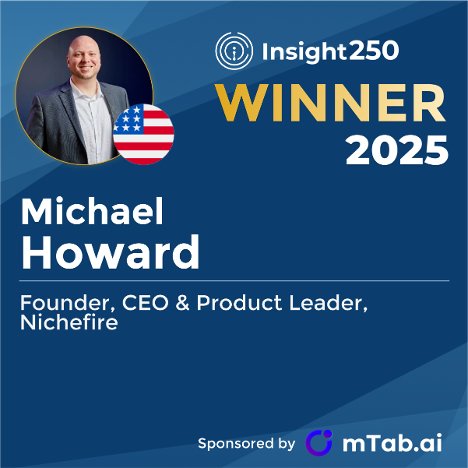
With insights advancing at an incredible pace and the value of insights ever increasing, I sat down with Insight250 Winner Michael Howard. As the CEO and Founder of Nichefire, Michael has dedicated his career to revolutionizing cultural intelligence through AI-driven trend forecasting, enabling brands to anticipate and act on shifts in consumer behavior before they happen. At Nichefire, he built an AI-powered predictive cultural intelligence platform, breaking down the traditional silos of trend forecasting by integrating search trends, web traffic, social media, news, and consumer discourse into a single, unified system.
Crispin: Your central argument, and the founding premise of Nichefire, is that culture is the earliest signal of market movement, and that every breakout product and every brand that suddenly feels irrelevant started as a cultural shift long before the data caught up. How did you arrive at that conviction, and what made you confident it was commercially actionable?
MH: It came from watching the same pattern repeat across categories. Culture is upstream of everything because they are the common beliefs, behaviors, interests, languages, rituals, artefacts, etc. that drive communities, fandoms, and people. Culture is what shapes who we are, what we need, and what we want. And we have the power to see that before it hits our surveys and sales data. It's a key to unlocking our future understanding of unmet needs, potential behaviors, consumption occasions, and ways to connect with people.
What made it commercially actionable was realizing the gap was structural, not informational. Organizations were not short on data. They were short on foresight. They were making their highest-stakes decisions, what to build, what to say, where to invest millions, on information that was already months behind where culture had moved. Once you see that the earliest indicator is sitting right there in culture, and that almost no one has a systematic way to read it, the commercial case writes itself. In practice, we've been able to help our customers launch $150m+ product lines, see up to 6x improvements in advertising KPIs, and see a 72% reduction in trend research time simply by allowing them to be more proactive and aligned with where culture is headed.
Crispin: There is a meaningful difference between a cultural signal, a cultural trend, and a fad. How does Nichefire distinguish between them in practice - and why does that classification matter so much for how clients should respond?
MH: A signal is the earliest flicker. It can be a shift in language, a behavior, or attention inside a community. A trend is a signal that has gained momentum across multiple dimensions and shown durability. A fad spikes hard and decays just as fast with no underlying structural support.
In practice, we separate them through a triangulation methodology. We measure multiple dimensions at once, like how people share opinions and express themselves, how they demonstrate interests, what influences them, etc. A fad usually lights up one dimension and then collapses. A real movement shows up across multiple dimensions of interactions and holds. On top of that, we build a forecasting model for every individual trend, because a GLP-1 health movement behaves nothing like a Formula 1 fandom. That per-trend approach lets us read the behavioral fingerprint, the emotion, velocity, breadth, and context, and tell you whether something is a sprint or a slow compounding shift.
It matters because the worst thing a brand can do is pour budget into a fad or sit out a durable movement. After all, it looks like noise. The classification is the difference between knowing when to lean in, when to hold back, and when to invest for the long game.
Crispin: The 12-to-18-month foresight window is a striking claim. How do you validate it? What does it look like when the model is right - and what happens when it gets it wrong?
MH: We validate it the way any serious forecasting discipline does, against ground truth. Our per-trend models learn from years of historical engagement data and millions of prior trend trajectories, and we run precision and recall checks against large public corpora, plus cross-source replication and hold-out tests, so findings are not biased to one platform or niche. Every readout carries quality metrics: a coverage score, a stability index, and an effective sample size. We are not asking anyone to take the number on faith. In select categories, we are forecasting up to 18 months out with over 90% accuracy, and we show the confidence behind it. But what makes it even more powerful is when you can see the accumulation of related signals along with it that validate similar trajectories.
When the model is right, it looks quiet, almost anticlimactic. A client activates against a movement six, nine, or twelve months before competitors even register it, and by the time the rest of the category piles in, they already own the position. That is what a $100 million-plus innovation pipeline launched ahead of competitors actually looks like in motion.
When it gets it wrong, and any honest forecaster will tell you sometimes it does, it is usually because a signal that looked durable got disrupted by an external shock, a black swan event, or decayed faster than its analogs. That is exactly why explainability is built in and why models retrain daily. We do not hand you a black-box line and walk away. You see the why behind every forecast, so when reality shifts, you see it shift too, and we adapt with it rather than defending a stale prediction.
Crispin: Nichefire takes in billions of signals and uses proprietary trend pattern data to forecast where consumer culture is heading. What is it about cultural data specifically that makes it so different from conventional social listening or market research data - and why does that difference matter for how the AI needs to be designed?
MH: Conventional sources answer different questions. Social listening tells you what people have already said. Surveys and focus groups tell you what people think when you stop them and ask. Both are valuable, and both are fundamentally backward-looking or prompted. Cultural data is different because it is unprompted, it is emergent, and it is messy in ways that actually carry the signal. It lives in the language, rituals, and narratives that communities form on their own, before they have any idea a brand is watching.
That changes how the AI has to be built. You cannot just run sentiment over a keyword stream and call it intelligence. Culture is heterogeneous, so a single global model averages away the very nuance you are trying to capture. That is why we model each trend individually, with its own lightweight forecasting model tuned to that trend's dynamics, whether it is seasonal, viral, or episodic. We layer in custom emotion and expressiveness models built on how people actually talk, a 47-category cultural classification for reliable rollups, and adaptive clustering that surfaces the why underneath shifting momentum. Generic AI is good at summarizing what is in front of it. Reading culture requires a system built for prediction, prioritization, and recommendation on noisy data.
Crispin: Most organisations believe they already have data. What are they actually missing - and how do you make that gap visible to a sceptical CMO or insights director?
MH: What they are missing is foresight and structure. They have enormous volumes of what has already happened and very little on what is about to happen. They have dashboards that confirm the present and almost nothing that anticipates the future. And critically, they have no systematic way to separate the few signals that will matter from the noise.
The way I make that visible to a skeptical insights leader is simple: I show them a movement inside their own category that their current stack has not flagged yet, then walk them through where it sits on its trajectory and where it is heading. The reaction is almost always the same. They recognize it the moment they see it, and then they realize their existing tools would not have surfaced it until it was already too late to lead. That gap, between when culture moves and when their organization can act, is the thing costing the industry billions every year. Once a leader sees it in their own backyard, the conversation stops being about whether they have data and starts being about how much earlier they could be moving.
Crispin: The $150M-plus in innovation pipelines launched ahead of competitors is a compelling proof point. Can you walk us through the anatomy of one of those wins - how a cultural signal became a business decision, and what the timeline looked like from detection to action?
MH: So, a win can look like many things. Sometimes we have no idea what we're looking for. Other times, we have a hunch that we want to validate and understand further. Either way, it starts with discovery. A good example is a case study we did with Nestle. The early signal around GLP-1 drugs like Ozempic and Wegovy did not surface in a food category at all. It surfaced in fitness and health conversations, where influencers and GLP-1 users were already discussing these drugs months before mainstream media picked it up. And well before it showed up in anyone's sales data. Ultimately, it helped paint the picture of emerging pain points GLP-1 consumers were demonstrating with their journey on these medications. We surfaced those signals and forecasted where they were going next. Then Nestle's team carried it to their frozen meals division, and it became Vital Pursuit. A product line built specifically for consumers on GLP-1s. By being first to market against a brand-new consumer need, they did not react to the trend. They arrived before it.
The reason I emphasize discovery is that the signal rarely announces itself inside your own category. Culture is heterogeneous, a GLP-1 movement behaves nothing like a Formula 1 fandom, and the early indicator for a food innovation lived in fitness communities, not on a shelf. We saw the same pattern with the "swicy" wave that revived another F&B brand, a mango chili creamsicle pulled straight from where flavor culture was moving, which drove 15 million engagements on a legacy brand. The teams that win are the ones willing to let the signal come from anywhere, because the richest whitespace almost always shows up at the edges first.
Crispin: Nichefire works with Nestle, Kraft Heinz, P&G, Lululemon and Roche, among others. In your experience, how well do the insight and market research functions inside large organisations actually understand the difference between social listening and genuine cultural intelligence? Is there a significant education gap?
MH: There is a bit of a gap. The way I see it, social listening is more of a class of tools or a capability to conduct research, whereas cultural intelligence is more of a discipline. And social listening is a highly useful capability that can live in PR teams, marketing teams, insights teams, and cultural intelligence. The gap I see is that organizations are still trying to figure out how to exercise all of their potential. Many organizations are still stuck on seeing social listening as a means of measuring the number of mentions around their brands and competitors. Which is a valid use case, but only a fraction of what those tools can unlock.
Nichefire and social listening complement each other very well. Nichefire is designed to pick up on the unknown "unknowns" grounded in that cultural data and provide conviction in where they are headed. Social listening can measure the known areas in great detail.
Crispin: As an Insight250 winner, you're recognised as one of the leaders shaping the future of the industry. Where do you think the insights profession is most behind the curve right now - and what would a genuinely future-ready cultural intelligence capability inside a brand look like if it were done well?
MH: Market research needs to get away from treating culture as a variable to be measured and start treating it as a signal to be decoded. That is the core of where the profession is behind the curve. The default instinct is still to operationalize culture, define it, scope it, fit it into a study, and report on it after the fact. But culture does not hold still long enough for that. Consumer behavior shifts in real time. It does not wait for your study to close. And it is shaped by niche communities and subcultures that never show up in a focus group, the fandoms, forums, and corners of the internet where the earliest indicators actually live. By the time a movement is legible enough to design a study around, it is already mainstream, and the advantage is gone.
Done well, a future-ready cultural intelligence capability looks fundamentally different. It is continuous rather than project-based, always listening rather than waking up when a brief comes in. It reads culture where it actually forms, in the communities and conversations upstream of surveys and sales data, not just where the brand expects the answer to be. And critically, it translates those early signals into decisions, not dashboards, so the organization can act months before the mainstream catches on. The teams delivering the most impact today are already doing exactly this: listening to culture continuously and decoding the early signals into conviction while there is still time to lead.
Crispin: The results Nichefire delivers - including a 4-to-6x improvement in content and advertising effectiveness and 72% faster trend discovery - suggest that cultural foresight has a direct commercial return. Why, then, do so many organisations still treat it as a nice-to-have rather than a core strategic input?
MH: Two reasons, mostly. First, foresight has historically been hard to quantify, so it was coded as soft. When something feels unmeasurable, it gets the innovation-budget treatment, nice to have, first to be cut. The irony is that the return is extremely measurable once you actually instrument it: faster discovery, dramatically more effective content and advertising, pipelines launched ahead of competitors. The commercial return was always there. What was missing was a way to make it concrete.
Second, organizations are structurally wired to reward certainty. It is easier to defend a budget against data that confirms what already happened than against a forecast of what is coming. So teams over-invest in the rear-view mirror because it feels safe, even though the entire cost, that 18-month lag, the failed launches, the missed windows, sits on the foresight side of the ledger. The shift happens the moment a leader watches anticipation beat reaction inside their own category one time. After that, it stops being a nice-to-have and becomes the thing they cannot operate without.
Crispin: You write in Culture Shock about fast culture, vibe shifts and the way digital platforms are compressing the lifecycle of trends. Is the foresight window itself getting shorter - and if so, what does that mean for how organisations need to be structured to use it before it closes?
MH: Yes, in places. Digital platforms have compressed the lifecycle of certain trends dramatically. What I would push back on is the assumption that everything is speeding up uniformly. There is fast culture, and there is slow culture, and they demand opposite responses. Fast culture spikes and decays, and the danger is overreacting to it. Slow culture compounds quietly over the years and builds the most durable brand value, and the danger there is missing it entirely because it rarely spikes.
What that means structurally is that organizations can no longer run on a single cadence. A quarterly planning rhythm cannot catch a fast vibe shift, and an always-on reactive posture will chase noise and miss the slow, value-dense movements. The organizations that win build for both: the ability to sprint on fast spikes without whiplash, and the patience to invest against slow movements before they peak. That requires foresight to be continuous and shared across functions. If your intelligence arrives on a slower clock than culture moves, the window closes before you can act, every time.
Crispin: Much of the most interesting work in predictive cultural intelligence is coming out of Cincinnati rather than the coasts. What does that tell us about the industry, about innovation, and perhaps about culture itself?
MH: I love this question. Cincinnati is one of the great consumer brand-building cities in the world, with deep roots in understanding how real people actually live and buy. That heritage matters. Building cultural intelligence here means we are surrounded by a discipline of connecting insight to product and brand decisions, and not insight for its own sake.
But the assumption that foresight must come from the coasts is itself a little outdated, and frankly, it is a cultural signal worth reading. Culture does not originate in one zip code. It forms everywhere, in every community, and increasingly, the interesting movements start far from the places that assume they set the agenda. Building in the middle of the country is a useful reminder of that. If you believe culture is distributed, it makes sense to read it from somewhere that is not convinced it is already the center of it.
Crispin: If you had to name the single cultural signal you are watching most closely right now - the one you believe the insights industry is most systematically underestimating - what would it be?
MH: The shift away from trusting institutional, polished authority toward trusting peer and community credibility. The industry still largely measures sentiment toward brands and messages as if the brand is the center of gravity. But across category after category, the real authority has migrated into communities, into the people who look and sound like the consumer rather than the people talking at them. We wrote about this macro behavior shift recently, where we observed a growing distrust of doctors and health professionals, and growing trust in communities, influencers, and web-based resources.
The insights world keeps measuring the wrong center of trust. That migration is reshaping how products get discovered, how reputations are made and lost, and where brand relevance actually comes from, and most measurement frameworks are still pointed at the institution instead of the community where the decision is really being made.
Hot Topic
Most organisations believe they compete on data. They invest in dashboards, analytics platforms, and real-time social listening tools that tell them what is happening right now. But if culture moves before markets do, the competitive advantage doesn't belong to whoever has the best rear-view mirror - it belongs to whoever can read the road ahead. Is the insights industry structurally incapable of delivering genuine foresight because its entire commercial model is built around the present tense?
MH: As it is currently built, largely yes, and I do not say that to provoke. I say it because it is the most important thing the industry needs to confront. The dominant commercial model sells confirmation. It is project-based, retrospective, and priced around answering a question after it has already formed. That model is structurally optimized for the present and past tense, and you cannot bolt foresight onto a system designed to confirm the present. The incentives pull the other way.
But structural is not the same as permanent. The model can change, and it has to. The competitive advantage no longer belongs to whoever has the best rear-view mirror. It belongs to whoever can read the road ahead. The firms that rebuild around anticipation rather than confirmation, around continuous foresight rather than batch reporting, are the ones that will still matter in ten years. The rest will keep selling increasingly precise descriptions of a present that their clients' competitors have already moved past.
Top Tip
We ask all our Insight250 contributors to share one practical recommendation with the ResearchWorld community. What is your top tip for an insights professional who wants to move from tracking culture to genuinely anticipating it?
MH: Change the question you start with. Most insights work begins with what is happening, which locks you into the present tense. Start instead with what led to where it is now, where it is going, and what would have to be true for it to last. That reframe forces you upstream, toward the communities and conversations where signals live before they become trends. And do not read those signals in isolation. Accumulate the related ones, the discourse, the search behavior, the adjacent communities, the early influencers, and read them together, because a cluster pointing the same direction is the early shape of a behavior shift, and that is what lets you see a movement forming before it has a name.
Crispin:
Thank you, Michael, for such a genuinely stimulating conversation, sharing your unique perspective and deep expertise on the topic. What strikes me most is that the case you make is not simply about better tools or faster data; it is about a fundamental reorientation of how the insights profession understands its own purpose. The shift from confirmation to anticipation, from measuring what has already happened to reading where culture is actually heading, is not incremental. It is a different discipline entirely. The Nichefire story, from the GLP-1 signal surfacing in fitness communities long before it reached a food aisle, to the structural argument that foresight has always been measurable but organisations were simply not looking for it, makes that case compellingly. I find myself particularly persuaded by the observation that the most durable competitive advantage does not belong to whoever has the best rear-view mirror. The profession would do well to take that seriously.
Crispin Beale
Chairman at QuMind, CEO at Insight250, Senior Strategic Advisor at mTab, CEO at IDXCrispin Beale is a marketing, data and customer experience expert. Crispin spent over a decade on the Executive Management Board of Chime Communications as Group CEO of leading brands such as Opinion Leader, Brand Democracy, Facts International and Watermelon. Prior to this Crispin held senior marketing and insight roles at BT, Royal Mail Group and Dixons. Crispin originally qualified as a chartered accountant and moved into management consultancy with Coopers & Lybrand (PwC). Crispin has been a Board Director (and Chairman) of the MRS for nearly 20 years and UK ESOMAR Representative for c15 years. As well as being CEO of Insight250, Crispin is currently Worldwide CEO of Digital Communications Solution Agency, IDX. Crispin is also the Senior Strategic Advisor at mTab and the Chairman of QuMind and spent 4 years as Group President of Behaviorally where he was responsibile for the client & commercial teams globally. Crispin is a passionate advocate for blending human intelligence and technology to deliver innovation and leadership across organisations.
Article series
Insight250
- The importance of business sense in research
- The role of humour in effective leadership
- The importance of ethics
- The importance of disruption in innovation and leadership
- The importance of Disruption in Innovation and Leadership Part 2
- The importance of Diversity & Inclusion
- The impact of colour
- Communicating insight with impact
- Insights on leadership, culture and polling
- The evolution of electric vehicles
- 2022 Top tips (part 1)
- 2022 Top tips (part 2)
- Maximising the potential of data
- The importance of flexible working
- Winners
- The importance of advanced analytics
- Judges for the 2022 Insight250 Awards announced
- The evolution from social listening to digital intelligence
- The Judges' Perspective
- The judge's perspective - part 2
- Insight Climate Collective
- Insights technology
- Understanding employee ownership
- Global insight perspectives
- Top Tips from our Leaders and Innovators
- The Evolution of Insights in the Food & Beverage Market
- The Evolution of Insights in CPG
- Neural Mechanisms Behind Consumer Decision-Making
- Celebrating and Elevating the Insights Industry
- The State of the Insights Industry
- Opportunities, challenges and threats that AI presents
- 2024 Insight250 Winners Announcement
- Connecting Brands and Consumers Through Insights
- The Importance of Human Insight and Attention
- The Elevating Role of Insights with Technology Innovation
- Haleon’s Insight Expert on Consumer Healthcare
- Insight from the Insight250: How AI is Impacting Qualitative Research
- How AI Tech is Doing the ‘Heavy Lifting’ for Insights
- Reviewing the top tips for 2025
- Google's Sarah Ashley on AI and revolutionising insights - Insights from the Insight250
- Beyond BI: The Future of Decision Intelligence for Insight Professionals
- The Advancement & Impact of Insights - An Insight250 Winners Series perspective with David Smith
- International Jury for the 2025 Insight250 Awards Announced
- Newly elected President, Anne-Sophie, on Revolutionizing the Impact of Insights
- Haleon's Litthya Baez on Enhancing Healthcare with Insights - Insight250 Winners Series
- Understanding the Insights of Consumer Decisions
- Moving Beyond Dashboards to Deliver Decisions with AI
- How AI is Transforming Insights
- How AI is Transforming Insights
- Five Years of Insight250: Elevating the Insight Industry