Focusing on Human-Centric Intelligence
The Insight250 spotlights and celebrates, annually, 250 of the world’s premier leaders and innovators in market research, consumer insights, and data-driven marketing.

Article series
Insight250
- The importance of business sense in research
- The role of humour in effective leadership
- The importance of ethics
- The importance of disruption in innovation and leadership
- The importance of Disruption in Innovation and Leadership Part 2
- The importance of Diversity & Inclusion
- The impact of colour
- Communicating insight with impact
- Insights on leadership, culture and polling
- The evolution of electric vehicles
- 2022 Top tips (part 1)
- 2022 Top tips (part 2)
- Maximising the potential of data
- The importance of flexible working
- Winners
- The importance of advanced analytics
- Judges for the 2022 Insight250 Awards announced
- The evolution from social listening to digital intelligence
- The Judges' Perspective
- The judge's perspective - part 2
- Insight Climate Collective
- Insights technology
- Understanding employee ownership
- Global insight perspectives
- Top Tips from our Leaders and Innovators
- The Evolution of Insights in the Food & Beverage Market
- The Evolution of Insights in CPG
- Neural Mechanisms Behind Consumer Decision-Making
- Celebrating and Elevating the Insights Industry
- The State of the Insights Industry
- Opportunities, challenges and threats that AI presents
- 2024 Insight250 Winners Announcement
- Connecting Brands and Consumers Through Insights
- The Importance of Human Insight and Attention
- The Elevating Role of Insights with Technology Innovation
- Haleon’s Insight Expert on Consumer Healthcare
- Insight from the Insight250: How AI is Impacting Qualitative Research
- How AI Tech is Doing the ‘Heavy Lifting’ for Insights
- Reviewing the top tips for 2025
- Google's Sarah Ashley on AI and revolutionising insights - Insights from the Insight250
- Beyond BI: The Future of Decision Intelligence for Insight Professionals
- The Advancement & Impact of Insights - An Insight250 Winners Series perspective with David Smith
- International Jury for the 2025 Insight250 Awards Announced
- Newly elected President, Anne-Sophie, on Revolutionizing the Impact of Insights
- Haleon's Litthya Baez on Enhancing Healthcare with Insights - Insight250 Winners Series
- Understanding the Insights of Consumer Decisions
- Moving Beyond Dashboards to Deliver Decisions with AI
- How AI is Transforming Insights
- How AI is Transforming Insights
- Five Years of Insight250: Elevating the Insight Industry
The Insight250 spotlights and celebrates, annually, 250 of the world’s premier leaders and innovators in market research, consumer insights, and data-driven marketing. The awards have created renewed excitement across the industry whilst strengthening the connectivity of the market research community. Winners of the 2025 Insight250 were announced last September - you can see the full list of Winners, and those from previous years, at Insight250.com. The 2026 Insight250 nominations are currently in review.
With so many exceptional professionals named to the Insight250, we regularly tap into their expertise and unique perspectives on a range of topics. This regular series does just that: inquiring about the expert perspectives of many of these individuals in a series of short topical features.
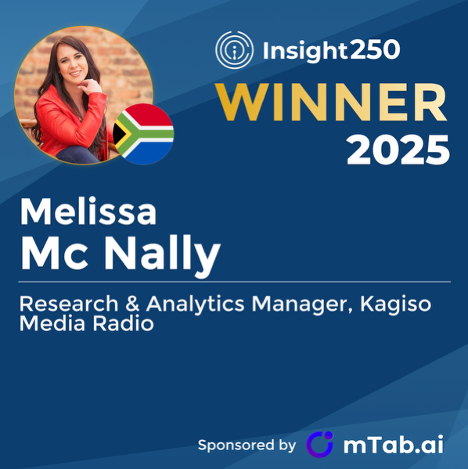
With insights advancing at an incredible pace and the value of insights ever increasing, I sat down with Insight250 Winner Melissa Mc Nally. Melissa has been involved in releasing the next-gen neuro solution for Kagiso Media, which allows clients and advertisers to test sonic IDs as well as creative to understand emotional engagement and attention, for better key campaign metrics and ROI. As Research & analytics Manager for Kagiso, she is involved in driving radio currency and broader audio research, and looks at ways to empower clients.
Crispin: You argue that the industry has become obsessed with attention as an outcome when attention is, in neurological terms, simply a cognitive gateway. How did the industry end up in this position, and why has the distinction between attention and cognition proved so difficult to communicate to clients and planners?
MM: I don't think the industry's focus on attention is wrong. I think it's incomplete.
For decades, we've relied on the same basic media metrics-reach, frequency, ratings, impressions and opportunities to see. Attention emerged because the industry was searching for something better: a way to move beyond exposure and understand whether people actually noticed communication.
The problem is that we became fascinated by what we could measure.
Attention gave us a number, and because commercial decisions demand accountability, that number quickly became treated as an outcome. We started celebrating the doorway instead of understanding what was happening inside the house.
From a neurological perspective, attention is simply a filtering mechanism. It determines what information enters conscious processing. But attention alone doesn't create memory, meaning, preference, or behaviour. The real work happens in cognition.
Cognition is where people interpret information, connect it to existing memories, assign emotional significance, and ultimately make decisions. Two people can pay the same amount of attention to the same message and walk away with completely different outcomes because cognition is shaped by emotion, culture, context and lived experience.
The distinction has been difficult to communicate because attention is visible and easy to quantify. Cognition is not. Attention gives us certainty. Cognition forces us to confront the complexity of human behaviour.
As an industry, we've often mistaken the ease of measurement for importance.
The future isn't about abandoning attention. It's about putting it back in its rightful place-as one part of a much larger human process.
Because ultimately, people don't behave according to what captures their attention. They behave according to what captures their minds.
Crispin: You have written about the brain as an energy-conservation machine that uses attention as a filter for deciding what deserves further processing. What does that framing change about how researchers and marketers should think about campaign effectiveness?
MM: One of the biggest misconceptions in marketing is that people are actively engaging with brands all day. They're not.
The brain evolved to keep us alive, not to consume advertising. From a neurological perspective, it is constantly trying to conserve energy, filtering vast amounts of information and deciding what is worth processing further. Attention is part of that filtering system.
This changes how we should think about effectiveness. Instead of asking, "How do we get people to pay attention?" we should be asking, "Why would the brain decide this is worth processing?"
Too often, marketing focuses on exposure and visibility. But attention alone doesn't create memory, meaning or behaviour. The brain prioritises information that feels relevant, emotionally significant, useful or connected to existing goals and motivations.
For researchers, this means moving beyond measuring whether something was seen or heard and understanding why it resonated. What emotions did it trigger? What memories or associations did it activate? Why did the brain decide this information mattered?
For marketers, it shifts the focus from interruption to relevance. The most effective campaigns aren't necessarily the loudest; they're the ones that connect with genuine human needs, emotions and motivations.
Ultimately, consumers are not passive recipients of information. They are highly efficient biological systems making constant decisions about where to invest their limited cognitive resources.
The job of marketing is not to win attention. It's to earn processing.
Crispin: High attention scores do not always translate into action. You have been making this case publicly for some time. What is the most striking real-world example you have encountered of a campaign that scored strongly on attention-based metrics but failed to move behaviour?
MM: I'd probably get myself into trouble if I gave a specific example (I'd say there are more examples than fewer). But the most striking cases are often the campaigns that everyone remembers, yet nobody can remember who they were for.
We've all seen highly engaging campaigns that generate exceptional attention scores, social conversation and creative acclaim, but deliver relatively little movement in sales, consideration or brand choice. People remember the joke, the celebrity or the emotional moment, but the brand itself never becomes meaningfully encoded in memory.
For me, that's one of the clearest demonstrations that attention is not the same thing as cognition.
The creative captures attention, but the brand doesn't capture relevance.
That said, before anyone rushes off and declares attention unimportant, the odds of success are still considerably higher for a good campaign than a bad one. A campaign that fails to capture attention at all is unlikely to create memory, meaning or behavioural change. Attention matters-it just isn't the whole story.
I've also seen the opposite: relatively simple campaigns with modest attention scores driving strong behavioural outcomes because they connected with a genuine consumer need, reinforced existing brand associations or arrived at exactly the right moment in the decision-making process.
That's why I often say attention is a necessary condition for effectiveness, but it is not a sufficient explanation for it.
The real question isn't whether people noticed the advertisement. It's whether they remembered it, attached meaning to it and ultimately changed their behaviour because of it.
Because the goal of advertising isn't simply to be seen. It's to leave a trace in the mind that influences future behaviour.
Crispin: You identify emotion, meaning, relevance, context and memory as the mechanisms that determine whether exposure becomes influence. Of those five, which does the industry most systematically undervalue, and why?
MM: If I had to choose one, it would be context.
And by context, I don't just mean where someone is when they encounter a message. I mean the broader context of their lives, including the emotional, social and cultural environments that shape how that message is interpreted.
Emotion, memory and even relevance have become part of the marketing conversation in recent years. Context, however, is often treated as a media variable rather than a human variable.
The reality is that people don't experience advertising in a vacuum. The same message can produce completely different outcomes depending on where someone is, what they're doing, how they're feeling, who they're with and the cultural lens through which they're interpreting it.
As researchers, we're often searching for universal truths, but human behaviour is remarkably situational. Context is where culture, circumstance and emotion collide. It's the reason the same person can respond differently to the same message on different days, and why the same message can mean different things to different people.
This is one of the reasons I find human behaviour so fascinating. People are wonderfully inconsistent-not because they're irrational, but because the contexts in which they make decisions are constantly changing.
I think the industry undervalues context because it introduces complexity. It's far easier to measure exposure than it is to understand the lived reality surrounding that exposure. Yet context is often the difference between a message that is merely noticed and one that genuinely resonates.
Ultimately, influence doesn't happen because a person was exposed to a message.
It happens because that message made sense in a particular moment, for a particular person, in a particular context.
On joy, measurement and what is missing
Crispin: You have proposed joy as a strategic metric, noting that businesses measure satisfaction, loyalty and advocacy but rarely joy. What would it look like in practice to build joy into a measurement framework, and what would it tell us that current metrics do not?
MM: I think the first step is recognising that joy isn't a single emotion-it's a collection of experiences that help people feel more human.
When we developed our Joy Framework, we identified several dimensions that consistently emerged in people's lives: connection, belonging, optimism, discovery, achievement, gratitude, playfulness and moments of control. These are the experiences that help people navigate uncertainty and create meaning in everyday life.
In practice, measuring joy would involve tracking how effectively brands, products, content or experiences contribute to these dimensions. Rather than simply asking whether someone was satisfied, we would ask whether the experience made them feel connected, inspired, valued, understood or more optimistic about their day.
What's interesting is that joy often reveals things that traditional metrics miss.
A customer may be satisfied because a service worked as expected. They may be loyal because switching is inconvenient. But joy tells us whether the experience created emotional value. Did it become memorable? Was it shared? Did it strengthen the relationship between the individual and the brand?
From a neuroscience perspective, this matters because emotion plays a critical role in memory formation and future decision-making. The experiences that generate joy are often the experiences that people remember most clearly and return to most willingly.
I believe the future of measurement lies in balancing transactional metrics with human metrics. Satisfaction tells us whether expectations were met. Joy tells us whether something meaningful happened.
And in a world increasingly shaped by automation and efficiency, meaning may become one of the most valuable measures we have.
Crispin: You coined the concept of micro-joy as one of the discussion areas for this topic. Can you explain what you mean by micro-joy and how it connects to emotional resilience in the consumer context?
MM: When people hear the word joy, they often think of major life events-weddings, promotions, holidays or significant achievements. But most people don't live in those moments. They live in the small moments in between.
That's where the idea of micro-joy comes from.
Micro-joy refers to the small, everyday experiences that create a brief sense of pleasure, connection, comfort, control or optimism. It might be a favourite radio presenter making you smile during your commute, a perfectly made cup of coffee, an unexpected message from a friend, discovering something new or simply finding a moment of calm in a busy day.
What fascinated me was how frequently these seemingly insignificant moments appeared in our research, particularly during periods of uncertainty. As economic pressure, social complexity and information overload increase, people don't necessarily look for grand sources of happiness. They look for manageable moments that help them reset, reconnect and keep moving forward.
One of the themes that emerged repeatedly in our work was captured in a simple phrase: "We're not fine. But we're ready." People are acutely aware of the pressures they're facing-financial, social and emotional-but they are still finding ways to adapt, cope and move forward. Micro-joys are often the mechanism that makes that possible.
That's where emotional resilience comes in.
Resilience isn't about avoiding stress or difficulty. It's about our ability to recover, adapt and maintain wellbeing despite those challenges. Micro-joys act as small emotional replenishment points throughout the day. They help restore a sense of agency, perspective and connection, which are all critical components of resilience.
For brands, this creates an interesting opportunity. The most valuable brands are not always the ones solving life's biggest problems. Sometimes they're the ones creating small moments of delight, comfort or meaning that fit naturally into people's daily lives.
I believe we've underestimated the power of these moments because they're difficult to see when we're focused on large-scale metrics. Yet when accumulated over time, micro-joys can have a profound impact on how people feel, what they remember and the relationships they build with brands.
Micro-joy is not about escaping reality.
It's about helping people navigate reality a little better.
Because we're not fine. But we're ready.
Crispin: After 20 years across marketing, media and social research, including a grounding in Research Psychology at Wits and studies in race relations and gender, you have become, as you put it, less interested in what people say they do and more focused on what actually drives behaviour. At what point in your career did that shift happen, and what caused it?
MM: I don't think there was a single moment. It was a gradual realisation that people are far more complex than the models we often use to describe them.
Early in my career, I was fascinated by what people told us through surveys, interviews and focus groups. But over time, I kept seeing a gap between what people said and what they actually did. People would describe their decisions as rational, yet their behaviour often suggested otherwise.
My background in Research Psychology helped me understand why. Much of human behaviour happens beneath conscious awareness. Emotion, memory, identity, social norms, culture and context all influence our decisions in ways we don't always recognise or articulate.
That insight shifted my focus from simply measuring attitudes to understanding behaviour. The more experience I gained, the more I realised that research is at its most powerful when it borrows not only from statistics, but from psychology, anthropology and even philosophy.
What fascinates me most is tension.
The tension between what people say and what they do. Between who they are and who they aspire to be. Between belonging and individuality. Between stability and change. Human beings are wonderfully contradictory, and those contradictions are often where the most meaningful insights live.
At their core, psychology, anthropology and philosophy are all trying to answer the same question: What does it mean to be human?
Today, I'm less interested in audiences as segments and more interested in humans as complex individuals navigating real lives. The space between intention and action fascinates me because that's where tension, identity, culture, emotion and meaning collide.
Because if we focus only on what people say, we understand opinions. If we understand behaviour, we begin to understand people.
On audio, SoundInsights and the South African context
Crispin: SoundInsights is described as a human-centric intelligence layer designed to rethink how brands, creative and media connect with people. What was broken about the previous generation of audio measurement that made you want to build something different?
MM: The short answer? We became incredibly good at measuring audiences and remarkably poor at understanding people.
Traditional audio measurement was built to answer questions such as how many, how often and who. Those are important questions, and they remain essential for trading and planning. But they tell us very little about what is happening inside the minds of the people behind those numbers.
For years, our industry focused on metrics such as reach, frequency, ratings and share. We knew whether someone was exposed to content. What we didn't know was what they felt, what they remembered, what resonated with them or whether any of it changed behaviour.
That was the gap that fascinated me.
As researchers, we've often treated audiences as data points, segments and demographics. But people don't experience media as demographics. They experience it as humans-through emotion, memory, culture, identity and context.
SoundInsights was built around a simple idea: what if we stopped measuring exposure alone and started understanding influence?
That means looking beyond audiences and into attention, emotion, cognition, behaviour and ultimately human connection. Because the future of measurement isn't just about knowing how many people were reached.
It's about understanding what moved them once they were.
Crispin: At the EGTA Market Intelligence Conference in Zurich, you presented work on what you called the Audio Signal Era, including a campaign called A Million and Change and your work on acoustic signal characteristics and brand strategy alignment. What is an audio signal in the sense you mean, and why does understanding it matter more than measuring reach?
MM: When I talk about an audio signal, I'm referring to the acoustic cues that carry meaning and emotion-not just the words being spoken, but how they're delivered.
Things like tone, pace, timbre, structure and emotional expression act as signals that the brain interprets, often before conscious thought takes place. These signals influence how a message is felt, remembered and ultimately acted upon.
For decades, we've focused on measuring reach-how many people had the opportunity to hear a message. That's important, but it only tells us about exposure.
What interests me is influence.
Two campaigns can achieve identical reach and frequency, yet produce completely different outcomes because the signals being transmitted are fundamentally different. One creates trust, connection and memory; the other simply passes through unnoticed.
What made A Million and Change so exciting was that we could actually observe this process in action. Using attribution modelling, we were able to see behavioural responses occurring within minutes of exposure. We weren't simply measuring audiences; we were measuring influence.
For an industry that has traditionally focused on reach and ratings, that's a significant shift. Suddenly, the conversation moves from "How many people heard it?" to "What happened because they heard it?"
For me, that's where things get really interesting.
The Audio Signal Era is about understanding not just who was reached, but what was actually transmitted, how the brain responded to it and whether it ultimately influenced behaviour.
Because reach tells us a message was heard. Signals help explain why it mattered.
Crispin: You have argued that in South Africa, audio plays a role that goes well beyond entertainment, helping people navigate uncertainty, maintain connection and make sense of their day. How does that change what researchers and planners should be measuring when they evaluate audio campaigns?
MM: I think it requires us to fundamentally rethink what audio actually is.
For years, we've evaluated FM radio, streaming and podcasts as separate channels. But consumers don't experience them that way. They experience them as part of a broader audio ecosystem that moves with them throughout the day.
Someone may wake up listening to FM radio, stream music at work, listen to a podcast while exercising and return to the radio on the drive home. The common thread isn't the platform. It's the role audio plays in their lives.
In South Africa, particularly, audio often goes far beyond entertainment. It provides companionship, connection, information, reassurance and a sense of belonging. It helps people make sense of their day and navigate an increasingly complex world.
If that's true, then measuring reach alone is nowhere near enough.
We need to understand attention, emotion, trust, memory and behavioural influence across the entire audio journey. We should be measuring not just whether people were exposed to a message, but how the environment, context and emotional state of the listener shaped its impact.
The future of audio measurement isn't about understanding platforms in isolation.
It's about understanding how people move through audio experiences and how those experiences influence thoughts, feelings and behaviour.
Because ultimately, people don't build relationships with channels.
They build relationships with voices, stories and moments that matter.
On building a human outcomes framework.
Crispin: Your third proposed topic calls for media planning to move from optimising for exposure to building measurement systems around human outcomes. What would a human outcomes framework actually look like in practice, and who in the industry is closest to building one?
MM: I think the first step is recognising that exposure is not an outcome.
For decades, we've built measurement systems around what media does-reach, frequency, impressions, clicks and increasingly attention. Those metrics tell us whether an opportunity to influence existed. They don't tell us whether influence actually occurred.
A human outcomes framework starts from a different place. Instead of asking, "What did the media do?" it asks, "What happened to the human?"
Did they remember the message? Did it change how they felt? Did it strengthen trust? Did it create meaning? Did it shift perception, influence a decision or drive behaviour?
For me, the future lies in connecting exposure to a chain of human outcomes: attention, emotion, cognition, memory and behaviour. That's where we begin to understand not just whether communication was delivered, but whether it genuinely mattered.
I also think we need to challenge our obsession with KPIs. For years, we've built Key Performance Indicators around media outputs and commercial outcomes. What if we started thinking about HPIs-Human Performance Indexes? Measures that help us understand how communication impacts people, not just platforms. Are we building trust? Creating connection? Increasing confidence? Inspiring action? Improving wellbeing? These are outcomes that matter to both people and businesses.
Because somewhere along the way, we started treating humans as the product rather than the purpose.
What's interesting is that no single organisation has fully solved this yet. Different parts of the industry are tackling different pieces of the puzzle. Attention researchers are helping us understand noticeability. Neuroscience is helping us understand emotional processing. Attribution is helping us understand behavioural outcomes. The challenge is that these often exist in isolation.
The real opportunity is integration.
At SoundInsights, that's the journey we're exploring. How do we connect human experience with commercial outcomes? How do we move beyond media metrics and understand the relationship between what people hear, what they feel, what they remember and ultimately what they do?
Because ultimately, businesses don't grow because people were exposed to communication.
They grow because people changed their behaviour.
Crispin: You have been part of shaping how audiences are measured in South Africa through your involvement with the NAB and BRC, and through work such as bringing The Infinite Dial to South Africa. Looking at the measurement infrastructure that exists today, what is the single most important thing that needs to change?
MM: If I had to choose one thing, it would be this: we need to stop measuring channels and start measuring people. Hear me out...
Historically, measurement systems were built around media silos. Radio had its currency, television had its currency, digital had its dashboards, and each was designed to answer questions about a specific platform. That made sense when media consumption was more linear.
But consumers don't live in channels. People move seamlessly between FM radio, streaming audio, podcasts, social media, video and digital platforms throughout the day. Yet our measurement systems often remain fragmented, creating multiple versions of the same human being depending on where they happen to be consuming content.
The challenge isn't a lack of data. In many ways, we have more data than ever before.
The challenge is that we're still trying to understand modern human behaviour through systems that were largely designed for a different media reality.
For me, the future isn't about building bigger datasets. It's about building better connections between them. We need measurement frameworks that reflect how people actually experience media, not how the industry organises itself.
Ultimately, audiences don't wake up in the morning and think, "Today I'm going to consume radio, then digital, then podcasting."
They simply live their lives, and our measurement systems should be able to do the same.
Because the most important unit of measurement has never been the channel. It's always been the human.
Hot Topic
The insights and media industries have invested heavily in attention as the defining currency of advertising effectiveness. Viewability, scroll stops, eye-tracking, dwell time: the vocabulary of attention now dominates how campaigns are bought, sold and evaluated. But attention is not cognition. It is the threshold question the brain asks before deciding whether to spend any further energy on a stimulus. What happens after that threshold is crossed, the emotional processing, the meaning-making, the memory formation, the eventual decision to act, remains largely unmeasured, because it is harder to count and harder to sell as a clean metric. Melissa McNally, Research and Analytics Manager at Kagiso Connect and a recognised Insight250 winner, has spent her career building the case for measurement that goes beyond exposure. Her work on SoundInsights and her presentations at the EGTA Market Intelligence Conference in Zurich are part of a broader argument: that if media research only tells us whether something was noticed, it is leaving out almost everything that matters.
Top Tip
We ask all our Insight250 winners to share one practical tip for the ResearchWorld community. What is yours?
Remember your responsibility as a researcher.
In a world overflowing with data, dashboards and increasingly sophisticated technology, it's easy to forget that our job is not simply to measure people. Our job is to understand them and amplify their voices.
Research shapes decisions, influences investment, informs policy and increasingly impacts how organisations interact with society. That comes with a responsibility to be curious, rigorous and courageous.
Push back when the story being told doesn't match the evidence.
One of the most important parts of our role is protecting the integrity of the insight. Sometimes that means challenging assumptions. Sometimes it means questioning a popular narrative. And sometimes it means pushing back when the data is being used to support a convenient piece of spin rather than the truth.
I've always believed that researchers should be advocates for evidence, not cheerleaders for agendas.
Never fall in love with a narrative. Fall in love with understanding.
Question assumptions. Be willing to say "I don't know" when the evidence isn't there. And remember that every statistic, segment and trend ultimately represents a real person navigating a real life.
The best researchers are not the ones with the most data. They're the ones who never lose sight of the people the data represents.
Crispin:
Thank you, Melissa. What stays with me most from our conversation is the consistency of your argument: that the industry has built increasingly sophisticated systems for measuring exposure while leaving the harder, more important questions about human experience largely unanswered. From your framing of attention as a cognitive gateway rather than an outcome, through to micro-joy as a mechanism for emotional resilience, and your vision of a human outcomes framework that puts people ahead of platforms, there is a clear and compelling thread running through everything you do. Your work on SoundInsights and the broader case you are making for measurement that reflects how people actually live, feel and decide feels timely and necessary. I hope this conversation encourages more researchers and planners to ask not just whether their message was noticed, but whether it genuinely mattered.
Crispin Beale
Chairman at QuMind, CEO at Insight250, Senior Strategic Advisor at mTab, CEO at IDXCrispin Beale is a marketing, data and customer experience expert. Crispin spent over a decade on the Executive Management Board of Chime Communications as Group CEO of leading brands such as Opinion Leader, Brand Democracy, Facts International and Watermelon. Prior to this Crispin held senior marketing and insight roles at BT, Royal Mail Group and Dixons. Crispin originally qualified as a chartered accountant and moved into management consultancy with Coopers & Lybrand (PwC). Crispin has been a Board Director (and Chairman) of the MRS for nearly 20 years and UK ESOMAR Representative for c15 years. As well as being CEO of Insight250, Crispin is currently Worldwide CEO of Digital Communications Solution Agency, IDX. Crispin is also the Senior Strategic Advisor at mTab and the Chairman of QuMind and spent 4 years as Group President of Behaviorally where he was responsibile for the client & commercial teams globally. Crispin is a passionate advocate for blending human intelligence and technology to deliver innovation and leadership across organisations.
Article series
Insight250
- The importance of business sense in research
- The role of humour in effective leadership
- The importance of ethics
- The importance of disruption in innovation and leadership
- The importance of Disruption in Innovation and Leadership Part 2
- The importance of Diversity & Inclusion
- The impact of colour
- Communicating insight with impact
- Insights on leadership, culture and polling
- The evolution of electric vehicles
- 2022 Top tips (part 1)
- 2022 Top tips (part 2)
- Maximising the potential of data
- The importance of flexible working
- Winners
- The importance of advanced analytics
- Judges for the 2022 Insight250 Awards announced
- The evolution from social listening to digital intelligence
- The Judges' Perspective
- The judge's perspective - part 2
- Insight Climate Collective
- Insights technology
- Understanding employee ownership
- Global insight perspectives
- Top Tips from our Leaders and Innovators
- The Evolution of Insights in the Food & Beverage Market
- The Evolution of Insights in CPG
- Neural Mechanisms Behind Consumer Decision-Making
- Celebrating and Elevating the Insights Industry
- The State of the Insights Industry
- Opportunities, challenges and threats that AI presents
- 2024 Insight250 Winners Announcement
- Connecting Brands and Consumers Through Insights
- The Importance of Human Insight and Attention
- The Elevating Role of Insights with Technology Innovation
- Haleon’s Insight Expert on Consumer Healthcare
- Insight from the Insight250: How AI is Impacting Qualitative Research
- How AI Tech is Doing the ‘Heavy Lifting’ for Insights
- Reviewing the top tips for 2025
- Google's Sarah Ashley on AI and revolutionising insights - Insights from the Insight250
- Beyond BI: The Future of Decision Intelligence for Insight Professionals
- The Advancement & Impact of Insights - An Insight250 Winners Series perspective with David Smith
- International Jury for the 2025 Insight250 Awards Announced
- Newly elected President, Anne-Sophie, on Revolutionizing the Impact of Insights
- Haleon's Litthya Baez on Enhancing Healthcare with Insights - Insight250 Winners Series
- Understanding the Insights of Consumer Decisions
- Moving Beyond Dashboards to Deliver Decisions with AI
- How AI is Transforming Insights
- How AI is Transforming Insights
- Five Years of Insight250: Elevating the Insight Industry