Focusing on Value, Trust and Brand Clarity
The Insight250 spotlights and celebrates, annually, 250 of the world’s premier leaders and innovators in market research, consumer insights, and data-driven marketing.

Article series
Insight250
- The importance of business sense in research
- The role of humour in effective leadership
- The importance of ethics
- The importance of disruption in innovation and leadership
- The importance of Disruption in Innovation and Leadership Part 2
- The importance of Diversity & Inclusion
- The impact of colour
- Communicating insight with impact
- Insights on leadership, culture and polling
- The evolution of electric vehicles
- 2022 Top tips (part 1)
- 2022 Top tips (part 2)
- Maximising the potential of data
- The importance of flexible working
- Winners
- The importance of advanced analytics
- Judges for the 2022 Insight250 Awards announced
- The evolution from social listening to digital intelligence
- The Judges' Perspective
- The judge's perspective - part 2
- Insight Climate Collective
- Insights technology
- Understanding employee ownership
- Global insight perspectives
- Top Tips from our Leaders and Innovators
- The Evolution of Insights in the Food & Beverage Market
- The Evolution of Insights in CPG
- Neural Mechanisms Behind Consumer Decision-Making
- Celebrating and Elevating the Insights Industry
- The State of the Insights Industry
- Opportunities, challenges and threats that AI presents
- 2024 Insight250 Winners Announcement
- Connecting Brands and Consumers Through Insights
- The Importance of Human Insight and Attention
- The Elevating Role of Insights with Technology Innovation
- Haleon’s Insight Expert on Consumer Healthcare
- Insight from the Insight250: How AI is Impacting Qualitative Research
- How AI Tech is Doing the ‘Heavy Lifting’ for Insights
- Reviewing the top tips for 2025
- Google's Sarah Ashley on AI and revolutionising insights - Insights from the Insight250
- Beyond BI: The Future of Decision Intelligence for Insight Professionals
- The Advancement & Impact of Insights - An Insight250 Winners Series perspective with David Smith
- International Jury for the 2025 Insight250 Awards Announced
- Newly elected President, Anne-Sophie, on Revolutionizing the Impact of Insights
- Haleon's Litthya Baez on Enhancing Healthcare with Insights - Insight250 Winners Series
- Understanding the Insights of Consumer Decisions
- Moving Beyond Dashboards to Deliver Decisions with AI
- How AI is Transforming Insights
- How AI is Transforming Insights
- Five Years of Insight250: Elevating the Insight Industry
The Insight250 spotlights and celebrates, annually, 250 of the world’s premier leaders and innovators in market research, consumer insights, and data-driven marketing. The awards have created renewed excitement across the industry whilst strengthening the connectivity of the market research community. Winners of the 2025 Insight250 were announced last September - you can see the full list of Winners, and those from previous years, at Insight250.com. The 2026 Insight250 nominations are currently in review.
With so many exceptional professionals named to the Insight250, we regularly tap into their expertise and unique perspectives on a range of topics. This regular series does just that: inquiring about the expert perspectives of many of these individuals in a series of short topical features.
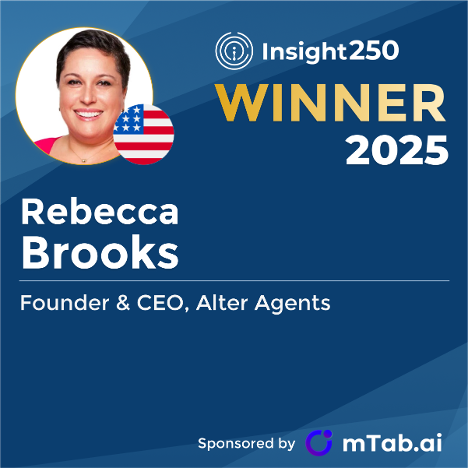
With insights advancing at an incredible pace and the value of insights ever increasing, I sat down with Insight250 Winner Rebecca Brooks. Rebecca founded Alter Agents, a woman-owned, award-winning consultancy, based on the belief that research could be done differently: both in the way research is conducted and presented to clients. She has shaped a company culture rooted in flexibility, empathy, and innovation, delivering high-impact research for brands like Snapchat, Pinterest, Netflix, and Viking Cruises.
Crispin: You have been tracking consumer sentiment since late 2019 - through the optimism bubble, the shattering of that bubble in 2020, the rise of the Highly Defeated Consumer in 2024, and now the Verification Economy. Looking at that arc, what is the single most dramatic shift you have observed in how American consumers relate to brands and shopping?
RB: The most dramatic shift in consumer sentiment we see is the decline of joy in shopping, making it less emotional and more transactional. In 2019, 60% of consumers looked forward to shopping. Today, that anticipation and enjoyment have measurably declined. The relationship between shoppers and brands has fundamentally changed because the emotional driver is disappearing. Shopping has shifted from an experience driven by positive emotions to one dominated by negative ones. The emotional experience of shopping has completely reversed.
Crispin: The Verification Economy is defined in your research as a moment where consumers invest time, attention and mental energy not just in choosing what to buy, but in proving their choices are right, safe and defensible. What does that shift from emotional to analytical purchasing mean in practice for how brands need to show up?
RB: When purchasing shifts from joyful to analytical, the entire relationship changes. Emotional buyers want to feel convinced; analytical buyers need to prove they’re right. This means brands can’t rely on narrative or aspiration anymore; they have to enable verification. Consumers consideration phase has elongated by 52%, reviewing 2-3 channels before buying even essentials. This is cognitive and time-consuming labor that brands need to respect and streamline. Brands need to overshare: third-party reviews, user reviews, pricing transparency, operational clarity because hiding anything signals distrust.
Crispin: Your research finds that shopping has lost its shine - that the enjoyment and anticipation that used to drive purchase behaviour has measurably declined. Is this a cyclical response to economic pressure, or are you seeing signs that something more structural has changed in how Americans relate to consumption?
RB: In previous downturns, even when spending contracted, the anticipation recovered. Consumers still wanted to shop once they had breathing room to do so. We’re not seeing that pattern now, and the data suggests why. Economic pressure is colliding with a feeling of loss of control and the structural signal that even consumers in good financial positions are pulling back shows it’s not just economic constraints. This decline has been steady over the last six years and these are big fundamental shifts in perception. Americans aren’t optimistic about their futures; this demonstrates a meaningful decline. When consumers with money are still pulling back, when their joy in shopping is declining regardless of financial position, we’re looking at something structural, not cyclical.
Crispin: Your data shows 73% of American households are planning to reduce non-essentials, 42% are postponing or cancelling life events, and even consumers in good financial positions are pulling back. What is the most important thing brands are getting wrong about how to respond to this environment?
RB: Treating it like a fleeting moment, that gas prices will decline soon and we will return to “normal.” Like post-COVID, there are fundamental changes ahead, and brands need to be preparing for them. Instead, they are offering more optimization when consumers desperately need clarity. 40% are leaving websites due to choice overload, yet the industry response is to invest in AI and personalization that adds complexity. Brands are also assuming trust will follow with transparency, but transparency without clarity just creates more avenues for scrutiny. Consumers are now actively skeptical of everything, including peer reviews and influencer recommendations because they’re encountering fakes at scale. The brands winning aren’t the ones claiming authenticity or offering more choice; they’re the ones reducing friction in verification and building systems consumers can trust, not just narratives they can believe in.
Crispin: You distinguish between the current moment and previous downturns - specifically that lower-income Americans are more economically vulnerable than during 2008, without the safety net that government stimulus previously provided. What does that mean for how brands should be segmenting and communicating right now?
RB: Recognize that consumers are making trade-offs at every income level and those trade-offs carry real weight. It’s not just about price or value; it’s about belief systems, broader economic pressures and what they’re giving up to make a purchase. A consumer trading down isn’t just about being rational; they may be sacrificing something they valued. A consumer pulling back despite having money isn’t being fickle; they are managing uncertainty with practicality. Treat the purchase with the gravity that your consumers are experiencing in trying to make decisions. Understand they’re giving up, financially, emotionally and philosophically to choose your product. That recognition changes how you segment, message and show up.
Crispin: Value has re-entered the building, as you put it, with one in three consumers making deliberate trading-down decisions. But your research also suggests this isn’t pure price sensitivity - it’s a more complex recalibration of what value actually means. How do you help brands understand the difference?
RB: Value today isn’t only what you get for the money you spend; it’s how you feel about yourself after you’ve spent that money. Is the best-case scenario that you didn’t make a disastrous decision? Or do you feel excited, elated, like you won with the purchase? Value carries emotional connotations now. One in three consumers is making deliberate trading-down decisions, but it’s not just pure price sensitivity, the consumers are actively choosing different definitions of “value” for different categories. The recalibration is that consumers are becoming deliberately segmented shoppers. They’re not becoming universally price conscious; they’re becoming strategically conscious about what categories deserve their attention and spend. Brands need to stop chasing value across the board and understand which category they’re in for which consumer segment.
Crispin: The Peak Optimization pillar of your research describes how the race to build the perfect shopping experience has accidentally built a maze - and that AI-assisted purchase decisions actually result in more uncertainty, not less. That is a striking finding. What is the mechanism behind it, and what should brands and retailers do differently?
RB: Yeah, we built a maze! AI recommendations remove human friction but add analytical burden. Consumers have to cognitively justify whether the algorithm is optimizing for them or for the retailer. But there’s a deeper problem: consumers are smart enough to know they’re being targeted everywhere, watched and lied to, including exposure to fake products and AI. When optimization feels like manipulation, it increases uncertainty rather than reducing it. Rather than fighting the entire media ecosystem, brands need to find moments to meet people where they actually are. That means surrendering algorithm-driven recommendations and instead enabling transparent curation, surfacing negative information and building systems that respect (not exploit) consumer skepticism. The brands winning are making verification frictionless, not choice.
Crispin: Your trust data is stark - only 28% of consumers agree that companies are transparent, and trust in peer-to-peer networks is falling too, down from 46% in 1972 to 34% today. If consumers don’t trust brands, institutions or each other, where does trust actually live now - and how do brands reach it?
RB: Trust lives in the inner circle, close friends and family, hands-on experiences and direct exposure. Trust is in proximity and reciprocity. Someone who used the product and is reporting back to people like them is more credible than a brand assertion or celebrity endorsement. Trust is a living exchange. It’s not housed in institutions or large platforms; it’s found in the direct, unmediated conversations between someone with experience and someone trying to make a decision.
Brands can’t be the trusted source; that seat is taken by your own experience and by peer voices. Instead, enable peer networks, show up in conversations you’re not controlling, and accept scrutiny as the price of participation.
Crispin: The shift from traditional advertising to influencers to nano-influencers reflects a consistent logic - the closer to someone’s own experience, the more believable. But your research also shows consumers are encountering fake reviews and are increasingly sceptical. Is authentic trust at scale still achievable for a large brand?
RB: Authentic trust at scale is achievable, but large brands must surrender the idea that they can be like nano-influencers and peers. Scale requires a different approach. Authentic trust comes through clear, consistent, transparent messaging, not just in advertising, but in how products and services show up. Large brands should acknowledge the moment we’re in with very low trust in institutions and earn credibility by not price gouging, being transparent about cost changes, and making purchases pain-free and accessible. Consumers won’t trust large brands the way they trust peers, so don’t try. Instead, build trust through structural guarantees: clear pricing, honest explanations, frictionless returns, and products that deliver. That’s authenticity built on track record, not proximity.
Crispin: Your report identifies three forward-looking forecasts - value is here to stay, human- made goods will command a premium, and distributed trust networks will become primary sources of reassurance. If a brand could only act on one of those three right now, which would you recommend and why?
RB: Value is here to stay and if you can’t get that right, the rest won’t help you. There isn’t going to be a return to normal. People aren’t going to forget this feeling or the moment we are in, especially as there are no clear signals on the horizon that the economy is going to stabilize and improve. This feeling is rewiring the way people feel about shopping. Addressing value is the smartest play for long-term success. Get the value right first and everything else becomes more possible.
Crispin: Alter Agents has been conducting this longitudinal research for six years and has built a distinctive methodology - Muraling - that combines your own quantitative tracking with a comprehensive synthesis of external research across economics, psychology, sociology and brand marketing. What does that methodology allow you to see that conventional research misses?
RB: Muraling takes our research out of the vacuum and looks at it in the broader context of the world around us. What are historians saying? Sociologists? Psychologists? What are trends in other spaces that can impact the way people shop? If you don’t do this, you miss the bigger picture that might illuminate a key finding. Conventional research without this broader contextual framework creates a myopic interpretation of insights. Muraling holds behavioral nuances and cross-functional relevance simultaneously. The methodology gives you not just what’s happening, but why, and what to do about it.
Crispin: If the brands that emerge as leaders from this period are the ones that provide certainty in an uncertain world and clarity in a sea of confusion, what does that actually look like in executional terms - and who is doing it well right now?
True brand clarity goes beyond good communication—it requires structural transparency. Today, large public companies often sacrifice accountability to chase AI expansion and quarterly shareholder growth. We see this with record-breaking profits and mass layoffs happening in the same organization. In contrast, smaller, value-driven brands are thriving - 49% of consumers have purposefully purchased from a local small business in the last three months to “opt out” of the corporate digital economy. These smaller brands succeed by offering direct talk from leadership, exceptional customer service, and a strict prioritization of the consumer over short-term profit. By openly acknowledging their trade-offs, these brands ensure customers know exactly what they are getting and why they can trust it.
Hot Topic
Crispin: For two decades, the dominant model of retail and brand strategy has been optimisation - more personalisation, more choice, more channels, more data, faster journeys, lower friction. The Verification Economy suggests that model has reached its limit. Consumers are not overwhelmed because there is too little information; they are overwhelmed because there is too much, and none of it feels trustworthy. If the optimisation era is over and the verification era has begun, does the entire apparatus of modern marketing need to be rethought from the ground up?
RB: I would argue the current marketing apparatus is built on the very old idea of “wooing” the customer. We are too cynical, informed, and skeptical to believe it anymore. The ad industry was built to court consumers through romance and glamour, but that no longer works in today’s cynical world. We want information and conviction. We aren’t trying to be wooed, but convinced. No more shoving ads in our faces trying to catch us with the latest sparkly thing. Instead, real conversations when and where consumers want to have them. It needs to change fundamentally but like many things that are in flux, I’m not sure we are ready to lay out that roadmap yet. What we do know is that the old playbook doesn’t work anymore and throwing more data and personalization at the problem only makes it worse.
Top Tip
Crispin: We ask all our Insight250 contributors to share one practical recommendation with the ResearchWorld community. What is your top tip for a brand or insights team trying to earn trust and reduce verification anxiety in the current consumer environment?
RB: Understand how your consumers are making decisions. Since we began working on consumer decision-making in 2010 with Google Zero Moment of Truth, we have reported on a growing disconnect between how brands are talking to consumers and how consumers are making their decisions. At this point, it’s become separate conversations that are not connecting. The change has been rapid and more dramatic than the marketing industry has been able to adapt to. Going back to the consumer and looking at the world from their perspective is critical for future success.
Ask yourself: What trade-offs do they have to make to purchase your brand? What are their anxieties and fears? How can your brand ease their burden?
The reality is that brands are having one conversation with consumers, but consumers want something else entirely. The Venn diagram doesn’t overlap at all. Until you understand what your consumers actually need from you, not what you want to tell them, you’ll continue talking past them. Start there.
Crispin:
Thank you, Rebecca, for such an engaging conversation. What comes through most clearly is that value, trust and clarity are no longer separate levers for brands to pull; they have merged into a single test that consumers apply to every purchase. The brands that pass it are not the ones with the slickest personalisation or the loudest claims of authenticity, but the ones willing to be plain: about price, about trade-offs, about what a purchase will and will not deliver. In a market where consumers have stopped expecting to be wooed and started demanding to be convinced, plainness is the new persuasion.
Crispin Beale
Chairman at QuMind, CEO at Insight250, Senior Strategic Advisor at mTab, CEO at IDXCrispin Beale is a marketing, data and customer experience expert. Crispin spent over a decade on the Executive Management Board of Chime Communications as Group CEO of leading brands such as Opinion Leader, Brand Democracy, Facts International and Watermelon. Prior to this Crispin held senior marketing and insight roles at BT, Royal Mail Group and Dixons. Crispin originally qualified as a chartered accountant and moved into management consultancy with Coopers & Lybrand (PwC). Crispin has been a Board Director (and Chairman) of the MRS for nearly 20 years and UK ESOMAR Representative for c15 years. As well as being CEO of Insight250, Crispin is currently Worldwide CEO of Digital Communications Solution Agency, IDX. Crispin is also the Senior Strategic Advisor at mTab and the Chairman of QuMind and spent 4 years as Group President of Behaviorally where he was responsibile for the client & commercial teams globally. Crispin is a passionate advocate for blending human intelligence and technology to deliver innovation and leadership across organisations.
Article series
Insight250
- The importance of business sense in research
- The role of humour in effective leadership
- The importance of ethics
- The importance of disruption in innovation and leadership
- The importance of Disruption in Innovation and Leadership Part 2
- The importance of Diversity & Inclusion
- The impact of colour
- Communicating insight with impact
- Insights on leadership, culture and polling
- The evolution of electric vehicles
- 2022 Top tips (part 1)
- 2022 Top tips (part 2)
- Maximising the potential of data
- The importance of flexible working
- Winners
- The importance of advanced analytics
- Judges for the 2022 Insight250 Awards announced
- The evolution from social listening to digital intelligence
- The Judges' Perspective
- The judge's perspective - part 2
- Insight Climate Collective
- Insights technology
- Understanding employee ownership
- Global insight perspectives
- Top Tips from our Leaders and Innovators
- The Evolution of Insights in the Food & Beverage Market
- The Evolution of Insights in CPG
- Neural Mechanisms Behind Consumer Decision-Making
- Celebrating and Elevating the Insights Industry
- The State of the Insights Industry
- Opportunities, challenges and threats that AI presents
- 2024 Insight250 Winners Announcement
- Connecting Brands and Consumers Through Insights
- The Importance of Human Insight and Attention
- The Elevating Role of Insights with Technology Innovation
- Haleon’s Insight Expert on Consumer Healthcare
- Insight from the Insight250: How AI is Impacting Qualitative Research
- How AI Tech is Doing the ‘Heavy Lifting’ for Insights
- Reviewing the top tips for 2025
- Google's Sarah Ashley on AI and revolutionising insights - Insights from the Insight250
- Beyond BI: The Future of Decision Intelligence for Insight Professionals
- The Advancement & Impact of Insights - An Insight250 Winners Series perspective with David Smith
- International Jury for the 2025 Insight250 Awards Announced
- Newly elected President, Anne-Sophie, on Revolutionizing the Impact of Insights
- Haleon's Litthya Baez on Enhancing Healthcare with Insights - Insight250 Winners Series
- Understanding the Insights of Consumer Decisions
- Moving Beyond Dashboards to Deliver Decisions with AI
- How AI is Transforming Insights
- How AI is Transforming Insights
- Five Years of Insight250: Elevating the Insight Industry