From Human Understanding to Decision Intelligence: Why the Future of Insights is Hum.ai.n
The Insight250 spotlights and celebrates, annually, 250 of the world’s premier leaders and innovators in market research, consumer insights, and data-driven marketing.

Article series
Insight250
- The importance of business sense in research
- The role of humour in effective leadership
- The importance of ethics
- The importance of disruption in innovation and leadership
- The importance of Disruption in Innovation and Leadership Part 2
- The importance of Diversity & Inclusion
- The impact of colour
- Communicating insight with impact
- Insights on leadership, culture and polling
- The evolution of electric vehicles
- 2022 Top tips (part 1)
- 2022 Top tips (part 2)
- Maximising the potential of data
- The importance of flexible working
- Winners
- The importance of advanced analytics
- Judges for the 2022 Insight250 Awards announced
- The evolution from social listening to digital intelligence
- The Judges' Perspective
- The judge's perspective - part 2
- Insight Climate Collective
- Insights technology
- Understanding employee ownership
- Global insight perspectives
- Top Tips from our Leaders and Innovators
- The Evolution of Insights in the Food & Beverage Market
- The Evolution of Insights in CPG
- Neural Mechanisms Behind Consumer Decision-Making
- Celebrating and Elevating the Insights Industry
- The State of the Insights Industry
- Opportunities, challenges and threats that AI presents
- 2024 Insight250 Winners Announcement
- Connecting Brands and Consumers Through Insights
- The Importance of Human Insight and Attention
- The Elevating Role of Insights with Technology Innovation
- Haleon’s Insight Expert on Consumer Healthcare
- Insight from the Insight250: How AI is Impacting Qualitative Research
- How AI Tech is Doing the ‘Heavy Lifting’ for Insights
- Reviewing the top tips for 2025
- Google's Sarah Ashley on AI and revolutionising insights - Insights from the Insight250
- Beyond BI: The Future of Decision Intelligence for Insight Professionals
- The Advancement & Impact of Insights - An Insight250 Winners Series perspective with David Smith
- International Jury for the 2025 Insight250 Awards Announced
- Newly elected President, Anne-Sophie, on Revolutionizing the Impact of Insights
- Haleon's Litthya Baez on Enhancing Healthcare with Insights - Insight250 Winners Series
- Understanding the Insights of Consumer Decisions
- Moving Beyond Dashboards to Deliver Decisions with AI
- How AI is Transforming Insights
- How AI is Transforming Insights
- Five Years of Insight250: Elevating the Insight Industry
The awards have created renewed excitement across the industry whilst strengthening the connectivity of the market research community. Winners of the 2025 Insight250 were announced last September - you can see the full list of Winners, and those from previous years, at Insight250.com. The 2026 Insight250 nominations are currently in review.
With so many exceptional professionals named to the Insight250, we regularly tap into their expertise and unique perspectives on a range of topics. This regular series does just that: inquiring about the expert perspectives of many of these individuals in a series of short topical features.
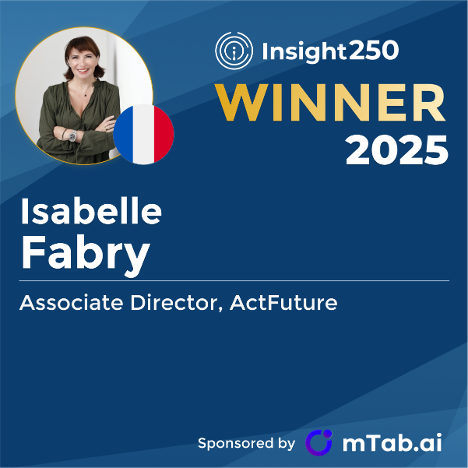
With insights advancing at an incredible pace and the value of insights ever increasing, I sat down with Insight250 Winner Isabelle Fabry. Isabelle drives ActFuture, which focuses on both qualitative and quantitative market research. She is also the ESOMAR Representative for France. She focuses on developing innovative remote and hybrid research methods for an array of clients.
Crispin: You founded ActFuture in 2001 and have been building hybrid, human-centred research approaches for over 25 years. Looking back at what point did you conclude that the industry was increasingly solving the wrong problem, and what made that clear to you?
IF: I would not say that the industry was solving the wrong problem. Understanding people remains at the heart of what we do and will continue to be essential. What has changed is the environment in which that understanding is created and used.
When I founded ActFuture in 2001, organisations were often confronted with a lack of information. Research helped uncover unmet needs, reveal motivations and reduce uncertainty. The profession's value came largely from its ability to generate knowledge that was otherwise inaccessible.
Today, the situation is very different. Most organisations have access to more information than they can realistically absorb. Consumer feedback, behavioural data, social listening, transactional data and, increasingly, artificial intelligence generate a constant flow of signals. Yet despite this abundance, decision-making often appears more complex than before.
Over time, I realised that the bottleneck was moving. The challenge was no longer primarily access to information but the ability to determine what was meaningful within an environment saturated with competing signals.
Across sectors as diverse as luxury, healthcare, FMCG and technology, I have observed the same phenomenon: executives rarely ask for more data. They ask for more clarity.
In that sense, I believe the future of insights lies less in producing additional information and more in helping organisations identify what matters and why.
Understanding remains essential, but its value ultimately depends on its ability to improve judgment and inform action.
Crispin: Your background spans semiotics from ESCP and marketing management from ESSEC, a combination that is unusual in the research industry. How has that double formation shaped the way you think about signals, meaning and decisions?
IF: My education exposed me to two disciplines that are rarely taught together but have shaped almost everything I have done since. Semiotics taught me that people do not simply respond to products, brands or messages. They interpret them. Every symbol, visual cue, narrative or experience carries cultural and emotional associations that influence perception, often beyond conscious awareness.
Marketing taught me something equally important: understanding only becomes valuable when it informs decisions.
One discipline focuses on meaning. The other focuses on action.
Much of my career has been spent trying to bridge those two perspectives. This is probably why I became interested in fields such as behavioural psychology, coaching, emotional analytics and, more recently, artificial intelligence. Each offers a different lens through which to understand how people make sense of the world and how organisations can make better decisions as a result.
What these disciplines have reinforced is the idea that human behaviour cannot be explained by information alone. People act through a combination of reason, emotion, culture, experience and context.
As information becomes increasingly abundant, I believe the ability to understand these deeper layers of meaning becomes more valuable rather than less. It is often the difference between knowing what people do and understanding why it matters.
Crispin: You launched the #HumansAreStillAlive movement in 2020, at a moment when the industry was retreating into remote and digital methods. What were you defending, and does that argument feel more or less urgent five years on?
IF: The initiative emerged during the pandemic, but it was never really about remote research.
It reflected a broader concern about the way technological progress is sometimes interpreted within our profession. Throughout my career, I have been enthusiastic about innovation. I have embraced new methodologies, biometric tools, emotional analytics and, more recently, artificial intelligence. The issue has never been technology itself.
The issue is the assumption that more technology automatically leads to better understanding.
Data can reveal patterns. Algorithms can identify correlations. AI can synthesise information at extraordinary speed. What none of these can do on their own is determine what matters. That requires interpretation, context and judgment. What surprised me about #HumansAreStillAlive was how widely it resonated internationally. Researchers from different countries and backgrounds seemed to recognise the same tension. As our tools become more sophisticated, the uniquely human dimensions of our profession become more important, not less.
Five years later, I believe that message has become even more relevant. One of the paradoxes of the AI era is that information is becoming increasingly abundant while meaning often remains scarce. The ability to understand context, recognise emotional nuances and connect apparently unrelated signals may become one of the most valuable capabilities an insight professional can develop.
Crispin: You argue that the core challenge is no longer generating more data or understanding, but transforming complexity into better decisions. What does Decision Intelligence actually look like in practice for your clients? Not as a concept, but as a deliverable?
IF: Decision Intelligence begins with a surprisingly simple question: What decision are we trying to improve?
Many research programmes start by discussing methodologies, data sources or analytical frameworks. These are important considerations, but they are not the starting point. The starting point should be the decision itself. What uncertainty is preventing action? What strategic choice needs to be made? What risk needs to be reduced?
Once those questions are clearly defined, the role of insights changes significantly. The objective is no longer simply to generate knowledge. It is to help decision-makers navigate complexity more effectively. In practical terms, this often means moving beyond traditional reports. It involves clarifying trade-offs, identifying priorities, understanding the implications of different options and helping organisations act with greater confidence despite uncertainty.
This is particularly important because certainty is becoming increasingly rare. Leaders operate in environments characterised by rapid change, fragmented information and competing interpretations of reality. For me, Decision Intelligence is not about producing better answers. It is about helping organisations make better decisions when perfect answers do not exist. That is where I believe the future value of insights increasingly resides.
Crispin: Market research has always claimed to inform decisions. What is genuinely new about the current moment, and why does the old model of research into insight into decision no longer hold?
IF: Market research has always contributed to decision-making. What is changing is not the purpose of the profession, but the environment in which decisions are made. For decades, research operated within a relatively stable model. Insights were generated, interpreted and translated into recommendations. While imperfect, the process remained broadly linear.
Today, organisations face a much more complex reality. Consumer understanding must coexist with behavioural data, financial indicators, social conversations, competitive intelligence and increasingly AI-generated analyses. Information is no longer scarce. It is continuous, fragmented and often contradictory. In this context, the challenge is not producing more knowledge but determining what deserves attention and how different sources of evidence should be interpreted. I also believe that many brands are facing a deeper challenge than is often acknowledged. Much has been written about declining attention spans or consumer scepticism. Yet I increasingly wonder whether many organisations are confronting something more fundamental: a crisis of meaning.
Consumers have not stopped consuming. They have become more selective about what deserves their trust, their attention and their engagement. The role of insights is therefore evolving. Beyond measuring behaviours or attitudes, we are increasingly helping organisations understand relevance: why certain brands, products or experiences remain meaningful while others gradually lose significance.
Crispin: Your recent partnership with BAI Analytics is explicitly positioned around making insights clearer, faster and more traceable for decision-making. What does the platform enable that a traditional research process cannot?
IF: What attracted me to BAI Analytics was not simply its technological sophistication. It was the problem it seeks to address. Most organisations already possess considerable knowledge. The difficulty is that this knowledge is dispersed across departments, reports, databases, customer interactions and external sources. Valuable information exists, but it often remains disconnected.
One of the most promising contributions of AI is its ability to connect these fragmented sources of knowledge and reveal relationships that would otherwise remain difficult to identify. This is particularly important because decision-making increasingly requires organisations to integrate multiple forms of intelligence simultaneously. Consumer research, operational data, financial performance, competitive dynamics and cultural trends all contribute to the picture.
BAI Analytics enables this broader perspective while maintaining something I consider essential: traceability. As generative AI becomes more powerful, organisations will need to understand not only what conclusions are being reached, but how those conclusions have been constructed.
The future will not belong to AI alone, nor to human expertise alone. It will belong to organisations capable of combining computational power with human judgment, contextual understanding and strategic reasoning. The challenge is no longer simply producing answers. It is ensuring that the answers are meaningful, transparent and actionable.
Crispin: Your work on the Havas Play and Gameloft gaming study used biometric emotion analysis to go beyond attention and recall metrics. What did that research reveal about the gap between what audiences see and what they actually feel, and why does that gap matter commercially?
IF: One of the most important lessons from that study was that visibility and significance are not necessarily the same thing. For many years, advertising effectiveness has been evaluated primarily through measures such as attention, recall and recognition. These indicators remain useful, but they do not fully explain why certain experiences resonate more deeply than
others.
The Gameloft for Brands and Havas Play research allowed us to explore the emotional dimension of engagement through biometric measurement. What emerged was a richer understanding of how people experience media environments.
Individuals may be exposed to the same content and demonstrate similar levels of attention while experiencing very different emotional journeys. Those emotional responses influence memory, perception and ultimately the relationship people develop with brands.
What was particularly interesting in gaming environments was the active nature of engagement. Participants were not simply watching content. They were interacting with it, making decisions and becoming immersed in experiences that generated meaningful emotional responses.
This reinforced a conviction that has shaped much of my work. Attention tells us that something has been noticed. Emotion helps us understand why it becomes significant. As attention becomes increasingly fragmented, understanding the emotional quality of engagement may become more valuable than measuring exposure alone.
Crispin: You describe emotional analytics as central to your practice. Why does emotional understanding become more important, not less, as AI and automation increase their role in the research process?
IF: We often describe emotion as something that influences behaviour. I increasingly see it as something that helps create meaning. Human beings rarely assign importance to information on purely rational grounds. What we remember, trust, value or act upon is often shaped by emotional relevance. Emotions help us determine what deserves attention and what can be ignored.
This is one of the reasons emotional understanding becomes more important as artificial intelligence progresses. AI is becoming remarkably effective at processing information. It can identify patterns, synthesise data and generate insights at unprecedented speed. What remains more difficult is understanding why certain patterns matter more than others in human terms.
Emotion provides part of that answer. It influences how people experience brands, products, services and decisions. It shapes relationships long before those relationships are translated into rational explanations.
This conviction also informed the development of the Brand Vitality Index that Georges Lewi and I recently introduced. Our ambition was to explore the relationship between financial value and emotional value.
Brands do not exist solely in balance sheets. They also exist in memories, cultural associations, personal experiences and emotional connections. The strongest brands are often those capable of creating both economic performance and emotional significance.
Crispin: Your ESCP semiotics background gives you a lens that most researchers do not have. How does reading signs and meanings differently change the quality of the decisions you help clients make?
IF: Semiotics begins with a simple observation: people do not respond only to what things are. They respond to what things mean. Every brand, product, visual identity, communication or experience carries symbolic associations. These associations shape perception, often more profoundly than functional characteristics alone.
This perspective becomes particularly valuable in categories where differentiation is increasingly difficult to sustain through product features alone. Luxury is an obvious example. Throughout several international projects, I have observed that heritage, craftsmanship, creativity and cultural relevance often contribute as much to perceived value as the product itself.
Meaning becomes part of the offer. More broadly, I believe brands increasingly operate in an environment characterised by information overload, fragmented attention and growing scepticism. Visibility alone is rarely sufficient.
The brands that endure are often those that remain relevant and significant within people’s lives. This is why semiotics remains so important today. It helps organisations move beyond surface reactions and understand the deeper systems of meaning that shape preferences, perceptions and behaviours.
Ultimately, brands create value not only through what they offer but through what they represent. And understanding that distinction often leads to better decisions.
Crispin: You are co-Representative for France at ESOMAR and on the scientific board at ADETEM, giving you a close view of where European practice is heading. How do you see the French and European insights community responding to the AI transition compared to the conversation in the US or UK?
IF: What strikes me most is that the debate is becoming remarkably similar across markets. Whether through ESOMAR, ADETEM or conversations with colleagues internationally, very few professionals are still questioning whether AI will transform our industry. That transformation is already underway. The discussion has shifted towards a more fundamental set of questions: how to preserve trust, maintain quality and ensure transparency in an environment where information can be generated at unprecedented speed.
In Europe, these concerns are often framed through the lenses of governance, ethics and accountability. While this is sometimes perceived as caution, I tend to view it as a sign of maturity. The insights profession has always relied on credibility. Clients do not simply expect information; they expect information that can be trusted, interpreted responsibly and translated into meaningful action.
What I find particularly encouraging is that the conversation is becoming less technological and more strategic. The question is no longer whether organisations should adopt AI, but how they can integrate it in ways that strengthen decision- making rather than simply accelerate information production.
In that respect, the future challenge appears less technological than organisational. The real differentiator will not be access to AI itself, but the ability to combine technological capabilities with human judgment, contextual understanding and responsible decision-making.
Crispin: You describe the future as Human plus AI rather than Human or AI. That is a positioning statement, but what does it mean operationally? Where exactly in the research and decision process does human judgment remain irreplaceable, and where should we let AI lead?
IF: I am often asked whether AI will replace researchers. I suspect this is the wrong question. The more interesting question is how AI changes the nature of expertise itself.
One of the defining paradoxes of the AI era is that while information is becoming increasingly abundant, judgment is becoming increasingly valuable. For much of the twentieth century, expertise was associated with access to knowledge. Today, access to information is becoming progressively democratised. What remains scarce is the ability to interpret that information intelligently and place it within a meaningful context.
AI is already demonstrating extraordinary capabilities in areas such as information processing, pattern recognition, synthesis and hypothesis generation. These are tasks that can now be performed at a speed and scale that would have been unimaginable only a few years ago.
Yet decision-making rarely depends on information alone. Organisations must constantly evaluate uncertainty, reconcile competing priorities, anticipate consequences and determine what deserves attention. These situations require interpretation as much as analysis. They require an understanding of context, culture, human behaviour and strategic intent.
This is why I do not see AI as reducing the importance of human expertise. On the contrary, I believe it is increasing the value of those dimensions of expertise that cannot easily be automated. The future belongs neither to humans nor to machines alone. It belongs to organisations capable of combining the strengths of both.
Crispin: The next generation of insight professionals will need a different set of capabilities from those who succeeded in the last two decades. Given everything you have built at ActFuture, what do you think needs to change about how the industry trains and develops its talent?
IF: The next generation of insight professionals will need to become considerably more multidisciplinary than previous generations. Methodological expertise will remain important. A strong understanding of research design, behavioural science, analytical rigour and evidence-based thinking will continue to form the foundation of the profession.
However, these capabilities alone are no longer sufficient. Professionals will increasingly need to understand technology, business strategy, psychology, communication and organisational decision-making. In many respects, the future of insights sits at the intersection of these different disciplines rather than within any one of them.
What I find particularly interesting is that the most inspiring leaders in our industry rarely define themselves through a single area of expertise. Through communities such as Insight250, I have had the opportunity to engage with professionals whose careers have been shaped by intellectual curiosity, cross-disciplinary thinking and a willingness to challenge conventional assumptions.
As information becomes easier to generate, I believe the profession will place greater emphasis on interpretation. The critical skill will not simply be the ability to produce insights, but the ability to understand their implications, place them in context and help organisations make better decisions as a result. Ultimately, the future belongs less to information specialists than to individuals capable of connecting knowledge, meaning and action.
Hot Topic
I believe the insights industry stands at an important crossroads. For decades, our profession has built a distinctive expertise in understanding people, their motivations, emotions, behaviours and cultural environments. Few disciplines have developed such a rich understanding of how human decisions are formed. The question today is whether we define ourselves primarily through the methods we use or through the value we create.
IF: If our role remains limited to producing reports, analyses and research outputs, there is a genuine possibility that other actors move closer to the decision-making process. Management consultants, data scientists and AI platforms are already expanding their influence in that direction.
However, I believe there is a more ambitious future available to our profession. One of the most significant shifts taking place today is that organisations are no longer struggling to obtain information. They are struggling to determine what that information means. They are trying to navigate increasingly complex environments in which different sources often point towards different conclusions. In this context, the value of insights lies not only in measurement, but in interpretation. Increasingly, our role is to help organisations understand significance: why something matters, how it should be understood and what implications it carries for future decisions.
The organisations that create the most value will not necessarily be those that possess the greatest volume of information, but those that are most capable of interpreting that information, placing it in context and translating it into coherent action.
That is why I believe the future of insights is gradually evolving from a discipline of measurement towards a discipline of meaning.
Top Tip
Before discussing methodologies, technologies or analytical frameworks, start with a simpler question: What decision are we trying to improve?
In my experience, that question has a remarkable ability to transform the quality of a project. It shifts the conversation away from data collection and towards impact. It encourages teams to focus on relevance rather than volume, and on action rather than information alone.
Research creates value when it helps organisations make better decisions. The most successful insight professionals will therefore be those who understand not only how to generate knowledge, but also how to translate that knowledge into meaningful action.
Final Reflection
IF: Throughout my career, I have explored human behaviour through a variety of lenses, including semiotics, qualitative research, behavioural psychology, emotional analytics and, more recently, artificial intelligence.
Each of these disciplines has offered a different perspective. Yet they have all reinforced a similar conclusion: human behaviour cannot be understood through information alone.
People continuously interpret the world around them. They assign meaning to experiences, brands, relationships and choices through the filter of their emotions, values, memories and cultural references.
Perhaps that is why, despite the extraordinary technological advances we are witnessing, the central challenge remains remarkably unchanged. Understanding people is not simply a matter of collecting more information. It is a matter of understanding what that information means within a human context.
The paradox of the AI era may ultimately be that as information becomes increasingly abundant, human understanding becomes increasingly valuable.
For me, that is what Hum.ai.n truly means.
Crispin: Isabelle, thank you for such a rich and genuinely thought-provoking conversation. Your observation that the bottleneck has shifted from generating information to determining what that information actually means feels like one of the clearest articulations of where research value lies today, and it is something I find myself returning to. The deceptively simple discipline of starting every project by asking which decision we are trying to improve is a reframe that I think many teams across the industry would benefit from adopting. Your ability to draw on semiotics, behavioural psychology and emotional analytics to build a coherent and compelling argument about the future of insights is exactly the kind of cross-disciplinary thinking the Insight250 community exists to celebrate. It has been a genuine pleasure, and I look forward to watching ActFuture continue to shape the conversation around Decision Intelligence.
Crispin Beale
Chairman at QuMind, CEO at Insight250, Senior Strategic Advisor at mTab, CEO at IDXCrispin Beale is a marketing, data and customer experience expert. Crispin spent over a decade on the Executive Management Board of Chime Communications as Group CEO of leading brands such as Opinion Leader, Brand Democracy, Facts International and Watermelon. Prior to this Crispin held senior marketing and insight roles at BT, Royal Mail Group and Dixons. Crispin originally qualified as a chartered accountant and moved into management consultancy with Coopers & Lybrand (PwC). Crispin has been a Board Director (and Chairman) of the MRS for nearly 20 years and UK ESOMAR Representative for c15 years. As well as being CEO of Insight250, Crispin is currently Worldwide CEO of Digital Communications Solution Agency, IDX. Crispin is also the Senior Strategic Advisor at mTab and the Chairman of QuMind and spent 4 years as Group President of Behaviorally where he was responsibile for the client & commercial teams globally. Crispin is a passionate advocate for blending human intelligence and technology to deliver innovation and leadership across organisations.
Article series
Insight250
- The importance of business sense in research
- The role of humour in effective leadership
- The importance of ethics
- The importance of disruption in innovation and leadership
- The importance of Disruption in Innovation and Leadership Part 2
- The importance of Diversity & Inclusion
- The impact of colour
- Communicating insight with impact
- Insights on leadership, culture and polling
- The evolution of electric vehicles
- 2022 Top tips (part 1)
- 2022 Top tips (part 2)
- Maximising the potential of data
- The importance of flexible working
- Winners
- The importance of advanced analytics
- Judges for the 2022 Insight250 Awards announced
- The evolution from social listening to digital intelligence
- The Judges' Perspective
- The judge's perspective - part 2
- Insight Climate Collective
- Insights technology
- Understanding employee ownership
- Global insight perspectives
- Top Tips from our Leaders and Innovators
- The Evolution of Insights in the Food & Beverage Market
- The Evolution of Insights in CPG
- Neural Mechanisms Behind Consumer Decision-Making
- Celebrating and Elevating the Insights Industry
- The State of the Insights Industry
- Opportunities, challenges and threats that AI presents
- 2024 Insight250 Winners Announcement
- Connecting Brands and Consumers Through Insights
- The Importance of Human Insight and Attention
- The Elevating Role of Insights with Technology Innovation
- Haleon’s Insight Expert on Consumer Healthcare
- Insight from the Insight250: How AI is Impacting Qualitative Research
- How AI Tech is Doing the ‘Heavy Lifting’ for Insights
- Reviewing the top tips for 2025
- Google's Sarah Ashley on AI and revolutionising insights - Insights from the Insight250
- Beyond BI: The Future of Decision Intelligence for Insight Professionals
- The Advancement & Impact of Insights - An Insight250 Winners Series perspective with David Smith
- International Jury for the 2025 Insight250 Awards Announced
- Newly elected President, Anne-Sophie, on Revolutionizing the Impact of Insights
- Haleon's Litthya Baez on Enhancing Healthcare with Insights - Insight250 Winners Series
- Understanding the Insights of Consumer Decisions
- Moving Beyond Dashboards to Deliver Decisions with AI
- How AI is Transforming Insights
- How AI is Transforming Insights
- Five Years of Insight250: Elevating the Insight Industry