How Brands Win in Africa
The Insight250 spotlights and celebrates, annually, 250 of the world’s premier leaders and innovators in market research, consumer insights, and data-driven marketing.

Article series
Insight250
- The importance of business sense in research
- The role of humour in effective leadership
- The importance of ethics
- The importance of disruption in innovation and leadership
- The importance of Disruption in Innovation and Leadership Part 2
- The importance of Diversity & Inclusion
- The impact of colour
- Communicating insight with impact
- Insights on leadership, culture and polling
- The evolution of electric vehicles
- 2022 Top tips (part 1)
- 2022 Top tips (part 2)
- Maximising the potential of data
- The importance of flexible working
- Winners
- The importance of advanced analytics
- Judges for the 2022 Insight250 Awards announced
- The evolution from social listening to digital intelligence
- The Judges' Perspective
- The judge's perspective - part 2
- Insight Climate Collective
- Insights technology
- Understanding employee ownership
- Global insight perspectives
- Top Tips from our Leaders and Innovators
- The Evolution of Insights in the Food & Beverage Market
- The Evolution of Insights in CPG
- Neural Mechanisms Behind Consumer Decision-Making
- Celebrating and Elevating the Insights Industry
- The State of the Insights Industry
- Opportunities, challenges and threats that AI presents
- 2024 Insight250 Winners Announcement
- Connecting Brands and Consumers Through Insights
- The Importance of Human Insight and Attention
- The Elevating Role of Insights with Technology Innovation
- Haleon’s Insight Expert on Consumer Healthcare
- Insight from the Insight250: How AI is Impacting Qualitative Research
- How AI Tech is Doing the ‘Heavy Lifting’ for Insights
- Reviewing the top tips for 2025
- Google's Sarah Ashley on AI and revolutionising insights - Insights from the Insight250
- Beyond BI: The Future of Decision Intelligence for Insight Professionals
- The Advancement & Impact of Insights - An Insight250 Winners Series perspective with David Smith
- International Jury for the 2025 Insight250 Awards Announced
- Newly elected President, Anne-Sophie, on Revolutionizing the Impact of Insights
- Haleon's Litthya Baez on Enhancing Healthcare with Insights - Insight250 Winners Series
- Understanding the Insights of Consumer Decisions
- Moving Beyond Dashboards to Deliver Decisions with AI
- How AI is Transforming Insights
- How AI is Transforming Insights
- Five Years of Insight250: Elevating the Insight Industry
The Insight250 spotlights and celebrates, annually, 250 of the world’s premier leaders and innovators in market research, consumer insights, and data-driven marketing. The awards have created renewed excitement across the industry whilst strengthening the connectivity of the market research community. Winners of the 2025 Insight250 were announced last September - you can see the full list of Winners, and those from previous years, at Insight250.com. You can also nominate for 2026.
With so many exceptional professionals named to the Insight250, we regularly tap into their expertise and unique perspectives on a range of topics. This regular series does just that: inquiring about the expert perspectives of many of these individuals in a series of short topical features.
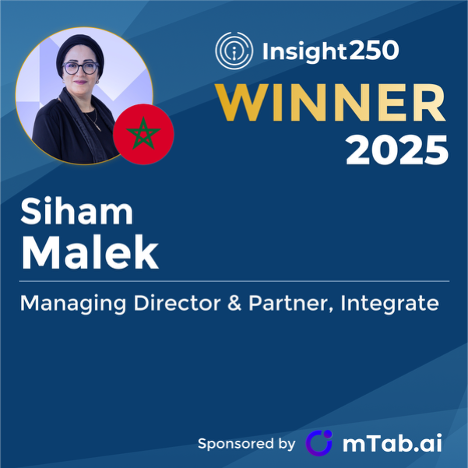
With insights advancing at an incredible pace and the value of insights ever increasing, I sat down with Insight250 Winner Siham Malek. Siham has an inspiring vision for the market research industry in Africa. She generously invests energy and funds to elevate the practice to international standards and beyond, while raising awareness about the importance of market research. Currently, she serves as Managing Director & Partner for Integrate and is the President of AMISE.
Crispin: What’s the deepest assumption global brands carry into Africa that the data tells you simply isn’t true?
SM: The deepest assumption is the ‘rising middle class’ narrative, a large, homogeneous, steadily growing middle class with predictable purchasing power. It is the most documented mistake in industry research over the last decade, and it produces the cyclical pattern of global brands entering Africa with high expectations, retreating when results disappoint, and re-entering a few years later under new leadership.
The African consumer base is bifurcated, not homogeneous: a very large group just above subsistence, a much smaller affluent group with Western middle-class purchasing power, and an in-between segment that supplements formal income with informal work — so spending fluctuates with seasons, currency moves, and shocks. The "rising middle class" is a useful narrative for an investment committee. It is not a consumer.
What sits underneath that bifurcation matters more. African consumers are deeply brand-conscious, even at lower income levels. BCG's research across 11 African countries found 70% of consumers believed established brands were best, and that Africans were three times more likely than consumers elsewhere to scrutinise their parents' brand choices. The mistake is assuming income predicts brand consciousness the way Western frameworks do.
The second layer: Africans dream global and consume local, and the split is not random. Brand Africa 2026 shows African brands rebounded to 15% of the Top 100 most admired, recovering from a historic low of 11% in 2025 — the sharpest single-year recovery the index has recorded. But the top has not changed. Nike has been number one for nine consecutive years; European brands hold 38% of the Top 100, North American 28%, Asian 19%. Worldpanel by Numerator shows shoppers spending 12.5% more on fewer brands, with frequency up 12%. In daily categories — food, beverages, personal care, home care, local brands win the basket. The aspirational global brand sits on the wishlist; the local brand sits in the kitchen.
This is what global brands miss. They build awareness campaigns assuming admiration equals consumption, and conclude after a few quarters that the math does not work. The math does work, but only for brands that read the consumer as bifurcated, sophisticated, and choosing between aspiration and daily reliability category by category. Admiration without daily usefulness is a billboard.
Daily usefulness without admiration is a commodity. Neither wins enough.
The brands that compound close the gap. Coca-Cola, Samsung, Nike, Unilever, Danone, most operating here for decades, are admired and consumed because they built operating models around the actual consumer, not the imagined one. The brands that retreat hold one side and lose the other.
Local brands face their own threat. Value-for-money challengers, particularly in traditional trade where roughly 80% of FMCG still moves in our markets, are eroding the daily-use position local brands have historically owned. The aspirational ceiling matters less than they think. The daily basket matters more.
Crispin: Africa is often treated as one market when in reality it’s anything but. How should global brands actually think about sequencing and segmenting their approach across such a diverse continent?
SM: The real question is whether brands should have an ‘Africa strategy’ at all. Based on how the brands that compound actually operate, the strongest approach is not segmentation. It is sequencing, building country strategies one at a time, and recognising that what transfers across markets is the discipline of consumer understanding, not the insight itself.
The ‘clusters’ framework, francophone West Africa, anglophone East Africa, Maghreb, Southern Africa, is useful for organising a strategy deck, but it does not survive operational contact. Brands do not operate clusters. They navigate a country’s regulator, manage a country’s distribution, hire from a country’s talent pool, and defend against a country’s competitors. The execution unit is the country.
The consumer unit is also the country. A Moroccan and an Algerian consumer share language and broad religious context, but their household structures, consumption occasions, and brand relationships are country-specific. A Nigerian and a Ghanaian consumer share regional position and currency exposure, but their channel behaviour, trust in formal institutions, and family decision-making diverge in ways that matter for every launch. The framework of how you listen transfers. What you find does not.
This separates the brands that compound from the brands that retreat. The compounders learn the consumer country by country and structure their organisations to do that work continuously. The retreaters run pan-African studies in three markets, extrapolate to ten, and discover after launch that market four behaves nothing like the assumed average.
The practical model is sequenced, not segmented. A brand picks one or two lead markets, typically among the five that anchor African consumer strategy: South Africa, Nigeria, Kenya, Egypt, Morocco, and builds deep capability there. It then expands into adjacent markets where it can leverage operating capability, but not transplant findings. Ghana follows Nigeria operationally; the Ghanaian consumer must still be understood on its own terms. Tanzania follows Kenya operationally; the Tanzanian consumer is not the Kenyan consumer.
Beyond that sit watch markets — deliberately deprioritised, not ignored.
This portfolio approach matters because African market dynamics shift every two to three years.
Currency crises, regulatory changes, political transitions, and demographic shifts redraw what is possible. A five-country ‘cluster strategy’ built in 2020 is already operating on assumptions the markets have moved past. A lead-and-adjacent portfolio adapts because it does not depend on a static consumer map that was never accurate to begin with.
Channel structure reinforces this. Modern trade is dominant in South Africa, mixed in Morocco, and marginal in Nigeria, country realities, not cluster averages.
So, do not try to segment Africa. Build country strategies that compound. Share the discipline across your portfolio, not the conclusions. There is no African consumer. There are real consumers in real countries, who must each be understood on their own terms. The brands that win recognise this. The brands that try to operate an ‘Africa strategy’ usually do not.
Crispin: Where does brand strategy most often go wrong in African markets, and what are the patterns you see repeatedly?
SM: Strategies fail in Africa for reasons that are structural, not tactical. Six conditions shape what is possible here, and most failed strategies are really collisions with one of them.
Currency and macro volatility. Pricing decisions made on a three-year plan get rewritten by a single devaluation. Brands that build cost structures, price ladders, and margin targets assuming relative stability discover that the strategy survives until the next FX cycle. The brands that compound build pricing architectures that flex — multiple pack sizes, multiple price points, deliberate downtrading paths, because the macro will move and the consumer’s wallet will move with it.
Traditional trade dominance. Roughly 80% of FMCG still moves through informal channels in our markets. The shopkeeper, not the shelf planogram, is the last mile of strategy. A brand that wins modern trade in South Africa and assumes the same playbook works in Lagos or Casablanca is operating in a fundamentally different system, one where credit terms to a duka owner, route-to-market density, and pack economics for single-serve consumption matter more than category management. It is also a system with no shelf abstraction to hide behind: when a brand value-engineers a formulation or shrinks a pack, the shopkeeper and the repeat buyer notice immediately.
Consumer bifurcation and informal income. Western marketing frameworks assume a middle class with predictable monthly purchasing power. The African in-between consumer supplements formal income with informal work, which means spending is event-driven, seasonal, and shock-sensitive. Strategies built on monthly repeat-purchase models break against a consumer who buys when the harvest comes in, when the remittance arrives, or when school fees are not due.
Distance between the consumer and the room. Strategy gets shaped by who is in the approval chain rather than who is in the market. The local team pleases the regional head, who pleases the global CEO, who has often never operated a traditional-trade market. Each layer pushes the strategy toward HQ assumptions and away from the African consumer, and the HQ-consumer gap is structurally wider here than in markets where the executive layer has lived the consumer reality.
Talent rotation and institutional memory. Multinational Africa postings often turn over every two to three years. The CMO who approved the strategy is gone before it has had time to compound, and the new CMO inherits a brand mid-build with no incentive to stay the course. Local brands have the opposite problem, the founder stays forever, the strategy is whatever the founder believes today, and scale is built on visibility rather than insight. The founder's instinct built the brand at $20M; the bifurcated consumer base means the segment that loved it then is not the segment that has to love it at $200M. When a sharper competitor enters, the visibility holds for a year. The consumer relationship underneath it does not.
Regulatory and political reset cycles. Import rules, tax regimes, advertising standards, and category-specific regulation change on cycles measured in years, not decades. A strategy built on a static regulatory map is operating on borrowed time. The brands that compound build organisations that can absorb these shifts; the brands that retreat treat each one as a crisis.
What unites these conditions is that they are not problems to be solved once. They are the operating environment. Strategies fail in Africa when they are designed for a market that does not exist here, such as a stable currency, modern retail, salaried consumers, long executive tenure, predictable regulation, and survive only when they are designed for the market that does.
Crispin: You’ve built Integrate as one of the region’s leading consumer insights firms. What does rigorous, decision-grade research methodology actually look like in African markets, and where do most studies fall short?
SM: Rigorous research in our markets is the discipline of triangulation. No single methodology survives contact with African consumer complexity. The discipline is the combination of face-to-face, mobile, CATI, online, where it actually works, retail audits, qualitative depth, syndicated panels, social listening, behavioural data, and the willingness to keep going until the picture stops contradicting itself. Three principles shape what "decision-grade" actually means here.
Triangulate the methods, and put mobile at the centre. Africa leapfrogged the desktop generation. The consumer never went online through a laptop — they went online through a phone, and for most of our markets, the mobile handset is the only digital interface the consumer has ever used. That changes the methodology stack. Mobile is not a channel we layer on top of online; it is the entry point. WhatsApp recruitment, SMS-led short surveys, mobile-first questionnaire design, voice notes in dialect, mobile money transaction trails, these reach consumers that desktop online never will, in formats they already trust. Face-to-face and CATI remain the backbone of quantitative work because digital infrastructure varies dramatically by country and segment, literacy is uneven, and trust in formal online platforms is not the default it is in mature markets. Face-to-face captures the rural consumer, the older consumer, the informal-economy consumer, and the linguistic minority. CATI fills the gaps where field access is constrained. Desktop online is layered last, where the consumer is actually there, not as a substitute for the modes that reach the consumer who is not.
Design sample frames honestly. This is where most national research quietly fails. The published sample reads ‘national representative.’ The actual sample is urban-male-employed-literate. The data is then weighted to reflect the population, but weighting cannot fully correct for systematic undercoverage, and the industry is now compounding the problem with the push to move trackers fully online for the cost savings. In our markets, that decision systematically removes the rural, the informal economy, and the offline-trust consumer from the data. The local client teams who know their markets resist it because they understand they will get 25% of the story. The decisions made from regional offices often go the other way — trackers are switched completely, the cost line improves, and a few quarters later we are being asked to interpret findings that contradict what the brand sees in the market. Sometimes the savings win over the depth of the insight, and the brand pays for it in strategy decisions built on a sample that no longer reflects its consumer.
Interpret in cultural context. Literal translation is not culturally appropriate translation. A questionnaire translated word-for-word from English into Arabic, French, or any African language without local cultural review is asking the consumer the wrong question. We invest in local interpreters who can flag when a question will be misunderstood, when a response category does not map to local concepts, and when a finding that looks anomalous is actually revealing something the global questionnaire never thought to ask. We work with local field partners who know the geographies, the gatekeepers, and the cultural dynamics that shape consumer access, a partner in Lagos who knows how to recruit in informal settlements is worth more than a methodology paper. We have also built for our reality: we developed our own Darija LLM because global language models did not reliably handle Moroccan Arabic, and while the major LLMs have caught up on the high-resource languages, they still struggle with dialects, mixed-language responses, and culturally encoded meaning. We use AI where it amplifies analysis, coding open-ends, sentiment, transcription, and pattern detection, without substituting for the human consumer contact the data layer requires.
Rigour is upstream of decision-grade. Research becomes decision-grade when it is briefed against the actual decision on the table, lands while the decision is still live, takes a clear point of view rather than dumping findings, and is honest about what it knows versus what it is inferring. A rigorous study that arrives six months late and reads as a tour of the consumer is archaeology. A decision-grade study tells the brand what to do, and why, with the specificity the P&L requires.
Done well, rigorous and decision-grade research is the discipline that makes the difference between a strategy informed by the consumer and a strategy that merely confirms the assumptions of the room.
Crispin: What does it actually mean for a brand to listen to the African consumer, and how is that different from simply commissioning research?
SM: Anyone can commission research. Few brands actually listen. The distinction is the difference between an output and a relationship — between describing the consumer at a moment and knowing the consumer over time.
Listening matters more in our markets than in mature ones because the surfaces where the consumer’s real truth shows up are different. Trust in formal institutions is lower, so a stranger with a clipboard gets a performative answer; the honest answer comes through a relationship. Households are multigenerational, which means the user, the buyer, and the budget-holder are often three different people, and a tracker that asks the wrong one of them produces clean data on the wrong consumer.
The shopkeeper sees the basket that the consumer would never describe out loud and hears the complaint they would never put in a survey. Religious and seasonal calendars shape purchases in ways no monthly tracker captures. Language nuance — dialect, code-switching, what is said in Darija that would never be said in standard Arabic — carries meaning no literal translation preserves. Listening reaches these surfaces. Commissioning research rarely does.
A beverage client we worked with provides the clearest example. Their quantitative tracker showed healthy awareness and rising promotional response — the numbers said the price campaigns were working. A qualitative deep dive in consumers' homes told a different story. Consumers were embarrassed to be seen with the brand. The constant promotions had repositioned it in their minds as cheap, and "cheap" in this category read as low quality. The brand’s absence from modern trade compounded the perception: if it was not on the shelves where aspirational brands sat, it must not belong there. None of this was visible in the quantitative data because no one had asked the question that would have surfaced it. The brand was paying to damage itself, and the tracker was telling them it was working.
Multinationals operating in African markets often default to commissioning standardised instruments from global headquarters — instruments designed to travel well across boardrooms, regardless of how poorly they land in local markets. The trackers run. The reports are delivered. The decisions are made.
And the consumer relationship never compounds because no one in the brand has actually sat in the consumer’s home. This is the central thesis of the book I wrote, Brand Impact Through Consumer Insight: the most important insight is rarely the one the research was commissioned to find.
The hardest part of listening is not methodology. It is posture. Listening requires senior leaders willing to spend time with consumers they did not invite to the boardroom, in environments that do not match their own, asking questions they did not script. That posture is rare. It is also, in our experience, the single biggest differentiator between the brands that win in our markets over decades and the brands that spend, retreat, and write off Africa as complicated.
Crispin: Can you share an example where proper consumer research delivered a 10X return on the investment that produced it, or where its absence cost a brand dearly?
SM: A pattern we see often is a regional brand with twenty years of consumer goodwill. The founder built it on strong product-market fit and a deep, intuitive understanding of the consumer of his generation. Over time, his network grows, his confidence in his instincts grows, and his appetite for formal research shrinks. He believes he knows the consumer; he is partly right.
Then the brand extends. A new flavour, a new pack format, a premium tier. The founder is convinced the consumer wants it; the senior team agrees because the strategy has worked before. A bank loan funds the tooling, the production run, and the launch. No primary research is done. Within six months, sales are well below forecast. Within a year, the line is being quietly delisted. The post-mortem reveals three failure modes. The new variant addressed an occasion the brand was not associated with. The premium tier required consumer trust that the brand had not yet earned in that price band. The pack format suited modern trade, but the brand’s actual share sat in traditional trade, where the format was awkward. None of these failures would have been mysterious to a consumer who had been asked. None of them was asked. The total cost is in the millions, bank loan, inventory write-off, two years of management bandwidth, damaged trade relationships, and dented brand equity. The research that would have surfaced the issues before launch would have cost a small fraction of the loss.
This pattern is more acute in our markets than in mature ones. Many African category leaders are still founder-run or one generation out, so the institutional research culture that disciplines founder instinct in mature markets is thinner. Capital is scarcer and bank loans are often personally guaranteed, so a failed line extension is closer to existential. And the demographic gap between the founder’s consumer and the next-generation consumer is wider here than almost anywhere. The brand built for the consumer of 1995 is selling to a consumer two demographic generations younger, who is more digitally exposed, more demanding, and more brand-conscious. The founder has never met her.
The 10X stories in our markets are rarely about research being heroic. They are about brands avoiding the silent losses that founder confidence enables — the launches that were redesigned, the variants re-priced, the extensions quietly killed before they consumed capital. Founder intuition is what built the brand. It is also what eventually limits it. Proper research is the multiplier on every line of investment that follows it. The brands that internalise this compound. The brands that do not eventually pay the founder-intuition tax.
Crispin: Drawing on Brand Africa’s 16 years of consumer data, what are the most striking patterns you see in how trust, brand relevance and commercial performance interact in African markets?
SM: Four patterns stand out across sixteen years of Brand Africa data. The first is the trajectory of African brand representation in the Top 100. From 34% African brands in the index’s early years, to a steady decline through 17% in 2022, to a historic low of 11% in 2025, and then a 4-point recovery to 15% in 2026 — the largest single-year recovery the index has recorded, but a recovery off a low, not a structural reversal. The top of the ranking has not changed. No African brand has appeared in the Top 10 for nine consecutive years. Nike has been number one for nine consecutive years. The story is African brand resilience in the middle of the ranking, and continued global brand dominance at the top.
The second is what Thebe Ikalafeng, the founder of Brand Africa, calls the African loyalty paradox: 80% of Africans believe in Africa, but only 15% of the brands they most admire are African. The distance between cultural belief and commercial behaviour is one of the most persistent findings in our data. The work for the next decade is to convert belief into commercial action. As Ikalafeng has said, ‘It is not enough for Africans to believe in Africa, they must buy Made-in-Africa.’
The third is the breakthrough of South African streetwear into the index. GALXBOY, Redbat, Maxhosa, and Bathu have entered the Top 100 on organic recall alone — no global marketing budgets, no PR campaigns, no celebrity endorsements at the scale of multinational competitors. Maxhosa ranked third in the streetwear cohort across three generational groups of African consumers. This is the strongest evidence we have that African brands can earn admiration on the global stage when the cultural relevance, the design language, and the consumer relationship are right. The brands are small. The signal is large.
The fourth is a sector caveat. Financial services in Africa are overwhelmingly African, 22 of the Top 25 financial services brands in the 2026 index, but this reflects the structural retreat of multinational banks more than consumer preference. HSBC withdrew from South Africa, Société Générale exited multiple francophone markets, BNP Paribas closed its South African corporate operations, and Standard Chartered sold several African subsidiaries. African banks have stepped into the void and expanded across borders. The sector tells us as much about industrial policy and global banking economics as about consumer behaviour, a useful reminder that not every ‘African brand wins’ headline is a consumer story.
What ties the four together is a hierarchy that the data has surfaced consistently over sixteen years: cultural relevance is the entry ticket, trust is what compounds, and commercial performance is the consequence rather than the starting point. The brands that have moved up the index built cultural relevance first, earned trust through a reliable consumer experience, and only then converted that trust into commercial scale. The brands that started with marketing spend and tried to backfill cultural relevance have rarely held their positions. Sixteen years of data say the same thing: in African markets, trust is the asset that compounds, and brands that try to buy it skip the only step that matters.
Crispin: Global brands frequently underestimate African consumers and local brands frequently underestimate what scale requires. Where do each tend to go wrong, and what does the data say about what actually closes that gap?
SM: Both sides fail at consumer understanding in different ways. Global brands fail to invest in it because of structural choices. Local brands lose it as they grow because they do not institutionalise it. The consumer is at the centre of the question, and both halves miss it.
For global brands, the consumer misjudgment is downstream of four structural decisions. The operating model. Most multinationals run hub-and-spoke systems designed for modern retail. African markets require granular reach into traditional trade, which demands time on the ground, presence in homes, and direct exposure to the consumer. The global model does not generate that exposure, so the consumer is studied from afar.
Capital allocation. Africa is a long-term investment market, not a short-term win market. When multinationals decide where to invest, they tend to go for markets that require less effort and generate more in less time. Africa requires patience. The continent rewards brands that compound over decades, not brands that optimise quarterly. The brands that win in our markets, Coca-Cola, Danone, Samsung, and Unilever, have committed capital with a 10-to-15-year horizon and held it through downturns. The brands that retreat applied short-payback logic to a long-payback market.
Organisational design. Africa is governed from Dubai, Geneva or London by executives who rotate every two to three years. The consumer relationship never compounds because the leadership relationship never compounds. And the local roles meant to hold consumer expertise are increasingly junior. Senior marketing and insights leaders sit at regional or global headquarters, while the people closest to the African consumer in the subsidiary often have neither the seniority to challenge global assumptions nor the authority to invest in what the market needs. The expertise is too senior to be local, and the local expertise is too junior to be heard.
Time horizon. Genuine consumer understanding requires multi-year panels, repeat ethnography, and sustained presence. Global brands operate on quarterly cycles. The understanding they generate is too thin to act on, so they default to global templates and miss the consumer entirely. The result is the consumer misjudgments we recognise — assumed price sensitivity, missed household dynamics, wrong cultural codes, products designed for those who answered the survey rather than those who actually buys. These are symptoms. The cause is upstream — the operating model does not allocate the time, the capital does not buy patience, and the people who should be advocating for both are not senior enough to be heard.
Local brands face a different problem. They often recruit senior marketing talent, but they channel that talent into performance marketing rather than brand building. The founder needs to see ROI, and performance marketing delivers it — measurable, short-term, sales-attributable. Brand building delivers long-term equity, pricing power, and defensive depth, but it is harder to measure and slower to compound, so it loses the budget fight every time. The result is brands that win on the field, distribution, promotion, tactical execution, but lose the brand. They are not building the equity that protects them when conditions change. And conditions always change: another brand enters with a more affordable price, a more convenient pack, a sharper consumer proposition. That is when local brands turn to research, to extinguish the fire, not to build the brand. Research becomes crisis management instead of a strategic foundation.
Behind this sits a mindset. Many local brand owners believe research is unnecessary, that they already know the consumer, and that any study would only confirm what they have. The consumer evolves faster than the founder’s mental model. The next-generation consumer, younger, more digitally exposed, more demanding, more brand-conscious, is the one the founder never met, and the one the brand needs to win.
The brands that scale successfully on the local side build an insights culture, not just a research budget. They invest in brand-building alongside performance marketing, accepting that long-term equity work is what defends the franchise when a sharper competitor arrives. They institutionalise listening. They treat the consumer relationship as infrastructure, not as a founder’s gift that runs out.
The gap is not really between global brands and local brands. The gap is between brands that put the consumer at the centre of how they operate — strategically, structurally, continuously, and at every level of seniority, and brands that do not.
Crispin: You have said the lessons from African markets travel beyond the continent. What are the two or three insights from your work that you think should genuinely change how brand strategists think everywhere, not just in Africa?
SM: Two insights from our work should change how global brand strategists operate. Both are visible in African markets in unambiguous terms and emerging in mature markets in ways most strategists have not yet acted on.
The first is that brand loyalty intensifies, not erodes, as consumer budgets become more constrained.
Western marketing frameworks have built themselves on the opposite assumption that lower-income consumers are price-driven and switch easily, while affluent consumers form deeper brand relationships. The data from our markets shows the inverse. Worldpanel by Numerator’s Brand Footprint study across Africa and the Middle East shows shoppers spending 12.5% more, but on fewer brands, with brand frequency up 12%, consolidating around trusted choices rather than exploring price alternatives. The mechanism is simple. Consumers with thin margins cannot afford a bad purchase.
Trust is a risk-management infrastructure, and it intensifies when the cost of being wrong is higher relative to income. This is not an African phenomenon. It is a constrained-budget phenomenon, and constrained-budget segments are now the fastest-growing consumer cohort in mature markets. Cost-of-living pressure across Europe and North America has moved millions of consumers into the same risk-managed brand posture. The growth of discount formats like Aldi and Lidl, the rise of private label in FMCG, the durable loyalty of trusted everyday brands, these are mature-market expressions of the dynamic our markets have shown clearly for years. The insight that should travel is this: when budgets tighten, the strategic move is to invest in the trust dimension of the brand, not in price competition.
The second is that consumer adoption is not deterministic. African markets have demonstrated this consistently for two decades through leapfrogging. Kenya skipped the fixed-line phone era and went directly to mobile. M-Pesa skipped traditional banking and built mobile money infrastructure before most Kenyans had bank accounts, and Africa now leads the world in digital and mobile banking.
Distributed solar in South Africa grew from 500 MW in 2019 to 5 GW in 2023, a tenfold increase in four years, without government subsidies — unlike California and Australia, where adoption was driven by generous incentives. The pattern is consistent: when the alternative is good enough and the legacy infrastructure is inadequate or absent, consumers skip the intermediate steps that mature markets assumed were sequential.
Mature-market brand strategy has historically assumed sequential adoption, cash to cards to digital, landline to mobile to smartphone, broadcast TV to cable to streaming. The brands that have built genuinely new categories in mature markets over the last decade, such as mobile payments, electric vehicles, plant-based foods, and streaming services, have done so by exploiting leapfrog moments where consumers were willing to skip a step. The brands that have struggled are the ones that assumed consumers would follow the legacy pathway. Mature markets have leapfrog moments, too; they are just masked by legacy infrastructure and the assumption that consumer behaviour follows a fixed path.
Both insights share a common foundation. Brand strategy in mature markets has been built on assumptions about consumer behaviour, that loyalty correlates with income, and that adoption follows a sequential path, which are not as universal as they appear. African market data exposes both because the conditions force the truth to the surface. The lesson is not that African consumers are unusual. The lesson is that they show, in unambiguous terms, what consumer behaviour actually looks like when the comfortable assumptions of mature-market abundance and legacy infrastructure are removed.
Crispin: As President of AMISE, you have spent years championing the market research profession in Morocco and across the region. How has the status and influence of insights within African businesses changed, and how much further does it need to go?
SM: The honest picture is that market research in Africa is moving at two speeds. In a handful of countries, South Africa, Nigeria, Kenya, Egypt and Morocco, the insights industry has reached a level of professionalism close to Western standards. These markets have established research associations like AMISE in Morocco, organised industries, credible local agencies, sophisticated clients, and a recognised role for insights in decision-making. In the rest of the continent, market research is still treated largely as fieldwork and data collection rather than as a strategic discipline. The gap between these two Africas is the structural reality of the profession today.
What is changing the picture, and changing it fast, is AI. The first wave of digital tools created barriers that favoured multinationals, only they had the scale, the technology budgets, and the global infrastructure to deploy modern research platforms. AI is breaking those barriers. Local research agencies that invest in AI now can compete at quality and depth that used to require multinational resources. The technological gap that defined the structure of our industry for thirty years is collapsing.
But Africa is not following the AI adoption pathway of mature markets. The full impact of generative AI and synthetic data in market research is still less visible here than in the West, partly because of infrastructure constraints, partly because African markets have always required more human-centred methodology. Yet precisely because Africa was late to fully adopt the first wave, the continent is well- positioned to leapfrog directly to the next layer: agentic AI, where systems plan and execute multi-step research workflows autonomously. Africa’s first digital revolution was connectivity. The second was mobile money. The third is emerging now, intelligent, autonomous systems built on top of those existing rails. The strategic question for our industry is whether we invest in the application and integration layers of that AI stack before the global infrastructure becomes structurally entrenched.
This is also where the question of AI governance becomes urgent. Global LLMs and synthetic data tools were trained on Western data, with Western cultural assumptions, and largely in English and a handful of dominant languages. For market research specifically, we need models built locally, for our languages, our cultural codes, our consumer realities. The alternative is to import AI tools that systematically under-represent or misrepresent African consumers. That is not a methodology choice. It is a sovereignty issue.
The good news is that Africa’s voice in the global insights conversation has grown substantially. ESOMAR held its first Africa-focused conference in Nairobi in February 2026, gathering industry leaders, brand and policy voices, and technology innovators around the theme of how Africa can shape the global AI revolution. That event was the result of more than two years of preparation through African community circles, professional networks, and connect groups. ESOMAR has formed a committee focused on Africa.
African research leaders are now on the programme committees, awards juries, and editorial boards of the global industry. We are no longer participants in the global insights conversation. We are co- creators. And on the client side, the change is real if still early. More African local brands are recognising that market research is not a cost but a multiplier on every other investment they make. The mindset shift from research-as-confirmation to research-as-strategy is happening, slowly, visibly, particularly among the next generation of local brand leaders.
It is a good start. It is still a start. The profession in Africa has moved further in the last five years than it did in the previous fifteen. The next five will determine whether we close the two-speed gap, whether African research labs build the AI capabilities the global industry will need, and whether African consumer voices are properly represented in the AI-driven future of our discipline.
Hot Topic
Is the research industry equipped to give global brands the consumer intelligence they need in African markets — or does it risk applying Western frameworks to markets that need a different approach?
SM: The honest answer depends on which Africa. There is no one African situation in market research, and the question is sharper when it is asked country by country.
In the leading markets, Morocco, Egypt, South Africa, Kenya, and Nigeria, the industry is closer to global standards than the headline narrative suggests. Specialised AI research agencies built in our markets are competing globally and shipping methodologies of their own. Actnable AI, founded in Africa, now serves clients worldwide. Hello Ara, based in South Africa, has won ESOMAR Best Paper awards in 2022 and 2023 for methodological innovation in AI and immersive research. Moroccan agencies, including Integrate, have launched self-developed digital twin solutions; at Integrate, we are also launching an AI- supported DIY research platform in the second half of 2026. These are not pilot projects waiting for multinational validation — they are operational tools serving clients now. The methodological gap in these markets exists, but it is narrower than it was five years ago and continues to close.
Over the rest of the continent, the picture is genuinely different. Methodological progress over the last five years, synthetic data, agentic AI, behavioural panels, multi-source triangulation, has been concentrated in mature markets where the panels, training data, AI infrastructure and senior talent already sit. In markets where that infrastructure is thin, the gap is real. AI and synthetic data risk widening it rather than closing it, because they amplify the data that already exists and overlook the data that does not.
What is needed is deliberate investment across three layers: multinationals extending their AI and panel capability into African markets, local agencies continuing to build the infrastructure where multinationals will not, and the global research community treating African consumer representation as a methodological priority rather than an afterthought. The cost of not investing is that the next decade of ‘global’ consumer insight will quietly exclude consumers from one of the world’s fastest-growing markets. The encouraging part is that the investment has started, in pockets, country by country, agency by agency. Scaling it is the work of the next five years.
Top Tip
One practical recommendation for a brand or insights leader looking to build a genuine, data-driven understanding of African consumers.
SM: Spend one week per quarter, every quarter, in the market with the consumer. Not in the office reviewing reports. Not in the boardroom debating strategy. In the homes, in the stores, in the streets, where the consumer actually lives.
Make this non-negotiable for every senior executive making decisions about Africa, including those sitting in Geneva, London, or Dubai.
At Integrate, we are increasingly organising these immersion sessions for our global and local clients who have built the discipline of staying in touch with their consumers. The pattern is consistent. The leaders who do this make better decisions faster. The brands they run compound more reliably. The strategies they approve hold up against the consumer reality they have actually seen. The single biggest difference between brands that win in our markets and brands that do not is how much time their leadership has spent with the actual consumer. Everything else, research budgets, methodology choices, AI tools, agency selection, is downstream of that single discipline. No insights
infrastructure can compensate for executives who have never spent meaningful time in the consumer’s home. And no executive who spends time in the consumer's home will allow their insights infrastructure to remain weak. It is the cheapest investment available, and it is the one most consistently skipped.
Crispin:
Thank you, Siham. This has been one of the most forensically argued and genuinely illuminating conversations I have had in this series. Two things in particular stayed with me. The first is your point that brand loyalty intensifies rather than erodes as budgets tighten, because constrained consumers simply cannot afford a bad purchase. It is such a clean inversion of the assumptions most Western brand strategists still carry, and it travels well beyond Africa. The second is the beverage brand case study, where the tracker was showing healthy numbers at precisely the moment consumers were too embarrassed to be seen with the product. That gap between what the data said and what was actually happening in people's homes is a sobering reminder of what commissioning research and genuinely listening are not the same thing. You have a rare ability to move between the granular realities of methodology and the strategic questions that keep brand leaders awake at night, and to make both feel urgent. The insights industry is lucky to have someone so committed not just to practising the discipline at the highest level, but to building it across a continent. I look forward to watching what comes next. Thank you.
Crispin Beale
Chairman at QuMind, CEO at Insight250, Senior Strategic Advisor at mTab, CEO at IDXCrispin Beale is a marketing, data and customer experience expert. Crispin spent over a decade on the Executive Management Board of Chime Communications as Group CEO of leading brands such as Opinion Leader, Brand Democracy, Facts International and Watermelon. Prior to this Crispin held senior marketing and insight roles at BT, Royal Mail Group and Dixons. Crispin originally qualified as a chartered accountant and moved into management consultancy with Coopers & Lybrand (PwC). Crispin has been a Board Director (and Chairman) of the MRS for nearly 20 years and UK ESOMAR Representative for c15 years. As well as being CEO of Insight250, Crispin is currently Worldwide CEO of Digital Communications Solution Agency, IDX. Crispin is also the Senior Strategic Advisor at mTab and the Chairman of QuMind and spent 4 years as Group President of Behaviorally where he was responsibile for the client & commercial teams globally. Crispin is a passionate advocate for blending human intelligence and technology to deliver innovation and leadership across organisations.
Article series
Insight250
- The importance of business sense in research
- The role of humour in effective leadership
- The importance of ethics
- The importance of disruption in innovation and leadership
- The importance of Disruption in Innovation and Leadership Part 2
- The importance of Diversity & Inclusion
- The impact of colour
- Communicating insight with impact
- Insights on leadership, culture and polling
- The evolution of electric vehicles
- 2022 Top tips (part 1)
- 2022 Top tips (part 2)
- Maximising the potential of data
- The importance of flexible working
- Winners
- The importance of advanced analytics
- Judges for the 2022 Insight250 Awards announced
- The evolution from social listening to digital intelligence
- The Judges' Perspective
- The judge's perspective - part 2
- Insight Climate Collective
- Insights technology
- Understanding employee ownership
- Global insight perspectives
- Top Tips from our Leaders and Innovators
- The Evolution of Insights in the Food & Beverage Market
- The Evolution of Insights in CPG
- Neural Mechanisms Behind Consumer Decision-Making
- Celebrating and Elevating the Insights Industry
- The State of the Insights Industry
- Opportunities, challenges and threats that AI presents
- 2024 Insight250 Winners Announcement
- Connecting Brands and Consumers Through Insights
- The Importance of Human Insight and Attention
- The Elevating Role of Insights with Technology Innovation
- Haleon’s Insight Expert on Consumer Healthcare
- Insight from the Insight250: How AI is Impacting Qualitative Research
- How AI Tech is Doing the ‘Heavy Lifting’ for Insights
- Reviewing the top tips for 2025
- Google's Sarah Ashley on AI and revolutionising insights - Insights from the Insight250
- Beyond BI: The Future of Decision Intelligence for Insight Professionals
- The Advancement & Impact of Insights - An Insight250 Winners Series perspective with David Smith
- International Jury for the 2025 Insight250 Awards Announced
- Newly elected President, Anne-Sophie, on Revolutionizing the Impact of Insights
- Haleon's Litthya Baez on Enhancing Healthcare with Insights - Insight250 Winners Series
- Understanding the Insights of Consumer Decisions
- Moving Beyond Dashboards to Deliver Decisions with AI
- How AI is Transforming Insights
- How AI is Transforming Insights
- Five Years of Insight250: Elevating the Insight Industry