How Insights Guide the American Medical Association’s Mission to Improve Healthcare
More than ten healthtech ventures and over twenty partnerships. Christopher Khoury explains how the American Medical Association's insights team helped create these opportunities and what research leaders can learn from its approach.
Article series
Insight250
- The importance of business sense in research
- The role of humour in effective leadership
- The importance of ethics
- The importance of disruption in innovation and leadership
- The importance of Disruption in Innovation and Leadership Part 2
- The importance of Diversity & Inclusion
- The impact of colour
- Communicating insight with impact
- Insights on leadership, culture and polling
- The evolution of electric vehicles
- 2022 Top tips (part 1)
- 2022 Top tips (part 2)
- Maximising the potential of data
- The importance of flexible working
- Winners
- The importance of advanced analytics
- Judges for the 2022 Insight250 Awards announced
- The evolution from social listening to digital intelligence
- The Judges' Perspective
- The judge's perspective - part 2
- Insight Climate Collective
- Insights technology
- Understanding employee ownership
- Global insight perspectives
- Top Tips from our Leaders and Innovators
- The Evolution of Insights in the Food & Beverage Market
- The Evolution of Insights in CPG
- Neural Mechanisms Behind Consumer Decision-Making
- Celebrating and Elevating the Insights Industry
- The State of the Insights Industry
- Opportunities, challenges and threats that AI presents
- 2024 Insight250 Winners Announcement
- Connecting Brands and Consumers Through Insights
- The Importance of Human Insight and Attention
- The Elevating Role of Insights with Technology Innovation
- Haleon’s Insight Expert on Consumer Healthcare
- Insight from the Insight250: How AI is Impacting Qualitative Research
- How AI Tech is Doing the ‘Heavy Lifting’ for Insights
- Reviewing the top tips for 2025
- Google's Sarah Ashley on AI and revolutionising insights - Insights from the Insight250
- Beyond BI: The Future of Decision Intelligence for Insight Professionals
- The Advancement & Impact of Insights - An Insight250 Winners Series perspective with David Smith
- International Jury for the 2025 Insight250 Awards Announced
- Newly elected President, Anne-Sophie, on Revolutionizing the Impact of Insights
- Haleon's Litthya Baez on Enhancing Healthcare with Insights - Insight250 Winners Series
- Understanding the Insights of Consumer Decisions
- Moving Beyond Dashboards to Deliver Decisions with AI
- How AI is Transforming Insights
- How AI is Transforming Insights
- Five Years of Insight250: Elevating the Insight Industry
The Insight250 spotlights and celebrates 250 of the world’s premier leaders and innovators in market research, consumer insights, and data-driven marketing. The awards have created renewed excitement across the industry whilst strengthening the connectivity of the market research community. Insight250 announced its 2026 winners in October. You can see the full list of Winners at Insight250.com.
With so many exceptional professionals named to the Insight250, we regularly tap into their expertise and unique perspectives across various topics. This regular series does just that: inquiring about the expert perspectives of many of these individuals in a series of short topical features.
As technology advances at an incredible pace and the value of insights grows, I sat down with Insight250 Winner Christopher Khoury. Christopher embodies the quintessential insights leader through his transformative work as Vice President of the Strategic Insights Group at the American Medical Association. Over the past 11 years, he has built and led a high-performing, diverse team of intelligence professionals who drive data-informed decision-making at the intersection of healthcare technology, policy, and business.
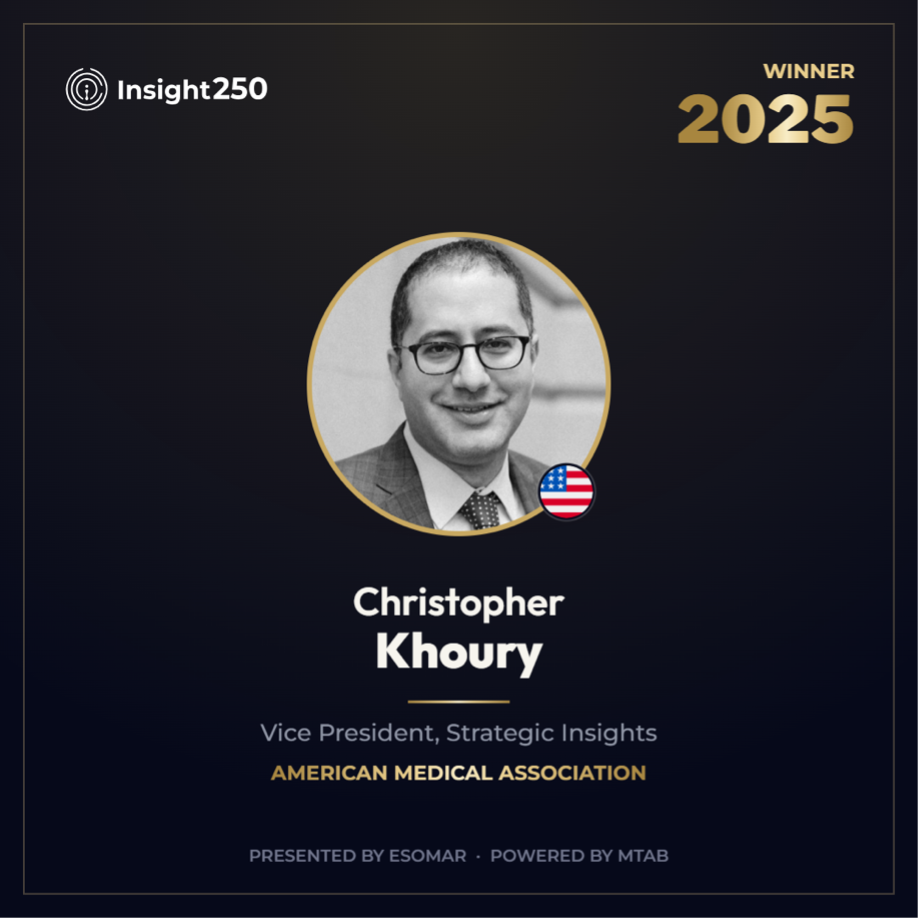
Christopher Khoury, Vice President, Strategic Insights, American Medical Association
Crispin: You have spent over a decade building and leading the Strategic Insights Group at the American Medical Association, advising the CEO, senior leadership, and Trustees across a $400 million mission budget. How did you come to see insights as a strategic function in that context, and what did it take to establish its credibility at the most senior levels?
CK: It was certainly an evolution. Much of it comes down to pushing the conversation early on toward deeper hypotheses and research questions. Those questions, and the insights discovered, need to be linked to the types of evaluative decisions leaders make all the time. Doing that well over time gave us more credibility and allowed us to move beyond the “market research report on a shelf” dilemma. It also helped that we had an enterprise purview, not tied to one particular organisational umbrella, but to the overall enterprise strategy.
Crispin: In commercial organisations, the insights function ultimately serves growth and competitive advantage. What replaces those drivers in a non-profit setting, and how does that fundamentally change the brief you give to insights work?
CK: This is a funny thing. It’s true that the “optimisation curve” is more diffuse because of how we think about performance. But at the same time, we’re equally concerned with growth and competitive advantage. As a membership-based non-profit, our large membership base and ability to grow it give us credibility to speak and contribute to so many facets of healthcare. And just as in commercial settings, we’re fighting for both share of wallet and mindshare, in our case among the physician population and other stakeholders.
Crispin: The AMA sits at the intersection of medicine, policy, ethics, and advocacy, with a stakeholder landscape that spans physicians, patients, policymakers, and the public. How do you design insights programmes that hold meaning across such varied audiences without losing coherence or rigour?
CK: Our insights function has a true north focused on the healthcare workforce, and more specifically, physicians. But to do that well, we need to understand the implications for many different stakeholders in healthcare, from life sciences and devices to insurers, health systems, investors, patients, and policymakers.
Crispin: You have described insights work at the AMA as catalysing more than ten new healthtech ventures and forging over twenty cross-sector partnerships. That is an unusual outcome for an insights function. How do you build the kind of strategic intelligence that opens up new directions rather than simply describing existing ones?
CK: Some of this is a natural outcome of the type of “HUMINT” intelligence gathering we do. When you’re in regular conversations with other industry stakeholders, asking questions without a particular business development agenda, and sharing our own vision for how healthcare should evolve, these opportunities can arise. So the takeaway is that good insights work begins with good conversations that build trust and surface opportunities for the organisation.
Crispin: In a commercial setting, a good insight is typically one that drives revenue or market share. How do you define a good insight in your world, and how do you measure whether insights work has genuinely advanced the mission?
CK: Actionability is important. And for something to be actionable, you need to know the organisation’s strengths and weaknesses, decision-making processes, personalities, and risk profile well.
While it’s not a perfect science, we see that when leadership teams we work with have clarity and shared understanding, they make faster progress on a particular initiative. You might call this reduced “Time to Market” otherwise. We also see benefit when we can make more confident decisions on the issues and opportunities in front of us.
Crispin: Non-profit organisations frequently operate under significant resource constraints. What have you learned about doing serious, rigorous insights work with limited budgets, and where do you draw the line between sufficiency and compromise?
CK: At least within healthcare, we benefit from a rich evidence base that peer-reviewed journals like JAMA and others represent. These are great sources for both ground truths and new perspectives. We’re also fortunate to have highly qualified insight professionals capable of executing work that would normally cost far too much if procured from management consultancies. The ROI case for having an internal insights team is very strong.
Crispin: The AMA’s 2026 research found that more than four in five physicians now use AI in practice, more than double the rate of three years earlier, yet concerns about deskilling are actually greater among younger, digitally native doctors. What does that pattern tell you about how organisations need to think about AI adoption, and what does it mean for the insights profession specifically?
CK: I think it speaks to a very deep insight: the human condition has been partially defined as our ability to produce meaningful labour that we can also benefit from. We’ve seen this concern from Hollywood screenwriters, factory workers, researchers, and physicians alike. For us, we emphasise that AI tools, when adopted, need to augment existing knowledge and skills. More broadly, the economics of AI adoption are not properly sorted out yet. It’s very hard to know the true cost and benefit as the tech innovators are exploring different pricing models and private investment buttresses so many of these companies.
Crispin: You sit on the board of the Institute for Augmented Artificial Intelligence in Medicine at Northwestern University Feinberg School of Medicine and previously on the WHO Roster of Experts for Digital Health among other appointments. How are AI and digital tools changing the kind of strategic intelligence that mission-driven organisations can generate, and what governance frameworks do you think are still missing?
CK: For organisations like Northwestern, the fundamentals of AI can be incredibly transformational towards diagnostic and therapeutic innovations. Success is partly because academic institutions are approaching the use of these tools in the same way they do other types of biomedical research, with a sense of “endpoints”, discipline, protocol/study design, and ethics.
Insights can borrow a lesson from this: start with sound human judgement and thoughtful study design before deploying a tool to assist you.
Crispin: Your career has moved from biomedical engineering and nanotechnology patents at Nanosphere, through Gallup and PwC, to leading insights at one of the most influential healthcare associations in the world. What has that breadth of experience given you as an insights leader that a more conventional path might not have?
CK: As I look back over 23 years now, I am grateful I took a less conventional path. But the through-line is there for me that centres around health and the human condition. I was just fortunate to be able to contribute to different facets. The workplace breadth, my curiosity about “political economies”, and my engineering training all helped me get better at systems and structural thinking, which is so critical to understanding the longstanding barriers and challenges that exist in our healthcare system.
Crispin: If you were advising a non-profit organisation building an insights capability from scratch, what would you tell them to prioritise first, and what common mistakes would you urge them to avoid?
CK: I would tell them that insights needs to be fundamentally coupled to enterprise strategy formulation and execution. It’s core, not a nice-to-have. Just as with general (legal) counsel, it needs to have protection of independent judgement while still focused on organisational success. Many non-profit organisations rely on a core talent profile of “vertical” subject matter expertise. A great insights function acts in a “horizontal” and networked way across the organisation. Don’t be afraid to hire for that mindset.
Crispin: What do you think the broader insights industry stands to learn from the way mission-driven organisations approach evidence, purpose, and accountability?
CK: Mission-driven organisations form their own ecosystems. There is a degree of organic self-assembly that happens over years and decades. I think there’s still much to learn and explore about how ecosystems collaborate and compete compared to markets with a particular competitive set.
HOT TOPIC
Crispin: Christopher, the question of how insights functions should be structured and governed in non-profit settings is one the industry has rarely addressed directly. In commercial organisations, the insights team ultimately answers to business performance. In a mission-driven organisation, that accountability is simultaneously broader and harder to define precisely. How do you build a function that is genuinely trusted across a complex stakeholder landscape, and what does good governance of insights look like when the measure of success is impact rather than profit?
CK: We all know trust and credibility build over time. I’ve found that saying “yes” to projects more often than not helped me build credibility largely because it gave me more licence to ask questions, build relationships with other leaders, and roll up my sleeves. Of course there are times to say a clear “no” too. Indeed, healthcare is a diverse tapestry of stakeholders. Good insights functions in our settings need to place themselves not only from the vantage point of “customers”, but other stakeholders too, even if they’re not totally aligned.
TOP TIP
Crispin: Christopher, we would love to include a short Top Tip from you in your own words. What is your number one piece of practical advice for insights professionals working in non-profit, healthcare, or mission-driven settings?
CK: Never look at your insights function in a vacuum and never sacrifice the human context for the sake of a technological panacea. In complex sectors like healthcare, the work we do as insights professionals is to support committed health professionals navigating an incredibly high cognitive load and emotional weight. Push back when a stakeholder tries to withhold the broader organisational or operational context from you because an insight statement is only ever as sharp as the reality it aims to solve.
Crispin: Christopher, thank you for such a thoughtful and wide-ranging conversation. What stays with me is how far your team has travelled from the “market research report on a shelf” to a function that sits at the heart of enterprise strategy, at the intersection of medicine, policy, ethics, and advocacy. Your point that good insights work begins with good conversations, held without a business development agenda, is one every insights leader should take to heart, as is your call to hire for a horizontal, networked mindset rather than vertical expertise alone. At a time when so much of our industry is chasing the next tool, your reminder never to sacrifice the human context for a technological panacea feels especially timely. As you put it, an insight is only ever as sharp as the reality it aims to solve. Thank you for sharing your perspective, and for the work you and your team do in support of physicians and the wider healthcare workforce.
Crispin Beale
Chairman at QuMind, CEO at Insight250, Senior Strategic Advisor at mTab, CEO at IDXCrispin Beale is a marketing, data and customer experience expert. Crispin spent over a decade on the Executive Management Board of Chime Communications as Group CEO of leading brands such as Opinion Leader, Brand Democracy, Facts International and Watermelon. Prior to this Crispin held senior marketing and insight roles at BT, Royal Mail Group and Dixons. Crispin originally qualified as a chartered accountant and moved into management consultancy with Coopers & Lybrand (PwC). Crispin has been a Board Director (and Chairman) of the MRS for nearly 20 years and UK ESOMAR Representative for c15 years. As well as being CEO of Insight250, Crispin is currently Worldwide CEO of Digital Communications Solution Agency, IDX. Crispin is also the Senior Strategic Advisor at mTab and the Chairman of QuMind and spent 4 years as Group President of Behaviorally where he was responsibile for the client & commercial teams globally. Crispin is a passionate advocate for blending human intelligence and technology to deliver innovation and leadership across organisations.
Article series
Insight250
- The importance of business sense in research
- The role of humour in effective leadership
- The importance of ethics
- The importance of disruption in innovation and leadership
- The importance of Disruption in Innovation and Leadership Part 2
- The importance of Diversity & Inclusion
- The impact of colour
- Communicating insight with impact
- Insights on leadership, culture and polling
- The evolution of electric vehicles
- 2022 Top tips (part 1)
- 2022 Top tips (part 2)
- Maximising the potential of data
- The importance of flexible working
- Winners
- The importance of advanced analytics
- Judges for the 2022 Insight250 Awards announced
- The evolution from social listening to digital intelligence
- The Judges' Perspective
- The judge's perspective - part 2
- Insight Climate Collective
- Insights technology
- Understanding employee ownership
- Global insight perspectives
- Top Tips from our Leaders and Innovators
- The Evolution of Insights in the Food & Beverage Market
- The Evolution of Insights in CPG
- Neural Mechanisms Behind Consumer Decision-Making
- Celebrating and Elevating the Insights Industry
- The State of the Insights Industry
- Opportunities, challenges and threats that AI presents
- 2024 Insight250 Winners Announcement
- Connecting Brands and Consumers Through Insights
- The Importance of Human Insight and Attention
- The Elevating Role of Insights with Technology Innovation
- Haleon’s Insight Expert on Consumer Healthcare
- Insight from the Insight250: How AI is Impacting Qualitative Research
- How AI Tech is Doing the ‘Heavy Lifting’ for Insights
- Reviewing the top tips for 2025
- Google's Sarah Ashley on AI and revolutionising insights - Insights from the Insight250
- Beyond BI: The Future of Decision Intelligence for Insight Professionals
- The Advancement & Impact of Insights - An Insight250 Winners Series perspective with David Smith
- International Jury for the 2025 Insight250 Awards Announced
- Newly elected President, Anne-Sophie, on Revolutionizing the Impact of Insights
- Haleon's Litthya Baez on Enhancing Healthcare with Insights - Insight250 Winners Series
- Understanding the Insights of Consumer Decisions
- Moving Beyond Dashboards to Deliver Decisions with AI
- How AI is Transforming Insights
- How AI is Transforming Insights
- Five Years of Insight250: Elevating the Insight Industry