Innovation Under Constraint
What Global Research Can Learn from Emerging Markets

Article series
Insight250
- The importance of business sense in research
- The role of humour in effective leadership
- The importance of ethics
- The importance of disruption in innovation and leadership
- The importance of Disruption in Innovation and Leadership Part 2
- The importance of Diversity & Inclusion
- The impact of colour
- Communicating insight with impact
- Insights on leadership, culture and polling
- The evolution of electric vehicles
- 2022 Top tips (part 1)
- 2022 Top tips (part 2)
- Maximising the potential of data
- The importance of flexible working
- Winners
- The importance of advanced analytics
- Judges for the 2022 Insight250 Awards announced
- The evolution from social listening to digital intelligence
- The Judges' Perspective
- The judge's perspective - part 2
- Insight Climate Collective
- Insights technology
- Understanding employee ownership
- Global insight perspectives
- Top Tips from our Leaders and Innovators
- The Evolution of Insights in the Food & Beverage Market
- The Evolution of Insights in CPG
- Neural Mechanisms Behind Consumer Decision-Making
- Celebrating and Elevating the Insights Industry
- The State of the Insights Industry
- Opportunities, challenges and threats that AI presents
- 2024 Insight250 Winners Announcement
- Connecting Brands and Consumers Through Insights
- The Importance of Human Insight and Attention
- The Elevating Role of Insights with Technology Innovation
- Haleon’s Insight Expert on Consumer Healthcare
- Insight from the Insight250: How AI is Impacting Qualitative Research
- How AI Tech is Doing the ‘Heavy Lifting’ for Insights
- Reviewing the top tips for 2025
- Google's Sarah Ashley on AI and revolutionising insights - Insights from the Insight250
- Beyond BI: The Future of Decision Intelligence for Insight Professionals
- The Advancement & Impact of Insights - An Insight250 Winners Series perspective with David Smith
- International Jury for the 2025 Insight250 Awards Announced
- Newly elected President, Anne-Sophie, on Revolutionizing the Impact of Insights
- Haleon's Litthya Baez on Enhancing Healthcare with Insights - Insight250 Winners Series
- Understanding the Insights of Consumer Decisions
- Moving Beyond Dashboards to Deliver Decisions with AI
- How AI is Transforming Insights
- How AI is Transforming Insights
- Five Years of Insight250: Elevating the Insight Industry
The Insight250 spotlights and celebrates, annually, 250 of the world’s premier leaders and innovators in market research, consumer insights, and data-driven marketing. The awards have created renewed excitement across the industry whilst strengthening the connectivity of the market research community. Winners of the 2025 Insight250 were announced last September - you can see the full list of Winners, and those from previous years, at Insight250.com. You can also nominate for 2026.
With so many exceptional professionals named to the Insight250, we regularly tap into their expertise and unique perspectives across various topics. This regular series does just that: inquiring about the expert perspectives of many of these individuals in a series of short topical features.
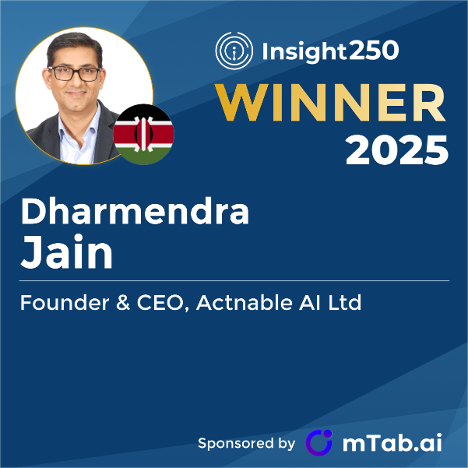
With insights advancing at an incredible pace and the value of insights ever increasing, I sat down with Insight250 Winner Dharmendra Jain, CEO of Actnable AI. Dharmendra has over two decades of proven record of transforming research processes driven by cutting-edge technologies. Dharmendra is the former Operations Director for Kantar, West, East & Central Africa. He is on the current ESOMAR Council board and a part of the ISO for Market, Opinion & Social Research committee as liaison for AI.
Crispin: You’ve spent much of your career working across India and Africa at the intersection
of research, data and AI. What first drew you to solving challenges in emerging
markets?
DJ: Research Operations in the emerging markets have always been full of constraints and challenges, whether it is India, Africa, Asia or LatAm. I recall that when I was in my early career as a data processing (DP) person, I was tasked with ensuring a speedy turnaround for data entry and data quality, as the data collection methodology was pen-and-paper. It was quite a task, and I came up with the idea of designing a Windows-based data entry screen with in-built data quality checks.
Another example: when I was with Kantar as Operations Director for Nigeria, my role required me to ensure seamless research operations, from project management and data collection to data quality and analysis. Given the nature of operations, face-to- face data collection and managing a field force of thousands of interviewers required an unconventional approach, so I designed an end-to-end field management system called Field MIS, which allows the field manager to schedule fieldwork and monitor and manage quality control online. That was a defining moment; we not only managed field operations effectively but also brought transparency and accountability through rewards and recognition within the system, ultimately reducing fraudulent activity and improving data quality and motivation among field staff.
I was very much encouraged, and it didn’t stop there. I kept solving such challenges with technology, including developing an AI-powered data quality management system in 2019 and a conversational chatbot in 2022 (before ChatGPT), which was selected as one of the best papers at the ESOMAR Congress 2022 in Toronto, Canada. Solving challenges through technology became my passion, which encouraged me to found my company, Actnable AI, in 2023.
Crispin: Emerging markets are often viewed as “difficult” research environments. Why do you believe those same constraints can actually become catalysts for innovation?
DJ: I believe ‘challenge’ is another name for ‘opportunity.’ We, as humans, discover our true potential when we are pushed to our limits or face challenges. Similarly, emerging markets generally do not have perfect conditions and often present a unique set of challenges, which are opportunities for us to think outside the box and innovate with limited resources. A very good example of solving data-quality challenges by using predictive AI.
Crispin: In markets where infrastructure, connectivity and data quality can vary significantly, how does that force organisations to think differently about research and insight generation?
DJ: As said before, challenging situations call for innovative and out-of-the-box thinking, which is true in the case of market research, too. The speed, data quality, and high cost of research have always been a challenge. Over the period, agencies have started adopting electronic data collection, online research and automation, offline data-collection apps, integrated data-quality control systems, and now using AI across the insight generation process. Emerging markets also exhibit leapfrogging, meaning they don’t have to follow the traditional technology adoption cycle.
Twenty-five years ago, Safaricom, Kenya’s leading telecom operator, observed consumer behaviour and understood how mobile voice credit could be used for money transactions between two parties, and that birthed the famous M-Pesa (mobile money) in Kenya, which eventually became the model for digital public transformation for the rest of the world.
Crispin: What can the global insights industry learn from the speed, adaptability and pragmatism often seen in emerging markets?
DJ: My observation suggests that the practices in the global or developed markets tend to focus more on standardisation and cookie-cutter approaches; however, emerging markets present a unique set of challenges that require a higher degree of flexibility and adaptability. Actionable insights do not just come from deploying sophisticated tools but also from understanding context and local nuances more deeply, and I believe that cannot be achieved with a one-size-fits-all approach.
Crispin: AI is transforming market research globally, but do emerging markets have an opportunity to leapfrog more established markets in how they adopt and apply these technologies?
DJ: Absolutely, emerging markets have an edge over the developed markets by having the leapfrogging phenomenon. Research in markets like Africa is already showing strong adoption (over 80%). Some examples: Research in various African languages can now be conducted more easily with the help of AI (e.g., language translation and transcription). The high penetration of the Internet and WhatsApp makes data collection via WhatsApp a great option for a fast turnaround.
My startup, Actnable AI, is helping brands and agencies quickly adapt to AI-powered research and, more importantly, do so within their existing/native workflows. For example, Actnable One platform offers language solutions in 132 languages, including around 30 African languages, with a ‘human-in-the-loop’ service. It also has an end-to-end qualitative research service, including sourcing participants from local agencies.
Crispin: You’ve spoken about the need to turn raw data into actionable decisions. Why do so many organisations still struggle to bridge the gap between insight and action?
DJ: I see this problem in two ways: one, the quality of data; secondly, overreliance on data without the context and cultural nuances. I see data everywhere, with less or no context. Therefore, it misses the point. I also think augmenting with behavioural data could be a game-changer.
Crispin: In fast-growing economies, consumer behaviour can evolve incredibly quickly. How should research methodologies adapt to keep pace with that level of change?
DJ: That’s a good question, considering leapfrogging, and a massive young population in the emerging markets demands agility in adopting new approaches, methods and ways of working; however, I see that’s where a kind of paradox, the truth of the matter is, unfortunately, transformation in research methods is not happening that fast. Another reason, I think, could be the global template rollout and a lack of locally backed decision-making. The good thing is that the trend is now changing. Thanks to the fast-growing reach of the internet, smartphones and other technologies, enabling the whole ecosystem.
Crispin: Do you think traditional research models built in mature markets are always transferable to regions like Africa and South Asia, or does the industry need to rethink its assumptions?
DJ: I think, certainly, the industry needs to rethink; each market offers its own environment, culture, society, as well as challenges that demand innovation and a pragmatic approach. A very good example of that is Actnable creative testing platform called Actnable Neuro AI. Before we rolled out in Africa, we had to test its methodological approach, from 100% online to CLT-based, to align with the more effective practice in Africa.
Crispin: There is a growing conversation around AI-generated insight and automation. How should organisations balance technological efficiency with local context and human understanding?
DJ: Indeed, we are at an inflexion point, the advancement in AI is redefining how we look at and execute the research project, and there is no debate about that; however, actionable insights generation requires a lot of human intervention, be it the local context, cultural understanding and the ability to understand rather than just working with best predictions. I believe AI won’t replace human capability for generating insights; it will help the process. So, the balance is the name of the game. Also, we should not use AI as a hammer to hit everywhere.
Crispin: Looking ahead, what do you believe the next generation of insights leaders will need to do differently to build globally relevant, future-ready organisations?
DJ: Avoid the “jumping on the bandwagon” syndrome. I believe “The future is human”, and human skills, capabilities and services delivered upon them will be valued more than AI-generated stuff. Therefore, a good researcher should be more curious and analytical, possess strong observational and reasoning skills, and be smart enough to embrace technology and innovate quickly.
Crispin: Thank you, Dharmendra, for sharing your unique perspective on the industry and its innovations. It’s been fantastic to hear your thoughts on the state of the insights and how the innovation of AI will continue to play a leading role in evolving our industry.
Crispin Beale
Chairman at QuMind, CEO at Insight250, Senior Strategic Advisor at mTab, CEO at IDXCrispin Beale is a marketing, data and customer experience expert. Crispin spent over a decade on the Executive Management Board of Chime Communications as Group CEO of leading brands such as Opinion Leader, Brand Democracy, Facts International and Watermelon. Prior to this Crispin held senior marketing and insight roles at BT, Royal Mail Group and Dixons. Crispin originally qualified as a chartered accountant and moved into management consultancy with Coopers & Lybrand (PwC). Crispin has been a Board Director (and Chairman) of the MRS for nearly 20 years and UK ESOMAR Representative for c15 years. As well as being CEO of Insight250, Crispin is currently Worldwide CEO of Digital Communications Solution Agency, IDX. Crispin is also the Senior Strategic Advisor at mTab and the Chairman of QuMind and spent 4 years as Group President of Behaviorally where he was responsibile for the client & commercial teams globally. Crispin is a passionate advocate for blending human intelligence and technology to deliver innovation and leadership across organisations.
Article series
Insight250
- The importance of business sense in research
- The role of humour in effective leadership
- The importance of ethics
- The importance of disruption in innovation and leadership
- The importance of Disruption in Innovation and Leadership Part 2
- The importance of Diversity & Inclusion
- The impact of colour
- Communicating insight with impact
- Insights on leadership, culture and polling
- The evolution of electric vehicles
- 2022 Top tips (part 1)
- 2022 Top tips (part 2)
- Maximising the potential of data
- The importance of flexible working
- Winners
- The importance of advanced analytics
- Judges for the 2022 Insight250 Awards announced
- The evolution from social listening to digital intelligence
- The Judges' Perspective
- The judge's perspective - part 2
- Insight Climate Collective
- Insights technology
- Understanding employee ownership
- Global insight perspectives
- Top Tips from our Leaders and Innovators
- The Evolution of Insights in the Food & Beverage Market
- The Evolution of Insights in CPG
- Neural Mechanisms Behind Consumer Decision-Making
- Celebrating and Elevating the Insights Industry
- The State of the Insights Industry
- Opportunities, challenges and threats that AI presents
- 2024 Insight250 Winners Announcement
- Connecting Brands and Consumers Through Insights
- The Importance of Human Insight and Attention
- The Elevating Role of Insights with Technology Innovation
- Haleon’s Insight Expert on Consumer Healthcare
- Insight from the Insight250: How AI is Impacting Qualitative Research
- How AI Tech is Doing the ‘Heavy Lifting’ for Insights
- Reviewing the top tips for 2025
- Google's Sarah Ashley on AI and revolutionising insights - Insights from the Insight250
- Beyond BI: The Future of Decision Intelligence for Insight Professionals
- The Advancement & Impact of Insights - An Insight250 Winners Series perspective with David Smith
- International Jury for the 2025 Insight250 Awards Announced
- Newly elected President, Anne-Sophie, on Revolutionizing the Impact of Insights
- Haleon's Litthya Baez on Enhancing Healthcare with Insights - Insight250 Winners Series
- Understanding the Insights of Consumer Decisions
- Moving Beyond Dashboards to Deliver Decisions with AI
- How AI is Transforming Insights
- How AI is Transforming Insights
- Five Years of Insight250: Elevating the Insight Industry