Making Sense of Complexity: How Intelligence Should Shape Decisions
The Insight250 spotlights and celebrates, annually, 250 of the world’s premier leaders and innovators in market research, consumer insights, and data-driven marketing.

Article series
Insight250
- The importance of business sense in research
- The role of humour in effective leadership
- The importance of ethics
- The importance of disruption in innovation and leadership
- The importance of Disruption in Innovation and Leadership Part 2
- The importance of Diversity & Inclusion
- The impact of colour
- Communicating insight with impact
- Insights on leadership, culture and polling
- The evolution of electric vehicles
- 2022 Top tips (part 1)
- 2022 Top tips (part 2)
- Maximising the potential of data
- The importance of flexible working
- Winners
- The importance of advanced analytics
- Judges for the 2022 Insight250 Awards announced
- The evolution from social listening to digital intelligence
- The Judges' Perspective
- The judge's perspective - part 2
- Insight Climate Collective
- Insights technology
- Understanding employee ownership
- Global insight perspectives
- Top Tips from our Leaders and Innovators
- The Evolution of Insights in the Food & Beverage Market
- The Evolution of Insights in CPG
- Neural Mechanisms Behind Consumer Decision-Making
- Celebrating and Elevating the Insights Industry
- The State of the Insights Industry
- Opportunities, challenges and threats that AI presents
- 2024 Insight250 Winners Announcement
- Connecting Brands and Consumers Through Insights
- The Importance of Human Insight and Attention
- The Elevating Role of Insights with Technology Innovation
- Haleon’s Insight Expert on Consumer Healthcare
- Insight from the Insight250: How AI is Impacting Qualitative Research
- How AI Tech is Doing the ‘Heavy Lifting’ for Insights
- Reviewing the top tips for 2025
- Google's Sarah Ashley on AI and revolutionising insights - Insights from the Insight250
- Beyond BI: The Future of Decision Intelligence for Insight Professionals
- The Advancement & Impact of Insights - An Insight250 Winners Series perspective with David Smith
- International Jury for the 2025 Insight250 Awards Announced
- Newly elected President, Anne-Sophie, on Revolutionizing the Impact of Insights
- Haleon's Litthya Baez on Enhancing Healthcare with Insights - Insight250 Winners Series
- Understanding the Insights of Consumer Decisions
- Moving Beyond Dashboards to Deliver Decisions with AI
- How AI is Transforming Insights
- How AI is Transforming Insights
- Five Years of Insight250: Elevating the Insight Industry
The Insight250 spotlights and celebrates, annually, 250 of the world’s premier leaders and innovators in market research, consumer insights, and data-driven marketing. The awards have created renewed excitement across the industry whilst strengthening the connectivity of the market research community. Winners of the 2025 Insight250 were announced last September - you can see the full list of Winners, and those from previous years, at Insight250.com. The 2026 Insight250 nominations are currently in review.
With so many exceptional professionals named to the Insight250, we regularly tap into their expertise and unique perspectives on a range of topics. This regular series does just that: inquiring about the expert perspectives of many of these individuals in a series of short topical features.
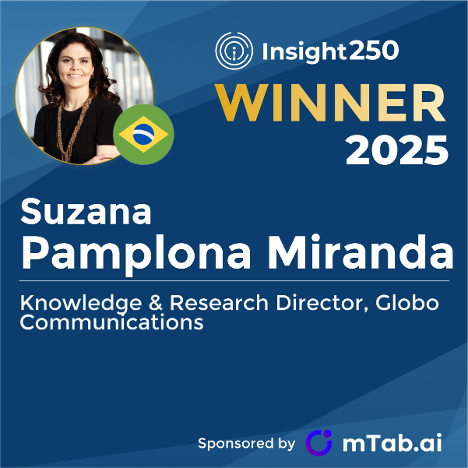
With insights advancing at an incredible pace and the value of insights ever increasing, I sat down with Insight250 Winner Suzana Pamplona Miranda. Suzana has been a driving force in the market research and audience measurement industry, fostering innovation, developing new leadership, setting industry standards, and implementing best practices. She currently serves as Knowledge & Research Director for Globo Communications. Her career spans across research institutes and major CPG companies such as Nestlé, Unilever, Johnson & Johnson, and Natura, before taking on a key role at Globo.
Crispin: You have said that data does not create value on its own and that meaning emerges where analytical rigour meets human context, interpretation and dialogue. In practice, what does it look like when that combination works, and what goes wrong when it does not?
SPM: When it works, we fulfil our purpose: transforming data into knowledge and knowledge into action that drives meaningful change. We connect dots, place findings into context, challenge assumptions, and help organisations understand not only what is happening, but why it matters.
That is when research moves beyond information and starts influencing decisions that create real impact—for businesses, for people, and ultimately for society.
When it does not, we end up producing a “parade” of obvious conclusions and reports full of facts but empty of meaning. We describe reality without interpreting it and deliver answers without helping people understand the real question. In that case, we add very little value and increasingly, it is the kind of work that AI can do just as well, if not better. In that case, we risk becoming the very thing some fear most: replaceable by robots.
Crispin: Your 2013 IIeX presentation was called Why I Hate Insights. More than a decade on, what was the argument you were making, and how much of it still holds?
SPM: Wow, thank you for reminding me of that talk. Looking back, it was one of those ideas that stayed with me long after I left the stage. In fact, I feel I could write an entire article in response to this question.
I would say that the central argument still holds—perhaps even more strongly than it did in 2013. The point I was making back then was not that insights are unimportant. I was challenging the semantics and etymology of the word itself, and the notion that knowledge emerges from a moment of revelation, as though it were something magical or an enlightened individual blessed with a unique gift of perception. That view is both limiting and ultimately lonely. What we do is rarely the product of a solitary revelation. It emerges through connection, dialogue, and interpretation. It involves hard work, intellectual rigour, a deep cultural and intellectual foundation, and critical thinking.
At the time, I argued that information was becoming more distributed, fragmented, and fluid. Today, with AI-generated content, synthetic personas, and an unprecedented abundance of data, that is even more true. The challenge is no longer access to information; it is understanding what makes sense and what ultimately matters.
Meaningful knowledge comes from asking better questions, connecting dots, interpreting context, and helping people to navigate an increasingly complex reality to inspire transformative action. Our role is not to generate more insights, but to create meaning from an overwhelming abundance of data.
That is why I still believe researchers should move from being providers of research to becoming curators of knowledge and meaning. Our value lies in helping organisations understand what matters, what changes, and what requires action. If I were giving the talk today, I would update the examples, but not the thesis. The underlying idea would remain exactly the same: progress often comes not from finding new answers, but from reframing the question and recontextualising the problem. Or, to paraphrase Proust, ”the real voyage of discovery lies not in seeking new landscapes, but in seeing with new eyes.”
Crispin: You describe your work as less about generating information and more about making sense of complexity with clarity, critical thinking and the discipline to question assumptions. What does questioning assumptions look like inside an organisation the size of Globo, where the pressure to confirm existing beliefs can be considerable?
SPM: Interestingly, the pressure to confirm existing beliefs has not been my experience. One of the things I value most about Globo is that the independence of the research function is not only respected, but expected. Challenging assumptions is seen as part of the job, not as an act of defiance. I would argue that independence is precisely what gives research its strategic value.
That goes beyond the freedom to challenge prevailing narratives. It also means having the autonomy to invest in knowledge that may not have an immediate business application but helps the organisation better understand the society it serves. A recent example is Brazil in the Mirror, a study that later became a published book and one of the most comprehensive explorations of Brazilian values conducted in the country.
Projects like this reflect Globo's belief that understanding society is not separate from business relevance; it is fundamental to it. Our role is not to validate existing beliefs, but to help the organisation see reality more clearly. Sometimes that means bringing evidence that reinforces confidence in a decision; sometimes it means presenting facts that challenge some ideas. Both are equally important. I believe organisations become vulnerable when they lose the ability to question their own certainties. One of the greatest privileges of my role is being trusted to bring evidence, perspective and intellectual rigour to conversations that matter.
Ultimately, the goal is not to prove people wrong. It is to help the organisation stay curious, intellectually honest, and connected to the challenges and opportunities it actually faces.
Crispin: Over more than 25 years you have worked client-side at Nestlé, Unilever, Johnson and Johnson, Natura and Globo. What does that breadth of experience give you that a career in agency or consultancy would not?
SPM: I should start by saying that my career did not begin client-side. My first professional experiences were actually in research agencies, both in public opinion and market research, and I remain deeply grateful for that foundation.
Those early years shaped me as a researcher. They gave me technical discipline, methodological rigour, and the intellectual basis that still guide my work today. They taught me not only how to maintain scientific standards, but also when and how to be pragmatic without compromising the quality or reliability of the evidence.
What I gained on the client side was something different, but equally valuable: a deeper understanding of business. I learned how decisions are made, the trade-offs involved, and the financial, organisational and human consequences those decisions can have.
That perspective changed the way I think about research. It made me more conscious of the bridge between generating knowledge and influencing action. Understanding the realities of decision-making allows me to be more precise in the questions I ask, the evidence I bring forward, and the influence I can have.
Looking back, I do not see those experiences as alternatives to one another. I see them as complementary. One taught me how to produce robust knowledge; the other taught me how to put that knowledge to work.
Crispin: As Knowledge and Research Director at Globo you work with a multidisciplinary team close to where key decisions are made. How do you keep that function genuinely influential rather than merely advisory?
SPM: I believe influence starts with credibility, but it grows through relevance. For a research function to be genuinely influential, it cannot operate on the sidelines, nor can it behave like a bakery that simply fulfills requests.
It needs to be embedded in the rhythms of the business: decision- making processes, performance reviews, planning cycles, and the everyday conversations where priorities are shaped. That is how evidence becomes part of the culture rather than an occasional input.
The second element is proximity. Not proximity in the sense of losing independence, but in understanding the realities of the business and the people making decisions. They are usually balancing competing priorities, constraints, risks and opportunities. If we do not understand that context, even the best evidence may fail to resonate.
I have found that influence grows when rigour is combined with empathy. The more we understand the pressures, objectives and trade- offs our stakeholders face, the better we can translate knowledge into something useful and actionable.
To me, the real test of influence is not whether the research team is invited into important conversations. It is whether people feel the absence of that perspective when it is not there. The goal is not to be a function that constantly asks for a seat at the table, but one that becomes a natural and indispensable part of how decisions are made - not a voice commenting from the sidelines, but a trusted partner in shaping decisions.
Ultimately, the role of a knowledge function is not to observe decisions from a distance, but to help shape them through evidence, context and perspective.
Crispin: Cultura no Espelho, developed in partnership with Quaest and presented at SXSW 2026, found that the distribution of cultural capital in Brazil closely mirrors the distribution of economic capital. What does that finding mean for how brands and media organisations should be thinking about their audiences?
SPM: The finding is a reminder that culture is not distributed as evenly as we often assume. If cultural capital closely mirrors economic capital, then access to references, experiences and opportunities for intellectual expansion is also shaped by inequality. And that creates both a responsibility and an opportunity.
Brands, advertisers and media organisations have an important role to play in expanding horizons, broadening cognitive repertoires, increasing representation and exposing people to ideas, experiences and perspectives they might not otherwise encounter. In that sense, communication is not only about persuasion or commercial outcomes; it is also a mechanism through which cultural capital circulates.
For media organisations in particular, the question is not simply how well we understand our audiences, but also how we contribute to their understanding of the world. The most valuable content does not just reflect society back to itself; it helps people see further, understand more, and imagine possibilities beyond their immediate reality.
Crispin: Brasil no Espelho involved close to ten thousand in-person interviews and resulted in a book for which you wrote the preface. What does a study of that scale and ambition tell us about the kind of research questions that still require genuine depth rather than speed?
SPM: Brazil in the Mirror was born from a broad question: who are Brazilians today? What values, beliefs and attitudes unite us, and which ones divide us? Is Brazil really as polarised as we often assume, or are there deeper areas of consensus that remain invisible beneath the public debate?
What Brazil in the Mirror reinforced for me is that some of the most important questions are not the ones the business is normally asking on a day-to-day basis.
If we had started with a conventional business brief, we would probably have produced a useful study. But we would never have uncovered many of the findings that emerged. The study was never designed to answer a marketing challenge, optimise a campaign, or improve a KPI, which are equally important, but they need to be agile, timely and closely tied to specific decisions.
Paradoxically, that is precisely what made it so relevant to business as well. Some of the most important insights do not emerge from looking directly at the problem we are trying to solve, but from stepping back and understanding the broader system around it.
Sometimes the greatest value of research is not answering the questions we already have. It is revealing the questions we did not know we should be asking.
Crispin: Globo presented work at Esomar LATAM on the Economics of Attention, examining how attention has become a strategic asset for advertising engagement. How does that sit alongside the argument that attention is being over-measured and misunderstood as a metric?
SPM: Attention matters. In a world saturated with noise, it has become a scarce and valuable resource. But not all attention is created equal. There are many ways to capture it, including sensationalism, controversy, hate speech, or simple interruption. The kind of attention that creates lasting engagement, however, depends on context, relevance and meaning. It comes from connecting with people in a way that feels coherent with both their interests and the content environment in which the message appears.
And that actually creates more impact and effectiveness. A metric should help reduce uncertainty, not add to the noise. Measuring attention tells us when the message has the opportunity to create an effect. In that sense, attention is not only an asset; it is also a responsibility.
Crispin: You have actively called for greater nomination of Latin American professionals to the Insight250, arguing that the region is under-represented relative to its relevance, diversity and impact. What would change in the global insights conversation if that representation improved?
SPM: I have never seen this as a matter of regional recognition or representativeness for its own sake. To me, it is a matter of enriching the global conversation.
Latin America represents more than 650 million people living in some of the world's most dynamic, unequal, creative and rapidly changing societies. We operate in environments where volatility, uncertainty, complexity and ambiguity are not theoretical constructs. Long before VUCA became a hype acronym, it was already part of our everyday reality. That inevitably shapes the questions we ask, the methods we develop and the way we think about consumers, citizens and culture.
When Latin American voices are under-represented, the global insights community loses access to those perspectives. And that matters because innovation in our industry does not come only from new technologies. It also comes from new ways of seeing.
I believe in plural and greater representation as a principle that helps to make the conversation less homogeneous, less self-centred and more intellectually diverse. It would bring different cultural lenses, different business realities and different approaches to understanding human behaviour.
In the end, diversity is not only about who is recognised. It is about expanding the range of ideas that are allowed to influence the future of our profession.
Crispin: Your career has been built in Brazil and Latin America. What does the global insights industry consistently misread or overlook about Brazilian consumers and Brazilian research practice?
SPM: Brazil is often portrayed as exotic when many of its characteristics are shared by societies that have experienced the historical background of extractive colonialism, deep inequality and institutional fragility.
What may be more distinctive is how Brazilians have learned to navigate this complex context. We are a remarkably diverse society, shaped by multiple cultural influences, contradictions and social realities. That has required a certain flexibility and adaptability. What is often described as the jeitinho brasileiro is frequently reduced to a stereotype. But at its core, it can also be understood as a social strategy for dealing with constraints, uncertainty and imperfect systems. It reflects an ability to find creative solutions when formal structures do not provide easy answers.
And those cultural aspects may have influenced Brazilian research practice as well. We tend to be comfortable with ambiguity and contradiction. We are used to working in environments where reality is rarely binary and challenging to operate.
Such context made Brazil historically more diplomatic than confrontational in the way it approaches impasses. We tend to look for accommodation before conflict, for coexistence before polarisation. That does not mean we don’t have them; it means we often try to solve our issues firstly through negotiation and adaptation, rather than through direct confrontation. In a world that seems increasingly polarised, there may be something valuable in that perspective. After all, most people are already fighting enough battles in their everyday lives.
Crispin: You have described the insights function as having the power to expand how organisations interpret reality, not only to inform performance. How do you make that case to a leadership team focused primarily on short-term commercial outcomes?
SPM: I would probably start by challenging the premise of the question. In my experience, understanding reality and delivering commercial results are not competing priorities. In fact, one is often what makes the other possible.
The role of an insights function is not to choose between the short term and the long term. It is to help organisations to balance them and to make better decisions in both.
The mistake is to assume that only what affects this quarter's results deserves attention. Most of the forces that eventually reshape markets, brands and businesses begin as weak signals long before they appear in performance reports.
I have found that leadership teams are generally very receptive to this conversation when it is connected to decisions they need to make. Ultimately, insights create value when they help organisations navigate the present without losing sight of the future.
Crispin: You have quoted Max Weber on gathering inexhaustible reality into comprehensible concepts, and Tom Ze on the productive tension between confusion and clarity. If you had to distill what the insights profession is actually for into a single sentence, what would it be?
SPM: What a difficult and beautiful question.
In Brazil, we have an expression: "to have the knife and the cheese in your hands", meaning to have everything you need to solve a problem. The Brazilian poet Adélia Prado brilliantly turns that idea upside down when she writes: "I do not want the knife or the cheese. I want the hunger." I have always loved that image.
To me, the purpose of the insights profession is not to hand people the knife and the cheese. It is to cultivate hunger: the curiosity to understand, the courage to question assumptions, and the desire to see beyond what is obvious.
But understanding is never an end in itself. Hunger only matters because it moves us. It makes us search, discover, decide and act.
So, if I may be bold enough to summarise the purpose of our profession in a single sentence, I would say: The purpose of the insights profession is to deepen understanding in ways that inspire better decisions and meaningful change.
Hot Topic
The insights industry has spent years debating how to earn a seat at the table.
SPM: Proximity matters less than the quality of the thinking being brought. Across more than 25 years at Nestlé, Unilever, Johnson and Johnson, Natura and Globo, I have built my career on the proposition that data without interpretation is noise, and that the real work of intelligence is making sense of complexity with rigour and critical honesty.
Top Tip
We ask all our Insight250 winners to share one practical tip for the ResearchWorld community. What is yours?
Be unconforming, but also vigilant. Do not accept ready-made or generic answers. Look beyond the obvious. As the Epicurean tradition reminds us, nothing comes from nothing.
Reality is usually far richer and more complex than any single explanation can capture. Always remember: correlation is not causation. And behind every pattern lie deeper cultural, social, economic and historical structures shaping what we observe.
But be equally vigilant with yourself. Do not let your own biases betray you, and do not fall in love with your own ideas too quickly.
Good research requires curiosity, the confidence to stand by the evidence even when you stand alone, but also the humility to question your own certainty. It is this tension that keeps our work honest.
Crispin:
Thank you, Suzana, for such an enlightening conversation on the evolving role of insights across our industry and beyond. Your point that "not all attention is created equal," and that measurement should tell us when a message has the opportunity to create an effect rather than simply how loud it is, feels like a necessary corrective in a saturated world. It is a reminder that our profession's task is not to chase noise but to make sense of it, which is really the thread running through everything you have shared here. Thank you again.
Crispin Beale
Chairman at QuMind, CEO at Insight250, Senior Strategic Advisor at mTab, CEO at IDXCrispin Beale is a marketing, data and customer experience expert. Crispin spent over a decade on the Executive Management Board of Chime Communications as Group CEO of leading brands such as Opinion Leader, Brand Democracy, Facts International and Watermelon. Prior to this Crispin held senior marketing and insight roles at BT, Royal Mail Group and Dixons. Crispin originally qualified as a chartered accountant and moved into management consultancy with Coopers & Lybrand (PwC). Crispin has been a Board Director (and Chairman) of the MRS for nearly 20 years and UK ESOMAR Representative for c15 years. As well as being CEO of Insight250, Crispin is currently Worldwide CEO of Digital Communications Solution Agency, IDX. Crispin is also the Senior Strategic Advisor at mTab and the Chairman of QuMind and spent 4 years as Group President of Behaviorally where he was responsibile for the client & commercial teams globally. Crispin is a passionate advocate for blending human intelligence and technology to deliver innovation and leadership across organisations.
Article series
Insight250
- The importance of business sense in research
- The role of humour in effective leadership
- The importance of ethics
- The importance of disruption in innovation and leadership
- The importance of Disruption in Innovation and Leadership Part 2
- The importance of Diversity & Inclusion
- The impact of colour
- Communicating insight with impact
- Insights on leadership, culture and polling
- The evolution of electric vehicles
- 2022 Top tips (part 1)
- 2022 Top tips (part 2)
- Maximising the potential of data
- The importance of flexible working
- Winners
- The importance of advanced analytics
- Judges for the 2022 Insight250 Awards announced
- The evolution from social listening to digital intelligence
- The Judges' Perspective
- The judge's perspective - part 2
- Insight Climate Collective
- Insights technology
- Understanding employee ownership
- Global insight perspectives
- Top Tips from our Leaders and Innovators
- The Evolution of Insights in the Food & Beverage Market
- The Evolution of Insights in CPG
- Neural Mechanisms Behind Consumer Decision-Making
- Celebrating and Elevating the Insights Industry
- The State of the Insights Industry
- Opportunities, challenges and threats that AI presents
- 2024 Insight250 Winners Announcement
- Connecting Brands and Consumers Through Insights
- The Importance of Human Insight and Attention
- The Elevating Role of Insights with Technology Innovation
- Haleon’s Insight Expert on Consumer Healthcare
- Insight from the Insight250: How AI is Impacting Qualitative Research
- How AI Tech is Doing the ‘Heavy Lifting’ for Insights
- Reviewing the top tips for 2025
- Google's Sarah Ashley on AI and revolutionising insights - Insights from the Insight250
- Beyond BI: The Future of Decision Intelligence for Insight Professionals
- The Advancement & Impact of Insights - An Insight250 Winners Series perspective with David Smith
- International Jury for the 2025 Insight250 Awards Announced
- Newly elected President, Anne-Sophie, on Revolutionizing the Impact of Insights
- Haleon's Litthya Baez on Enhancing Healthcare with Insights - Insight250 Winners Series
- Understanding the Insights of Consumer Decisions
- Moving Beyond Dashboards to Deliver Decisions with AI
- How AI is Transforming Insights
- How AI is Transforming Insights
- Five Years of Insight250: Elevating the Insight Industry