On the Frontline of AI Decision Intelligence Innovation
The Insight250 spotlights and celebrates 250 of the world’s premier leaders and innovators in market research, consumer insights, and data-driven marketing.

Article series
Insight250
- The importance of business sense in research
- The role of humour in effective leadership
- The importance of ethics
- The importance of disruption in innovation and leadership
- The importance of Disruption in Innovation and Leadership Part 2
- The importance of Diversity & Inclusion
- The impact of colour
- Communicating insight with impact
- Insights on leadership, culture and polling
- The evolution of electric vehicles
- 2022 Top tips (part 1)
- 2022 Top tips (part 2)
- Maximising the potential of data
- The importance of flexible working
- Winners
- The importance of advanced analytics
- Judges for the 2022 Insight250 Awards announced
- The evolution from social listening to digital intelligence
- The Judges' Perspective
- The judge's perspective - part 2
- Insight Climate Collective
- Insights technology
- Understanding employee ownership
- Global insight perspectives
- Top Tips from our Leaders and Innovators
- The Evolution of Insights in the Food & Beverage Market
- The Evolution of Insights in CPG
- Neural Mechanisms Behind Consumer Decision-Making
- Celebrating and Elevating the Insights Industry
- The State of the Insights Industry
- Opportunities, challenges and threats that AI presents
- 2024 Insight250 Winners Announcement
- Connecting Brands and Consumers Through Insights
- The Importance of Human Insight and Attention
- The Elevating Role of Insights with Technology Innovation
- Haleon’s Insight Expert on Consumer Healthcare
- Insight from the Insight250: How AI is Impacting Qualitative Research
- How AI Tech is Doing the ‘Heavy Lifting’ for Insights
- Reviewing the top tips for 2025
- Google's Sarah Ashley on AI and revolutionising insights - Insights from the Insight250
- Beyond BI: The Future of Decision Intelligence for Insight Professionals
- The Advancement & Impact of Insights - An Insight250 Winners Series perspective with David Smith
- International Jury for the 2025 Insight250 Awards Announced
- Newly elected President, Anne-Sophie, on Revolutionizing the Impact of Insights
- Haleon's Litthya Baez on Enhancing Healthcare with Insights - Insight250 Winners Series
- Understanding the Insights of Consumer Decisions
- Moving Beyond Dashboards to Deliver Decisions with AI
- How AI is Transforming Insights
- How AI is Transforming Insights
- Five Years of Insight250: Elevating the Insight Industry
The Insight250 spotlights and celebrates 250 of the world’s premier leaders and innovators in market research, consumer insights, and data-driven marketing. The awards have created renewed excitement across the industry whilst strengthening the connectivity of the market research community. Winners of the 2025 Insight250 were announced this past September - you can see the full list of Winners at Insight250.com.
With so many exceptional professionals named to the Insight250, we regularly tap into their expertise and unique perspectives on a range of topics. This regular series does just that: inquiring about the expert perspectives of many of these individuals in a series of short topical features.
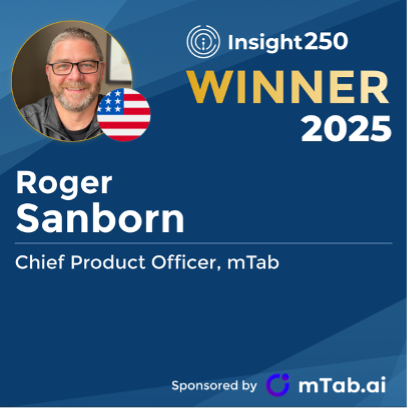
With technology advancing at an incredible pace and the value of insights ever increasing, I sat down with Insight250 Winner Roger Sanborn. As Chief Product Officer at mTab, Roger is developing the next generation of AI-driven decision intelligence solutions for clients across industries like media & entertainment, automotive and food & beverage. He has over 25 years of experience in product strategy and implementation to unlock profit opportunities and maintain a competitive advantage. Previously, he held strategic product positions with Microsoft and SAP.
Crispin: Talk about the evolution of Decision Intelligence and the impact AI has had on it over the last year or so?
RS: Decision Intelligence has undergone a fundamental shift recently. For years, our industry operated on a linear model - collect data, analyze it, produce a report, and hope someone acts on it. That gap between insight and action is where most of the value leaks out.
AI, particularly agentic AI and large language models, is collapsing that gap. We've moved from "here's what happened" to "here's what's happening, here's why, and here's what you should do about it" in near real-time. Insights are no longer a periodic reporting function; they're becoming a continuous decision-making capability.
And where it gets really exciting is autonomous execution, systems that don't just recommend a pricing adjustment, but orchestrate it across your tech stack with appropriate human oversight. AI is converging advanced analytics, causal reasoning, and workflow automation into a unified capability. That's not just better decisions, it's a fundamentally different way for organizations to operate.
Crispin: You and your team at mTab have been pioneering the development of AI nearly since its commercial outset. What’s been the most challenging aspect of this process?
RS: Honestly, the biggest challenge is discipline. AI is evolving so fast that there's a constant pull to chase the latest capability. But our job isn't to build impressive AI, it's to solve real business problems. Staying anchored to customer outcomes when the technology landscape shifts every few months requires real intentionality.
The second challenge is managing transformation while delivering value today. Our clients depend on us right now, so you can't disappear into a lab and emerge with something new. You have to evolve a living product, modernizing the foundation while keeping the lights on and continuing to deliver value for customers. That's an engineering and prioritization challenge that doesn't get talked about enough.
Then there's the people side, which, I think, is the most underappreciated challenge in this space. Building AI-native products isn't just a technical skill set; it's a mindset shift. Your teams need to be comfortable with ambiguity and rapid experimentation while still maintaining the rigor customers expect. That cultural transformation is harder and more important than any technical decision we've made.
Crispin: With companies across industries like automotive, entertainment and food & beverage relying on mTab.ai solutions, what is the most impactful application you generally see with the technology?
RS: The most impactful application is almost always the same regardless of industry, closing the loop between insight and action. Every one of our clients, whether they're in automotive, entertainment, or food and beverage, has the same fundamental problem: they're drowning in data but starving for decisions.
What changes the game is when you can take fragmented data sources - survey data, behavioral data, market data and unify them, and then move beyond dashboards into actual recommendations. For example, a media company isn't just asking "how did our content perform?" They need to know why it performed that way with a specific audience and what to do next. An automotive brand doesn't just want tracking data - they want to understand the causal drivers behind consideration and act on them in-market.
The pattern we see across industries is that the biggest value isn't in any single analytic technique. It's in connecting the dots across data sources and analytic methods that have traditionally been siloed, and then making those insights accessible to the people making decisions every day, not just the research team. When you democratize that capability, the impact compounds across the entire organization.
Crispin: Considering the agentic and generative dimensions of AI, where do you see the possibilities of each when it comes to Decision Intelligence and insights?
RS: Generative and agentic AI are often talked about together, but they play very different roles in Decision Intelligence, and understanding the distinction matters.
Generative AI has been transformative for the insight side of the equation. It's made it possible to synthesize vast amounts of data into narratives, translate complex analysis into plain language, and democratize access to insights across an organization. Things that used to take a research team days - writing summaries, building storylines from data, answering ad hoc questions - can now happen in seconds. That's enormously valuable, but it's still fundamentally about informing humans.
Agentic AI is where the real paradigm shift happens. This is where you move from generating insights to acting on them. An agent doesn't just tell you that your brand consideration is declining among a key demographic - it identifies the causal drivers, evaluates intervention options, and orchestrates a response across your marketing stack. It reasons, plans, and executes with appropriate human guardrails.
The real power is when you combine them. Generative AI makes the system intelligible - it explains what's happening and why in ways humans can understand and trust. Agentic AI makes it actionable - it turns those insights into coordinated execution. Together, they create a system that can think, communicate, and act. That's the full promise of Decision Intelligence, and it's what we're building toward at mTab.
Crispin: With upwards of 87% of companies saying they are increasing their AI investments for insights and intelligence this year, where do you see the most significant barriers to brands engaging the advantages of AI?
RS: The biggest barrier is rarely technology or budget, it's readiness. Many companies are increasing AI spend, but often layering AI onto workflows that weren't designed for it. If your data lives in dozens of siloed tools and your insights team is disconnected from decision-makers, adding AI accelerates the existing process rather than transforming it. The companies seeing real impact are the ones willing to rethink the workflow itself, not just add intelligence on top.
The second barrier is trust, and it's a legitimate one. AI can produce impressive outputs, but if decision-makers can't understand how it arrived at a recommendation, they're unlikely to act on it. Building that trust requires explainability, transparency, and a track record of delivering results. That's not something that happens overnight; it takes intentional design and patience.
The third is moving from experimentation to impact. A lot of organizations are running AI pilots, and many are showing real promise. But there's a meaningful gap between a successful proof of concept and an enterprise capability that's embedded in daily operations. Bridging that gap requires clear alignment between the AI investment and measurable business outcomes, along with the organizational commitment to see it through. The companies that get that right are the ones that will pull ahead.
Crispin: Where do you see your team advancing Decision Intelligence with AI over the coming year?
RS: Our focus over the next year is very deliberate; we're building the foundation that everything else will run on. That starts with unifying the data layer. We're creating a platform where clients can bring together survey data, behavioral data, and market data into a single environment, so insights aren't trapped in silos. That sounds straightforward, but getting it right is what makes everything downstream possible.
On top of that, we're bringing our first production AI agents to market. These aren't chatbots or simple automations. They're intelligent workflows that can reason across data sources, apply the right analytic methods, and deliver actionable recommendations, with human oversight built in. We're starting with high-value use cases where the impact is immediate and measurable for our clients.
But what I'm most excited about is the investment we're making in causal reasoning. Most AI in our space is very good at telling you what happened and predicting what might happen next. Very few can tell you why something happened and what levers you can actually pull to change the outcome. That's the capability we believe will define the next era of Decision Intelligence, and we're laying that groundwork now in ways that will compound over the coming years.
Top Tip: What is your top tip when it comes to assessing AI in terms of identifying the ideal technology and applications for maximum impact?
RS: Start with the decision, not the technology. It's easy to get seduced by what AI can do and go looking for problems to solve with it. The companies that get the most impact flip that - they identify the highest-value decisions in their organization, map the gaps in how those decisions are being made today, and then ask what role AI should play in closing those gaps.
That lens changes everything. It forces you to evaluate AI not on technical sophistication, but on whether it actually improves the quality, speed, or consistency of decisions that drive business outcomes. Some of those solutions will be cutting-edge agentic systems. Others might be surprisingly simple. The point is that the decision is the unit of value, not the model or the feature.
And once you have that clarity, be ruthless about proof. Don't accept a compelling demo as evidence of impact. Demand measurable outcomes tied to real business metrics. The gap between what AI can do in a controlled environment and what it delivers in production is still significant, and the organizations that hold their investments to that standard are the ones that will see real, compounding returns.
Crispin: Roger, thank you for sharing the unique insight you have on the realm of AI development and advancement for insights and intelligence. It’s been fantastic to hear your thoughts on one of the hottest technology advancements over the last decade and where you see it evolving in the future.
Crispin Beale
Chairman at QuMind, CEO at Insight250, Senior Strategic Advisor at mTab, CEO at IDXCrispin Beale is a marketing, data and customer experience expert. Crispin spent over a decade on the Executive Management Board of Chime Communications as Group CEO of leading brands such as Opinion Leader, Brand Democracy, Facts International and Watermelon. Prior to this Crispin held senior marketing and insight roles at BT, Royal Mail Group and Dixons. Crispin originally qualified as a chartered accountant and moved into management consultancy with Coopers & Lybrand (PwC). Crispin has been a Board Director (and Chairman) of the MRS for nearly 20 years and UK ESOMAR Representative for c15 years. As well as being CEO of Insight250, Crispin is currently Worldwide CEO of Digital Communications Solution Agency, IDX. Crispin is also the Senior Strategic Advisor at mTab and the Chairman of QuMind and spent 4 years as Group President of Behaviorally where he was responsibile for the client & commercial teams globally. Crispin is a passionate advocate for blending human intelligence and technology to deliver innovation and leadership across organisations.
Article series
Insight250
- The importance of business sense in research
- The role of humour in effective leadership
- The importance of ethics
- The importance of disruption in innovation and leadership
- The importance of Disruption in Innovation and Leadership Part 2
- The importance of Diversity & Inclusion
- The impact of colour
- Communicating insight with impact
- Insights on leadership, culture and polling
- The evolution of electric vehicles
- 2022 Top tips (part 1)
- 2022 Top tips (part 2)
- Maximising the potential of data
- The importance of flexible working
- Winners
- The importance of advanced analytics
- Judges for the 2022 Insight250 Awards announced
- The evolution from social listening to digital intelligence
- The Judges' Perspective
- The judge's perspective - part 2
- Insight Climate Collective
- Insights technology
- Understanding employee ownership
- Global insight perspectives
- Top Tips from our Leaders and Innovators
- The Evolution of Insights in the Food & Beverage Market
- The Evolution of Insights in CPG
- Neural Mechanisms Behind Consumer Decision-Making
- Celebrating and Elevating the Insights Industry
- The State of the Insights Industry
- Opportunities, challenges and threats that AI presents
- 2024 Insight250 Winners Announcement
- Connecting Brands and Consumers Through Insights
- The Importance of Human Insight and Attention
- The Elevating Role of Insights with Technology Innovation
- Haleon’s Insight Expert on Consumer Healthcare
- Insight from the Insight250: How AI is Impacting Qualitative Research
- How AI Tech is Doing the ‘Heavy Lifting’ for Insights
- Reviewing the top tips for 2025
- Google's Sarah Ashley on AI and revolutionising insights - Insights from the Insight250
- Beyond BI: The Future of Decision Intelligence for Insight Professionals
- The Advancement & Impact of Insights - An Insight250 Winners Series perspective with David Smith
- International Jury for the 2025 Insight250 Awards Announced
- Newly elected President, Anne-Sophie, on Revolutionizing the Impact of Insights
- Haleon's Litthya Baez on Enhancing Healthcare with Insights - Insight250 Winners Series
- Understanding the Insights of Consumer Decisions
- Moving Beyond Dashboards to Deliver Decisions with AI
- How AI is Transforming Insights
- How AI is Transforming Insights
- Five Years of Insight250: Elevating the Insight Industry