Shifting Priorities Have Consumers Validating Brands
The Insight250 spotlights and celebrates, annually, 250 of the world’s premier leaders and innovators in market research, consumer insights, and data-driven marketing.

Article series
Insight250
- The importance of business sense in research
- The role of humour in effective leadership
- The importance of ethics
- The importance of disruption in innovation and leadership
- The importance of Disruption in Innovation and Leadership Part 2
- The importance of Diversity & Inclusion
- The impact of colour
- Communicating insight with impact
- Insights on leadership, culture and polling
- The evolution of electric vehicles
- 2022 Top tips (part 1)
- 2022 Top tips (part 2)
- Maximising the potential of data
- The importance of flexible working
- Winners
- The importance of advanced analytics
- Judges for the 2022 Insight250 Awards announced
- The evolution from social listening to digital intelligence
- The Judges' Perspective
- The judge's perspective - part 2
- Insight Climate Collective
- Insights technology
- Understanding employee ownership
- Global insight perspectives
- Top Tips from our Leaders and Innovators
- The Evolution of Insights in the Food & Beverage Market
- The Evolution of Insights in CPG
- Neural Mechanisms Behind Consumer Decision-Making
- Celebrating and Elevating the Insights Industry
- The State of the Insights Industry
- Opportunities, challenges and threats that AI presents
- 2024 Insight250 Winners Announcement
- Connecting Brands and Consumers Through Insights
- The Importance of Human Insight and Attention
- The Elevating Role of Insights with Technology Innovation
- Haleon’s Insight Expert on Consumer Healthcare
- Insight from the Insight250: How AI is Impacting Qualitative Research
- How AI Tech is Doing the ‘Heavy Lifting’ for Insights
- Reviewing the top tips for 2025
- Google's Sarah Ashley on AI and revolutionising insights - Insights from the Insight250
- Beyond BI: The Future of Decision Intelligence for Insight Professionals
- The Advancement & Impact of Insights - An Insight250 Winners Series perspective with David Smith
- International Jury for the 2025 Insight250 Awards Announced
- Newly elected President, Anne-Sophie, on Revolutionizing the Impact of Insights
- Haleon's Litthya Baez on Enhancing Healthcare with Insights - Insight250 Winners Series
- Understanding the Insights of Consumer Decisions
- Moving Beyond Dashboards to Deliver Decisions with AI
- How AI is Transforming Insights
- How AI is Transforming Insights
- Five Years of Insight250: Elevating the Insight Industry
The Insight250 spotlights and celebrates, annually, 250 of the world’s premier leaders and innovators in market research, consumer insights, and data-driven marketing. The awards have created renewed excitement across the industry whilst strengthening the connectivity of the market research community. Winners of the 2025 Insight250 were announced last September - you can see the full list of Winners, and those from previous years, at Insight250.com. The 2026 Insight250 nominations are currently in review.
With so many exceptional professionals named to the Insight250, we regularly tap into their expertise and unique perspectives on a range of topics. This regular series does just that: inquiring about the expert perspectives of many of these individuals in a series of short topical features.
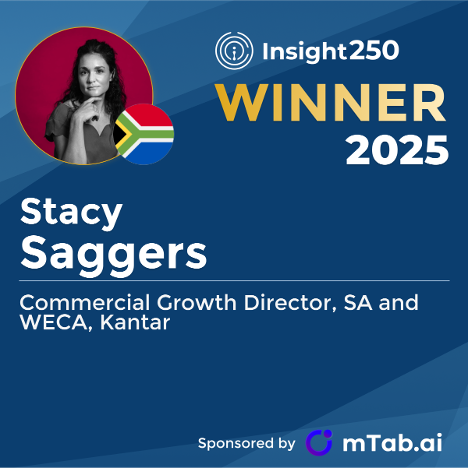
With insights advancing at an incredible pace and the value of insights ever increasing, I sat down with Insight250 Winner Stacy Saggers. As Commercial Growth Director, SA and WECA for Kantar, Stacy runs two podcasts, presents at industry events such as IMC and also runs the business development teams in both SA and WECA. Previously, she held strategic roles with Phillip Morris and Unilever.
Crispin: What makes the 2026 edition feel different, and why is this moment significant?
SS: What feels fundamentally different in 2026 is the depth of pressure. We ask consumers to rate themselves on a gut feel scale of "I'm hungry and don't know where my next meal is coming from" to "I can cover my and my family's meals but there isn't enough to pay for other expenses" to "I can cover food and expenses but it’s very tough" to "I can cover all my expenses without worry.”
This year, the percentage of people who are only able to cover food moved from 18% to 26%, while those who are "not stressed" moved from 43% to 38%. The Marketing All Product Survey (MAPS) confirms this sentiment with a sharp increase from 42% to 47% of people at a national level, noting that they are worried about how they will pay for groceries.
This isn’t just “times are tough”, we’re seeing households having to fundamentally renegotiate how they live, how they prioritise, and how they show up in the world. The level of financial strain is unprecedented in our data, and it’s forcing much more permanent behavioural and identity shifts.
At the same time, access to tools, information and increasingly AI is accelerating consumer capability. So you have this very unusual moment where consumers are under more pressure than we’ve ever seen, but also more informed and more empowered than ever before.
That combination makes this an interesting moment, where the rules of engagement for brands are being rewritten in real time.
Crispin: How can consumers be constrained, considered and empowered at the same time?
SS: It sounds contradictory, but it’s exactly what’s happening.
● Constrained: incomes are stretched, costs are rising, and consumers are making hard trade-offs every day.
● Considered: those trade-offs are deeply intentional. Consumers are thinking harder, comparing more, and evaluating what really matters.
● Empowered: they have more access to information, tools, and now AI-driven recommendations than ever before.
The tension point means that consumers are no longer passive recipients of brand messaging; they are active decision-makers strongly influenced by AI recommendations for brand solutions. And that means brands don’t just need to be seen or known; they need to justify their choice every single time they’re chosen.
Crispin: Financial pressure is reshaping identity, not just behaviour. What does that mean?
SS: Behaviour is what people do. Identity is who they believe they are.
Historically, financial pressure has shown up as temporary behavioural shifts; trading down, buying less, switching brands. But what we’re seeing now is deeper: people are redefining what success, aspiration, and self-expression look like.
Instead of “I buy premium to signal success,” it becomes “I am someone who makes smart, considered decisions.”
Instead of consumption as status, we’re seeing resourcefulness becoming a badge of identity.
That’s a profound shift, because once identity changes, the old playbooks around aspiration and premium cues start to lose their power.
Crispin: How is youth unemployment shaping identity and aspirational cues?
SS: Youth unemployment is a defining force, and it’s reshaping aspiration in very tangible ways.
For many younger consumers, traditional pathways to success are no longer options. So aspiration is becoming:
● More self-directed (entrepreneurial, side hustles, building something yourself)
● More digital-first (leveraging platforms, content, reach)
● Less tied to traditional markers of success like formal employment or legacy brands
What’s important for brands to understand is that aspiration hasn’t disappeared, it’s being reframed to be less about "arrival” and more about agency, the choice to navigate, adapt and create opportunity despite constraints.
Crispin: Is the shift away from traditional premium cues permanent or cyclical?
SS: It’s both, but there are structural elements that will endure. Yes, some behaviours will ease if economic pressure lifts. But the reframing of value and identity is more permanent.
Once consumers have learned:
● How to access alternatives
● How to compare more effectively
● How to make decisions on their own terms
They don’t simply “go back.” So premium doesn’t disappear, but it does become redefined to be less about price or status, and more about meaningful difference and justification of choice.
Crispin: What does “value as a system” look like?
SS: Consumers are no longer evaluating value on a single dimension like price.
They are running a more complex, multi-dimensional calculation that include:
● Functional value: does it work, is it worth it, does it last?
● Emotional value: does it feel right, reduce stress, deliver confidence?
● Social value: does it say something about me, fit my world, align with my identity?
And crucially, they are balancing these against each other.
So a cheaper product isn’t always better if it fails emotionally or socially, and a more expensive one isn’t justified unless it delivers clearly across multiple dimensions.
That’s why we describe value as a system; because it’s dynamic, contextual, and constantly evaluated.
SS: How much harder is it for established brands to hold their position?
Significantly harder. Barriers to entry have dropped, product innovation is more accessible, and consumers are more open to switching brands than ever before.
That means established brands can’t rely on legacy equity alone.
The opportunity, though, is significant for brands that get it right:
● those that deliver clear, consistent value across the system
● those that are easy to find, easy to evaluate, easy to trust
● and those that show up meaningfully across the full consumer journey
Growth comes from earning relevance continuously, not from past positioning.
Crispin: What does the rise of AI for brand recommendations tell us?
It tells us that the way brand equity is built is fundamentally shifting. The number one reason that South Africans use AI is for brand recommendations.
For brands this is a fundamental point, it means that salience is no longer about blasting the media budget on a billboard or on our socials. Its about being findable by AI. Equity is less controllable by brands since it isnt built via communication, it is built via the access points that AI draws from such as reviews, ratings, availability, consistency of experience.
Crispin: How should marketers respond to delegated trust in AI?
SS: This is one of the biggest shifts we’re seeing.
When two-thirds of consumers trust AI recommendations, they are effectively outsourcing decision-making. Marketers need to respond in three ways:
1. Strengthen the fundamentals: product quality, delivery, consistency
2. Manage their data footprint: ensure accurate, rich, and brand-aligned signals across platforms
3. Think beyond campaigns: because campaigns don’t directly feed these recommendation systems in the same way experience and signals do
It’s a shift from managing perception to managing reality at scale.
Crispin: What practical steps can marketers take in spaces they don’t own?
There are three practical priorities:
● Audit your ecosystem: Understand where and how your brand shows up; reviews, listings, maps, platforms. Kantar has a product to assist with this very thing.
● Actively manage signals: Respond to reviews, fix inconsistencies, ensure accurate information
● Design for difference in experience: Because meaningful difference now travels through real-world interactions, not just messaging
You may not own the space, but you can absolutely influence what exists within it.
Crispin: How has your view of commercial growth evolved?
SS: In the past we have often framed commercial growth quite narrowly as revenue, pipeline and conversion. What I’ve come to see is that sustainable growth is fundamentally about meaningful difference which translates into commercial growth.
Meaningful difference is built through:
● Understanding consumers deeply
● Responding to what really matters to them
● Continuously evolving how you show up
Insight isn’t an input into growth; it’s the engine of it.
Because if you’re not grounded in what’s changing in people’s lives, you’re optimising against the wrong reality.
Crispin: What is the single most important thing marketers should do differently?
SS: Stop thinking about value as something you communicate, and start thinking about it as something you prove. In a world where consumers are more constrained, more considered, and increasingly supported by AI:
● Every gap gets exposed
● Every inconsistency gets amplified
● Every claim gets tested
The brands that will win are the ones that:
● Deliver value across the full system
● Show up consistently across every touchpoint
● Earn trust in ways that go far beyond advertising
Because in 2026, consumers aren’t just choosing brands, they’re validating them. Now is not the time for marketers to be lazy.
Crispin:
Thank you, Stacy. The framing of value as a system rather than a single dimension genuinely reframes how I think about what brands owe their customers right now. And your observation that consumers are no longer just choosing brands but actively validating them feels like the sharpest possible summary of the moment we are all navigating. The data you shared on the scale of financial strain in South Africa, and the permanence of the identity shifts that are following in its wake, should be required reading for any marketer still operating from a pre-2024 playbook. The insights industry exists precisely to surface truths like these, and conversations like ours remind me why that work has never mattered more.
Crispin Beale
Chairman at QuMind, CEO at Insight250, Senior Strategic Advisor at mTab, CEO at IDXCrispin Beale is a marketing, data and customer experience expert. Crispin spent over a decade on the Executive Management Board of Chime Communications as Group CEO of leading brands such as Opinion Leader, Brand Democracy, Facts International and Watermelon. Prior to this Crispin held senior marketing and insight roles at BT, Royal Mail Group and Dixons. Crispin originally qualified as a chartered accountant and moved into management consultancy with Coopers & Lybrand (PwC). Crispin has been a Board Director (and Chairman) of the MRS for nearly 20 years and UK ESOMAR Representative for c15 years. As well as being CEO of Insight250, Crispin is currently Worldwide CEO of Digital Communications Solution Agency, IDX. Crispin is also the Senior Strategic Advisor at mTab and the Chairman of QuMind and spent 4 years as Group President of Behaviorally where he was responsibile for the client & commercial teams globally. Crispin is a passionate advocate for blending human intelligence and technology to deliver innovation and leadership across organisations.
Article series
Insight250
- The importance of business sense in research
- The role of humour in effective leadership
- The importance of ethics
- The importance of disruption in innovation and leadership
- The importance of Disruption in Innovation and Leadership Part 2
- The importance of Diversity & Inclusion
- The impact of colour
- Communicating insight with impact
- Insights on leadership, culture and polling
- The evolution of electric vehicles
- 2022 Top tips (part 1)
- 2022 Top tips (part 2)
- Maximising the potential of data
- The importance of flexible working
- Winners
- The importance of advanced analytics
- Judges for the 2022 Insight250 Awards announced
- The evolution from social listening to digital intelligence
- The Judges' Perspective
- The judge's perspective - part 2
- Insight Climate Collective
- Insights technology
- Understanding employee ownership
- Global insight perspectives
- Top Tips from our Leaders and Innovators
- The Evolution of Insights in the Food & Beverage Market
- The Evolution of Insights in CPG
- Neural Mechanisms Behind Consumer Decision-Making
- Celebrating and Elevating the Insights Industry
- The State of the Insights Industry
- Opportunities, challenges and threats that AI presents
- 2024 Insight250 Winners Announcement
- Connecting Brands and Consumers Through Insights
- The Importance of Human Insight and Attention
- The Elevating Role of Insights with Technology Innovation
- Haleon’s Insight Expert on Consumer Healthcare
- Insight from the Insight250: How AI is Impacting Qualitative Research
- How AI Tech is Doing the ‘Heavy Lifting’ for Insights
- Reviewing the top tips for 2025
- Google's Sarah Ashley on AI and revolutionising insights - Insights from the Insight250
- Beyond BI: The Future of Decision Intelligence for Insight Professionals
- The Advancement & Impact of Insights - An Insight250 Winners Series perspective with David Smith
- International Jury for the 2025 Insight250 Awards Announced
- Newly elected President, Anne-Sophie, on Revolutionizing the Impact of Insights
- Haleon's Litthya Baez on Enhancing Healthcare with Insights - Insight250 Winners Series
- Understanding the Insights of Consumer Decisions
- Moving Beyond Dashboards to Deliver Decisions with AI
- How AI is Transforming Insights
- How AI is Transforming Insights
- Five Years of Insight250: Elevating the Insight Industry