Simplifying the Impact of Insights in Increasingly Complex Markets
The Insight250 spotlights and celebrates, annually, 250 of the world’s premier leaders and innovators in market research, consumer insights, and data-driven marketing.

Article series
Insight250
- The importance of business sense in research
- The role of humour in effective leadership
- The importance of ethics
- The importance of disruption in innovation and leadership
- The importance of Disruption in Innovation and Leadership Part 2
- The importance of Diversity & Inclusion
- The impact of colour
- Communicating insight with impact
- Insights on leadership, culture and polling
- The evolution of electric vehicles
- 2022 Top tips (part 1)
- 2022 Top tips (part 2)
- Maximising the potential of data
- The importance of flexible working
- Winners
- The importance of advanced analytics
- Judges for the 2022 Insight250 Awards announced
- The evolution from social listening to digital intelligence
- The Judges' Perspective
- The judge's perspective - part 2
- Insight Climate Collective
- Insights technology
- Understanding employee ownership
- Global insight perspectives
- Top Tips from our Leaders and Innovators
- The Evolution of Insights in the Food & Beverage Market
- The Evolution of Insights in CPG
- Neural Mechanisms Behind Consumer Decision-Making
- Celebrating and Elevating the Insights Industry
- The State of the Insights Industry
- Opportunities, challenges and threats that AI presents
- 2024 Insight250 Winners Announcement
- Connecting Brands and Consumers Through Insights
- The Importance of Human Insight and Attention
- The Elevating Role of Insights with Technology Innovation
- Haleon’s Insight Expert on Consumer Healthcare
- Insight from the Insight250: How AI is Impacting Qualitative Research
- How AI Tech is Doing the ‘Heavy Lifting’ for Insights
- Reviewing the top tips for 2025
- Google's Sarah Ashley on AI and revolutionising insights - Insights from the Insight250
- Beyond BI: The Future of Decision Intelligence for Insight Professionals
- The Advancement & Impact of Insights - An Insight250 Winners Series perspective with David Smith
- International Jury for the 2025 Insight250 Awards Announced
- Newly elected President, Anne-Sophie, on Revolutionizing the Impact of Insights
- Haleon's Litthya Baez on Enhancing Healthcare with Insights - Insight250 Winners Series
- Understanding the Insights of Consumer Decisions
- Moving Beyond Dashboards to Deliver Decisions with AI
- How AI is Transforming Insights
- How AI is Transforming Insights
- Five Years of Insight250: Elevating the Insight Industry
The Insight250 spotlights and celebrates, annually, 250 of the world’s premier leaders and innovators in market research, consumer insights, and data-driven marketing. The awards have created renewed excitement across the industry whilst strengthening the connectivity of the market research community. Winners of the 2025 Insight250 were announced last September - you can see the full list of Winners, and those from previous years, at Insight250.com. You can also nominate for 2026.
With so many exceptional professionals named to the Insight250, we regularly tap into their expertise and unique perspectives across various topics. This regular series does just that: inquiring about the expert perspectives of many of these individuals in a series of short topical features.
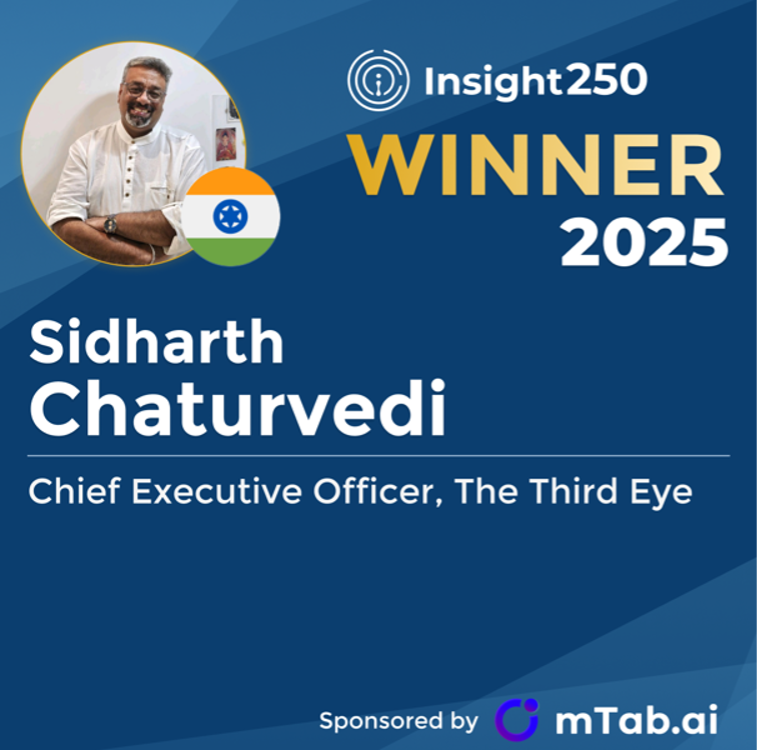
With insights advancing at an incredible pace and the value of insights ever increasing, I sat down with Insight250 Winner Sidharth Chaturvedi. As CEO of The Third Eye, Sidharth partners brands like ITC Foods, Coca-Cola India, GSK, HT and Horlicks by using insights and consumer psychology, culture, and semiotics. He's been a qualitative research professional since 2007.
Crispin: You have described agility in insights as being as much about discernment as about speed. What do you mean by that — and why does the distinction matter so much right now?
SC: I think the industry has started using “agility” and “speed” as if they mean the same thing. They do not. Speed is velocity. Agility is judgment. It is knowing what kind of thinking a business decision actually requires.
There is a version of a meal you can make in 45 minutes with instant seasoning, precooked meats/rice and ready-made breads. It can be flavourful, satisfying and exactly right for a busy weekday. There is also a version that takes hours in a slow-cooked pot, made for a Sunday gathering where the meal itself is the occasion. Both are valid. Both do the job. But different jobs. The skill is in knowing which one the moment calls for.
Research works the same way.
Some questions need rapid directional signals. Others need immersion, cultural decoding, and more patient interpretation. The problem begins when we ask for the Sunday version on Tuesday, at Tuesday night's cost.
That distinction matters more now because AI and automation have made speed dramatically more accessible. But faster processing is not the same as better understanding. The future of agile insighting is not about moving fast all the time. It is about knowing when speed is enough, when depth is necessary, and what level of truth the business decision actually deserves.
Crispin: The push for faster, always-on research has been gathering pace for years. At what point does compressing timelines start to compress the quality of the thinking?
SC: Timelines start compressing thinking when there is no space left for interpretation. Speed itself is not the enemy. However, poorly designed speed is. A sharp, focused sprint can be extremely valuable. But when every stage of the process is squeezed — the brief, the fieldwork, the synthesis, the debate - what disappears first is meaning behind the data. The data is still very much alive and kicking.
That is when research becomes overly literal. We report what people said, but do not fully examine what they meant. We identify a pattern, but do not ask whether it is temporary, structural, performative or commercially meaningful. Always-on systems are useful as sensing mechanisms. They tell us where movement is happening. But they should not be mistaken for meaning machines. Continuous visibility is not the same as continuous insight.
If the cost of being wrong is low, speed may be the right answer. If the cost is strategic, i.e., a brand repositioning, a cultural bet, a major innovation, or a new consumer segment, that is when compression can become expensive.
Crispin: Not every business question deserves the same research response. How should insights leaders develop the judgment to know when speed is the right tool and when it is not?
SC: Insights leaders need to treat research design less as a procurement or a calendar decision and more as a judgment call. The first question often asked is now “How fast can we do this?” or “What methodology fits the budget?” It should actually be: “What kind of uncertainty are we dealing with?” Some uncertainty is executional. Which pack is working better? Is the message clear? Are consumers reacting positively to a feature? These often need speed, iteration and directionality. Other uncertainty is strategic. What does this category mean in people’s lives? Why is a brand losing relevance? What is changing in the consumer’s relationship with beauty, health, masculinity, trust or aspiration? These need a different kind of attention.
The discernment I have referred to earlier is in distinguishing between decisions that are reversible and decisions that are foundational. A lot of poor research happens because the wrong standard of evidence is applied to the wrong kind of question. We either over-engineer what only needed a quick signal or under-invest in questions that needed real depth.
Crispin: You have spent nearly two decades working at the intersection of culture, semiotics and consumer psychology, particularly in the Indian market. How does cultural complexity challenge the “faster is better” assumption that dominates so much of the global research conversation?
SC: India is actually a very useful corrective to the idea that faster always means better. It is a market where scale does not automatically create clarity. Very often, scale produces more variation, more tension and more competing meanings. A behaviour that signals progress in one region may signal status in another, rebellion in another, and basic dignity somewhere else. This is why I would reword your phrasing of cultural complexity, challenging faster is better. It actually does not. Cultural complexity disciplines speed.
Fast systems can tell us what is moving. But culture helps us understand what that movement means. In India, categories rarely operate only at a functional level. Food is about care, purity, status and memory. Beauty is about confidence, morality, aspiration and scrutiny. Health is about the body, but also duty, fear, productivity and family. If we read only the visible behaviour, we miss the invisible burden of meaning around it.
This is where semiotics and cultural insight become commercially important. They prevent us from mistaking visibility for significance.
Crispin: Third Eye was founded on the idea that great insights require tracking the consumer from the physical to the emotional. How has that philosophy held up as AI and automation have entered the picture?
SC: AI has not weakened our belief in tracking consumers from the physical to the emotional. It has made that belief more important. The physical layer is what people do: what they buy, watch, click, use, reject, or repeat. AI is already very strong at reading this layer at scale. That is hugely valuable. But the emotional layer asks a different question: what is this behaviour doing for the person?
Is it giving them control? Belonging? Escape? Status? Relief? Permission? A sense of modernity? A way to manage guilt? That is where human interpretation still matters deeply.
The mistake is to assume that once behaviour is visible, meaning is obvious. It rarely is. The same action can carry very different emotional meanings depending on culture, life stage, region, class, gender or category.
For us, the enduring value of insight lies in moving from action to motive, from pattern to meaning, from consumer as respondent to consumer as human being. AI can accelerate the journey. But it cannot remove the need for that journey.
Crispin: There is a growing risk that AI-generated insights optimise for pattern recognition at the expense of contradiction, nuance and emotional texture. How real is that risk — and what should organisations be doing about it?
SC: The risk is real, but it is not that AI will simply produce bad insights.The greater risk is that AI produces plausible insights too quickly. A well-written summary can create the feeling that understanding has happened. But pattern recognition and meaning-making are not the same thing. Most AI systems are designed to find coherence. But some of the most valuable insight work begins where coherence breaks down: when consumers hesitate, contradict themselves, borrow language they do not fully believe, or behave in ways that do not match their stated values. Organisations should therefore be deliberate about where AI sits in the process.
Use AI to accelerate sensing, sorting, summarising and synthesis. But do not outsource the judgment of what matters. AI can make insight teams faster. But without interpretive discipline, it can also make them prematurely certain.
Crispin: India is one of the world’s most complex consumer environments, layered with contradiction, regional variation and rapidly shifting aspirations. What has working in that context taught you about what rigorous insighting actually requires?
SC: Working in India teaches you that rigour is not the same as volume. Rigour is not just about asking more questions, adding more cities or producing heavier decks. It is the discipline of understanding behaviour in context. India forces that discipline because the market rarely gives you one clean answer. The same consumer can be value-conscious in one category and highly indulgent in another – we have met youngsters willing to extend their budget for a ticket to a concert but equally easily downtrade on a 10 Re beverage. A household can be conservative in one decision and experimental in another.
Rigorous insight requires three things: contextual intelligence, interpretive humility and the ability to sit with tension without rushing to simplify it. That last part is critical. In many markets, especially India, tension is not a flaw in the data. It is often the evidence of change.
Crispin: Insights functions are under constant pressure to demonstrate commercial relevance and speed of delivery. How do you make the case for depth and immersion to a client or stakeholder who just wants a fast answer?
I rarely argue for depth in abstract terms anymore. That argument is also unfair and lopsided. Clients are under genuine pressure. They need speed, efficiency and commercial relevance. So the better conversation is not “Why is depth important?” It is: “What kind of mistake are we trying to avoid?”
Depth helps separate a temporary reaction from a durable shift. It helps distinguish what people say for social performance from what actually guides behaviour. It helps reveal whether a trend is merely visible or genuinely meaningful. But depth also needs discipline. It should not become an excuse for bloated research. Sometimes depth comes from sharper framing, better immersion, more experienced interpretation and tighter synthesis and not from longer timelines.
The point is not to defend slow research. The point is to match the level of understanding to the consequence of the decision.
Crispin: What does genuinely agile insighting look like in practice, not just in terms of timelines, but in terms of how teams are structured, how briefs are written and how findings are communicated?
SC: Genuinely agile insighting does not look like a plan for doing everything faster. It has to look like a plan for removing unnecessary drag from thinking. It starts with better briefs. A lot of research inefficiency begins because organisations pack too many questions into one project. Agile briefs are sharper. They ask: What decision needs to be made?
What do we already know? What level of confidence is required? What would actually change after this work?
Second, teams executing agile research need a range. Not every problem needs the same machinery. Some need rapid testing. Some need continuous sensing. Some need cultural immersion. Some need semiotic decoding. The mistake is forcing every question through one standardised system.
Third, communication has to become more decisive. Agile insight cannot end in a 100-slide information dump. It must clarify what matters, what is uncertain, what the business should act on now, and what needs further depth. For us, agility does not translate to the compression of every process. We see it as a systematic and intelligent prioritizing (and deprioritizing) of effort.
Crispin: Looking ahead, what will the next generation of insights leaders need to do differently to ensure that the profession does not sacrifice its strategic value on the altar of speed?
If insights leaders compete only on speed, there will always be a faster tool. Their enduring value will come from helping businesses understand which human shifts matter, which do not, and where to place intelligent bets. Future insights leaders will need to become stronger at framing problems, not just answering briefs. They will need to understand culture, language, symbolism, category meaning and human motivation because the obvious answers will increasingly be automated.
They will also need the courage to qualify certainty and to be able to say: this pattern is visible but not yet stable, this trend is loud but shallow, this behaviour is growing, but its meaning is still unclear. And most importantly, this question needs more than a quick answer. That kind of judgment may feel uncomfortable in organisations that reward speed and confidence. But it is exactly where strategic value lies.
Hot Topic: As AI accelerates the pace of analysis and automation reshapes how research is conducted, is the insights industry in danger of becoming very good at answering questions quickly but less and less capable of asking the right ones?
SC: AI is making it much easier to generate answers, summaries and implications at scale. That is a major opportunity. But the quality of any answer is still limited by the quality of the question that produced it. The danger is that insight functions become more efficient but less curious. When organisations are obsessed with speed, research can become overly reactive. It answers the questions already in the system: Is this working? Which option is better? What are people saying?
Those are useful questions, but they are not always transformative ones. AI can absolutely help researchers ask better questions, but only if we use the time saved for thinking, not just for producing more outputs. In a world overflowing with answers, original questions will become a strategic advantage.
Top Tip: If you could give one piece of advice to an insights leader trying to protect depth and strategic rigour in a world that keeps asking for faster and cheaper, what would it be? And what would your top tip be for the next generation of researchers and insight professionals entering the profession today?
SC: In one sentence, it would be - Protect interpretation time as fiercely as delivery timelines. Use agile tools and principles of speed where it works best, in parts of the process that merit compression. Leverage these so that you can build time for synthesis, debate and judgment. For the next generation of researchers, my advice would be: Learn the tools, of course. Use AI well. Understand data. But do not confuse capability with craft.
Study people, culture, language, rituals, symbols, silences, anxieties, aspirations and everyday behaviour. Learn to observe what people do before they explain it. Learn to hear what sits beneath what they say.
The future researcher’s value is not because they can collect answers at the speed of light. That is short-term and myopic – a tool will always do it faster and at scale. The truly valuable researcher of the future will be the one who knows what to make of all that is collected.
Crispin: Thank you, Sidharth, for sharing your deep expertise on the insights and particularly its application to the complex markets, like those across India innovations. It’s been fantastic to hear your thoughts on the state of the insights and how innovation will continue to play a leading role in evolving our industry.
Crispin Beale
Chairman at QuMind, CEO at Insight250, Senior Strategic Advisor at mTab, CEO at IDXCrispin Beale is a marketing, data and customer experience expert. Crispin spent over a decade on the Executive Management Board of Chime Communications as Group CEO of leading brands such as Opinion Leader, Brand Democracy, Facts International and Watermelon. Prior to this Crispin held senior marketing and insight roles at BT, Royal Mail Group and Dixons. Crispin originally qualified as a chartered accountant and moved into management consultancy with Coopers & Lybrand (PwC). Crispin has been a Board Director (and Chairman) of the MRS for nearly 20 years and UK ESOMAR Representative for c15 years. As well as being CEO of Insight250, Crispin is currently Worldwide CEO of Digital Communications Solution Agency, IDX. Crispin is also the Senior Strategic Advisor at mTab and the Chairman of QuMind and spent 4 years as Group President of Behaviorally where he was responsibile for the client & commercial teams globally. Crispin is a passionate advocate for blending human intelligence and technology to deliver innovation and leadership across organisations.
Article series
Insight250
- The importance of business sense in research
- The role of humour in effective leadership
- The importance of ethics
- The importance of disruption in innovation and leadership
- The importance of Disruption in Innovation and Leadership Part 2
- The importance of Diversity & Inclusion
- The impact of colour
- Communicating insight with impact
- Insights on leadership, culture and polling
- The evolution of electric vehicles
- 2022 Top tips (part 1)
- 2022 Top tips (part 2)
- Maximising the potential of data
- The importance of flexible working
- Winners
- The importance of advanced analytics
- Judges for the 2022 Insight250 Awards announced
- The evolution from social listening to digital intelligence
- The Judges' Perspective
- The judge's perspective - part 2
- Insight Climate Collective
- Insights technology
- Understanding employee ownership
- Global insight perspectives
- Top Tips from our Leaders and Innovators
- The Evolution of Insights in the Food & Beverage Market
- The Evolution of Insights in CPG
- Neural Mechanisms Behind Consumer Decision-Making
- Celebrating and Elevating the Insights Industry
- The State of the Insights Industry
- Opportunities, challenges and threats that AI presents
- 2024 Insight250 Winners Announcement
- Connecting Brands and Consumers Through Insights
- The Importance of Human Insight and Attention
- The Elevating Role of Insights with Technology Innovation
- Haleon’s Insight Expert on Consumer Healthcare
- Insight from the Insight250: How AI is Impacting Qualitative Research
- How AI Tech is Doing the ‘Heavy Lifting’ for Insights
- Reviewing the top tips for 2025
- Google's Sarah Ashley on AI and revolutionising insights - Insights from the Insight250
- Beyond BI: The Future of Decision Intelligence for Insight Professionals
- The Advancement & Impact of Insights - An Insight250 Winners Series perspective with David Smith
- International Jury for the 2025 Insight250 Awards Announced
- Newly elected President, Anne-Sophie, on Revolutionizing the Impact of Insights
- Haleon's Litthya Baez on Enhancing Healthcare with Insights - Insight250 Winners Series
- Understanding the Insights of Consumer Decisions
- Moving Beyond Dashboards to Deliver Decisions with AI
- How AI is Transforming Insights
- How AI is Transforming Insights
- Five Years of Insight250: Elevating the Insight Industry