The Coherence Gap: Why Insights Fail And What to Do About It
The Insight250 spotlights and celebrates, annually, 250 of the world’s premier leaders and innovators in market research, consumer insights, and data-driven marketing.

Article series
Insight250
- The importance of business sense in research
- The role of humour in effective leadership
- The importance of ethics
- The importance of disruption in innovation and leadership
- The importance of Disruption in Innovation and Leadership Part 2
- The importance of Diversity & Inclusion
- The impact of colour
- Communicating insight with impact
- Insights on leadership, culture and polling
- The evolution of electric vehicles
- 2022 Top tips (part 1)
- 2022 Top tips (part 2)
- Maximising the potential of data
- The importance of flexible working
- Winners
- The importance of advanced analytics
- Judges for the 2022 Insight250 Awards announced
- The evolution from social listening to digital intelligence
- The Judges' Perspective
- The judge's perspective - part 2
- Insight Climate Collective
- Insights technology
- Understanding employee ownership
- Global insight perspectives
- Top Tips from our Leaders and Innovators
- The Evolution of Insights in the Food & Beverage Market
- The Evolution of Insights in CPG
- Neural Mechanisms Behind Consumer Decision-Making
- Celebrating and Elevating the Insights Industry
- The State of the Insights Industry
- Opportunities, challenges and threats that AI presents
- 2024 Insight250 Winners Announcement
- Connecting Brands and Consumers Through Insights
- The Importance of Human Insight and Attention
- The Elevating Role of Insights with Technology Innovation
- Haleon’s Insight Expert on Consumer Healthcare
- Insight from the Insight250: How AI is Impacting Qualitative Research
- How AI Tech is Doing the ‘Heavy Lifting’ for Insights
- Reviewing the top tips for 2025
- Google's Sarah Ashley on AI and revolutionising insights - Insights from the Insight250
- Beyond BI: The Future of Decision Intelligence for Insight Professionals
- The Advancement & Impact of Insights - An Insight250 Winners Series perspective with David Smith
- International Jury for the 2025 Insight250 Awards Announced
- Newly elected President, Anne-Sophie, on Revolutionizing the Impact of Insights
- Haleon's Litthya Baez on Enhancing Healthcare with Insights - Insight250 Winners Series
- Understanding the Insights of Consumer Decisions
- Moving Beyond Dashboards to Deliver Decisions with AI
- How AI is Transforming Insights
- How AI is Transforming Insights
- Five Years of Insight250: Elevating the Insight Industry
The Insight250 spotlights and celebrates, annually, 250 of the world’s premier leaders and innovators in market research, consumer insights, and data-driven marketing. The awards have created renewed excitement across the industry whilst strengthening the connectivity of the market research community. Winners of the 2025 Insight250 were announced last September - you can see the full list of Winners, and those from previous years, at Insight250.com. You can also nominate for 2026.
With so many exceptional professionals named to the Insight250, we regularly tap into their expertise and unique perspectives across various topics. This regular series does just that: inquiring about the expert perspectives of many of these individuals in a series of short topical features.
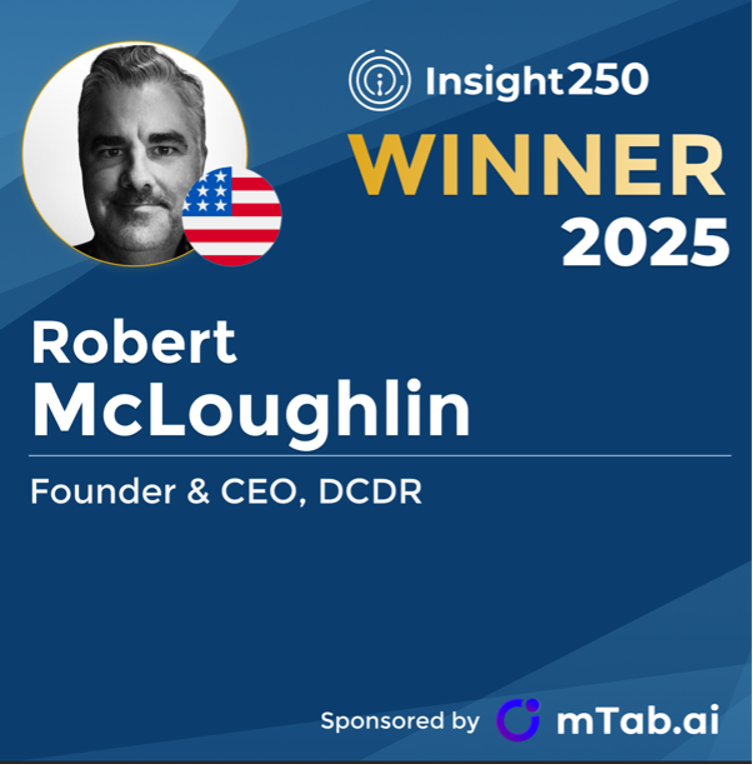
With insights advancing at an incredible pace and the value of insights ever increasing, I sat down with Insight250 Winner Rob McLoughlin. Rob is a seasoned professional with over two decades in market research and consumer insights. He has led teams at DoubleClick, AOL, and PopSugar, consistently pushing the boundaries of data-driven digital marketing. Now, he is the Founder of DCDR, an insights and innovation consultancy. He also regularly contributes to industry publications and is a frequent conference speaker.
Crispin: You describe the Coherence Gap as the invisible distance between what the data says and what the organisation actually does. How do you know when you are looking at a Coherence Gap rather than simply a bad decision, and what are the tell-tale signs that an insights function is suffering from one?
RM: The distinction comes down to pattern versus event. A bad decision is an individual event: the data was available, it was misread or misweighted, and the organization can move on and survive the blowback. A Coherence Gap is systemic. The same signals surface repeatedly, the same conclusions are drawn, and yet behavior remains unchanged. It is the persistence of misalignment, not the presence of a single error, that defines it.
Within an insights function, the warning signs tend to cluster in three areas. First, signal dilution. As research moves upward, it gets progressively softened. Challenging verbatims are dismissed as “unrepresentative,” and uncomfortable findings are reframed until what reaches decision-makers is a version of the truth that aligns with existing strategy. The sharper the insight, the more likely it is to be blunted.
Second, anticipatory self-censorship. Insights teams begin editing before they present, shaping findings to avoid friction rather than provoke action. This is usually learned behavior: when difficult conversations consistently fail to produce change, teams adapt by making their work easier to accept rather than harder to ignore.
Third, executive distance from the raw signal. Ask senior leaders when they last engaged directly with unfiltered customer input—not a summary, not a deck, but the primary material itself—and the answer is often telling. In organizations with a Coherence Gap, leadership relies heavily on interpreted insight rather than firsthand exposure, which weakens the feedback loop between reality and decision-making.
This is rarely intentional. It is the natural byproduct of a system that, over time, begins to reward internal coherence, decisions that fit the existing narrative, more than responsiveness to external evidence. The result is sometimes less trust in the insight, and often a failure to let insight meaningfully shape action. It’s a pattern I’ve seen repeatedly across organizations, and one I’m exploring in more depth in my upcoming work.
Crispin: The paradox at the heart of your argument is striking — that the insights function has never been more sophisticated, and yet decisions keep getting made without it. Why is sophistication not translating into influence, and is it possible that more rigorous research is actually making the problem worse?
RM: The uncomfortable answer is yes, greater sophistication can actually widen the gap. In fact, we are increasingly living in an age of incoherence: more data, more tools, more analysis, and yet less alignment between what organizations know and what they do. Today, that sophistication extends beyond better methodologies or polished decks to include an explosion of tools, data access, automation, and AI. Insights teams can generate analysis faster, model scenarios more precisely, and produce outputs at unprecedented scale, but increased capability does not automatically translate into increased influence. In fact, when insight becomes abundant, continuous, and highly refined, it is easier for organizations to treat it as background context rather than a trigger for action. AI-generated summaries, dashboards, and predictive models can create the impression that the organization is “on top of the data,” even as the actual decisions remain unchanged.
The underlying issue is that some insights functions have been optimizing for output, now supercharged by tools and AI, rather than impact on decisions. Those are fundamentally different problems. One is about how much and how well you produce; the other is about
whether what you produce actually changes behavior. If the system is not designed to translate evidence into action, then more advanced tools and better analysis do not close the gap, they amplify it. You end up with faster, clearer, more scalable insight that still fails to move decisions. In that context, the failure is systemic. Learning how to make insights matter is the most important modern lesson.
Crispin: You use the phrase coherence drift to describe the process by which insight loses its grip on decision-making over time. What causes it, and at what point in the journey from data to boardroom does the breakdown most commonly occur?
RM: Coherence drift is rarely the result of a decision to ignore the evidence. It’s the result of a hundred small decisions that each made sense at the departmental level. A layer of management summarizes the research report. The summary omits the findings that don’t have immediate strategic implications. The strategic implications that do get surfaced get framed in ways that don’t require immediate response. By the time the signal reaches the boardroom, it has been through so many reasonable editorial passes that it no longer resembles what the data actually showed.
The breakdown most commonly occurs at the translation layer, the point where someone has to convert a research finding into a strategic implication that will be received by people who didn’t read the research and have strong existing views about the strategy. That conversion is where the signal degrades most severely, because the person doing the translation is making rational calculations about what will land, what will require explanation, what will generate resistance. Those calculations are not cynical. They are the ordinary behavior of someone who has learned, through experience, what the culture can absorb. The result is that the most important signals — the ones most at odds with the current story — are exactly the ones most likely to be edited out before they arrive.
Crispin: Decision Intelligence is specifically about building the connective tissue between insight and action rather than producing better data. What does that connective tissue actually consist of — and what does it look like when an organisation has built it well?
RM: The connective tissue consists of a small number of structural shifts that operate at different levels of the organization.
First is structural proximity. The insights function sits inside the decision-making process, not upstream of it. Research is not there to “inform” strategy after the fact; it is part of how strategy is actively tested. That means insights leaders are present where bets are being made, shaping the conversation in real time rather than feeding it from a distance.
Second is explicit hypothesis design. Organizations that do this well treat strategy as a set of testable assumptions. For any meaningful initiative, they define in advance what must be true for it to succeed, what evidence would confirm that, and critically, what evidence would require them to change course. Most organizations evaluate results against a strategy they are already committed to. Strong connective tissue means specifying, upfront, what outcome would actually challenge that commitment.
Third is the presence of protected pathways for raw signals. There are deliberate mechanisms to move unfiltered customer and frontline intelligence directly into decision forums without being diluted along the way. In some cases, this also means aligning decision rights more closely with where that intelligence originates, rather than forcing it through layers designed to summarize rather than transmit.
You know this connective tissue is working when responsiveness becomes asymmetric. Not because the organization is pessimistic, but because it has been designed to make uncomfortable signals safe to surface and consequential when they arrive.
Crispin: There is a risk that Decision Intelligence becomes another piece of consultancy language that means different things to different people. How do you define it precisely enough to make it actionable — and what does it require of researchers that traditional insight work does not?
RM: Decision Intelligence only becomes useful if it is defined in a way that can be tested in practice. At DCDR, I’ve built the work around decisions that move revenue, whether at the executive level or in something as specific as an RFP response or client question. The definition I use is this: Decision Intelligence is the organizational capacity to ensure that what you know, what you measure, and what you consistently do are telling the same story about reality. It is not about producing better knowledge; it is about keeping knowledge and behavior in honest contact with each other. That definition makes it actionable because it can be audited. For any meaningful decision, you can ask three questions: does the stated rationale actually reflect the evidence, is that evidence reaching decision- makers in a form that could change the outcome, and does the final decision align with both, or is it being driven by something else such as incentives, inertia, or legacy commitments?
What this requires of researchers is a shift in accountability. Traditional insight work ends at delivery: the analysis is sound, the story is clear, and what happens next sits with the business. Decision Intelligence extends that responsibility through the decision itself and into its consequences. It requires researchers to take a view on whether evidence is being used well, not just whether it was produced well, and to stay engaged long enough to see how decisions play out. That creates a different kind of professional exposure, but it is also where real influence begins.
Crispin: You work extensively in digital media and content, where organisations are swimming in signals but starved for clarity. What is it about that particular environment that makes the Coherence Gap so acute, and what can other sectors learn from how digital media is trying to close it?
RM: Digital media makes the Coherence Gap especially visible because the signal environment is so dense, immediate, and often contradictory. Engagement metrics point one way, revenue another, brand health a third, and each function builds its own version of reality from the same data. What reaches strategy is typically the version that best fits the narrative already in place. The challenge is compounded by the fact that these organizations are not just data-rich, but identity-rich. They have invested heavily in audience definitions, editorial voices, and platform positions that carry real cultural and commercial weight. When the data begins to describe an audience or behavior that no longer fits that identity, the gap becomes difficult to close because doing so requires evolving the story of the business itself, not just adjusting tactics.
What other sectors can take from this is not the tooling, but the discipline. The organizations that manage this well treat measurement as a way of testing strategy, not just reporting on it. They build explicit feedback loops between what the data shows and what the strategy claims, with a regular expectation that those two things may come into tension. Crucially, when the evidence does force a shift, they do not leave that change implicit. They actively update the corporate or sales narrative and communicate it across the organization so that teams are aligned around a shared, current version of reality. The key shift is moving from asking “are we performing against the plan?” to “does the evidence still support the plan at all?” and then ensuring that any new answer is clearly understood and acted on.
Crispin: Your argument implies that the insights profession needs to reposition itself, from people who report on what the data says to people who fix the gap between data and action. How large is the cultural and skills shift required to make that move — and how many insights professionals are genuinely ready for it?
RM: The shift is significant, and it is cultural as much as it is technical. The traditional compact of the insights function has been clear: be rigorous, stay neutral, surface what is true, and leave the outcome to the business. That model offers a degree of professional protection. If the work is sound and nothing changes, the failure sits elsewhere. It is one reason insights often sit at the back of the deck rather than leading the conversation. It is safe, predictable, and not structurally required to answer the “so what” in a way that drives action. Closing the Coherence Gap requires stepping beyond that protection. It means taking a position on whether evidence is being used well, staying engaged through the decision itself, and accepting a degree of accountability for outcomes, not just outputs. That is a meaningful shift in exposure, and most organizations do not consistently reward it yet. The skills required, such as navigating decision dynamics, understanding how choices actually get made, and recognizing the gap between stated and real priorities, can be developed.
The harder shift is the willingness to use those skills in environments that have historically valued rigor over influence. Many insights professionals are more ready than it might appear. There is a long-standing frustration with seeing strong evidence fail to translate into action, and what has often been missing is not intent but a framework for engaging differently. The more open question is whether organizations are ready to meet them there, because without that, the burden of change sits disproportionately on the insights function.
Crispin: Closing the Coherence Gap requires researchers to engage with organisational dynamics, decision-making processes and internal politics in ways that traditional research training does not prepare them for. What does an insights professional need to learn, or unlearn, to operate effectively in that space?
RM: It starts with unlearning. The most important shift is letting go of the assumption that evidence speaks for itself. It does not. The researcher needs to speak up. Evidence is received by people with existing narratives, incentives, and professional identities tied to the current strategy. When a finding challenges those, it is not processed as neutral information; it can land as a threat. Recognizing that is not cynicism, it is realism about how organizations function. Operating effectively means working with that reality, not expecting better data alone to overcome it.
From there, the key coherence capability is an internal audit: the ability to map where the organization’s story, its information, and its decisions are aligned, and where they are not. That map determines how insight needs to be delivered. Some findings will reinforce what leaders are already prepared to do, others require careful translation into the existing frame, and some are so misaligned with the current narrative that presenting them without context will trigger defensiveness rather than action. Alongside that is a practical understanding of how decisions actually get made, including who holds decision rights, what constraints they operate under, and how to shape evidence into formats that those decision-makers can use. Traditional research optimizes for completeness; operating in this space requires optimizing for consequence.
In practical terms, this requires a blend of skills that sit outside traditional research training: stakeholder navigation, narrative framing, and the confidence to challenge decisions constructively. It also requires judgment about when to push, when to translate, and when to reframe evidence so it can be heard. These are fundamentally about operating effectively within the human organization where decisions actually get made.
Crispin: The insights function is often structurally positioned in organisations in ways that limit its influence, reporting into marketing, sitting away from the C-suite, being brought in after the strategy has already been shaped. How much of the Coherence Gap is a data problem, and how much is an org-chart problem?
RM: In most organizations, the Coherence Gap is far more an org-chart problem than a data problem. More precisely, it is a decision-rights problem. The quality of the data is often higher than the quality of the decisions it informs. The issue is not the evidence itself, but the distance between that evidence and where, and how, decisions are actually made. That distance shows up structurally. Insights teams are frequently positioned to validate decisions rather than shape them. Strategy is set, direction is chosen, and research is brought in to support the narrative rather than test it. This is the gap expressed in architectural form: evidence is made to fit the story, instead of the story adapting to the evidence.
Closing that gap is less about improving research and more about repositioning authority. When decision rights sit closer to where the signal lives, and when insights are embedded early enough to influence direction rather than justify it, the gap narrows naturally. The most effective organizations reflect this structurally, placing insights in proximity to the decision-making core and on equal footing within it. The shift is not about better communication; it is about reducing the distance between knowing and doing.
Crispin: You were recognised as an Insight250 winner in the context of digital media and content intelligence. What is it about that sector specifically that has pushed Decision Intelligence thinking furthest, and what would the broader research industry need to adopt from digital media's approach to measurement and activation?
RM: Digital media has pushed Decision Intelligence further because its feedback loops are fast, continuous, and highly visible. When audience behavior is measured in real time rather than over quarterly cycles, the distance between evidence and decision naturally compresses. That same speed applies to culture itself. Trends emerge, peak, and disappear at a pace that is difficult for research and marketing functions to keep up with, even in an environment with relatively low friction compared to traditional media. The result is a constant tension between the velocity of culture and the organization’s ability to interpret and respond to it coherently.
One practice the broader research industry can adopt is assumption-level measurement. At its best, digital media does not just track performance against a plan; it tests the assumptions behind the plan before and during execution. This includes pre-testing, A/B testing, and pre-launch content effectiveness work that helps estimate impact before going live. The goal is not just to see what works, but to understand why it should work in advance. The challenge is that speed often undermines this discipline. Because content can be launched and iterated quickly, some organizations bypass pre-testing entirely in favor of getting to market faster. Speed begins to replace learning, even though the capability to learn ahead of time exists.
The second is a cultural shift toward rapid narrative revision. The strongest digital organizations treat updating the story as a sign of strength, not inconsistency. When the data changes, the narrative changes with it, and that new narrative is actively shared across the organization so teams stay aligned. In sectors where strategy is tied to slower planning cycles, that kind of adaptability is rare. But without it, the gap between what the data shows and what the organization believes only widens.
Crispin: AI is generating more data, faster, and making it easier than ever to produce sophisticated-looking analysis. If the Coherence Gap exists because organisations cannot absorb and act on the insight they already have, what does flooding them with more AI-generated intelligence actually do to the problem?
RM: It makes the problem worse in a specific and predictable way. The Coherence Gap is not caused by a lack of data as most organizations already have more evidence than their decision-making processes can absorb. AI increases both the volume and velocity of that evidence, including a growing layer of low-quality or generic output often referred to as “slop.” Even when the analysis is high quality, it still enters a system that filters it in the same way: amplifying what supports the existing narrative, discounting what challenges it, and sidelining what creates friction. More intelligence, in that context, does not resolve the gap; it compounds it.
RM: There is also a distinct risk with AI: the appearance of rigor without the friction of inquiry. Human researchers bring discernment, context, and accountability. They can challenge assumptions, hold uncomfortable implications in the room, and sharpen raw findings into stories that decision-makers can actually engage with. AI-generated output, by contrast, can be endlessly reshaped and reframed until it aligns with what the organization already believes, with no inherent resistance. That makes it easier to manage the insight rather than respond to it, unless human expertise actively intervenes to interpret, pressure-test, and elevate it.
This is where coherence becomes critical. It provides a way to test AI-generated outputs against reality by asking whether they remain faithful to the original signal and whether they meaningfully connect to decisions being made. Used well, AI can help surface overlooked patterns and scale analysis, but it needs to be paired with human judgment that can refine the story and ensure it holds together. The role of the researcher shifts from producing analysis to interrogating, refining, and pressure-testing it so that what reaches decision-makers does not just sound right, but drives real change.
Crispin: If the insights industry took the Coherence Gap seriously as a structural problem, not just an individual project failure — what would have to change institutionally, and who would need to lead that change?
RM: Three things would need to change institutionally, and they build on each other.
First, the profession would need to expand its standards to include outcome accountability, not just finding quality. Today, insights work is judged on rigor, clarity, and recommendation strength. It is rarely evaluated on whether those recommendations were acted on, whether the evidence reached the decisions it was meant to influence, or whether behavior actually changed. Until the field measures what happens after delivery, it will continue to optimize for the work itself rather than its impact. Tracking whether insights are used, and why or why not, has to become part of the discipline.
Second, the relationship between insights and decision-making needs to be treated as a design choice, not an org-chart byproduct. Most organizations have not explicitly designed how insight enters decisions, where the function sits, or what authority it has when evidence is being managed rather than used. Making that architecture deliberate, and holding it to a standard of coherence rather than convenience, would materially reduce the gap.
Third, the language and training of the field need to shift from delivery to translation. The defining question is no longer “what does the data say?” but “what would need to change for this to be acted on?” That shift reframes the role from reporting findings to enabling decisions. It requires different skills, different expectations, and a different kind of accountability, and it needs to be reflected in how practitioners are trained, developed, and supported across the industry.
As for who leads it, this change sits in the middle of the organization. It requires leaders who are close enough to the evidence to see what is being filtered out, and senior enough to name it as a structural issue. Senior insights leaders and Chief Research Officers are uniquely positioned to do this. The constraint is less about capability and more about permission. The field has not fully legitimized the idea that this is the problem to solve.
Once it does, those voices become far harder to ignore. It’s one of the reasons I’ve been developing this work more fully, in a book I’ll be releasing later this year.
Hot Topic: Every year, organisations invest billions in market research, analytics and insight generation. And every year, a significant proportion of that investment produces work that is read once, filed, and never acted on. The standard explanation is that insights professionals need to communicate better - tell better stories, make punchier presentations, get closer to the business. But what if the problem is not communication at all? What if organisations are structurally incapable of absorbing insight at the rate it is being produced - and what if the answer is not more or better research, but a fundamentally different relationship between the insights function and the decision-making process?
RM: I believe most organizations do not have a communication problem; they have a coherence problem in what has become an age of incoherence, with more data, more tools, more analysis, and yet less alignment between what they know and what they do. The issue is not that researchers are failing to tell compelling stories, but that the organization is not structurally set up to let evidence change its mind. Incoherent systems treat each project as a self-contained event, so studies are read, filed, and forgotten, and the business loses the compounding value that comes from letting each finding refine or evolve the narrative over time. In a coherent organization, research is cumulative: new work is explicitly connected to prior learning, assumptions are revisited, and each study either strengthens the current story or legitimately updates it, so insight behaves more like compound interest than a series of one-off bets.
Insights functions typically sit upstream from where real bets are made, so research is asked to validate and decorate decisions that have already been taken rather than test their rigor, which reinforces this fragmentation. That creates what I’ve termed the Coherence Gap: the invisible distance between what the data says and what the organization consistently does, reinforced by diluted signals, executive distance from raw evidence, and decision rights that sit far from where the insight lives. In that context, more or better research cannot solve the problem. The answer is a fundamentally different relationship between insight and decision-making, one in which strategy is treated as a set of testable assumptions, unfiltered signals have protected pathways into decision forums, and the accountability of the insights function expands beyond merely reporting results to ensuring that what the organization knows, measures, and does remain in honest, continuous alignment.
Top Tip
What is your top tip for an insights professional who wants to start closing the Coherence Gap in their own organisation, and where should they begin? Stop optimizing for the polish of the answer and start optimizing for the ambition of the question that drives it.
RM: Most Coherence Gap failures are not research failures; they are narrative framing failures. The question is usually shaped by the organization’s existing story, which means the work can only confirm or refine that story, not genuinely challenge it. The most valuable move an insights professional can make is to go upstream, into the moment where the question is defined, rather than focusing only on how the answer is delivered. A well-placed challenge at that stage sharpens how the organization sees reality, helping it stay ahead of shifting markets, respond to emerging competitors, and uncover new opportunities. The organizations that do this well are better at anticipating what is coming, not just explaining what has already happened.
In practical terms, for any significant project, ask three things: who framed the question, what assumptions does it embed, and what findings would actually force a change in direction? If the honest answer is “none,” the work is reinforcing the current strategy, not testing it. That may still be useful, but it is not closing the gap.
My advice is to start small and make it concrete. Take one upcoming project or decision and intervene at the briefing stage. Redefine the question so it creates a real possibility of being wrong, and use a low‑stakes project to visibly demonstrate the benefits of working within a more coherent decision framework. That is where coherence begins.
Crispin: Thank you, Rob for sharing your deep expertise on these fascinating topics and particularly the application to the complex markets, like those across India innovations. It’s been fantastic to hear your thoughts on the state of the insights and how innovation will continue to play a leading role in evolving our industry.
Crispin Beale
Chairman at QuMind, CEO at Insight250, Senior Strategic Advisor at mTab, CEO at IDXCrispin Beale is a marketing, data and customer experience expert. Crispin spent over a decade on the Executive Management Board of Chime Communications as Group CEO of leading brands such as Opinion Leader, Brand Democracy, Facts International and Watermelon. Prior to this Crispin held senior marketing and insight roles at BT, Royal Mail Group and Dixons. Crispin originally qualified as a chartered accountant and moved into management consultancy with Coopers & Lybrand (PwC). Crispin has been a Board Director (and Chairman) of the MRS for nearly 20 years and UK ESOMAR Representative for c15 years. As well as being CEO of Insight250, Crispin is currently Worldwide CEO of Digital Communications Solution Agency, IDX. Crispin is also the Senior Strategic Advisor at mTab and the Chairman of QuMind and spent 4 years as Group President of Behaviorally where he was responsibile for the client & commercial teams globally. Crispin is a passionate advocate for blending human intelligence and technology to deliver innovation and leadership across organisations.
Article series
Insight250
- The importance of business sense in research
- The role of humour in effective leadership
- The importance of ethics
- The importance of disruption in innovation and leadership
- The importance of Disruption in Innovation and Leadership Part 2
- The importance of Diversity & Inclusion
- The impact of colour
- Communicating insight with impact
- Insights on leadership, culture and polling
- The evolution of electric vehicles
- 2022 Top tips (part 1)
- 2022 Top tips (part 2)
- Maximising the potential of data
- The importance of flexible working
- Winners
- The importance of advanced analytics
- Judges for the 2022 Insight250 Awards announced
- The evolution from social listening to digital intelligence
- The Judges' Perspective
- The judge's perspective - part 2
- Insight Climate Collective
- Insights technology
- Understanding employee ownership
- Global insight perspectives
- Top Tips from our Leaders and Innovators
- The Evolution of Insights in the Food & Beverage Market
- The Evolution of Insights in CPG
- Neural Mechanisms Behind Consumer Decision-Making
- Celebrating and Elevating the Insights Industry
- The State of the Insights Industry
- Opportunities, challenges and threats that AI presents
- 2024 Insight250 Winners Announcement
- Connecting Brands and Consumers Through Insights
- The Importance of Human Insight and Attention
- The Elevating Role of Insights with Technology Innovation
- Haleon’s Insight Expert on Consumer Healthcare
- Insight from the Insight250: How AI is Impacting Qualitative Research
- How AI Tech is Doing the ‘Heavy Lifting’ for Insights
- Reviewing the top tips for 2025
- Google's Sarah Ashley on AI and revolutionising insights - Insights from the Insight250
- Beyond BI: The Future of Decision Intelligence for Insight Professionals
- The Advancement & Impact of Insights - An Insight250 Winners Series perspective with David Smith
- International Jury for the 2025 Insight250 Awards Announced
- Newly elected President, Anne-Sophie, on Revolutionizing the Impact of Insights
- Haleon's Litthya Baez on Enhancing Healthcare with Insights - Insight250 Winners Series
- Understanding the Insights of Consumer Decisions
- Moving Beyond Dashboards to Deliver Decisions with AI
- How AI is Transforming Insights
- How AI is Transforming Insights
- Five Years of Insight250: Elevating the Insight Industry