The Skills Insight Professionals Need in the AI Era
The Insight250 spotlights and celebrates, annually, 250 of the world’s premier leaders and innovators in market research, consumer insights, and data-driven marketing

Article series
Insight250
- The importance of business sense in research
- The role of humour in effective leadership
- The importance of ethics
- The importance of disruption in innovation and leadership
- The importance of Disruption in Innovation and Leadership Part 2
- The importance of Diversity & Inclusion
- The impact of colour
- Communicating insight with impact
- Insights on leadership, culture and polling
- The evolution of electric vehicles
- 2022 Top tips (part 1)
- 2022 Top tips (part 2)
- Maximising the potential of data
- The importance of flexible working
- Winners
- The importance of advanced analytics
- Judges for the 2022 Insight250 Awards announced
- The evolution from social listening to digital intelligence
- The Judges' Perspective
- The judge's perspective - part 2
- Insight Climate Collective
- Insights technology
- Understanding employee ownership
- Global insight perspectives
- Top Tips from our Leaders and Innovators
- The Evolution of Insights in the Food & Beverage Market
- The Evolution of Insights in CPG
- Neural Mechanisms Behind Consumer Decision-Making
- Celebrating and Elevating the Insights Industry
- The State of the Insights Industry
- Opportunities, challenges and threats that AI presents
- 2024 Insight250 Winners Announcement
- Connecting Brands and Consumers Through Insights
- The Importance of Human Insight and Attention
- The Elevating Role of Insights with Technology Innovation
- Haleon’s Insight Expert on Consumer Healthcare
- Insight from the Insight250: How AI is Impacting Qualitative Research
- How AI Tech is Doing the ‘Heavy Lifting’ for Insights
- Reviewing the top tips for 2025
- Google's Sarah Ashley on AI and revolutionising insights - Insights from the Insight250
- Beyond BI: The Future of Decision Intelligence for Insight Professionals
- The Advancement & Impact of Insights - An Insight250 Winners Series perspective with David Smith
- International Jury for the 2025 Insight250 Awards Announced
- Newly elected President, Anne-Sophie, on Revolutionizing the Impact of Insights
- Haleon's Litthya Baez on Enhancing Healthcare with Insights - Insight250 Winners Series
- Understanding the Insights of Consumer Decisions
- Moving Beyond Dashboards to Deliver Decisions with AI
- How AI is Transforming Insights
- How AI is Transforming Insights
- Five Years of Insight250: Elevating the Insight Industry
The Insight250 spotlights and celebrates, annually, 250 of the world’s premier leaders and innovators in market research, consumer insights, and data-driven marketing. The awards have created renewed excitement across the industry whilst strengthening the connectivity of the market research community. Winners of the 2025 Insight250 were announced last September - you can see the full list of Winners, and those from previous years, at Insight250.com. The 2026 Insight250 nominations are currently in review.
With so many exceptional professionals named to the Insight250, we regularly tap into their expertise and unique perspectives on a range of topics. This regular series does just that: inquiring about the expert perspectives of many of these individuals in a series of short topical features.
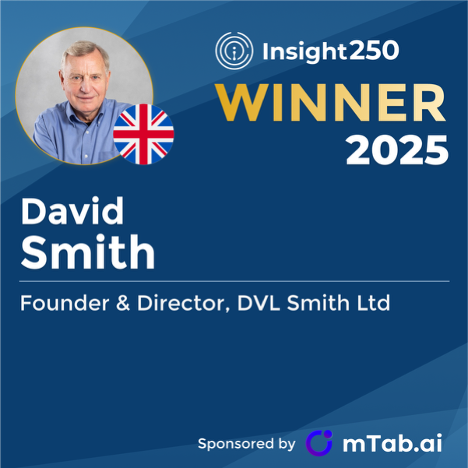
With insights advancing at an incredible pace and the value of insights ever increasing, I sat down with Insight250 Winner David Smith. David is the Founder & Director of DVL Smith, which provides training on insights and analysis. He is also the author of The High Performance Customer Insight Professional and has been awarded the MRS Silver Medal and ESOMAR Excellence in Intelligence Award. He holds a Ph.D. in organizational psychology and is a Professor at the University of Hertfordshire Business School. His achievements include setting up and running a highly successful research agency, writing numerous books on research, more recently on entrepreneurial skills, consulting on a wide range of important topics within the sector, including storytelling and the impact of AI, and public speaking on various research topics. He is also a lecturer, and I recently co-presented with him at Leicester University on careers in Insight and research.
Crispin: We agreed that the theme of our conversation would be the skills insight professionals need to thrive in the AI era. When I asked you about this, your first response was plus ça change, suggesting that the fundamental skills we have always needed are still the ones we need today. That might surprise some people. Could you explain what you mean?
DS: Yes. I think one of the biggest threats facing the insight industry is the argument now coming from some quarters, what we might call the “maximalist case” for AI. This argument says, in effect: let’s settle for an AI-only version of insight. It may only be 70 per cent as good as the version that includes skilled human judgement, but perhaps we should accept that because it is cheaper, faster and good enough in most cases.
To me, that is the slippery slope. It forces us to ask a vital question: what exactly sits in that final 30 per cent? What is the human contribution the maximalists are effectively saying we can do without?
And when I reflected on that, I realised that the skills insight professionals need to bring to powerful human-AI solutions are, in many ways, the same skills outstanding insight professionals have always brought to the party.
The difference is that, in the AI era, we need to make those skills much more explicit, much more valued and much more deliberately practised.
Crispin: So, in a nutshell, how would you summarise these top-end skills, the ones that have always characterised outstanding insight practice and which you are now arguing we need to dial up when working alongside AI?
DS: I would start with contextual sensemaking, the ability to see the big picture panorama. AI can certainly help here, but it is often less good at teasing out the nuances that allow us to pinpoint a genuine insight rather than just produce a summary of evidence.
Then there are our detective-like abductive reasoning skills, the ability to find the best possible explanation when information is incomplete, the situation is complex and there are lots of moving parts. There is also the human ability to generate audacious, creative, renegade solutions in what could become an increasingly samey AI world. Average creativity is now fast and almost free. But truly original thinking still requires that human je ne sais quoi.
Another crucial skill is what I would call mental time travel. Humans can look back into the past, understand what worked and what didn’t, and then carry that learning forward into imaginative future strategies.
AI can analyse historical records, but it does not have our visceral, emotional understanding of what events actually meant to people, or how the best of human endeavour can be carried forward into the future.
Then there is our ability to add compassion, kindness, emotional intelligence, integrity and informed human values to our outputs. And finally, although AI can certainly help us structure and improve business narratives, the ultimate art of telling stories that tap into human emotions remains a quintessentially human skill.
Crispin: That checklist of what insight professionals can do when they bring their A-game to a problem raises another question. Why, as an industry, have we sometimes struggled to get these power skills fully recognised by the C-suite over the last few decades? Without deflecting too far from our main conversation, what are your thoughts on that?
DS: I think it is because, as an industry, we have largely failed to communicate a simple, unifying idea that explains what the insight industry is really about. We have not always communicated our “noble purpose” clearly enough.
This was something I spoke about at the Athens Congress a few years ago, where I argued that we should promote insight professionals as diverse thinkers and modern polymaths, people who collaborate with AI, combine wisdom, compassion, emotional intelligence and human creativity, and use these qualities to unlock powerful insight.
I think my statement went on to say something like: in the AI era, it is the insight industry that can help shape the future of business, government and society through our deep understanding of what it means to be human. That, to me, is a powerful purpose.
Crispin: And how did that go down?
DS: It rather fell on stony ground and never really went anywhere. I feel slightly guilty for not pushing the idea further at the time. I think there is something in the DNA and psyche of the insight industry that says: because we generally do good, solid, valuable work, surely that work will naturally be recognised.
But life does not always work like that.
One of the tough lessons is that communicating what you do is often almost as important as what you actually do. If people do not understand the value you create, they may not recognise it, even when it is right in front of them.
Crispin: So, on a more positive note, do you think there is still an opportunity to communicate the vital importance of these human power skills as part of the human-AI relationship that is now developing?
DS: Absolutely. I think what has become much clearer over the last six months is the importance of amplifying our human skills and capabilities.
We are beginning to recognise that human capability becomes more valuable, not less, as AI gets better. It is interesting that more people are now talking about the new premium on human judgement. There is also much more discussion around metacognition, by which I mean the ability to question the quality of our own thinking while we work alongside AI.
We need to keep asking: when is AI helping us think better, and when might it be narrowing our thinking?
We need to become much more conscious of the kind of thinking we are deploying, and how that thinking can help us get the best from AI without becoming over-dependent on it.
Crispin: So, in summary, you believe the insight industry can still put itself at the centre of high-quality critical and creative thinking?
DS: Absolutely. There is a real opportunity for the insight industry to become a leading voice in explaining that the danger is not AI itself.
The danger is allowing AI to replace critical thought rather than strengthen it. I think we have all learned a lot from the distinction between intelligent cognitive offloading and lazy cognitive surrender.
Cognitive offloading is something to be welcomed. It frees people to spend more time on judgement, interpretation, imagination, ethics and strategic thinking. We can see how aspects of the insight process can be offloaded to AI in this way without threatening the core of our craft.
But cognitive surrender is different. That is the slippery slope. It happens when people stop thinking because AI has produced a convincing facsimile of thinking, something that looks polished and plausible, but may be flawed underneath.
The danger is that these shiny, fluent arguments slip through the net because people are no longer challenging them properly. So why can’t we be the industry that leads the way in helping people practise intelligent cognitive offloading without drifting into cognitive surrender?
Crispin: Is that sweet spot trainable? Can people learn how to use AI for intelligent cognitive offloading without falling into cognitive surrender, while still holding on to those human power skills you outlined earlier?
DS: Yes, I believe they can. But we need to accept that we are entering a new era of thinking, the era of collective intelligence.
This is not just about co-creativity, which is something we have talked about for years. It is a more powerful idea than that. Imagine person A working with ChatGPT, person B working with Claude and person C working with Perplexity, and then all those AI-augmented perspectives being brought into a shared conversation.
That creates a multiplier effect in the way we think. But to make the most of that, we need frameworks that guide the process.
At Polymathmind AI, my colleague Adam Riley and I have developed a six-stage human-AI collaboration process. There will be other approaches, of course, but ours begins with the importance of humans leading with intent. The initial framing must be human.
Then we invite AI into the conversation to widen the aperture and surface blind spots. Next, humans re-enter the process to judge and select. This is one of our key defences against cognitive surrender.
Then we bring AI back in to stress-test our thinking, red-team our assumptions and keep us disciplined. After that, humans commit to a solution, recognising that accountability cannot be outsourced to AI.
Finally, the team reflects on how the interaction has worked, so that we build metacognitive muscle for the future. So yes, I think we are all beginning to learn what it really means to amplify the human advantage in the AI era.
And there may be an important bonus here for the customer insight industry. As the C-suite recognises the need to invest in AI technology, it is also more likely to recognise the need to invest in the advanced human thinking skills required to make AI work well.
That creates a major opportunity for the insight industry. The very power skills we have been discussing — critical thinking, creativity, sensemaking, human judgement and emotional intelligence — could become more visible, more valued and more clearly linked to competitive advantage.
The twist is that we may not see this simply through the preservation of the traditional customer insight function as we have known it. In some organisations, that classic function may shrink or be reshaped. But the higher-order customer insight skillset could become much more widely distributed across the business.
We may see more people wearing strategy, CX, innovation or commercial hats who also fully embrace the customer insight mindset, a mindset rooted in curiosity, critical thinking, creativity and a deep understanding of human behaviour. In that sense, the future of insight may not just be about protecting a department. It may be about spreading the best of insight thinking to the key decision points across the organisation, precisely where amplified human thinking in the AI era can deliver the greatest value.
Crispin: Reflecting on your own career, if you were starting again today with AI in full flow, do you think it would make your life easier or more difficult as a business researcher?
DS: On the upside, AI is absolutely fantastic. It can help us assemble evidence, organise it, call up the mental models that help us reflect on what the evidence is saying, and do all this in a fraction of the time and cost it took in the early days of DVL Smith.
I sometimes think that all those 70-hour weeks I put in to build the business could have been cut back dramatically. But I also have to accept that I built the business in what was, in many ways, a golden age of consultancy.
There was less competition than there is now. It was easier to build personal relationships with clients. We did not have quite the same energy-sapping procurement processes, preferred supplier rosters and regulatory burdens.
So yes, I know I was lucky. Let’s leave it at that.
But I am also genuinely excited about what AI can do for the insight industry. And through my polymathmind venture, I am really enjoying exploring how AI can be used in an insight context while still keeping human judgement, creativity and values firmly in the loop.
Crispin: Finally, what one single tip would you give to young people coming into the insight industry in this AI era?
DS: I would say: make Germaine Greer your role model. She was once asked to list her hobbies for Who’s Who. As I recall, she did not put golf, gardening or supporting Tottenham Hotspur. She put: thinking. And I think that is the key.
For young people entering the insight industry, the great differentiator will be the quality of their human thinking. That means putting in the hard yards of forensic intellectual effort. It means making sure you are working on what matters most, checking critical assumptions, reworking initial drafts, interrogating AI outputs and constantly doing the intellectual agonising that leads to the creative leap.
And, in the spirit of Germaine Greer, it also means enjoying that process. Because high-quality creative thinking is not an optional extra in insight. It is the craft. If young insight professionals can combine that depth of human thinking with intelligent use of AI, then I believe they will not just survive in the AI era. They will help shape the future of the industry.
Crispin:
David, thank you for one of the most intellectually stimulating conversations I have had on the subject of AI and the future of insight. What strikes me most is the elegant precision of your central argument: that the skills which have always defined outstanding insight practice are not being made obsolete by AI, they are being thrown into sharper relief by it. The distinction you draw between intelligent cognitive offloading and cognitive surrender is, I think, one of the most useful conceptual tools I have encountered in any discussion of this subject, and one I suspect many of us will be returning to for years to come. The Germaine Greer flourish at the close was, characteristically, both unexpected and exactly right. For young professionals entering this industry, the invitation to treat thinking itself as a discipline, a craft, a genuine source of pride and pleasure, is perhaps the most important and most human piece of advice anyone could offer them at this particular moment. I came away from our conversation more optimistic about the future of insight than I have felt in some time, and that is no small thing to say. Thank you again.
Crispin Beale
Chairman at QuMind, CEO at Insight250, Senior Strategic Advisor at mTab, CEO at IDXCrispin Beale is a marketing, data and customer experience expert. Crispin spent over a decade on the Executive Management Board of Chime Communications as Group CEO of leading brands such as Opinion Leader, Brand Democracy, Facts International and Watermelon. Prior to this Crispin held senior marketing and insight roles at BT, Royal Mail Group and Dixons. Crispin originally qualified as a chartered accountant and moved into management consultancy with Coopers & Lybrand (PwC). Crispin has been a Board Director (and Chairman) of the MRS for nearly 20 years and UK ESOMAR Representative for c15 years. As well as being CEO of Insight250, Crispin is currently Worldwide CEO of Digital Communications Solution Agency, IDX. Crispin is also the Senior Strategic Advisor at mTab and the Chairman of QuMind and spent 4 years as Group President of Behaviorally where he was responsibile for the client & commercial teams globally. Crispin is a passionate advocate for blending human intelligence and technology to deliver innovation and leadership across organisations.
Article series
Insight250
- The importance of business sense in research
- The role of humour in effective leadership
- The importance of ethics
- The importance of disruption in innovation and leadership
- The importance of Disruption in Innovation and Leadership Part 2
- The importance of Diversity & Inclusion
- The impact of colour
- Communicating insight with impact
- Insights on leadership, culture and polling
- The evolution of electric vehicles
- 2022 Top tips (part 1)
- 2022 Top tips (part 2)
- Maximising the potential of data
- The importance of flexible working
- Winners
- The importance of advanced analytics
- Judges for the 2022 Insight250 Awards announced
- The evolution from social listening to digital intelligence
- The Judges' Perspective
- The judge's perspective - part 2
- Insight Climate Collective
- Insights technology
- Understanding employee ownership
- Global insight perspectives
- Top Tips from our Leaders and Innovators
- The Evolution of Insights in the Food & Beverage Market
- The Evolution of Insights in CPG
- Neural Mechanisms Behind Consumer Decision-Making
- Celebrating and Elevating the Insights Industry
- The State of the Insights Industry
- Opportunities, challenges and threats that AI presents
- 2024 Insight250 Winners Announcement
- Connecting Brands and Consumers Through Insights
- The Importance of Human Insight and Attention
- The Elevating Role of Insights with Technology Innovation
- Haleon’s Insight Expert on Consumer Healthcare
- Insight from the Insight250: How AI is Impacting Qualitative Research
- How AI Tech is Doing the ‘Heavy Lifting’ for Insights
- Reviewing the top tips for 2025
- Google's Sarah Ashley on AI and revolutionising insights - Insights from the Insight250
- Beyond BI: The Future of Decision Intelligence for Insight Professionals
- The Advancement & Impact of Insights - An Insight250 Winners Series perspective with David Smith
- International Jury for the 2025 Insight250 Awards Announced
- Newly elected President, Anne-Sophie, on Revolutionizing the Impact of Insights
- Haleon's Litthya Baez on Enhancing Healthcare with Insights - Insight250 Winners Series
- Understanding the Insights of Consumer Decisions
- Moving Beyond Dashboards to Deliver Decisions with AI
- How AI is Transforming Insights
- How AI is Transforming Insights
- Five Years of Insight250: Elevating the Insight Industry