Unbonded: Are Human Relationships Losing Their Central Place in Our Emotional Lives?
The Insight250 spotlights and celebrates, annually, 250 of the world’s premier leaders and innovators in market research, consumer insights, and data-driven marketing.
Article series
Insight250
- The importance of business sense in research
- The role of humour in effective leadership
- The importance of ethics
- The importance of disruption in innovation and leadership
- The importance of Disruption in Innovation and Leadership Part 2
- The importance of Diversity & Inclusion
- The impact of colour
- Communicating insight with impact
- Insights on leadership, culture and polling
- The evolution of electric vehicles
- 2022 Top tips (part 1)
- 2022 Top tips (part 2)
- Maximising the potential of data
- The importance of flexible working
- Winners
- The importance of advanced analytics
- Judges for the 2022 Insight250 Awards announced
- The evolution from social listening to digital intelligence
- The Judges' Perspective
- The judge's perspective - part 2
- Insight Climate Collective
- Insights technology
- Understanding employee ownership
- Global insight perspectives
- Top Tips from our Leaders and Innovators
- The Evolution of Insights in the Food & Beverage Market
- The Evolution of Insights in CPG
- Neural Mechanisms Behind Consumer Decision-Making
- Celebrating and Elevating the Insights Industry
- The State of the Insights Industry
- Opportunities, challenges and threats that AI presents
- 2024 Insight250 Winners Announcement
- Connecting Brands and Consumers Through Insights
- The Importance of Human Insight and Attention
- The Elevating Role of Insights with Technology Innovation
- Haleon’s Insight Expert on Consumer Healthcare
- Insight from the Insight250: How AI is Impacting Qualitative Research
- How AI Tech is Doing the ‘Heavy Lifting’ for Insights
- Reviewing the top tips for 2025
- Google's Sarah Ashley on AI and revolutionising insights - Insights from the Insight250
- Beyond BI: The Future of Decision Intelligence for Insight Professionals
- The Advancement & Impact of Insights - An Insight250 Winners Series perspective with David Smith
- International Jury for the 2025 Insight250 Awards Announced
- Newly elected President, Anne-Sophie, on Revolutionizing the Impact of Insights
- Haleon's Litthya Baez on Enhancing Healthcare with Insights - Insight250 Winners Series
- Understanding the Insights of Consumer Decisions
- Moving Beyond Dashboards to Deliver Decisions with AI
- How AI is Transforming Insights
- How AI is Transforming Insights
- Five Years of Insight250: Elevating the Insight Industry
The awards have created renewed excitement across the industry whilst strengthening the connectivity of the market research community. Winners of the 2025 Insight250 were announced last September - you can see the full list of Winners, and those from previous years, at Insight250.com. You can also nominate for 2026.
With so many exceptional professionals named to the Insight250, we regularly tap into their expertise and unique perspectives on a range of topics. This regular series does just that: inquiring about the expert perspectives of many of these individuals in a series of short topical features.
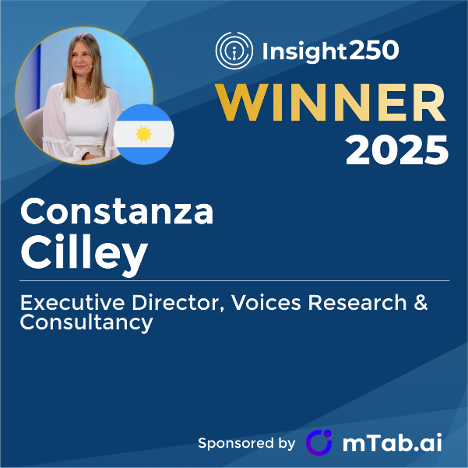
With insights advancing at an incredible pace and the value of insights ever increasing, I sat down with Insight250 Winner Constanza Cilley. Constanza is a distinguished leader in market research and social insights, with over 25 years of experience driving innovation and thought leadership. As Co-founder and Executive Director of Voices in Argentina, and was the former General Director of TNS Gallup Kantar. She is also President of SAIMO (Argentine Society of Marketing and Opinion Researchers), where she has expanded membership and visibility.
Crispin: The unbonded finding that people now value their relationships with animals almost as much as with other humans is genuinely arresting. What was the moment in the data where you both realised you were looking at something significant rather than noise?
CC: We were not excited when we saw the number. We were worried. For decades, research across sociology, psychology and economics has consistently shown that close human relationships are among the strongest predictors of well-being. So when we saw the percentage of Argentines who considered relationships with other people ‘very important’ fall from 62% to 47% in just six years, our first reaction was not curiosity but suspicion.
We assumed we had made a mistake. We checked the sample, weighting and fieldwork. Everything was correct. The number stayed. That was the moment we stopped treating it as a research finding and started treating it as a warning.
The finding became even more significant when we saw it alongside other trends we had been studying separately: pet humanization, plant parenthood, declining fertility intentions, emotional conversations with AI, the normalization of solitude, and new forms of intimacy with lower commitment thresholds. What initially looked like isolated phenomena suddenly began to look like pieces of the same puzzle.
Crispin: The study draws on six years of longitudinal data from Argentina. What does that time depth give you that a single wave of research simply could not?
CC: A single survey can identify an interesting phenomenon. Longitudinal data allow us to observe cultural transformation. The six-year perspective helped us see that this was not a temporary reaction to the pandemic, economic instability or political events. We were observing a directional shift. Without the longitudinal data, we might have concluded that people were going through a difficult moment. With it, we could see that the place human relationships occupy in people’s emotional lives was gradually changing. Six years also gave us something more uncomfortable: the trend did not pause during the pandemic. If anything, the period that was supposed to remind us how much we need each other accelerated the shift. That tells you something important about the forces driving it.
Crispin: Argentina is known for strong social bonds and deep interpersonal culture. Does that make the decline more surprising -- or does it make it a more powerful signal of something broader?
CC: Probably both. Argentina has historically been associated with strong family bonds, intense friendships and highly social forms of everyday life. Human connection is deeply embedded in the country’s culture.
That is precisely why we find the signal so important. If this were happening first in highly individualistic societies, it might be easier to explain away. The fact that it appears in a culture traditionally characterized by relational abundance suggests that broader structural forces may be reshaping connection itself.
If relational decline can take root in Buenos Aires, a city built on cafes, long dinners and psychoanalysis, it can take root anywhere. Argentina does not soften the finding. It universalizes it.
Crispin: You are careful to distinguish this from loneliness or social isolation. How would you describe the difference, and why does that distinction matter for how researchers and policymakers respond to it?
CC: This distinction is fundamental. Loneliness is about a lack of connection. UNBONDED is about changing where connection lives.
Many of the people in our study are not isolated. They have families, friends, colleagues and social networks. What is changing is the role human relationships play within their emotional ecosystem.
For decades, companionship, belonging, emotional regulation and support were functions primarily concentrated in relationships with other people. What we are observing is a gradual redistribution of those functions across a broader affective ecosystem that increasingly includes pets, plants, nature, digital communities, personal rituals and artificial intelligence. Human relationships are not disappearing. They are becoming premium, more selective, more effortful, and for a growing number of people, simply not worth the cost.
This is why we describe the shift as a movement from relational abundance to relational sustainability. The policy implications are very different. If the problem is loneliness, the answer is more human interaction. If the phenomenon is UNBONDED, the challenge is understanding how people redistribute emotional energy and what happens when human relationships are no longer the exclusive providers of companionship, emotional regulation and support.
Crispin: The paper identifies younger generations, men and those with lower levels of education as the groups showing the sharpest decline in the importance assigned to human relationships. What do those three groups have in common that might help explain the pattern?
CC: What these groups have in common is that they are also among the least satisfied with their relationships with other people.
Young adults report significantly lower levels of relational satisfaction than older generations. Men report lower satisfaction than women. The same pattern appears among people with lower levels of education.
We believe this is an important clue. If relationships become harder to sustain, more disappointing, more fragile or less rewarding, it is understandable that people may begin to allocate emotional energy elsewhere.
But there is a second, more unsettling possibility worth naming: these groups are also among those most exposed to alternatives. Younger generations grew up with AI companions and algorithmically optimized social feedback. Men have been the primary early adopters of companion AI. The question is not just why they are dissatisfied with human relationships. It is whether the alternatives have become good enough to compete.
In other words, the decline in the importance assigned to human relationships may not be driven only by a rejection of what exists. It may reflect the pull of what is becoming available.
Crispin: You describe an "affective ecosystem" in which pets, plants, digital interactions, solitary activities and AI are gaining emotional ground. Is this a substitution -- people replacing human connection -- or something more like a diversification of where emotional needs get met?
CC: We see it primarily as redistribution rather than substitution, but the honest answer is that we do not know yet, and that uncertainty is important.
A pet may provide companionship and unconditional presence. Plants may provide routine and calm. Nature may provide restoration. AI may provide a space for reflection or emotional expression.
What we are observing is the emergence of a broader affective ecosystem where emotional needs are increasingly distributed across multiple actors. Human relationships remain extremely important, but they no longer carry the entire emotional load.
What looks like diversification at the individual level may look like substitution at the societal level, if it means fewer people are investing in the difficult, reciprocal work of human relationships. The ecosystem metaphor matters here: in a healthy ecosystem, diversification strengthens the whole. The risk is a monoculture of low-friction connections.
Having said this, around 4 out of 10 AI users for emotional purposes mention that they feel this interaction with AI impacts in their relationship with humans: 1/10 say it replaces human connection, 3/10 say it complements it.
Crispin: The use of participant photography to code connection and disconnection across eight dimensions is a striking methodological choice. What did the images reveal that words alone would have missed?
CC: The most striking pattern was the absence. When people photographed moments of connection, other humans were often not the subject. A cup of coffee alone. A dog is sleeping. A window with rain. These were not images of isolation. People described them warmly, as moments of genuine connection. That tells you something profound about how the definition of connection itself is shifting.
When people described disconnection in words, they tended to reach for conventional language: loneliness, distance, indifference. The images told a different story. Disconnection appeared in workplaces, institutional environments, transitional spaces and situations involving overload and loss of control.
One of the strongest insights from the visual exercise was that connection today often appears as a state of emotional containment rather than as intense social engagement. That would have been almost impossible to surface through a questionnaire alone.
Crispin: Combining longitudinal survey data with visual and qualitative methods is not straightforward. What were the hardest integration challenges, and how did you resolve them?
CC: The hardest challenge was resisting the temptation to use the qualitative work to explain away what the numbers showed.
It is easy to tell a reassuring story: yes, the numbers declined, but the interviews show people still value relationships deeply. We tried to hold both truths. The surveys showed structural shifts. The qualitative work provided an interpretation. The photographs captured lived experience at a level neither could reach alone.
Rather than forcing all methods into a single explanatory framework, we looked for recurring mechanisms across them. Concepts such as emotional fatigue, relational selectivity and relational sustainability emerged repeatedly across methodologies, giving us confidence we were observing a coherent phenomenon.
We are not sure we fully resolved the tension between what the numbers say and what the images show. And we think that tension is part of the finding.
Crispin: You argue that if human relationships can no longer be assumed to be the primary source of well-being, researchers may need to rethink segmentation models, measures of social capital and the questions we routinely ask. Where would you start?
CC: We would start by moving beyond demographic segmentation alone.
Two people with identical demographics may inhabit completely different emotional worlds. One may rely primarily on family and friends. Another may derive companionship from pets, emotional regulation from AI, restoration from nature and meaning from a small number of highly selective human relationships. Research has traditionally focused on people, households and demographic structures. We increasingly need to understand affective ecosystems.
We would also start by questioning the Net Promoter Score of human relationships. The industry is built on measuring satisfaction with products, services and experiences. We rarely ask people how satisfied they are with the relationships in their lives, and whether that answer predicts behavior better than the demographic variables we have been using for decades.
Finally, the industry should pay more attention to silent relational actors. Pets, plants and AI are no longer peripheral. Many people actively participate in everyday emotional life. If we keep designing research as though emotional life is organized around humans alone, we will keep finding evidence that confirms that assumption, even as the world reorganizes around something else.
Crispin: The paper will be presented at ESOMAR Congress in Valencia later this year. What is the one thing you most want the global research community to take away from it?
CC: We hope to have the opportunity to present at ESOMAR Congress later this year, although we have no confirmation yet. But regardless of where the conversation takes place, the message remains the same.
The questions we ask shape the reality we see. If our surveys assume human relationships are the primary unit of emotional life, we will keep finding evidence that confirms it, even as the world quietly reorganizes around something else.
The most important contribution of UNBONDED is not the decline in the importance assigned to human relationships. It is the possibility that we are entering a world where humans are no longer the exclusive providers of companionship, emotional regulation and support. If that is true, many of the assumptions underlying how we study wellbeing, social capital, identity and consumer behaviour need to evolve, not as a methodological refinement, but as a matter of intellectual honesty about what we are actually measuring.
Crispin: Constanza, you are President of SAIMO and a Council Member of WAPOR, and you have been tracking Argentine society closely for over a decade through VOICES. Cornel, you have spent years at the intersection of research technology and human behaviour at Make Opinion and before that at Ipsos. How did those two different vantage points shape the paper?
CC: The paper emerged from the intersection of two genuinely different ways of seeing.
Constanza brought the longitudinal depth and the cultural fluency to know when a number means something. Years of tracking Argentine society across values, wellbeing and public opinion gave her the instinct to recognize a structural shift rather than a cyclical one.
Cornel brought the technology lens, watching behavior change in panel data as AI and social platforms evolved, and learning to treat adoption patterns as leading indicators of deeper shifts. The combination of those perspectives kept us honest. When one of us reached for a technological explanation, the other pulled it back to the social. When the social narrative felt too comfortable, the behavioral data complicated it.
What the two vantage points shared was a belief that research should surface what is actually happening in people's lives, not just confirm what we already expect to find. That shared conviction is probably what made the collaboration work.
Crispin: If the Unbonded trend continues at its current trajectory, what does the world look like in ten years -- for relationships, for brands, for the research industry?
CC: We do not believe the future will be a world without relationships. But it may be a world organized around relational sustainability rather than relational abundance.
The uncomfortable version: in ten years, a meaningful share of people may have their primary daily emotional relationship with a non-human entity, an AI, a pet, a parasocial figure. That is not science fiction. The trajectory is already visible. The question for society is whether that produces flourishing or fragility.
For brands, the challenge will be becoming sources of presence without pressure, entities that offer something emotionally useful without demanding the reciprocity that makes human relationships feel costly. That is a significant opportunity, and also a significant ethical responsibility.
For researchers, the challenge will be whether we have built the methods to tell the difference between a person who is genuinely thriving in a diversified affective ecosystem and one who has simply stopped trying. That distinction will matter, for public policy, for brand strategy, and for how we understand what it means to live well.
And for society, the key question may be whether well-being and social cohesion can be sustained when emotional infrastructure becomes more unevenly distributed across the population. That is the question UNBONDED cannot yet answer. But we think it is the right one to be asking.
Top Tip
We ask all our Insight250 winners to share one practical tip for the ResearchWorld community. What is yours?
CC: Curiosity and an open mind are central to our job. Always listen and observe more than you talk.
Cornel: Network relentlessly with people in the industry. Not for leads or opportunities, but because there is always something to learn. Every conversation with someone doing research differently, in a different market, or from a different discipline, sharpens how you think. The insights industry is small enough that most people are generous with their time, and curious enough that those conversations tend to go somewhere unexpected. Do not wait for conferences. Reach out.
Crispin:
Thank you, Constanza. The UNBONDED research is one of the most thought-provoking pieces of work I have encountered in recent years, precisely because it challenges assumptions that have underpinned how our industry measures emotional life for decades. The longitudinal rigour gives the findings real weight, and the methodological combination of survey data, qualitative work and participant photography is exactly the kind of triangulation that complex social phenomena demand. What strikes me most is the distinction between loneliness and what you describe as a redistribution of emotional energy across a broader affective ecosystem. That is a genuinely important conceptual advance, and one the research community needs to sit with seriously. As someone who has spent considerable time thinking about how technology and human behaviour intersect, I believe the questions UNBONDED raises about segmentation, social capital and what we are actually measuring when we ask about wellbeing are overdue. The research industry has always been at its best when it surfaces uncomfortable truths rather than confirming comfortable ones. This paper does exactly that. Thank you again.
Crispin Beale
Chairman at QuMind, CEO at Insight250, Senior Strategic Advisor at mTab, CEO at IDXCrispin Beale is a marketing, data and customer experience expert. Crispin spent over a decade on the Executive Management Board of Chime Communications as Group CEO of leading brands such as Opinion Leader, Brand Democracy, Facts International and Watermelon. Prior to this Crispin held senior marketing and insight roles at BT, Royal Mail Group and Dixons. Crispin originally qualified as a chartered accountant and moved into management consultancy with Coopers & Lybrand (PwC). Crispin has been a Board Director (and Chairman) of the MRS for nearly 20 years and UK ESOMAR Representative for c15 years. As well as being CEO of Insight250, Crispin is currently Worldwide CEO of Digital Communications Solution Agency, IDX. Crispin is also the Senior Strategic Advisor at mTab and the Chairman of QuMind and spent 4 years as Group President of Behaviorally where he was responsibile for the client & commercial teams globally. Crispin is a passionate advocate for blending human intelligence and technology to deliver innovation and leadership across organisations.
Article series
Insight250
- The importance of business sense in research
- The role of humour in effective leadership
- The importance of ethics
- The importance of disruption in innovation and leadership
- The importance of Disruption in Innovation and Leadership Part 2
- The importance of Diversity & Inclusion
- The impact of colour
- Communicating insight with impact
- Insights on leadership, culture and polling
- The evolution of electric vehicles
- 2022 Top tips (part 1)
- 2022 Top tips (part 2)
- Maximising the potential of data
- The importance of flexible working
- Winners
- The importance of advanced analytics
- Judges for the 2022 Insight250 Awards announced
- The evolution from social listening to digital intelligence
- The Judges' Perspective
- The judge's perspective - part 2
- Insight Climate Collective
- Insights technology
- Understanding employee ownership
- Global insight perspectives
- Top Tips from our Leaders and Innovators
- The Evolution of Insights in the Food & Beverage Market
- The Evolution of Insights in CPG
- Neural Mechanisms Behind Consumer Decision-Making
- Celebrating and Elevating the Insights Industry
- The State of the Insights Industry
- Opportunities, challenges and threats that AI presents
- 2024 Insight250 Winners Announcement
- Connecting Brands and Consumers Through Insights
- The Importance of Human Insight and Attention
- The Elevating Role of Insights with Technology Innovation
- Haleon’s Insight Expert on Consumer Healthcare
- Insight from the Insight250: How AI is Impacting Qualitative Research
- How AI Tech is Doing the ‘Heavy Lifting’ for Insights
- Reviewing the top tips for 2025
- Google's Sarah Ashley on AI and revolutionising insights - Insights from the Insight250
- Beyond BI: The Future of Decision Intelligence for Insight Professionals
- The Advancement & Impact of Insights - An Insight250 Winners Series perspective with David Smith
- International Jury for the 2025 Insight250 Awards Announced
- Newly elected President, Anne-Sophie, on Revolutionizing the Impact of Insights
- Haleon's Litthya Baez on Enhancing Healthcare with Insights - Insight250 Winners Series
- Understanding the Insights of Consumer Decisions
- Moving Beyond Dashboards to Deliver Decisions with AI
- How AI is Transforming Insights
- How AI is Transforming Insights
- Five Years of Insight250: Elevating the Insight Industry