Foresighting the Future of Categories
What can small shifts in culture and consumer behaviour tell us about where a category is heading? Anjana Pillai explores how researchers can spot early signals of change and assess which ones could shape a category’s future.
Article series
Insight250
- The importance of business sense in research
- The role of humour in effective leadership
- The importance of ethics
- The importance of disruption in innovation and leadership
- The importance of Disruption in Innovation and Leadership Part 2
- The importance of Diversity & Inclusion
- The impact of colour
- Communicating insight with impact
- Insights on leadership, culture and polling
- The evolution of electric vehicles
- 2022 Top tips (part 1)
- 2022 Top tips (part 2)
- Maximising the potential of data
- The importance of flexible working
- Winners
- The importance of advanced analytics
- Judges for the 2022 Insight250 Awards announced
- The evolution from social listening to digital intelligence
- The Judges' Perspective
- The judge's perspective - part 2
- Insight Climate Collective
- Insights technology
- Understanding employee ownership
- Global insight perspectives
- Top Tips from our Leaders and Innovators
- The Evolution of Insights in the Food & Beverage Market
- The Evolution of Insights in CPG
- Neural Mechanisms Behind Consumer Decision-Making
- Celebrating and Elevating the Insights Industry
- The State of the Insights Industry
- Opportunities, challenges and threats that AI presents
- 2024 Insight250 Winners Announcement
- Connecting Brands and Consumers Through Insights
- The Importance of Human Insight and Attention
- The Elevating Role of Insights with Technology Innovation
- Haleon’s Insight Expert on Consumer Healthcare
- Insight from the Insight250: How AI is Impacting Qualitative Research
- How AI Tech is Doing the ‘Heavy Lifting’ for Insights
- Reviewing the top tips for 2025
- Google's Sarah Ashley on AI and revolutionising insights - Insights from the Insight250
- Beyond BI: The Future of Decision Intelligence for Insight Professionals
- The Advancement & Impact of Insights - An Insight250 Winners Series perspective with David Smith
- International Jury for the 2025 Insight250 Awards Announced
- Newly elected President, Anne-Sophie, on Revolutionizing the Impact of Insights
- Haleon's Litthya Baez on Enhancing Healthcare with Insights - Insight250 Winners Series
- Understanding the Insights of Consumer Decisions
- Moving Beyond Dashboards to Deliver Decisions with AI
- How AI is Transforming Insights
- How AI is Transforming Insights
- Five Years of Insight250: Elevating the Insight Industry
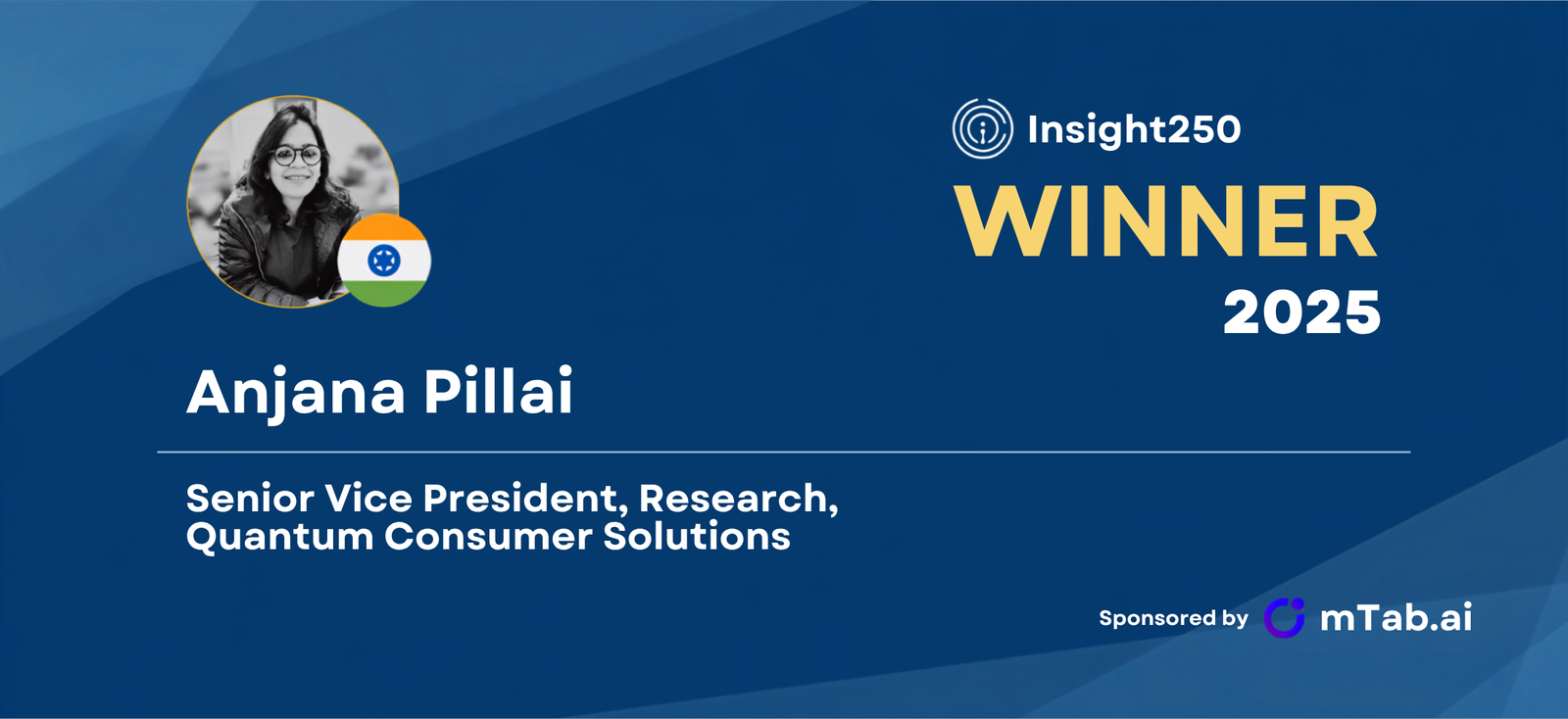
Anjana Pillai, Senior Vice President, Research, Quantum Consumer Solutions
The Insight250 spotlights and celebrates, annually, 250 of the world’s premier leaders and innovators in market research, consumer insights, and data-driven marketing. The awards have created renewed excitement across the industry whilst strengthening the connectivity of the market research community. Winners of the 2025 Insight250 were announced last September - you can see the full list of Winners, and those from previous years, at Insight250.com. The 2026 Insight250 nominations are currently in review.
With so many exceptional professionals named to the Insight250, we regularly tap into their expertise and unique perspectives on a range of topics. This regular series does just that: inquiring about the expert perspectives of many of these individuals in a series of short topical features.
With insights advancing at an incredible pace and the value of insights ever increasing, I sat down with Insight250 Winner Anjana Pillai. Anjana has over 20 years of experience in insights and design strategy. She was one of the first few researchers in the country to be accredited by Unilever. Over the years, she has been a part of many successful partnerships across industries, with brands such as UL Foods & Refreshments, Amazon e-comm, Swiggy, Twitter, Titan watches, GSK and ITC Foods.
Crispin: Foresighting is a word that gets used loosely - sometimes to mean trend tracking, sometimes scenario planning, sometimes horizon scanning. How do you define it precisely, and what distinguishes genuine category foresighting from the trend reports that most organisations already commission?
AP: You are right when you say foresighting is a word that gets used loosely. I’d like to clarify that foresighting is not trend tracking or horizon scanning with a longer timeline.
It’s the discipline of understanding where culture, technology, society and consumer behaviour are headed and asking what that means for a category before the impact becomes obvious to everyone. Most trend reports tell you what’s emerging.
Foresighting asks a much harder question: which of these shifts will actually reshape consumer expectations, and what should we do about it now? The output from foresighting is never a list of trends. It is a set of strategic choices for the business.
Crispin: Most market research is designed to understand where a category is now or where it has been. Category foresighting asks a fundamentally different question - where is this category going, and why? What does that shift in question require of the research design, the data sources and the people doing the work?
AP: Traditional research studies consumers and behaviours as they are today. Foresighting studies consumers who are already being socialised into the future. The goal is not simply to understand current needs, but to understand how cultural, technological and economic forces might create entirely new ones. It asks what forces are reshaping the world around consumers and how those forces might alter expectations, behaviours and categories in the future.
As a result, our research lens broadens. We move beyond consumers to examine the systems shaping them—tracking shifts in technology, demographics, culture, economics, regulation, and adjacent category evolution. The data sources become broader too. Consumer interactions are important, but they are complemented by trend analysis, digital discourse, expert provocations, startup ecosystems, innovation pipelines, cultural signals and leading-edge consumer cohorts.
The people doing the work need to be broader as well. Foresighting requires researchers, but also anthropologists, strategists, futurists, category experts and cultural observers. We require an eclectic team that is able to interpret what multiple signals might mean when viewed together.
Crispin: Categories evolve in ways that can look obvious in hindsight and invisible in real time. What are the earliest and most reliable signals that a category is about to undergo significant change - and how do you build a research programme that is sensitive enough to detect them?
AP: Categories don’t change dramatically and that’s why they may be invisible at first. However, you start seeing some interesting signals and signs. For instance, you will see new rituals, new language, new anxieties, new aspirations emerge around the category, and often among smaller groups of people long before they show up in mainstream data. It is important to understand that strong signals on the future rarely come from the mainstream because the mainstream is designed to reflect the present.
Strong signals emerge from future consumers who are being socialised into the category differently. For eg: Future beauty consumers today are being socialized into the category through creators, communities, and AI-powered tools long before they buy. They enter the category informed, opinionated, and expecting solutions tailored to their unique needs. This points to a future where personalization may become the beauty category’s primary source of value creation.
However, to arrive at the strongest signals that will shape the future, one needs to check if these signals are showing up simultaneously in different places - not just in outlier consumer behaviour, but in startup activity, innovation pipelines such as Shark Tank pitches, social discourse, etc. That’s how you can identify the imminent signals. Hence, it is important to cast the net wide and look at multiple sources of emerging behaviour.
Crispin: Foresighting a category requires you to look across multiple horizons simultaneously - the immediate, the medium term and the genuinely long range. How do you structure that work so that the three horizons inform each other rather than producing three separate and disconnected outputs?
AP: I would say that it would be a mistake to treat short-, medium-term, and long-term futures as separate exercises.The value of foresighting lies in connecting all three. When these horizons inform each other, foresight becomes strategy. When they don’t, it becomes speculation and the future remains interesting, but never becomes actionable.
Take the future of commuting for instance. The long-term horizon might imagine a world of flying cars and aerial mobility. The medium-term horizon asks which of those futures are actually becoming plausible through advances in battery technology, regulation, infrastructure and consumer acceptance. The short-term horizon then asks what actions make sense today: investing in EV ecosystems, shared mobility platforms or smart transport networks. When the three horizons inform each other, foresight becomes strategy. When they don’t, you end up fascinated by flying cars while overlooking the EVs, shared mobility networks and autonomous systems that are already moving us towards that future.
Crispin: Category foresighting draws on a much wider range of inputs than conventional research - cultural signals, adjacent category behaviour, technology trajectories, regulatory shifts, demographic change. How do you synthesise those inputs in a way that produces coherent strategic insight rather than an overwhelming list of possible futures?
AP: Firstly, the goal isn’t to collect more signals but to identify the forces underneath them. Take a category like beverages. You might observe the growth of protein drinks, gut-health beverages, hydration apps, etc. Viewed separately, these look like many independent trends. But when you step back, a larger pattern emerges. The real shift isn’t protein or hydration. It’s the rise of performance, prevention and self- management as organising principles for health.
Secondly, quantitative analysis becomes critical from a synthesis point of view. Growth data - search volumes, sales growth, startup investment, menu penetration, social conversation and platform listings - help us understand what is gaining momentum.
However, numbers alone cannot explain why. The real synthesising in foresighting comes from making meaning of quantitative and qualitative data together. For instance, at first glance, multiple trends on mobility seem to point towards a future of access over ownership – rise in shared mobility, subscription models, ride-hailing, etc., but this is where foresighting must remain grounded in culture and human motivations.
In India, consumer interactions showed us that ownership remains a powerful symbol of achievement, progress and social mobility. A car or two-wheeler often represents years of aspiration realised, not simply a mode of transport acquired. As a result, the future of mobility in India may not be a simple shift from ownership to access. It may be a hybrid future where consumers embrace the flexibility of access while continuing to value ownership as a marker of identity and success.
This is precisely why foresighting cannot stop at identifying trends that are gaining traction. The task is to understand how those trends interact with deeper human motivations.
Crispin: One of the hardest problems in foresighting is distinguishing between genuinely predictive signals and noise that merely looks significant. What is your methodology for making that distinction - and how do you build confidence in a forecast that by definition cannot be verified until it is too late to act on the alternative?
AP: At Quantum, we believe a signal becomes meaningful only when it passes through three filters: culture, category and consumer evolution. A cultural shift tells us that values, aspirations or behaviours are changing. A category shift tells us that products, formats, business models or competitive dynamics are evolving in response. A consumer shift tells us that people are beginning to adopt new habits, rituals or expectations.
When a signal starts appearing across all three layers and is gaining momentum from a growth and numbers point of view, it is no longer an isolated phenomenon; it is clearly becoming a directional force, and that brings you all the conviction you need to act on it.
Crispin: Many organisations commission trend research but very few have a genuine foresighting capability. What is the difference between those that do it well and those that are simply going through the motions - and what structural or cultural conditions are necessary for foresighting to actually influence strategy?
AP: The organisations that do this well don’t treat foresighting as a research exercise or a project. They treat it as a strategic capability and an organisational habit. They build systems to continuously monitor change, engage with future consumers and challenge assumptions about their category, even when the category numbers are reasonably healthy.
What truly makes a difference is when organisations use these foresights to influence investment decisions, innovation pipelines and portfolio choices. I truly believe that if foresighting doesn’t change where the money goes, it isn’t really foresighting.
Crispin: Category foresighting often reveals uncomfortable possibilities - that a category is about to be disrupted, that a brand’s current positioning will become irrelevant, that a competitor from outside the category is about to redefine it. How do you present those findings in a way that generates action rather than defensiveness?
AP: People become defensive when you tell them their category is under threat. What people are willing to engage with is the idea that their category could become something bigger.
They are much more open when you show them multiple futures and the implications of each and invite them to think of the future that they would like to drive. The conversation shifts from “I don’t believe this” to “this is the future I want to construct”. We present foresighting findings as a way to expand imagination around what is possible.
Crispin: The organisations best placed to shape the future of their categories are usually the ones already leading them. And yet category leaders are often the most resistant to foresighting that challenges their assumptions. How do you overcome that paradox in practice?
AP: I am not sure category leaders are inherently more resistant to foresighting. In many cases, they are actually the organisations investing most heavily in it. The real difference is not between leaders and challengers, but between organisations that see the future as something to react to and those that see it as something to shape.
However, like you are saying, some leader organizations are resistant to foresighting, the challenge is that large organisations can sometimes become over-reliant on the signals generated by their current business. When most of your data comes from today’s consumers, today’s products and today’s revenue streams, you become blind to early indicators of change.
At Quantum, we overcome the paradox by bringing leaders closer to future consumers. It’s difficult to dismiss a future when you’re seeing it already being lived by emerging cohorts.
Crispin: The insights industry is very good at telling clients what consumers think and feel right now. It is considerably less good at telling them what consumers will want in three or five years’ time. Why has the industry been slow to develop genuine foresighting capability - and what is the commercial case for investing in it now?
AP: The role of research for the longest while has been to reduce risk, validate decisions and explain what consumers think today. Foresighting is about asking what might consumers want tomorrow. That requires a certain comfort with ambiguity. It’s easier to tell a client what is happening than to explore what could happen.
But categories are no longer evolving at the pace they once did. Entire categories are being reshaped by forces outside the category itself - technology, changing cultural values, platform ecosystems and new business models. New behaviours are scaling in months and not years anymore.
While understanding the present is essential for current performance, the ability to thrive in the near future comes from understanding where the present is heading. That is the commercial case for investing in it now.
Crispin: AI is changing the speed and scale at which signals can be detected and synthesised. What does that mean for category foresighting specifically - does it make the work more powerful, or does it risk producing a false confidence in forecasts that are pattern-matched rather than genuinely understood?
AP: AI is incredibly good at spotting patterns. The challenge is that futures are not built from patterns alone. They’re built from meaning. AI can help us detect signals faster and at greater scale than ever before, but AI cannot yet tell us why people care - understanding which signals matter, and why, remains a deeply human task.
Crispin: If you could point to one category whose future is being consistently misread by the organisations competing in it right now - and where better foresighting would produce a materially different strategic response - what would it be and why?
AP: There are a few, but I’d say education. Much of the category is still organised around degrees, institutions and credentials. Consumers increasingly care about adaptability, employability and continuous reinvention. In a world where technology is constantly threatening to reshape work, the future of education may not be about preparing people for a career. It may be about helping them repeatedly reinvent themselves. The institutions and organisations that recognise that shift early will define the category.
Top Tip
Crispin: We ask all our Insight250 contributors to share one practical recommendation with the ResearchWorld community. What is your top tip for an insights professional who wants to build a genuine category foresighting capability in their organisation - and where is the best place to start?
AP: The future often arrives as something we dismissed too early. I would urge researchers to build the habit of paying attention to small shifts that feel strange, niche or even easy to ignore. When you encounter an emerging behaviour or idea, don’t ask whether it’s big yet. Instead ask, what potential changes in culture does it point to? That simple shift moves the conversation from trend spotting to futures thinking.
Crispin: Thank you, Anjana, for such a rich and thought-provoking discussion. What I found most compelling is your insistence that foresighting only earns its name when the three horizons, short, medium and long term, are made to inform one another, because without that discipline it becomes speculation rather than strategy. Your three-filter test for a genuine signal, checking that a shift is showing up in culture, category and consumer behaviour all at once, gives researchers a rigorous way to separate real direction from noise. I was also struck by your example on mobility in India, where ownership remains a powerful marker of aspiration even as access-based models grow, because it is a reminder that global trends still need grounding in local human motivation before they can be trusted. And your line that foresighting isn't really foresighting unless it changes where the money goes is one I suspect a lot of our readers will want to hold their own organisations to. Thank you again for such a generous and clear-eyed look at how categories actually change, and for showing that the earliest signals are so often the ones we are tempted to dismiss.
Crispin Beale
Chairman at QuMind, CEO at Insight250, Senior Strategic Advisor at mTab, CEO at IDXCrispin Beale is a marketing, data and customer experience expert. Crispin spent over a decade on the Executive Management Board of Chime Communications as Group CEO of leading brands such as Opinion Leader, Brand Democracy, Facts International and Watermelon. Prior to this Crispin held senior marketing and insight roles at BT, Royal Mail Group and Dixons. Crispin originally qualified as a chartered accountant and moved into management consultancy with Coopers & Lybrand (PwC). Crispin has been a Board Director (and Chairman) of the MRS for nearly 20 years and UK ESOMAR Representative for c15 years. As well as being CEO of Insight250, Crispin is currently Worldwide CEO of Digital Communications Solution Agency, IDX. Crispin is also the Senior Strategic Advisor at mTab and the Chairman of QuMind and spent 4 years as Group President of Behaviorally where he was responsibile for the client & commercial teams globally. Crispin is a passionate advocate for blending human intelligence and technology to deliver innovation and leadership across organisations.
Article series
Insight250
- The importance of business sense in research
- The role of humour in effective leadership
- The importance of ethics
- The importance of disruption in innovation and leadership
- The importance of Disruption in Innovation and Leadership Part 2
- The importance of Diversity & Inclusion
- The impact of colour
- Communicating insight with impact
- Insights on leadership, culture and polling
- The evolution of electric vehicles
- 2022 Top tips (part 1)
- 2022 Top tips (part 2)
- Maximising the potential of data
- The importance of flexible working
- Winners
- The importance of advanced analytics
- Judges for the 2022 Insight250 Awards announced
- The evolution from social listening to digital intelligence
- The Judges' Perspective
- The judge's perspective - part 2
- Insight Climate Collective
- Insights technology
- Understanding employee ownership
- Global insight perspectives
- Top Tips from our Leaders and Innovators
- The Evolution of Insights in the Food & Beverage Market
- The Evolution of Insights in CPG
- Neural Mechanisms Behind Consumer Decision-Making
- Celebrating and Elevating the Insights Industry
- The State of the Insights Industry
- Opportunities, challenges and threats that AI presents
- 2024 Insight250 Winners Announcement
- Connecting Brands and Consumers Through Insights
- The Importance of Human Insight and Attention
- The Elevating Role of Insights with Technology Innovation
- Haleon’s Insight Expert on Consumer Healthcare
- Insight from the Insight250: How AI is Impacting Qualitative Research
- How AI Tech is Doing the ‘Heavy Lifting’ for Insights
- Reviewing the top tips for 2025
- Google's Sarah Ashley on AI and revolutionising insights - Insights from the Insight250
- Beyond BI: The Future of Decision Intelligence for Insight Professionals
- The Advancement & Impact of Insights - An Insight250 Winners Series perspective with David Smith
- International Jury for the 2025 Insight250 Awards Announced
- Newly elected President, Anne-Sophie, on Revolutionizing the Impact of Insights
- Haleon's Litthya Baez on Enhancing Healthcare with Insights - Insight250 Winners Series
- Understanding the Insights of Consumer Decisions
- Moving Beyond Dashboards to Deliver Decisions with AI
- How AI is Transforming Insights
- How AI is Transforming Insights
- Five Years of Insight250: Elevating the Insight Industry