People First, Future First: Digital Twins in Strategic Innovation
What if you could place a real consumer inside the future you are designing for? Thomas Troch explores how digital twins can help innovation teams test ideas across plausible futures, rooted in human insight, consent and validation.
Article series
Insight250
- The importance of business sense in research
- The role of humour in effective leadership
- The importance of ethics
- The importance of disruption in innovation and leadership
- The importance of Disruption in Innovation and Leadership Part 2
- The importance of Diversity & Inclusion
- The impact of colour
- Communicating insight with impact
- Insights on leadership, culture and polling
- The evolution of electric vehicles
- 2022 Top tips (part 1)
- 2022 Top tips (part 2)
- Maximising the potential of data
- The importance of flexible working
- Winners
- The importance of advanced analytics
- Judges for the 2022 Insight250 Awards announced
- The evolution from social listening to digital intelligence
- The Judges' Perspective
- The judge's perspective - part 2
- Insight Climate Collective
- Insights technology
- Understanding employee ownership
- Global insight perspectives
- Top Tips from our Leaders and Innovators
- The Evolution of Insights in the Food & Beverage Market
- The Evolution of Insights in CPG
- Neural Mechanisms Behind Consumer Decision-Making
- Celebrating and Elevating the Insights Industry
- The State of the Insights Industry
- Opportunities, challenges and threats that AI presents
- 2024 Insight250 Winners Announcement
- Connecting Brands and Consumers Through Insights
- The Importance of Human Insight and Attention
- The Elevating Role of Insights with Technology Innovation
- Haleon’s Insight Expert on Consumer Healthcare
- Insight from the Insight250: How AI is Impacting Qualitative Research
- How AI Tech is Doing the ‘Heavy Lifting’ for Insights
- Reviewing the top tips for 2025
- Google's Sarah Ashley on AI and revolutionising insights - Insights from the Insight250
- Beyond BI: The Future of Decision Intelligence for Insight Professionals
- The Advancement & Impact of Insights - An Insight250 Winners Series perspective with David Smith
- International Jury for the 2025 Insight250 Awards Announced
- Newly elected President, Anne-Sophie, on Revolutionizing the Impact of Insights
- Haleon's Litthya Baez on Enhancing Healthcare with Insights - Insight250 Winners Series
- Understanding the Insights of Consumer Decisions
- Moving Beyond Dashboards to Deliver Decisions with AI
- How AI is Transforming Insights
- How AI is Transforming Insights
- Five Years of Insight250: Elevating the Insight Industry
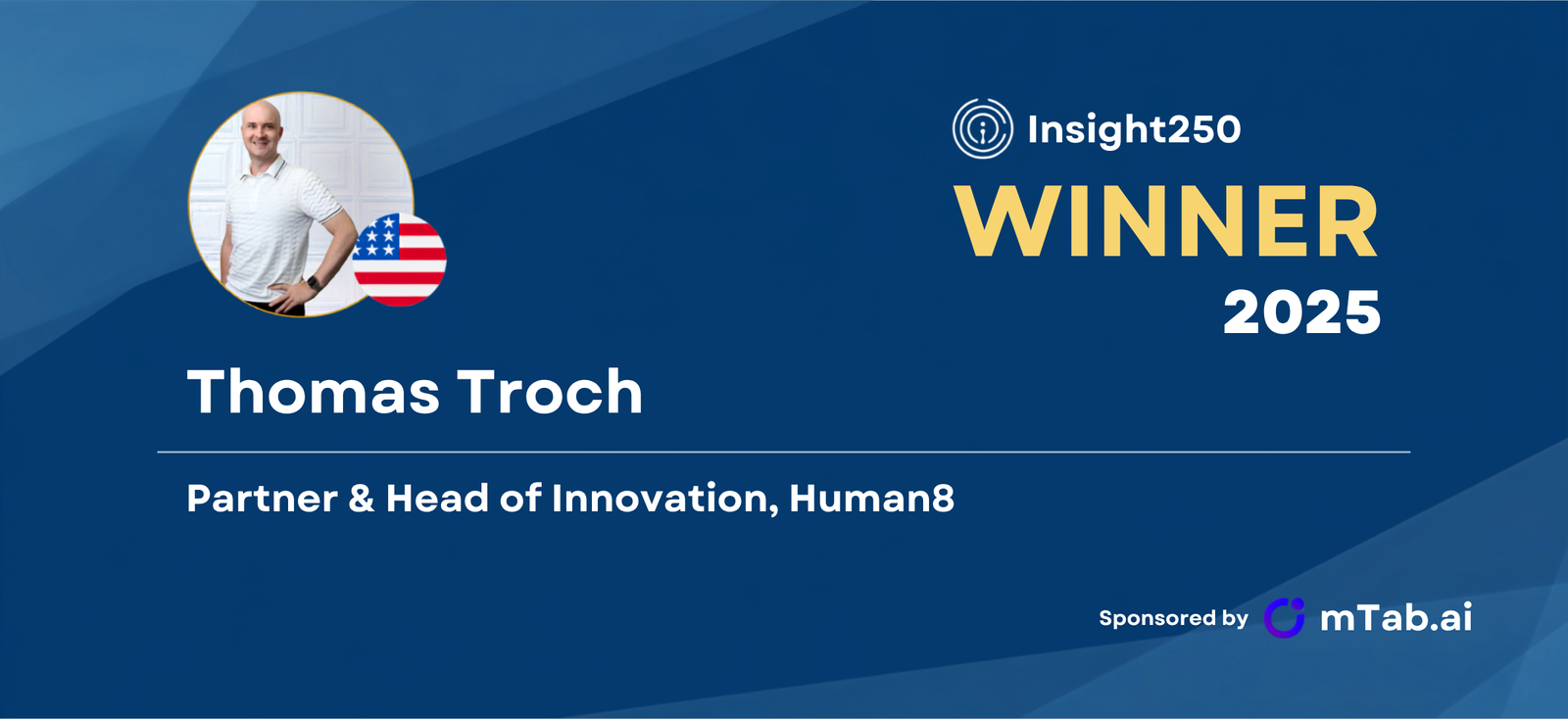
Thomas Troch, Partner & Head of Innovation, Human8
The Insight250 spotlights and celebrates, annually, 250 of the world’s premier leaders and innovators in market research, consumer insights, and data-driven marketing. The awards have created renewed excitement across the industry whilst strengthening the connectivity of the market research community. Winners of the 2025 Insight250 were announced last September - you can see the full list of Winners, and those from previous years, at Insight250.com. The 2026 Insight250 nominations are currently in review.
With so many exceptional professionals named to the Insight250, we regularly tap into their expertise and unique perspectives on a range of topics. This regular series does just that: inquiring about the expert perspectives of many of these individuals in a series of short topical features.
With insights advancing at an incredible pace and the value of insights ever increasing, I sat down with Insight250 Winner Thomas Troch. As a Partner and Head of Innovation with Human8, Thomas continues to shape the insights industry through his pioneering work at the intersection of human understanding and technological advancement. Building on his track record of transforming insights into million-dollar innovations for global brands like Anheuser-Busch, Mars Snacking, and L'Oréal, Thomas has emerged as a leader in AI applications for insight generation and innovation. His approach to AI integration focuses not merely on efficiency but on reframing problems entirely, enabling teams to explore unexpected ideation pathways that traditional methods often miss.
Crispin: The idea of digital twins has existed in engineering and manufacturing for some time, but applying them to human behaviour and strategic foresight feels like a genuinely new frontier. How would you explain what a consumer digital twin actually is to someone encountering the concept for the first time?
TT: The simplest way I’d put it is this: a consumer digital twin is a model of a real, consenting person, built from their own data, that we can keep talking to long after the original research has closed. It is worth being explicit that a twin is not the same thing as a persona. A persona is a summary of a group, a useful average of a type of person. A twin starts from one real individual, so it gives you a far more granular and nuanced view, and real diversity between one twin and the next, the way actual people differ from each other. When you need to, you can still group twins into a segment to work with them, but you are grouping up from real individuals rather than starting from the average. That granularity is the people-first part. Everything is anchored in a real person who agreed to be there, answering new questions in their own voice.
Crispin: You describe these twins as being built from a consenting individual’s own data. What kinds of data go into constructing a twin, and how do you ensure the result is genuinely representative of that person rather than a statistical approximation of a type?
TT: Each twin is built from that person’s own first-party data, the things they told us and showed us about how they think and live in a particular category. We turn that into what we call an identity card: how they reason, what they care about, the memories and lived experiences sitting behind their choices. We also brief the twin on how the person actually speaks, so it doesn’t drift into a generic model voice. What keeps it honest is grounding. When a twin answers, we track how much of that answer rests on real evidence from the person rather than the model filling a gap, and we test the twin against the real human to see how closely the two track. In our work, those correlations have been high. So, it represents an individual because it is built from one, and because we keep checking it against them rather than against a segment.
Crispin: The notion of ‘carrying a person into the future’ is an evocative one. What does that actually look like in practice during an innovation session or strategic workshop?
TT: Part of it starts with the person themselves. We ask them to project forward, describing how they expect their own life and needs to change over the next few years, and we build that into the twin. But people are not great at predicting their own future. We tend to picture it as a straight continuation of who we are today, so that self-projection alone is not enough. So, alongside the person’s own view, we build a set of plausible future worlds, evidence-based versions of where things could be heading. In innovation work, those worlds are most often anchored to a specific category, though the same approach can run broader, right up to societal scenarios, when the question calls for it. And they are not only about how consumer needs shift; a world can just as easily turn on how the category or the wider industry gets reshaped.
Either way, they bring in the changes around the person that no individual can see coming. In a session, you place the same twin into each of those worlds and read how its needs move, sometimes looking across all of them for what holds everywhere, more often designing for one you have deliberately chosen. A concrete example is when a team has to lock an R&D timeline years before launch. You can take a single concept and see how it would need to differ to win in each world, which turns a fuzzy forward bet into a much more specific brief for R&D. And because the twin answers in its own voice from inside each world, the team is reasoning against a real person, not a slide of trends.
Crispin: Your methodology involves building multiple plausible future worlds and then placing the same twins into each one. How do you construct those future scenarios, and what disciplines or inputs shape them?
TT: We build the worlds from evidence rather than imagination, and that distinction matters to me. The raw material is a mix: a client’s own category data and the cultural strategy work from our Space Doctors team. Connecting those perspectives is where it gets interesting. Human insight tells you what really drives people today, and cultural foresight reads the shifts in values and norms that move a market in ways no straight line predicts. Put together, they strengthen each other. It is a real case of one plus one making three. For work about the future of a category, we always build several scenarios rather than betting on a single outlook, and our sweet spot so far has been to align on five plausible futures. Each world is defined by where the future is actually unsettled rather than by what everyone already agrees on, and they all sit on a shared baseline of things that are near certain. We also attach signals to each world, the early signposts that would tell us it is starting to take shape, so the set keeps evolving as the evidence does instead of ageing the day we finish it.
Crispin: How do you guard against the scenarios themselves becoming self- fulfilling or overly shaped by the assumptions of the team building them?
TT: The main guard is that the worlds are built from signal, not from the team's preferences, so they are defined by real uncertainty rather than by the future we would find convenient. Then we test them, in a couple of ways. First, we put the worlds in front of a panel of experts and ask them to rate how plausible each one is, both overall and in the markets they know best. That is a check from people who have no stake in our assumptions.
Second, we run a blind test: experts read anonymized twin responses and have to name which world each twin is living in, with no labels to go on. When they can do that well above chance, and when the worlds they confuse are the ones sitting close together rather than far apart, you know the set carries a readable signal instead of blurring into the team’s house view. We also check that the future answers still trace back to real people, and we compare against a model with no grounding to make sure the worlds add something a generic forecast would not. None of that makes us right about the future. It does keep us honest about whether we have built something real or just dressed up our own assumptions.
Crispin: When a twin behaves differently across two future worlds, what does that tell an innovation team, and how do they act on it?
TT: First, it tells you the worlds are doing their job, because a future that does not change behavior is just wallpaper. But the more useful thing is what it does to the team’s mindset. When you say you are designing for a future year, it is surprisingly easy for a workshop to slide into an internal conversation about what is technically feasible by then. Watching the same person want different things in different worlds pulls the focus back to the world and the human, to what someone will need rather than what we happen to be able to build. That is the people-first versus tech-first shift, and for me it is the real value. As for acting on it: where a direction holds up across every world, the team can commit with real conviction. Where the payoff depends on which world arrives, they still commit, but deliberately, with the assumptions out in the open and the signposts to watch already named.
Crispin: Consent is clearly central to your approach. Beyond obtaining it, how do you think about ongoing responsibility to the real people whose data underpins a twin, particularly as that twin is used in contexts they may not have anticipated?
TT: Consent at the start is the easy part. The harder responsibility is ongoing, and a lot of it comes down to staying inside the agreement people actually made. Our twins are deliberately category-specific. We build a rich picture of how someone thinks about one area of their life, the area they agreed to share with us, and we keep the twin working within that topic rather than stretching it to speak about things the person never signed up for. That is partly an ethical choice and partly why the outputs stay reliable. The other piece is keeping the relationship live. There is a real desire to loop back to the people behind the twins and update them over time, so the twin keeps reflecting on who they are becoming instead of freezing them at one moment. I think you have to treat consent as a dynamic obligation, not a signature you collected once.
Crispin: Human8 is a company built on the principle that human understanding sits at the heart of good research. How do you reconcile the use of synthetic AI personas with that founding philosophy?
TT: It helps that I don’t think of these as synthetic personas at all. A persona is assembled from a group. Our twins are built from real individuals and their own data, which means they are made out of human understanding rather than standing in for the absence of it.
The way I see it, a twin extends the life of the insight we already gathered from people. In strategic work, you generate an enormous volume of rich material, and what gets delivered in the end is the highly condensed version, the playbook. There is always untapped potential left in the original data. A twin is how you keep using that to its full value instead of letting it sit in a report. So it works with human understanding instead of replacing it.
Crispin: There is a risk that organisations fall in love with the efficiency of synthetic research and quietly deprioritise direct human engagement. How do you think the industry should navigate that tension?
TT: There is a real risk, yes, but the way I think about twins pushes back on it. Direct human engagement is not what twins compete with. It is what they are built on. A twin only exists because a real person shared how they think, so the human side is not something you can step back from without the twins losing their value too. Where efficiency really helps is access. Twins go into the mix as one way to reach people, and you pick the right tool for each job. In a workshop, for example, I will use the twins for some use cases, and for others still set up a live connection, where people share their ideas straight with the team, and you get those unfiltered reactions in the room. There is an energy in that you cannot manufacture. So for me it is less about resisting efficiency and more about being deliberate: keep direct human engagement as the foundation and treat the twins as one of several ways to build on it.
Crispin: Can you walk us through a specific moment from your recent R&D where the digital twin methodology produced an insight or direction that conventional research approaches would have struggled to surface?
TT: A lot of my work sits at the front end of innovation, and one key starting point is often the development of innovation platforms. A platform defines the most fertile ground for innovation, the territory a brand should play in. One of its main jobs is to be a springboard for ideation, so you can judge one fairly by how many strong directions it opens up. In a recent R&D study, we built the same platform brief two ways. The first was the way we would normally build it, from present-day insight and a single assumed future, what you could call a static platform. The second combined that same human insight with the twins placed into five plausible futures, a dynamic innovation platform.
Holding the brief and topic constant, we coded both for distinct, high-quality ideation directions, the real creative routes a team can build ideas from. The dynamic platform opened two to three times as many of them, reached into parts of the opportunity space the static one did not touch at all, and around four times the share of its directions pushed past the obvious into more forward-leaning territory. The reason that is hard to reach any other way is simply that you can only ask today’s consumers about the world they live in now. The twins let you put a real person inside a future that has not arrived, and ask what they would need there.
Crispin: You have worked with some of the world's largest consumer brands across innovation programmes. What conditions need to be in place for a client organisation to be genuinely ready to use this kind of foresight methodology?
TT: The biggest condition is that the organization is really thinking on a forward horizon, making bets now for where their category is heading rather than only optimizing what sells today. The second condition is the one that separates the ready from the rest: appetite to challenge their own core. The clients who get the most from this are the ones willing to explore solutions well beyond their current offer, even ones that could disrupt their own business. If a team only wants confirmation that their current direction is fine, they will get far less out of it. They also need to come into it understanding that it works alongside human research, not in place of it. When those things are true, the conversation gets ambitious quite quickly.
Crispin: Where do you see digital twin methodology in strategic innovation five years from now, and what still needs to be resolved, technically, ethically, or commercially, before it reaches its full potential?
TT: Five years out, I think the real shift is from static insight to what I would call dynamic insight. Today, insights are most often captured in a static deck. Dynamic insight is a living layer the organization keeps working with, one you keep asking new questions and running against new concepts long after the original study closes. Alongside that, it lets teams keep hard-to-reach people in the room, the leading-edge consumers and experts you could rarely hold onto for round after round of work. And I would hope the people-first, future-first way of thinking becomes more of a default, where a strategy room starts from what the world and the consumer will need rather than from what is technically feasible. Taking your three opportunities in turn. Technically, it is about building validation into every interaction rather than a check you run once at the start, so each answer a twin gives carries a read on how much of it rests on real evidence, what we track today as a grounding score, while keeping the twins refreshed as their data dates. Ethically, keeping consent live in practice rather than a one-off. And commercially, the industry is agreeing what good looks like, so this is never sold as a cheap replacement for talking to humans. The building blocks are already there, like that grounding score. The job over the next few years is making them continuous and keeping the real people at the center as we do.
Hot Topic
TT: For me, one of the most critical success factors in innovation is timing, and it is the one thing research has never really been able to completely solve. You develop robust innovation platforms for a future horizon, then ideate and develop concepts, and eventually product, against that future. But you have always been doing it through the rearview mirror, reasoning forward from today’s consumer and reality because that is all the evidence you had. Future digital twins are the first real answer to that I have seen.
By combining human insight with cultural insight, they let you build and pressure-test that future-forward thinking with real people carried into where the category is going. That is what makes the work genuinely future-first, and it is why I think this matters well beyond the technology itself.
Top Tip
Crispin: What is your number one piece of practical advice for an innovation leader considering digital twin methodology for the first time, something they could act on before they even commission a full program?
TT: Here is a question I would sit with before you commission anything. Which audiences would give you your richest learning, but are also the hardest to reach and the hardest to keep in the room for round after round of iterative work? For a lot of teams that is their most expert or most in-demand consumers. That gap, the people you learn the most from but can engage the least, is exactly where twins earn their place. If you can name those audiences, you already know where this would pay off first.
Crispin: Thank you, Thomas, for such a rich and considered conversation. What stays with me most is the distinction you draw between a persona and a twin, that a persona is built from an average while a twin is built from a real, consenting individual, because it reframes the whole debate about authenticity in AI-assisted research. The idea of placing a single twin into five plausible futures, then reading where its needs hold steady and where they diverge, strikes me as exactly the kind of evidence-led thinking our industry needs as it grapples with committing to R&D timelines years before launch. The grounding score you described, tracking how much of each answer traces back to real evidence rather than the model filling a gap, also seems to me the sort of discipline that will separate serious applications of this technology from those simply chasing efficiency. And your point that direct human engagement is not what twins compete with, but what they are built on, is one I suspect many of our readers will want to sit with for some time. Thank you again for your generosity and clarity on a subject that is moving quickly, and where grounded thinking like yours is invaluable.
Crispin Beale
Chairman at QuMind, CEO at Insight250, Senior Strategic Advisor at mTab, CEO at IDXCrispin Beale is a marketing, data and customer experience expert. Crispin spent over a decade on the Executive Management Board of Chime Communications as Group CEO of leading brands such as Opinion Leader, Brand Democracy, Facts International and Watermelon. Prior to this Crispin held senior marketing and insight roles at BT, Royal Mail Group and Dixons. Crispin originally qualified as a chartered accountant and moved into management consultancy with Coopers & Lybrand (PwC). Crispin has been a Board Director (and Chairman) of the MRS for nearly 20 years and UK ESOMAR Representative for c15 years. As well as being CEO of Insight250, Crispin is currently Worldwide CEO of Digital Communications Solution Agency, IDX. Crispin is also the Senior Strategic Advisor at mTab and the Chairman of QuMind and spent 4 years as Group President of Behaviorally where he was responsibile for the client & commercial teams globally. Crispin is a passionate advocate for blending human intelligence and technology to deliver innovation and leadership across organisations.
Article series
Insight250
- The importance of business sense in research
- The role of humour in effective leadership
- The importance of ethics
- The importance of disruption in innovation and leadership
- The importance of Disruption in Innovation and Leadership Part 2
- The importance of Diversity & Inclusion
- The impact of colour
- Communicating insight with impact
- Insights on leadership, culture and polling
- The evolution of electric vehicles
- 2022 Top tips (part 1)
- 2022 Top tips (part 2)
- Maximising the potential of data
- The importance of flexible working
- Winners
- The importance of advanced analytics
- Judges for the 2022 Insight250 Awards announced
- The evolution from social listening to digital intelligence
- The Judges' Perspective
- The judge's perspective - part 2
- Insight Climate Collective
- Insights technology
- Understanding employee ownership
- Global insight perspectives
- Top Tips from our Leaders and Innovators
- The Evolution of Insights in the Food & Beverage Market
- The Evolution of Insights in CPG
- Neural Mechanisms Behind Consumer Decision-Making
- Celebrating and Elevating the Insights Industry
- The State of the Insights Industry
- Opportunities, challenges and threats that AI presents
- 2024 Insight250 Winners Announcement
- Connecting Brands and Consumers Through Insights
- The Importance of Human Insight and Attention
- The Elevating Role of Insights with Technology Innovation
- Haleon’s Insight Expert on Consumer Healthcare
- Insight from the Insight250: How AI is Impacting Qualitative Research
- How AI Tech is Doing the ‘Heavy Lifting’ for Insights
- Reviewing the top tips for 2025
- Google's Sarah Ashley on AI and revolutionising insights - Insights from the Insight250
- Beyond BI: The Future of Decision Intelligence for Insight Professionals
- The Advancement & Impact of Insights - An Insight250 Winners Series perspective with David Smith
- International Jury for the 2025 Insight250 Awards Announced
- Newly elected President, Anne-Sophie, on Revolutionizing the Impact of Insights
- Haleon's Litthya Baez on Enhancing Healthcare with Insights - Insight250 Winners Series
- Understanding the Insights of Consumer Decisions
- Moving Beyond Dashboards to Deliver Decisions with AI
- How AI is Transforming Insights
- How AI is Transforming Insights
- Five Years of Insight250: Elevating the Insight Industry